10 rials 1961
Market Prices
15 salesAbout This Note
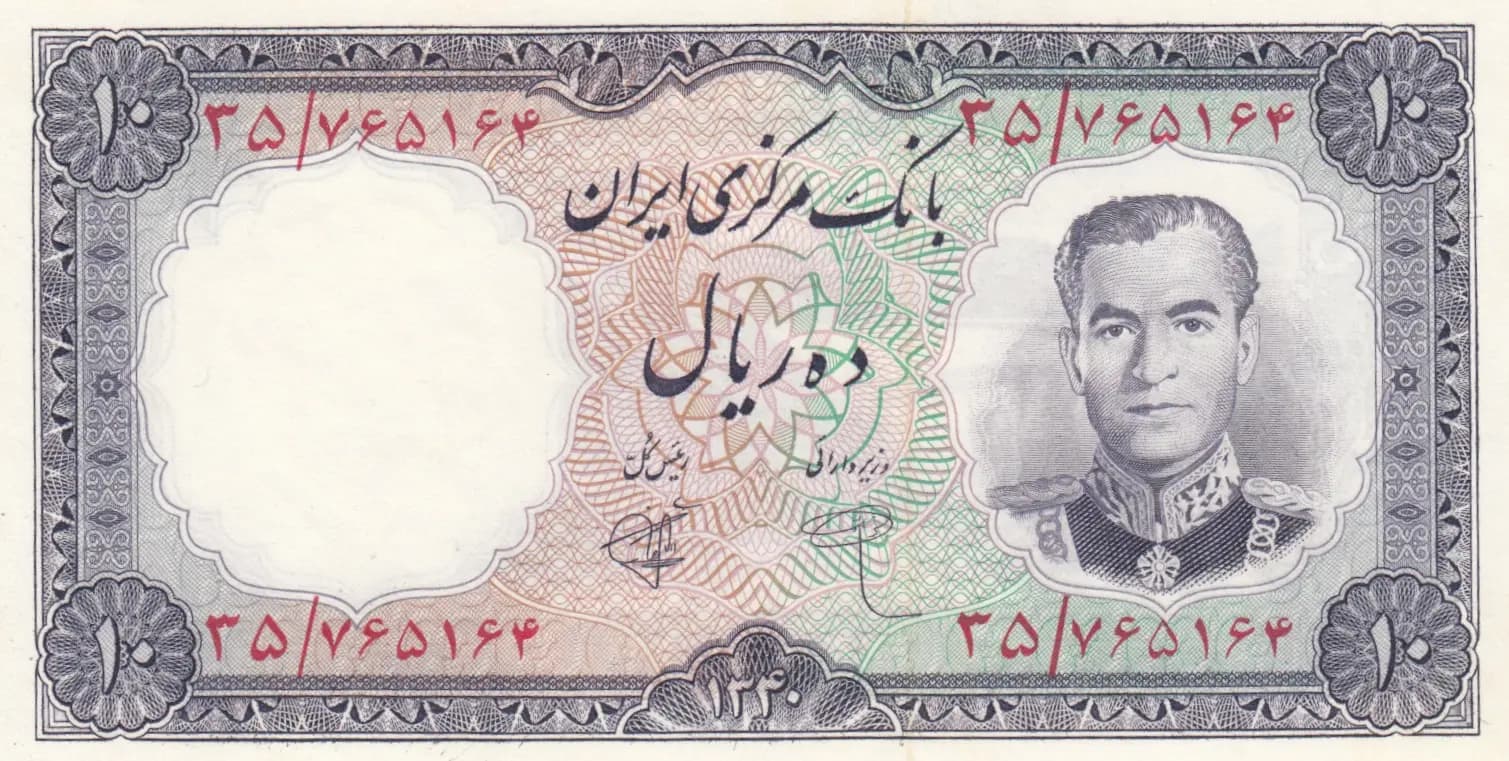
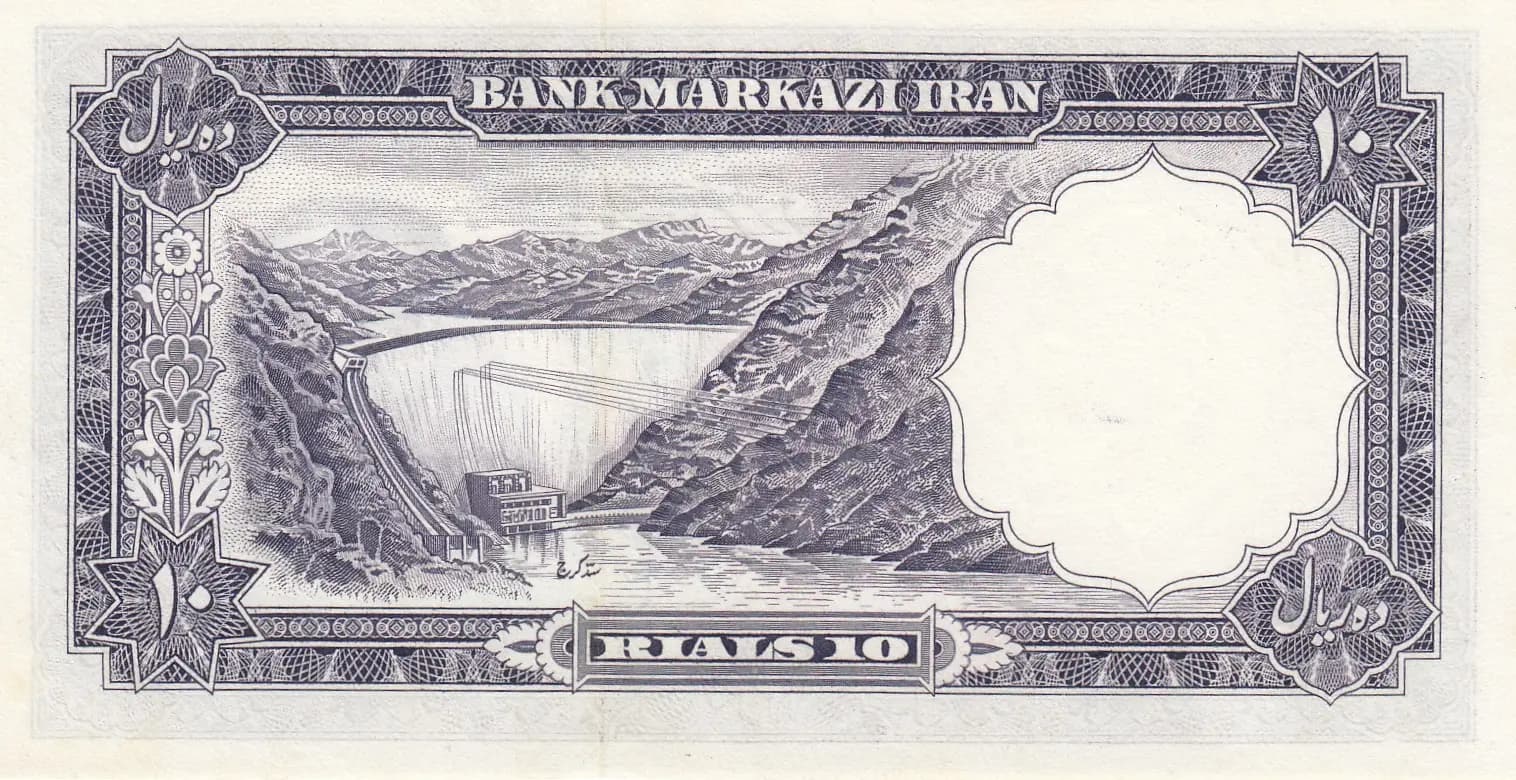
This is an Iranian 10 Rials banknote from 1961 (SH 1340) issued by Bank Markazi Iran, graded in Uncirculated condition. The front features Shah Mohammad Reza Pahlavi in formal military dress uniform positioned on the right side within an ornate oval frame, set against a beige and cream background with elaborate floral and geometric security patterns. The reverse displays a detailed engraving of the Amir Kabir Dam near Karaj in a mountainous landscape, rendered in black and blue-gray tones. Despite the UNC grade, the front shows visible aging with red markings and some creasing from handling, while the reverse remains well-preserved with clear engraving detail.
Common. The eBay sales history provided shows consistent trading in the $3–$20 range across multiple condition grades over more than a decade, with UNC examples typically selling for $12–$20. The 2019 catalog value of $12 UNC aligns with this market data. High print runs and ready availability in the collector market are indicated by the frequency of sales across multiple platforms. This is a standard circulation-issue note from a major central bank with no indications of limited mintage, recall, or scarcity.
This banknote was issued during the reign of Mohammad Reza Pahlavi, the last Shah of Iran, whose portrait in military uniform appears on the obverse—a standard iconographic element emphasizing his role as supreme military commander and modernizer of the Iranian state. The reverse depicts the Amir Kabir Dam (also known as the Karaj Dam), a significant infrastructure project completed in the 1960s that represented the Shah's modernization agenda and technological ambitions for Iran. The note's design and imagery reflect the state's emphasis on national development and the Shah's central role in Iran's mid-century progress.
The obverse features Shah Mohammad Reza Pahlavi depicted in full formal military dress uniform with decorations and medals, positioned in an ornate oval portrait frame on the right side of the note. The background employs a warm palette of beige, cream, pink/salmon, and green with intricate guilloche patterns and elaborate floral corner ornaments providing security detail throughout. Large blank cartouche areas on the left and center presumably held additional text or security features. The reverse showcases a meticulously engraved landscape of the Amir Kabir Dam, depicting the concrete dam structure with its spillways and intake tower, nestled within a dramatic mountainous valley with steep rocky walls and a water reservoir behind the dam. The engineering detail and surrounding terrain are rendered through fine cross-hatching and tonal variation in black and blue-gray inks against a white background, with matching ornate geometric borders consistent with the obverse design vocabulary.
Front side: 'بانک مرکزی ایران' (Bank Markazi Iran / Central Bank of Iran); Persian numerals showing date/serial number in two locations. Back side: 'BANK MARKAZI IRAN' (Central Bank of Iran); 'IRAN' (Iran); '10' (denomination in English numerals).
Intaglio (engraved) printing, executed by the security printer Howe & Smith (H&S). The note exhibits the characteristic fine line work, guilloche security patterns, and detailed landscape rendering typical of high-security banknote production from this era. Both the portrait and dam engraving demonstrate the precision and depth achievable through intaglio technique, with complex background patterns providing anti-counterfeiting measures through fine detail that would be difficult to reproduce through offset or other printing methods.
No significant varieties are documented in the PMG population report for Pick 71; the catalog lists only one variant for this base Pick number. The visual analysis shows Persian numerals in the serial number area and standard Bank Markazi Iran inscriptions consistent with the known 1961 issue. No overprints, signature varieties, or notable serial number prefixes that would distinguish a separate variety are evident from the images provided. The note appears to be a standard printing from the regular issue.