10 rials 1951
Market Prices
3 salesAbout This Note
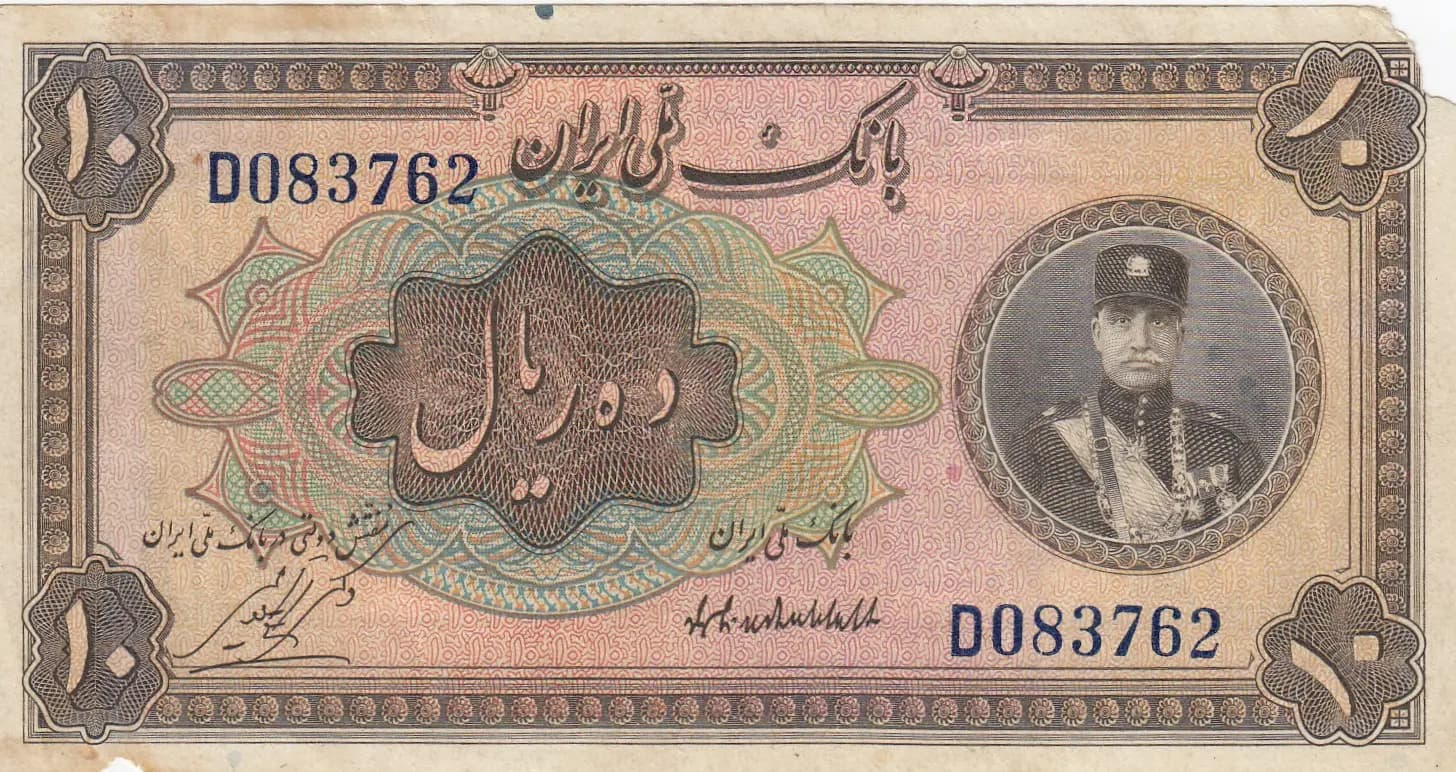
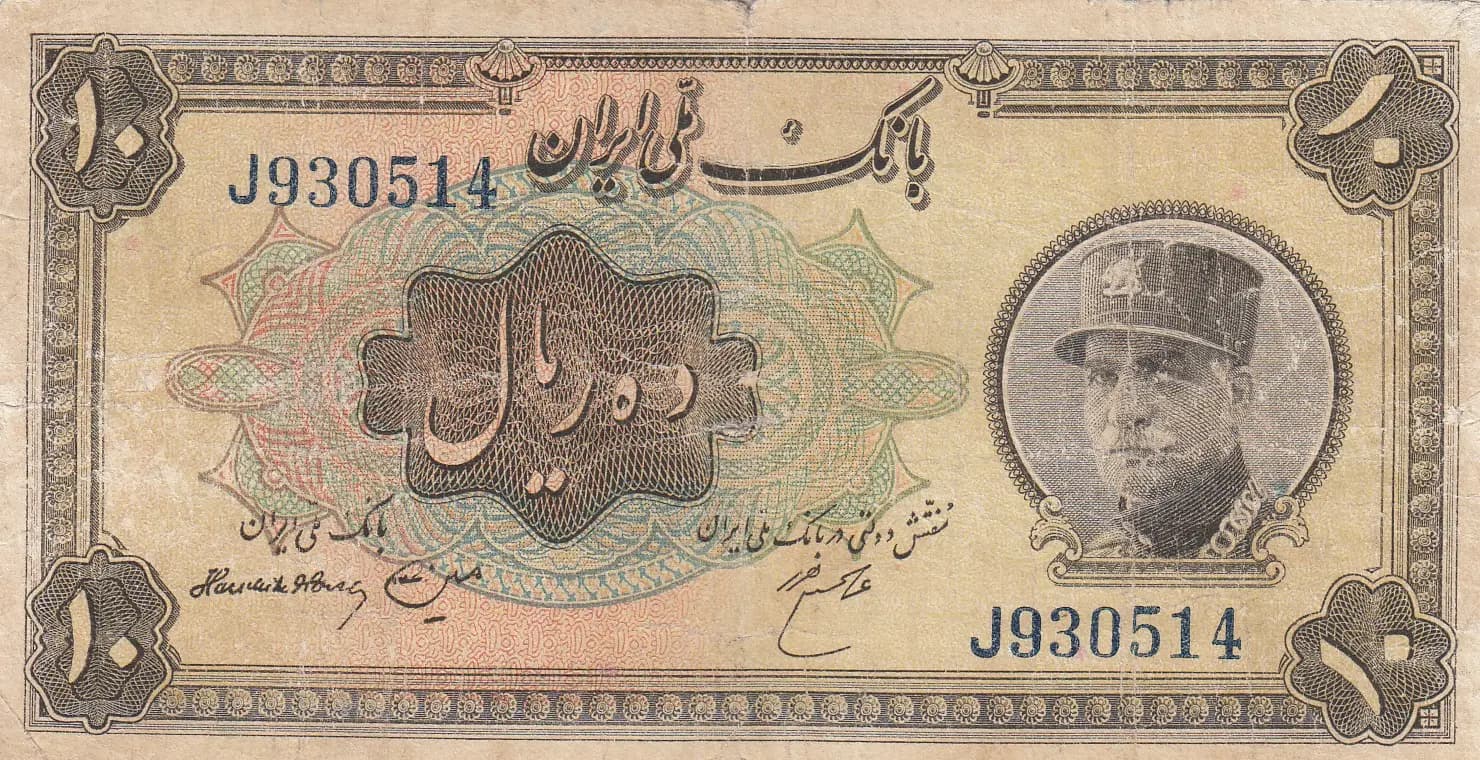
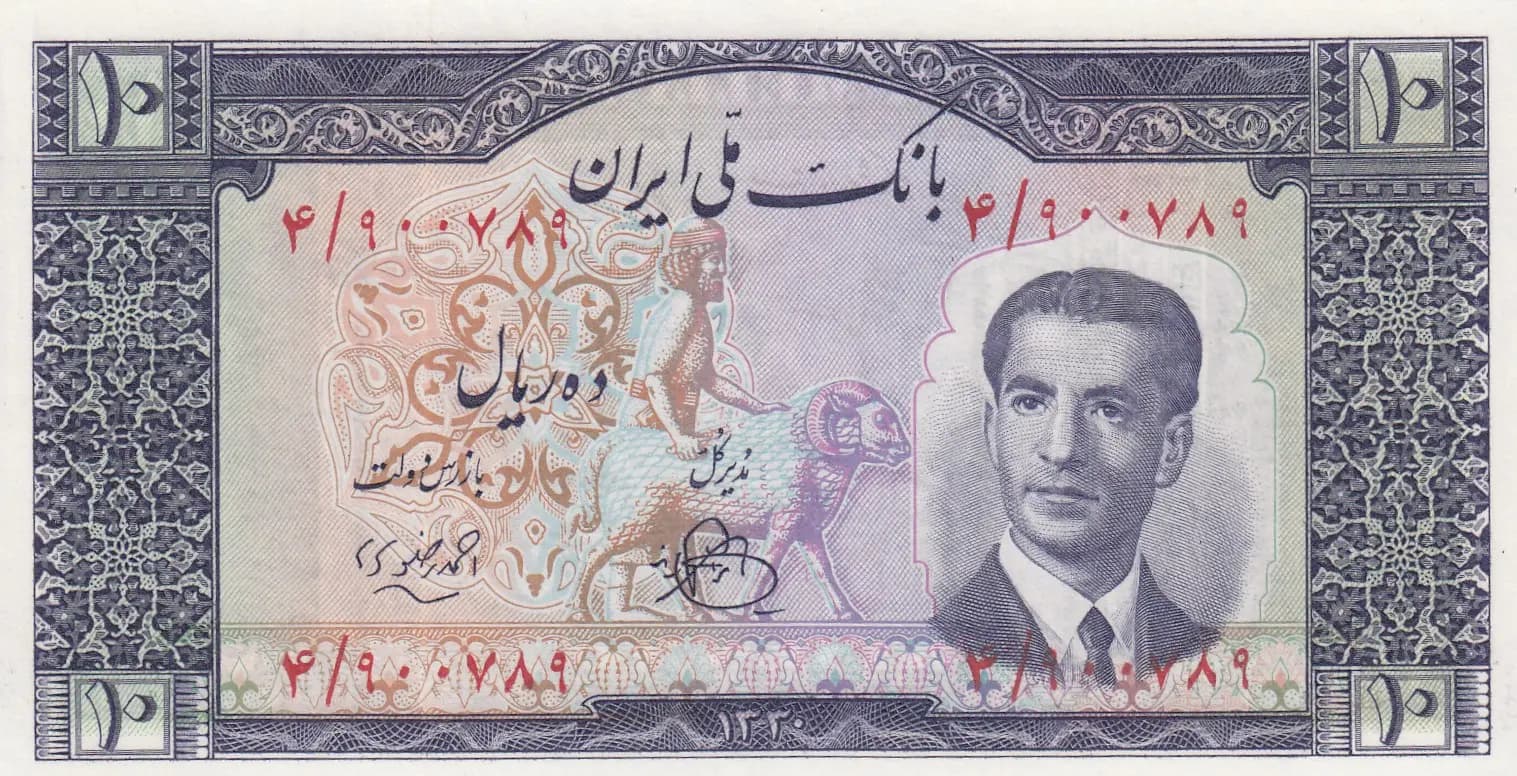
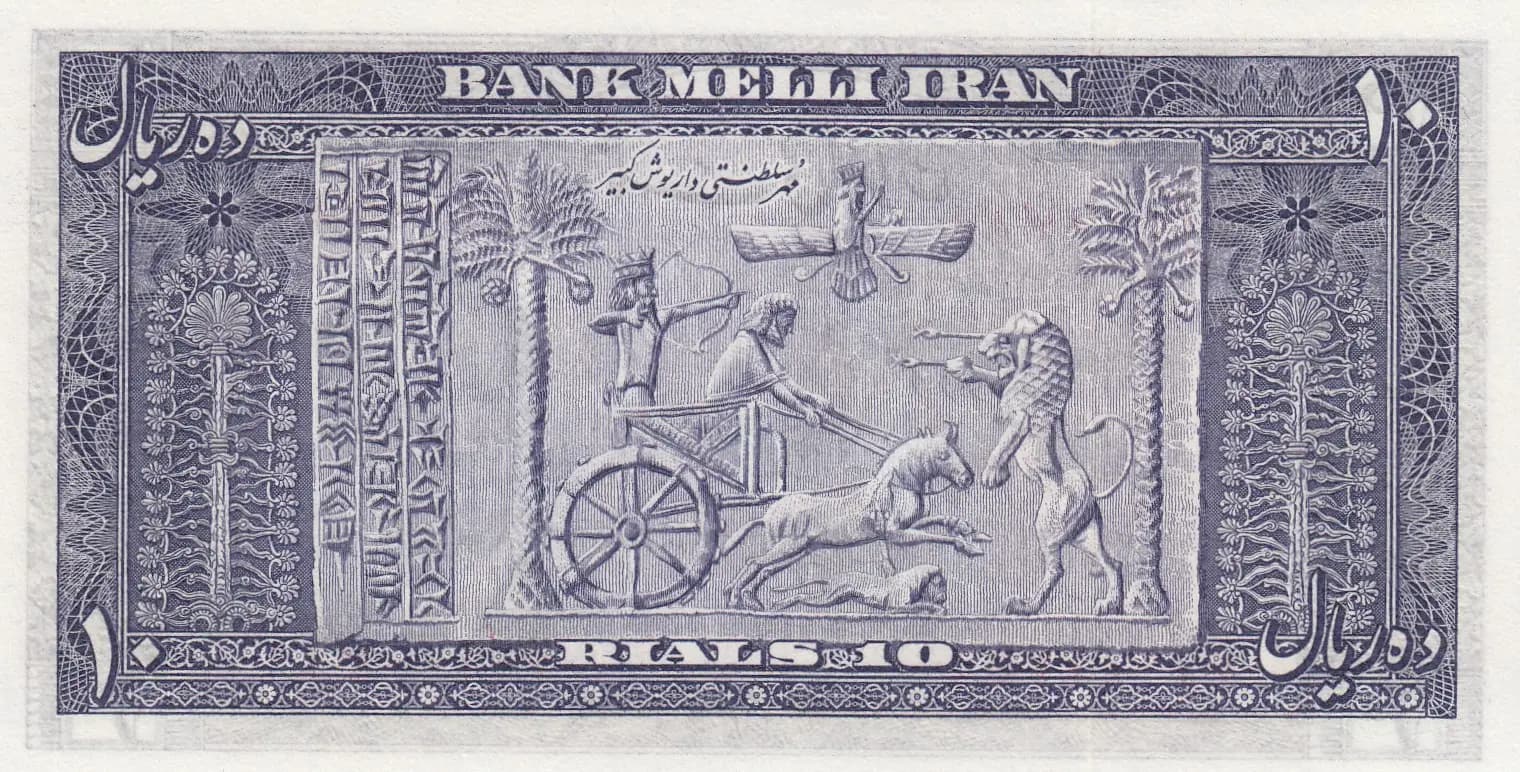
This is a Bank Melli Iran 10 Rials note from 1951 (SH 1330), featuring Shah Mohammad Reza Pahlavi in formal Western business attire on the obverse and an ancient Persian royal hunting scene with chariot and archer on the reverse. The note exhibits the hallmark characteristics of Harrison & Sons engraving work with fine line detail throughout, ornate Persian geometric borders, and a purple-lavender obverse with dark blue reverse. While the catalog lists this in UNC condition, the visual analysis reveals visible creasing, fold marks, handwritten signatures crossing the face, and moderate circulation wear, indicating this example is more accurately AUNC or VF-XF rather than true UNC.
Common. eBay market data shows regular sales in the $30-37.50 range for AUNC examples (2014-2016), with catalog values in UNC graded at only $15 (2016 reference). The consistent availability at low price points and established eBay trading history indicate this is a standard circulation issue from a lengthy production run. This Pick number represents regular currency production by Bank Melli Iran during a stable period of the Pahlavi reign, with no known scarcity, recall history, or restricted printing.
Issued during the early Pahlavi era under Shah Mohammad Reza Pahlavi's modernization program, this note reflects Iran's mid-20th century transition and nationalist identity. The obverse portraiture of the Shah in Western business dress symbolizes his Westernization policies, while the reverse's depiction of the ancient Persian royal hunt scene with chariot and archer evokes Iran's pre-Islamic imperial heritage and Achaemenid glory—specifically referencing the sophisticated hunting traditions and royal iconography of Darius the Great's era, linking contemporary Iran to its ancient Persian dynasties.
The obverse features a formal three-quarter portrait of Shah Mohammad Reza Pahlavi, depicted in black and white engraving within a decorative scalloped frame positioned on the right side of the note. The left side displays an ornate Persian geometric and floral design panel in brown/tan tones typical of Islamic decorative arts. The entire note is framed by intricate geometric border patterns in dark navy blue against a light purple/lavender background. The reverse showcases a classical Persian relief composition depicting a royal hunting scene—specifically an archer in a chariot drawn by horses, accompanied by lions or felines and a winged mythological figure (possibly Faravahar), rendered as a detailed engraved reproduction of ancient Achaemenid artistic tradition. The reverse background is white with black engraving and dark blue ornamental borders matching the obverse design aesthetic.
FRONT: 'بانک ملی ایران' (Bank Melli Iran / National Bank of Iran) appears at top; '۲۱/۹/۱۳۸۹' (Date 21/9/1330 in Persian calendar, corresponding to 1951) appears at bottom in Persian numerals; '۱۰' (10 in Persian numerals) appears in decorative corner boxes. BACK: 'BANK MELLI IRAN' (Bank Melli Iran in Latin letters) at top; 'RANDS 10' at bottom (note: 'rands' is non-standard transliteration, should read as 10 Rials); '۱۰' (10 in Persian numerals) in corner elements; 'دولت ایران' (Government of Iran) in Persian.
Intaglio engraving (line engraving) executed by Harrison & Sons of London, as was standard for Bank Melli Iran notes of this period. The fine line work, geometric security patterns, complex ornamental borders, and precise portrait rendering are characteristic of Harrison's high-security banknote production. No printer imprint appears on the note itself, consistent with Bank Melli Iran's practices of this era. The note features a vertical yellow security thread on the obverse as an additional security measure.
This example is dated 21/9/1330 (SH calendar). Varieties of P-54 exist with different signatures and possibly different date ranges within the 1330 (1951) issue year. The handwritten signatures/marks visible on this example's obverse (crossing the decorative panel and portrait area) suggest post-issuance marking rather than a printing variety. Serial number details are not clearly visible in the provided images but would be necessary to determine the specific signature variety and printing subset of this issue.