50 rupiah 1964
“thin paper”
Market Prices
64 salesAbout This Note
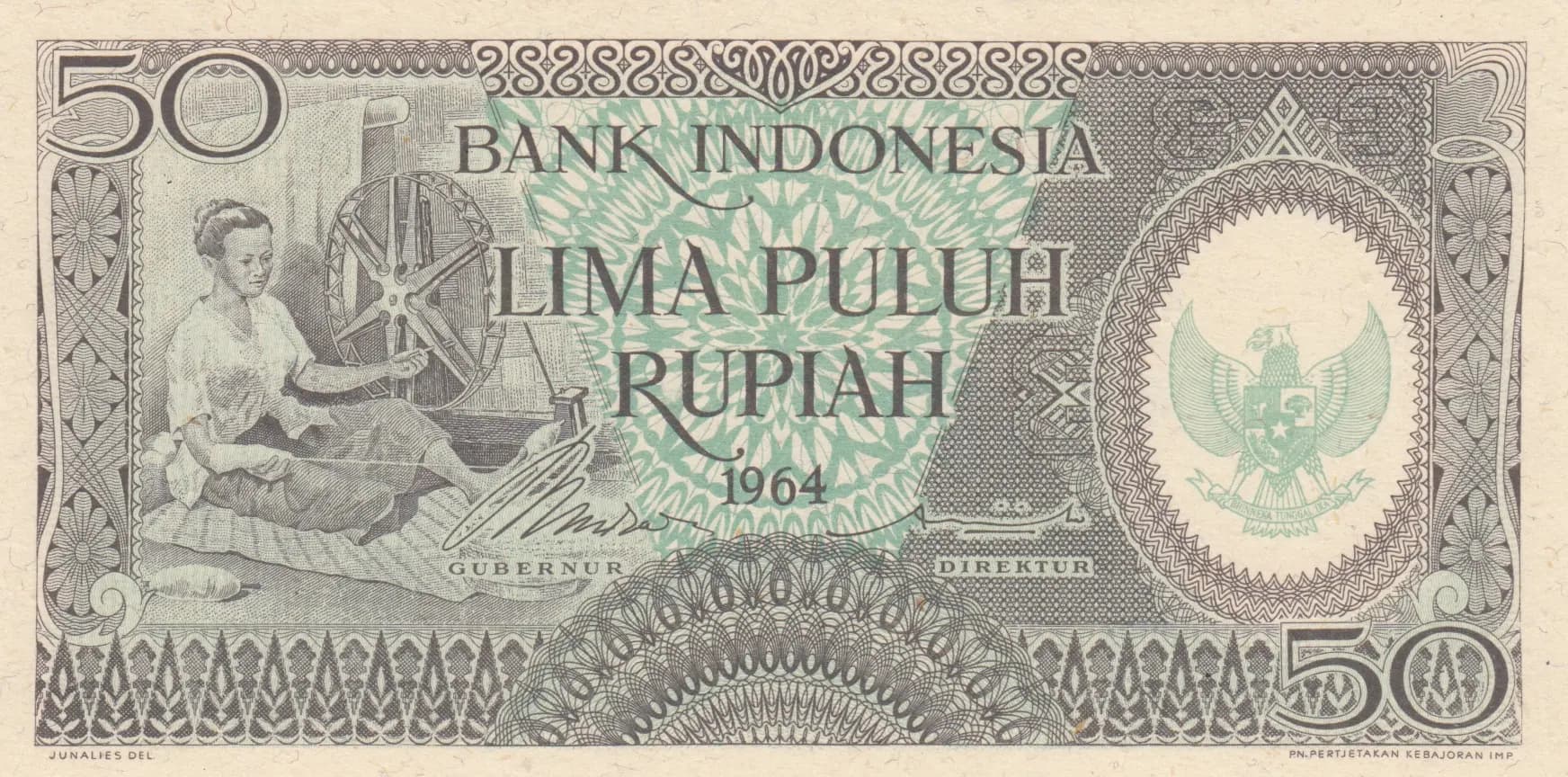
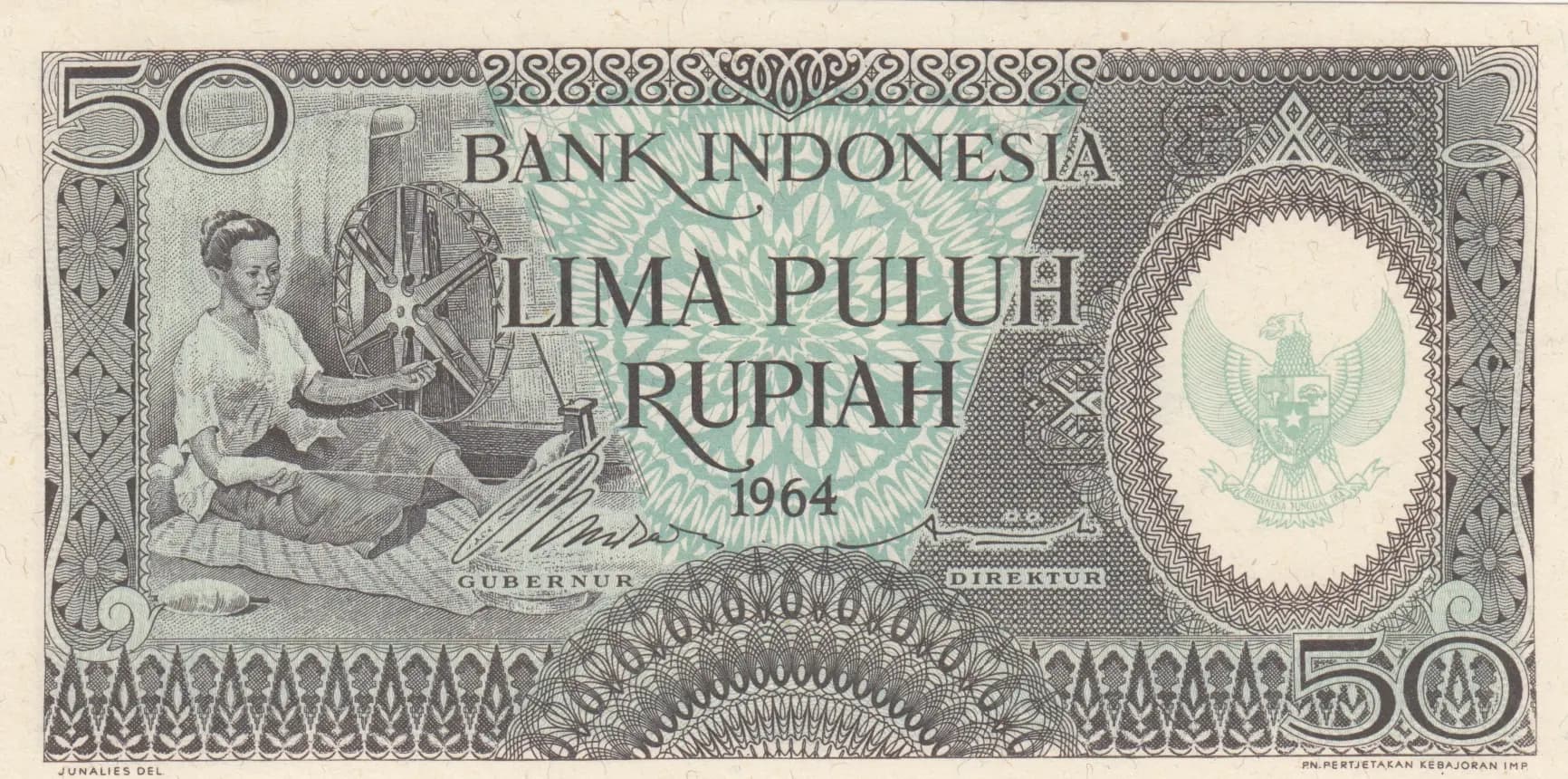
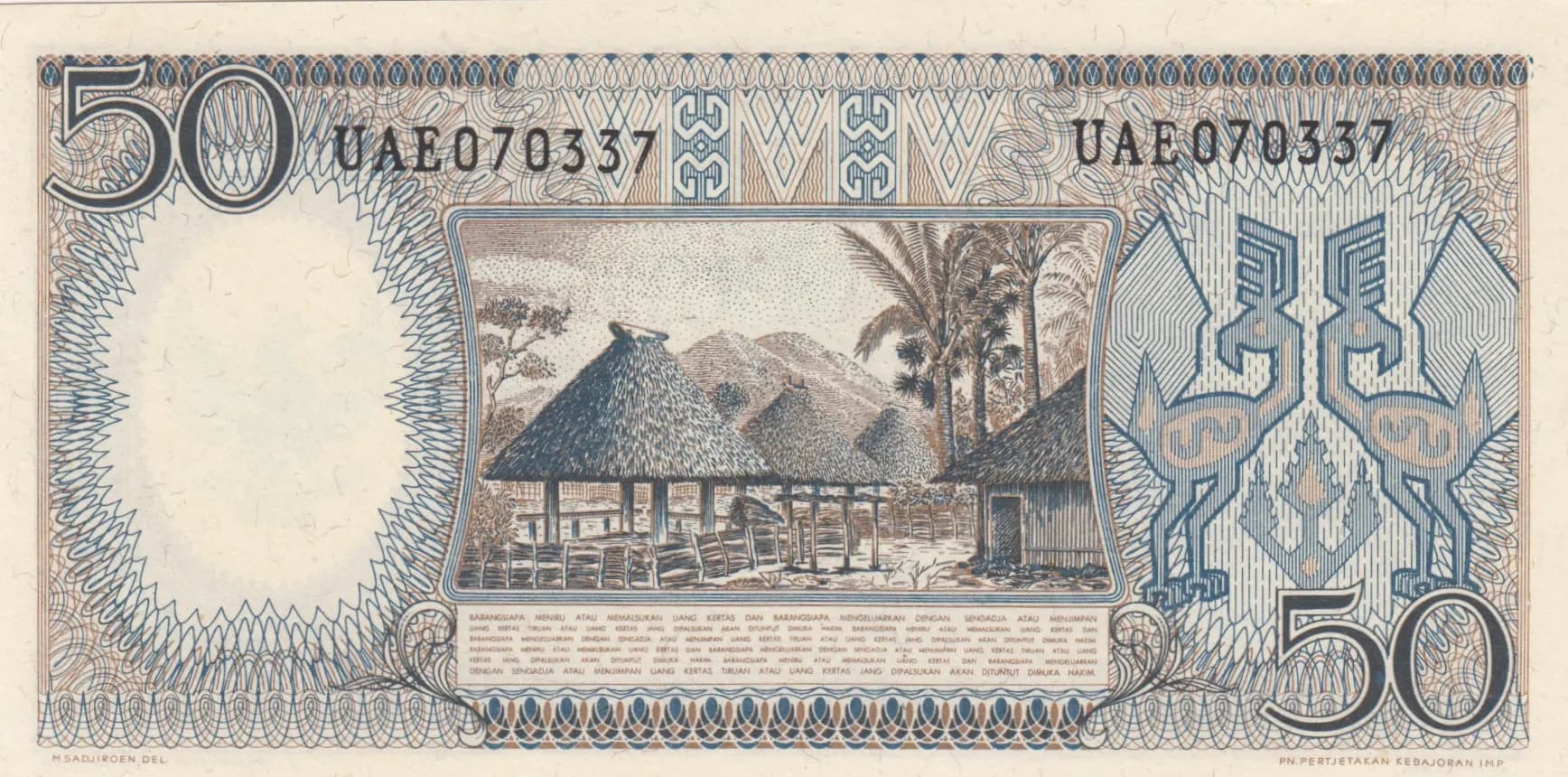
An excellent example of Indonesia's early post-independence currency, this 1964 50 Rupiah note (Pick-96) showcases fine engraving work across both sides in uncirculated condition. The front features a woman engaged in traditional textile work at a spinning wheel, while the reverse depicts characteristic Indonesian architecture with a thatched-roof structure set against a mountainous landscape. The thin paper noted in the catalog is typical of this issue and adds to the delicate, ephemeral quality of this early Bank Indonesia note.
Common. The 1964 50 Rupiah (Pick-96) was part of a standard circulation issue by Bank Indonesia and remains widely available to collectors, even in uncirculated condition. No evidence suggests an exceptionally limited print run, early recall, or scarcity in the numismatic market. Notes of this denomination and era typically trade at modest prices reflecting their common status.
This 1964 50 Rupiah note was issued during Indonesia's early years following independence (1945), a period marked by nation-building and the establishment of a stable currency system under Bank Indonesia. The imagery reflects Indonesia's cultural heritage and economic foundations—the woman at the spinning wheel on the obverse symbolizes traditional Indonesian textile production and domestic craftsmanship, while the traditional architecture on the reverse represents the nation's architectural and cultural identity during this formative period of the young republic.
The obverse features a portrait of an Indonesian woman in profile, seated and engaged in traditional spinning or weaving work, symbolizing the nation's textile heritage and domestic labor. The reverse displays a traditional Indonesian dwelling with a distinctive steeply-pitched or thatched roof, set within a mountainous landscape with palm trees, representing the architectural vernacular of the Indonesian archipelago. Both sides are framed by ornate geometric decorative borders typical of Bank Indonesia's design aesthetic of this era. The front incorporates a large circular seal or emblem on the right side with radiant, geometric patterning, likely incorporating national symbols. The color scheme employs green tones on the obverse and blue tones on the reverse, creating visual distinction between the sides while maintaining overall design cohesion.
FRONT SIDE: '50' (denomination, top left and bottom right corners); 'BANK INDONESIA' (issuing authority); 'LIMA PULUH RUPIAH' (Indonesian for 'Fifty Rupiah'); '1964' (year of issue); 'GUBERNUR' (Governor); 'DIREKTUR' (Director); 'JUNALIES DEL' (engraver credit); 'PN.PERJETAKAN KEBAJORAN IMP' (Printing house: PN Perjetakan Kebajoran). BACK SIDE: '50' (denomination, top left and bottom right); 'UAE070337' (serial number, appears twice at top); 'M.SADIROEN DEL' (reverse engraver credit); 'PN.PERJETAKAN KEBAJORAN IMP' (printing house credit); legal/informational text panel in Indonesian below the central vignette (specific content not fully legible in images).
Intaglio engraving (steel plate engraving), as evidenced by the fine line work, detailed portrait rendering, ornate border patterns, and the precision visible in both the geometric designs and landscape vignette. The printer was PN Perjetakan Kebajoran (Kebajoran Printing Works), credited on both sides. This was the standard security printing method employed by Bank Indonesia for its early banknote issues, providing intricate detail and anti-counterfeiting features through the raised inked surfaces characteristic of engraved banknotes.
The observed specimen carries the serial number 'UAE070337' (appearing twice on the reverse). Varieties for this Pick number may include different signature combinations (GUBERNUR and DIREKTUR positions), serial number prefixes, and printing variations. The serial number prefix 'UAE' and the specific number sequence should be noted for detailed catalog purposes. No overprints or other distinguishing features indicating a major variety are apparent from the visual analysis.