10 rupiah 1963
Market Prices
51 salesAbout This Note
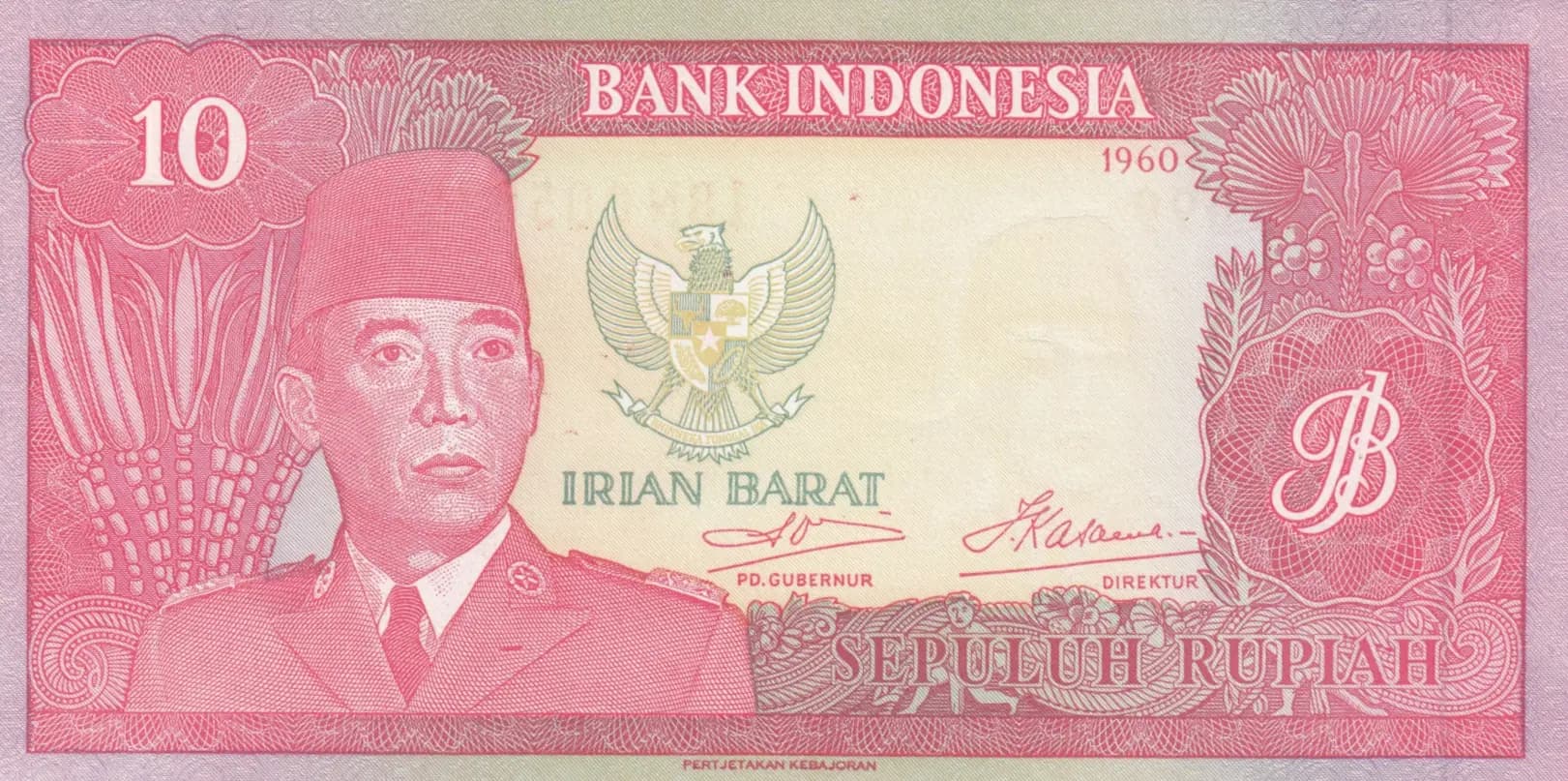
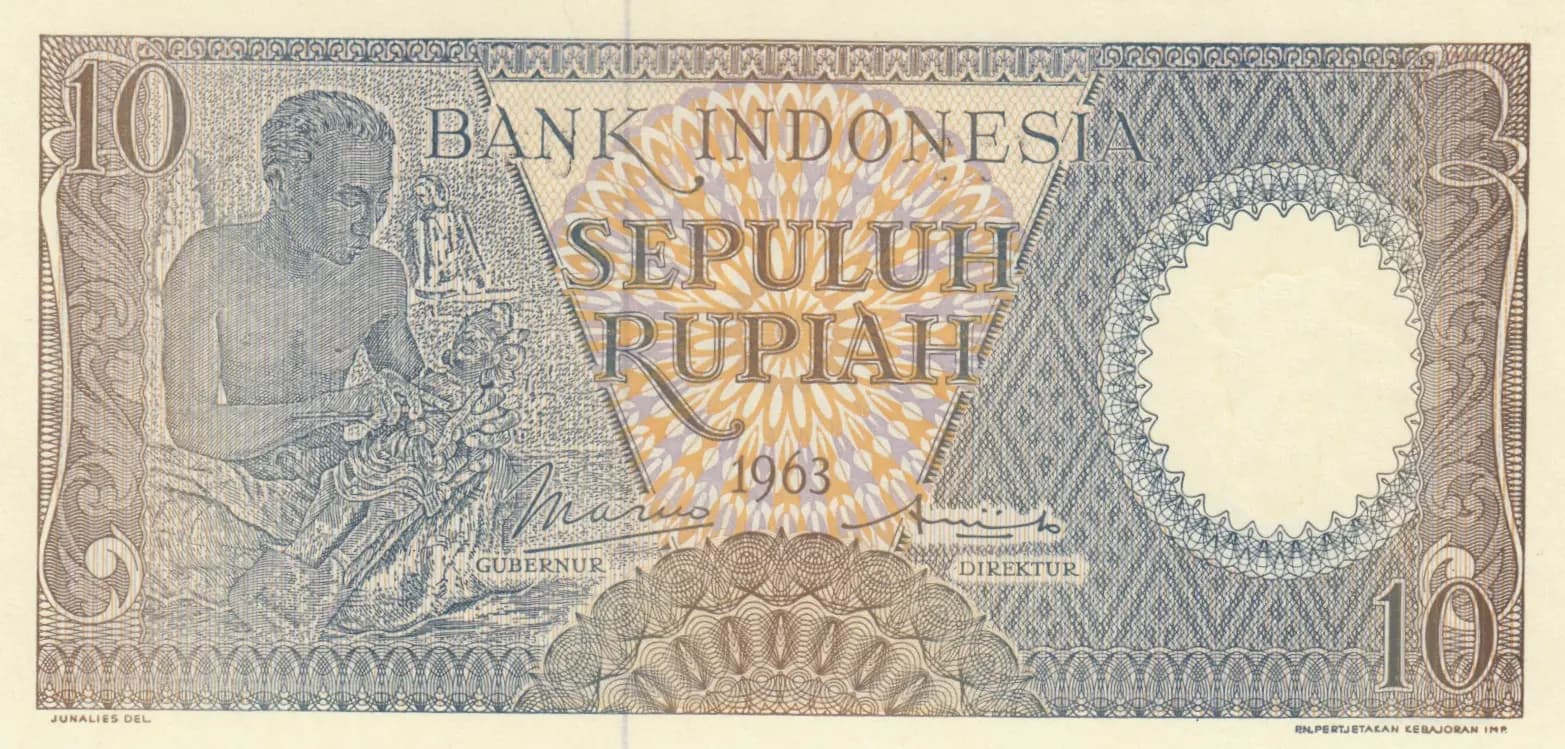
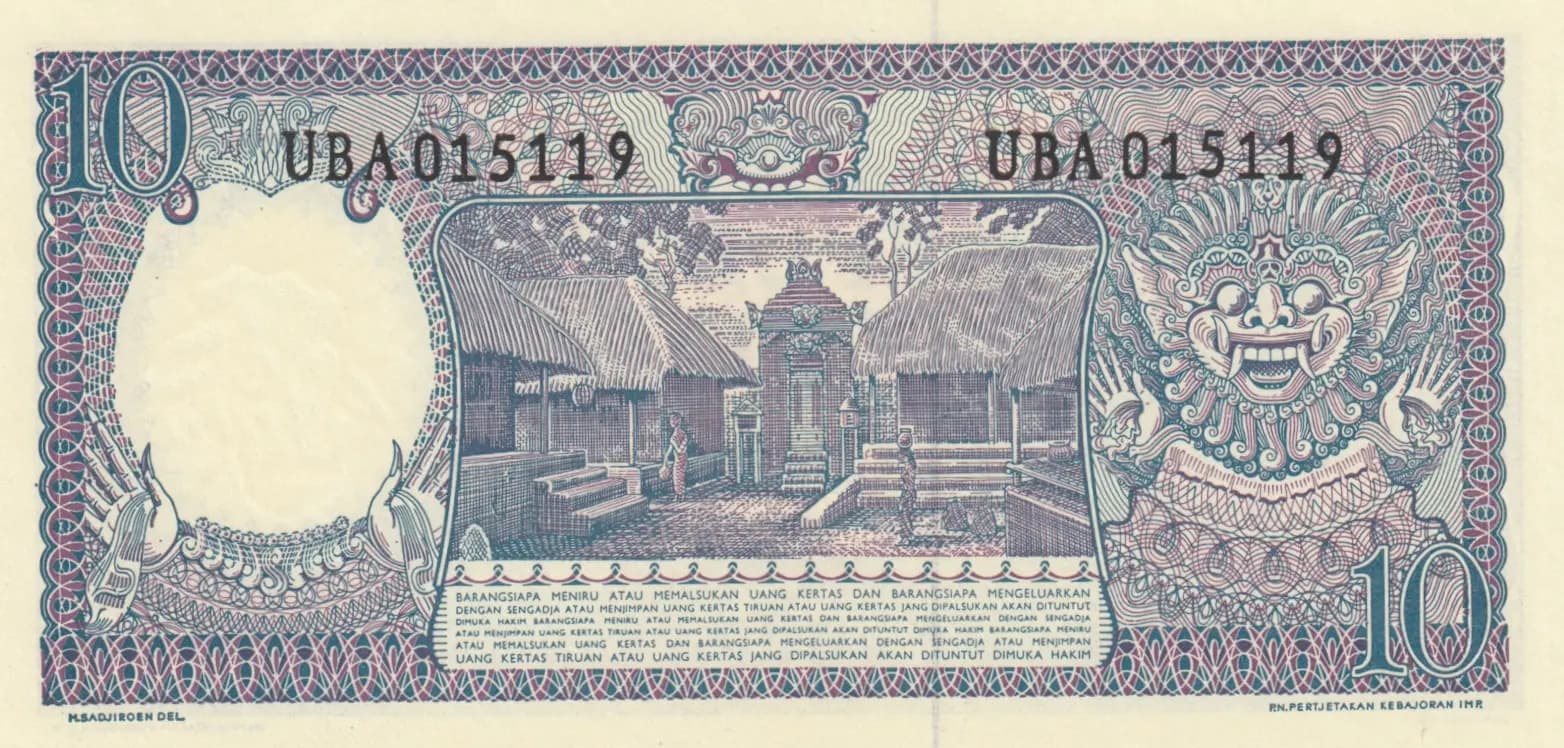
This is an uncirculated 1963 Indonesian 10 rupiah note (Pick P-89) issued by Bank Indonesia, featuring exceptional preservation with crisp printing and no signs of circulation wear. The front displays a classical male portrait bust in profile facing right alongside ornate decorative elements and a prominent sunburst design, while the reverse showcases a detailed engraving of a traditional Indonesian temple complex with characteristic tiered roofs, flanked by ornamental mask and emblem designs. The note exhibits the hallmark engraved security features typical of early 1960s Indonesian currency, making it an interesting example of post-independence Indonesian numismatic design.
Common. This note regularly appears on the secondary market with numerous recorded sales, predominantly in the $1-5 USD range for uncirculated examples. The eBay price history provided shows consistent availability with UNC specimens selling for $1.35-$3.90 across multiple transactions from 2011-2020, and even as recently as December 2025 at $1.99. The PMG population data and extensive auction history indicate this was a substantial print run with no known scarcity. While graded examples (PMG 66-68) command modest premiums ($14-$68), this reflects premium condition, not rarity of the underlying note type.
This 1963 note was issued during Indonesia's early post-independence period under President Sukarno, reflecting the nation's efforts to establish sovereign monetary control through Bank Indonesia. The reverse depicts traditional Balinese temple architecture, symbolizing the cultural heritage and regional identity of the Indonesian archipelago during this formative period. The elaborate engraving and classical European-influenced design aesthetic reflect the transitional numismatic style of newly independent Indonesia, combining Western printing techniques with indigenous cultural imagery.
The obverse features a classical engraved portrait of an unidentified male subject in right-facing profile, rendered in the traditional European engraving style typical of mid-20th century currency design. The portrait is positioned on the left side with an empty oval portrait frame on the right, creating balanced symmetry. A prominent ornamental sunburst or rosette design in orange and tan tones dominates the center, behind which are printed the issuer name 'BANK INDONESIA' and denomination 'SEPULUH RUPIAH' (Ten Rupiah). The entire note is framed by intricate geometric and Greek key pattern borders with floral decorative elements. The reverse showcases a central rectangular vignette depicting a traditional Balinese temple complex (likely representing the Balinese Hindu-Buddhist architectural heritage), with multiple tiered roofs and ornamental architectural details characteristic of Indonesian temple design. This central architectural scene is flanked by an ornamental mythical face or mask design on the left (representing Balinese cultural iconography) and a decorative emblem on the right. The border repeats the complex geometric interlocking patterns from the obverse. Serial numbers 'UBA 015119' appear at the top in both left and right positions.
FRONT SIDE: 'BANK INDONESIA' (Bank Indonesia), 'SEPULUH RUPIAH' (Ten Rupiah), '10' (denomination numeral), '1963' (date of issue), 'GUBERNUR' (Governor), 'DIREKTUR' (Director), 'JUNALIES DEL' (artist attribution - Junalies designed), 'JAJASAN PERUSAHAAN PERCETAKAN NEGARA DAN' (State Printing Company and [continued]). BACK SIDE: '10' (denomination numeral), 'UBA 015119' (serial number, printed twice), 'H. BADJIROEN DEL' (artist attribution - H. Badjiroen designed), 'PERCETAKAN KEBAJORAN IMM' (Kebajoran IMM Printing), and prominent legal warning: 'BARANGSIAPA MENIRU ATAU MEMALSUKAN UANG KERTAS DAN BARANGSIAPA MENGELUARKAN DENGAN SENGAJA ATAU MENGHIMPUN UANG KERTAS TIUAN ATAU UANG KERTAS YANG DIPALSUKAN AKAN DITUNTUT HAKIM' (Whoever counterfeits or falsifies banknotes and whoever intentionally issues or hoards such counterfeited or false banknotes will be prosecuted before the judge).
Intaglio engraving (line engraving), the dominant security printing method for this era. The detailed portraits, fine geometric patterns, ornamental borders, and architectural vignette all exhibit the characteristic sharp lines and intricate depth typical of high-quality intaglio work. The printer is identified as Percetakan Kebajoran (Kebajoran Printing), as noted in the visual analysis. This represented the state-of-the-art security printing technology available to Indonesian monetary authorities in the early 1960s, providing resistance to counterfeiting through the complexity of the engraved plates.
Serial number 'UBA 015119' is visible on the observed specimen. The note exhibits signatures for both Governor (GUBERNUR) and Director (DIREKTUR) positions as indicated in the inscriptions. Based on the catalog data noting a reference to similar earlier note INDONESIA P-56, this Pick P-89 represents a later denomination variant in the 1963 series. No overprints or special markings are evident in the visual analysis, suggesting this is a standard circulation variety of the 1963 issue without scarce prefix variations documented.