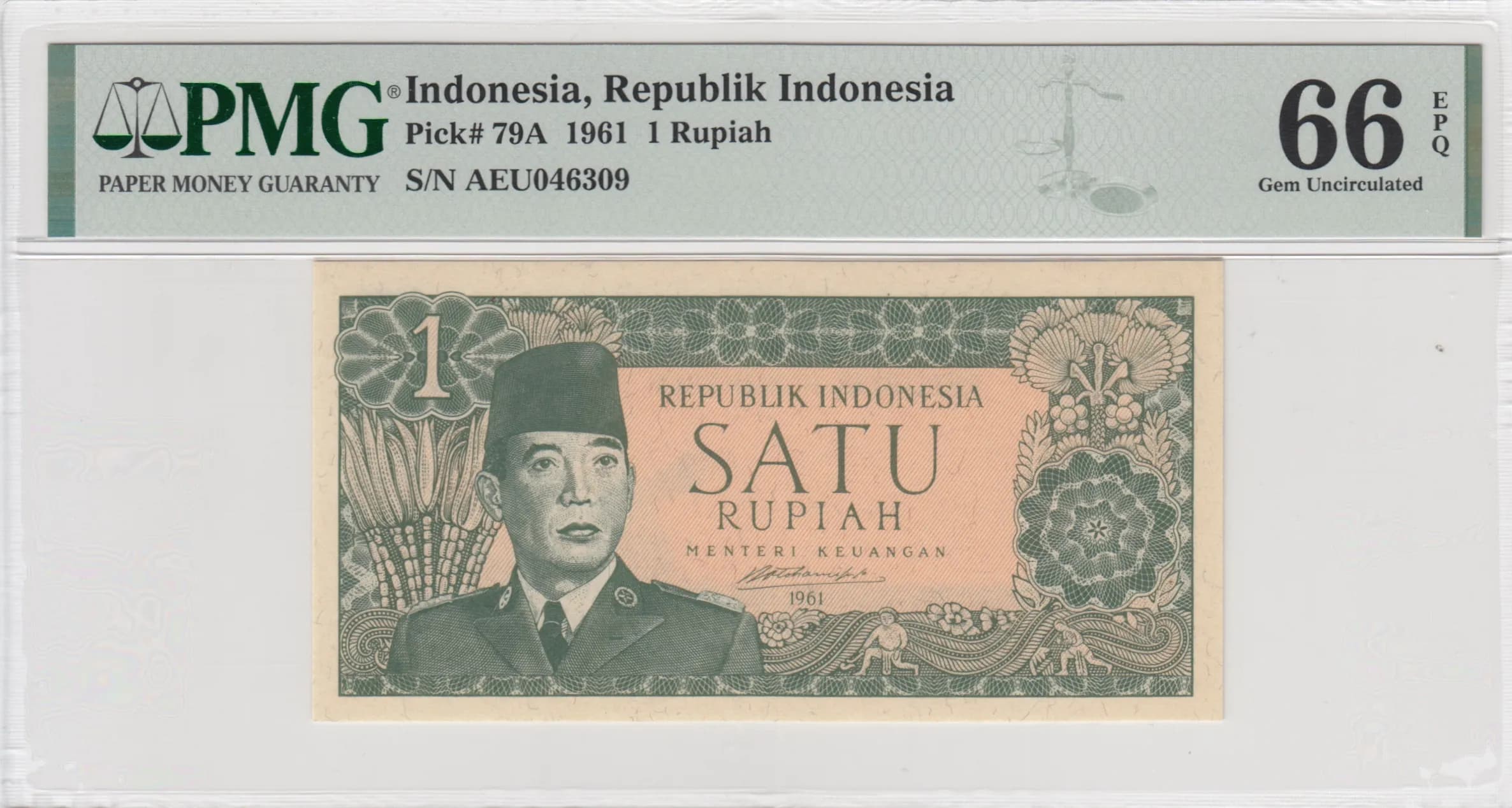
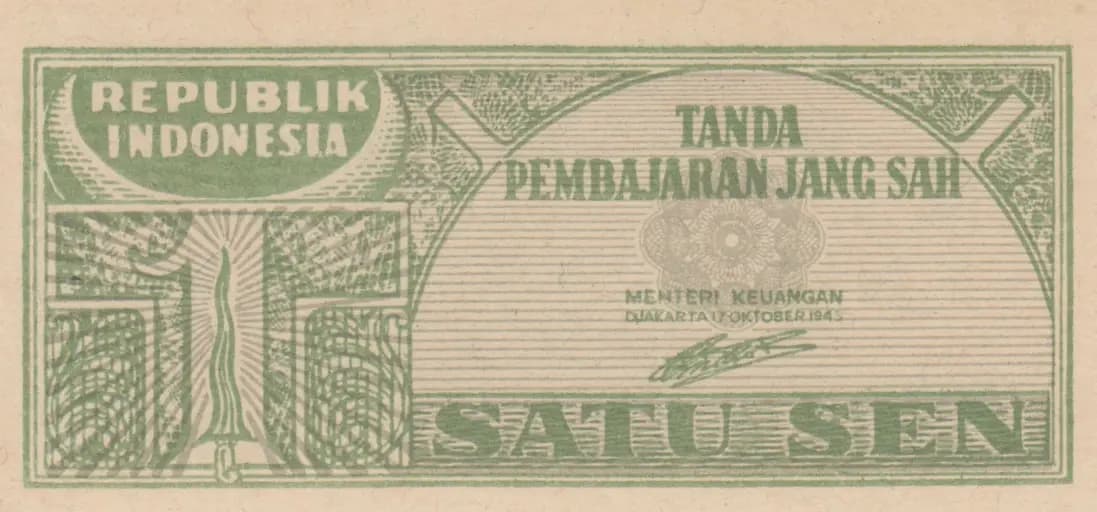
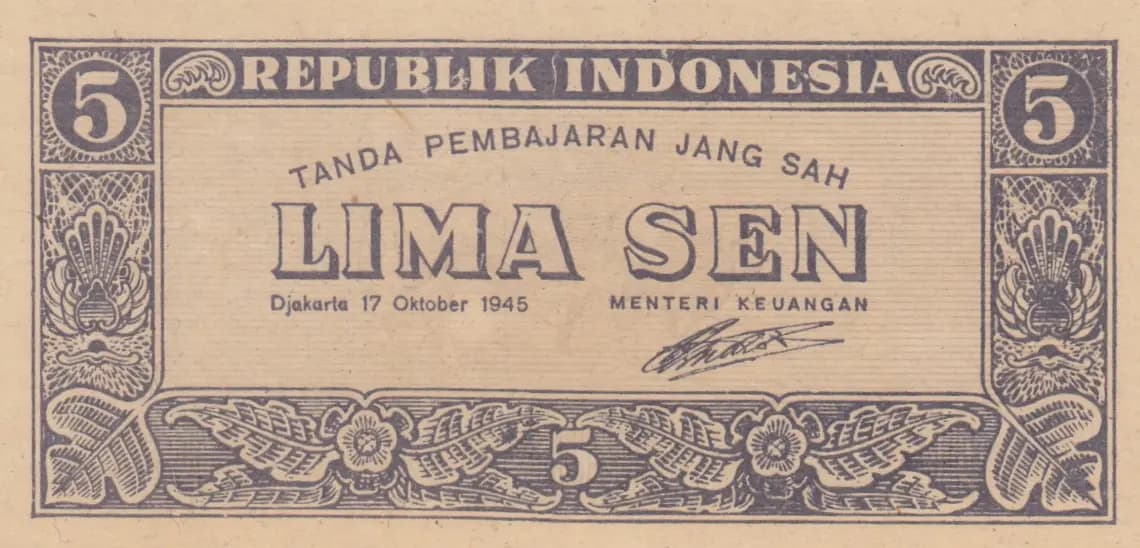
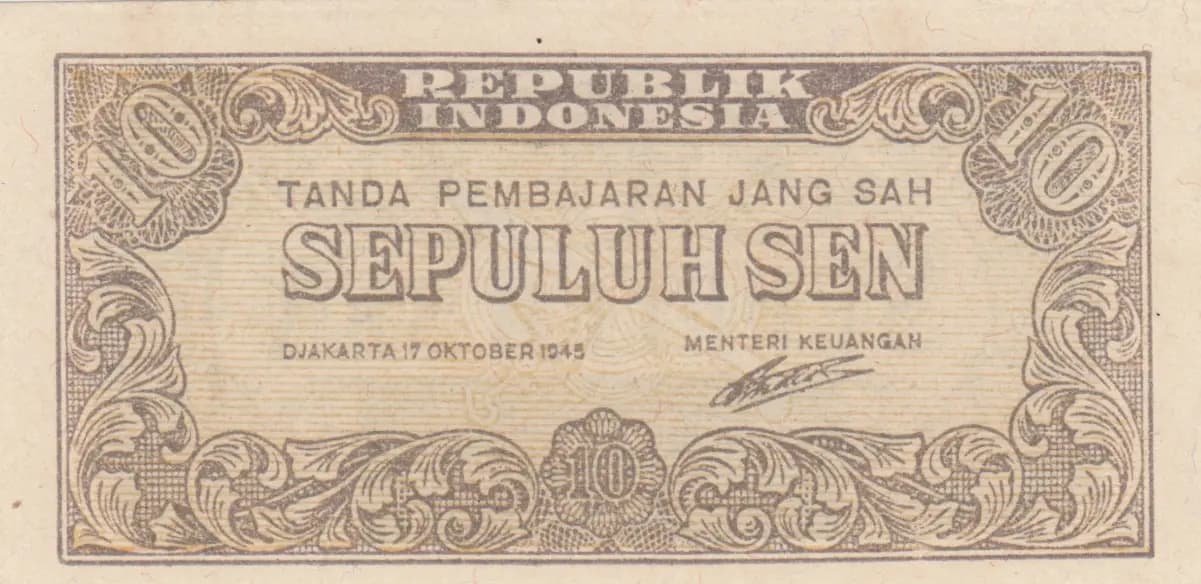
1 rupiah 1961
Market Prices
39 salesAbout This Note
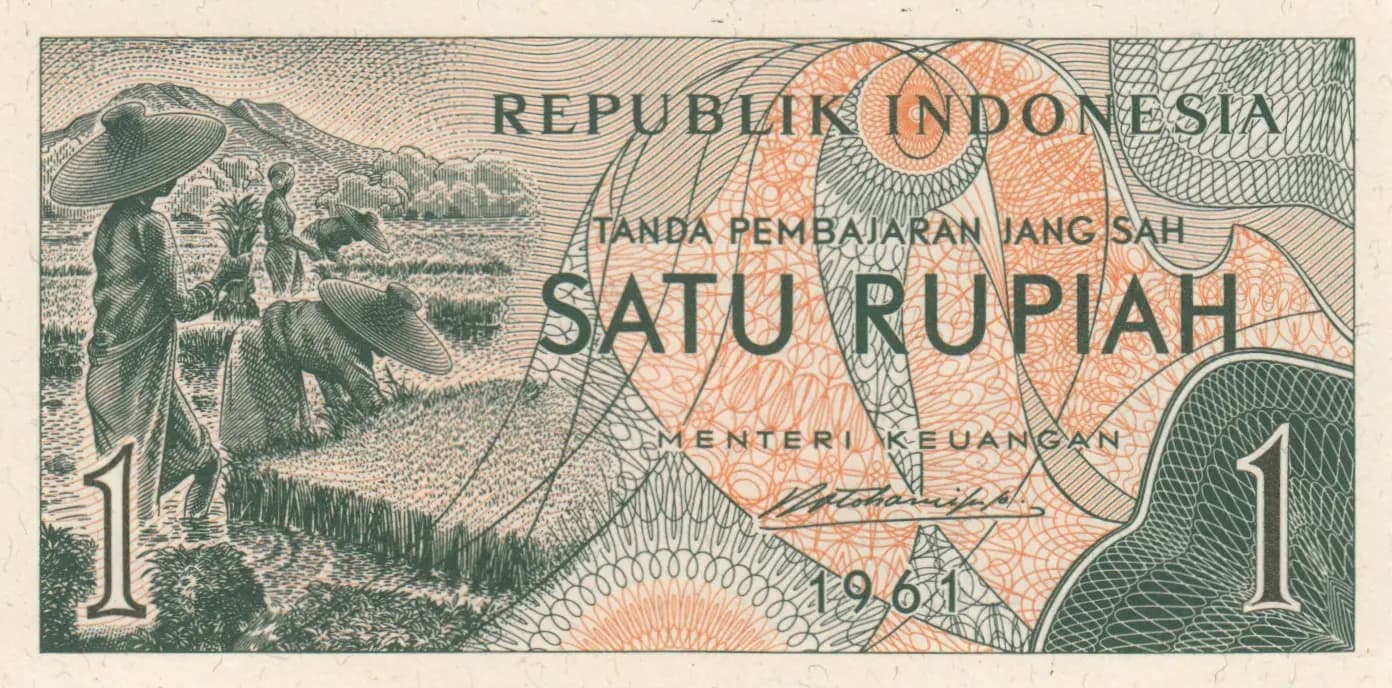
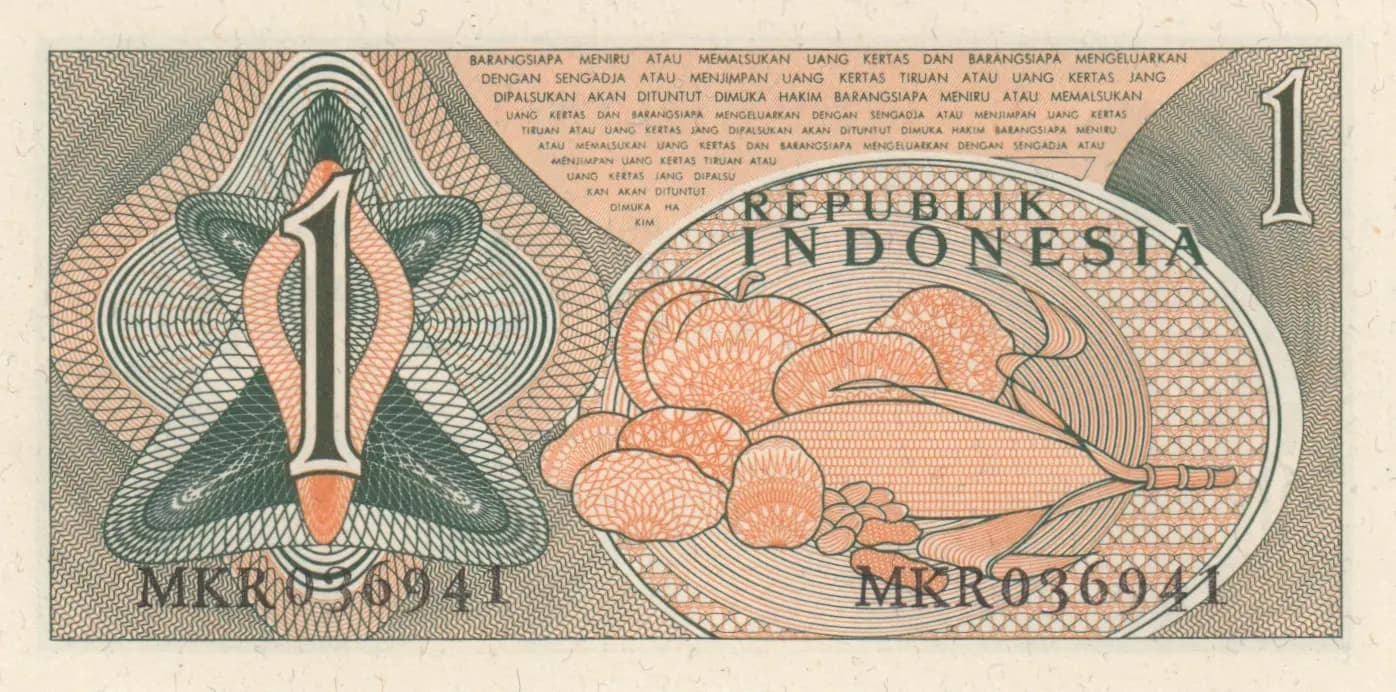
This 1961 Indonesia 1 Rupiah (P-78) presents an exceptional example of early post-independence Indonesian currency design, depicting a rice harvest scene with three figures in traditional dress working in an agricultural landscape. The note exhibits the characteristic dark green on orange underprint typical of this issue, rendered in fine engraved detail with excellent preservation consistent with uncirculated condition. The reverse features the Garuda Pancasila national emblem alongside a detailed botanical illustration, representing the nation's cultural and natural heritage during a formative period of the young republic.
Common. The eBay price history demonstrates consistent sales in the $1-3 range for uncirculated examples over nearly two decades (2011-2025), with even professionally graded PMG 67 specimens regularly selling for $13-22. These extremely low secondary market prices and frequent availability indicate a substantial surviving population. The 2019 catalogue value of $0.75 for UNC confirms modest collector demand. Early Indonesian rupiah notes from this period were produced in large quantities to establish the new nation's currency, and circulated heavily, but significant quantities remain in collections. Print run estimates support a common classification.
Issued in 1961, this banknote represents Indonesia during the presidency of Sukarno, a critical period for the newly independent nation (independent 1945, formally recognized 1949). The rice harvest imagery reflects the agrarian foundation of Indonesia's economy and the government's emphasis on agricultural development and self-sufficiency. The prominence of the Garuda Pancasila on the reverse symbolizes national identity and unity during a time of consolidating the diverse archipelago into a cohesive state.
The obverse features a vivid agricultural scene occupying the left portion, depicting three Indonesian workers in traditional sarongs and head coverings engaged in rice paddy cultivation, with a mountainous landscape visible in the background. This imagery symbolizes Indonesia's agrarian economy and cultural heritage. The center and right sides feature intricate ornamental patterns in orange and green, with large denomination numerals '1' positioned at the left and right edges within decorative cartouches. The reverse displays the Garuda Pancasila—Indonesia's national emblem featuring the mythological eagle (Garuda) holding a shield with the national symbols—on the left side. The right side showcases a detailed botanical illustration of a flowering plant within an ornate circular frame, likely representing Indonesia's rich flora. Both sides feature fine engraved background patterns and repeated legal text serving security purposes. The color scheme of dark green on orange underprint provides strong visual distinction characteristic of this 1961 issue.
Front: 'REPUBLIK INDONESIA' (Republic of Indonesia); 'TANDA PEMBAJARAN JANG SAH' (Legal Tender); 'SATU RUPIAH' (One Rupiah); 'MENTERI KEUANGAN' (Minister of Finance); '1961' (year of issue). Back: 'REPUBLIK INDONESIA' (Republic of Indonesia); 'BARANGSIAPA MENIRU ATAU MEMALSUKAN UANG KERTAS DAN BARANGSIAPA MENGELUARKAN DENGAN SENGAJA ATAU MENJUMPAI UANG KERTAS TIRUUAN ATAU UANG KERTAS JANG DIPALSUKAN AKAN DITUNTUT DIMUKA HAKIM' (Whoever counterfeits or forges banknotes and whoever deliberately issues or discovers counterfeit or forged banknotes shall be prosecuted before a judge—standard counterfeiting warning); Serial number 'MKR036941' appearing in multiple locations.
Intaglio engraving (line engraving and possibly rotogravure), evidenced by the fine detail work, intricate cross-hatching patterns, and complex ornamental designs visible throughout both obverse and reverse. The precise line work and depth of the agricultural scene and botanical illustration are consistent with high-quality engraved banknote production. While the specific printer for this P-78 base variety is not definitively documented in standard references, the production quality suggests work by a established security printing firm contracted by the Indonesian government; note that P-78b and P-78c variants are documented as printed by JEZ (Joh. Enschedé en Zonen).
Pick catalog identifies this as P-78, with documented variants P-78b and P-78c both attributed to printer JEZ (Joh. Enschedé en Zonen). The visual analysis indicates serial number 'MKR036941,' which may provide additional variety identification by serial number prefix or specific security printer marks. Without access to comprehensive variety guides distinguishing P-78 from its 'b' and 'c' variants, the specific printing variant cannot be definitively determined from the available information, though the production quality and design characteristics are consistent with the main P-78 issue.