5 rupees 1943
Market Prices
29 salesAbout This Note
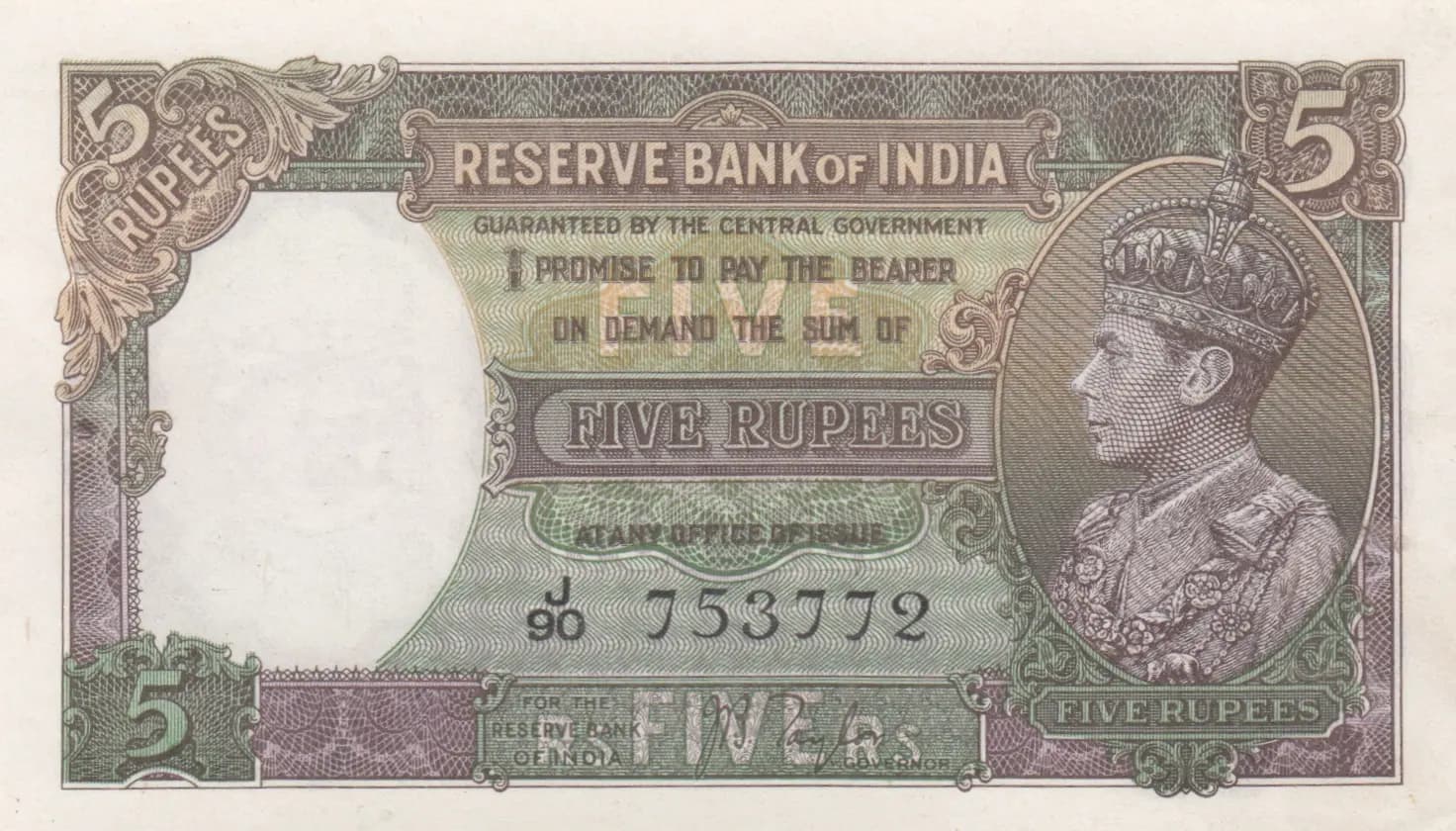
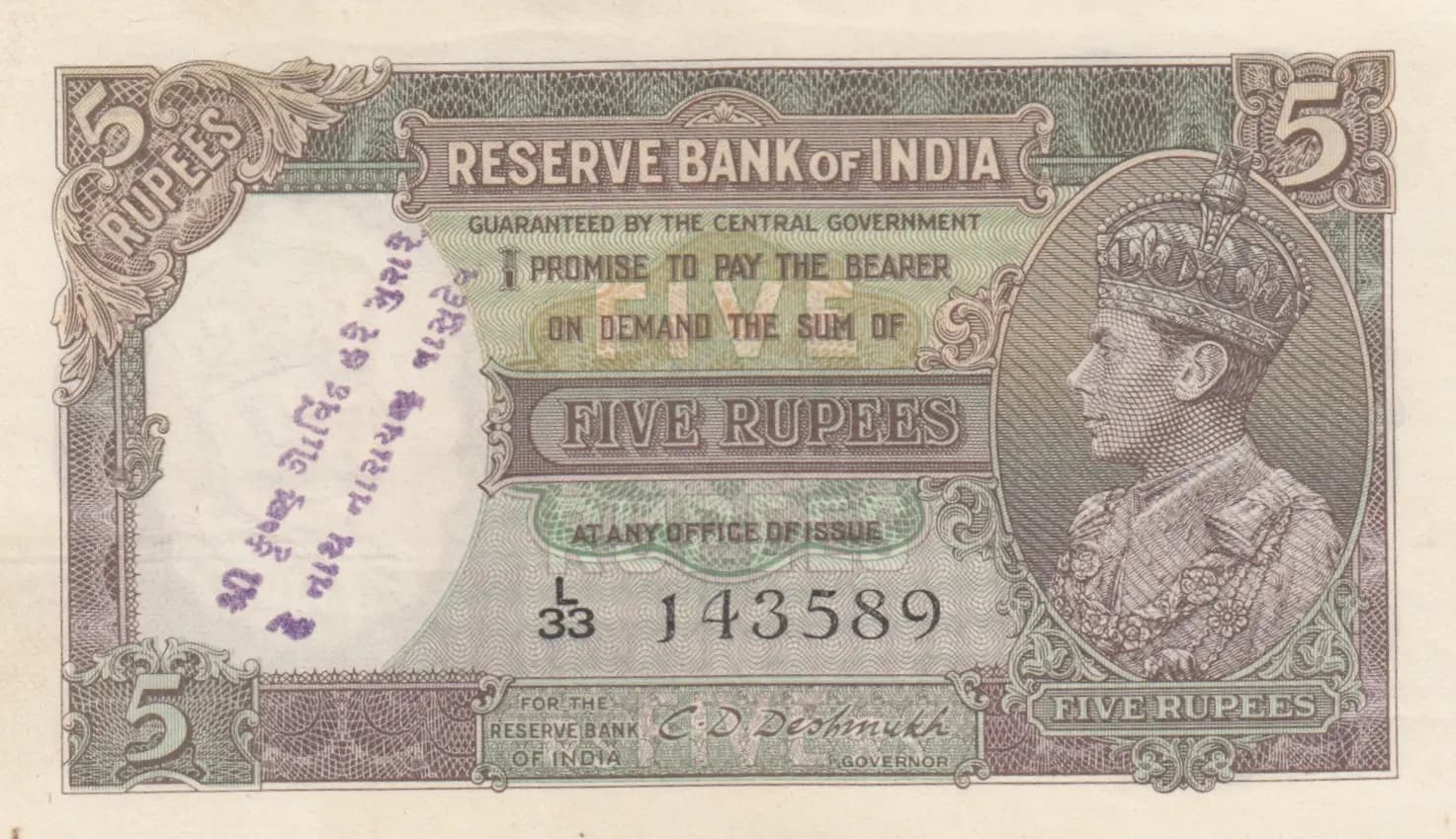
This is an AU-graded 1943 Reserve Bank of India 5 Rupees note (Pick P-18b) featuring King George VI in profile on the obverse. The note displays characteristic brown and green coloration with ornate decorative borders and intricate security engraving throughout. Notable condition features include purple/violet stamp marks on the left margin and evidence of careful handling consistent with AU-grade specimens; the design details and printing remain well-preserved, making this a desirable example of the wartime series.
Common. The 1943 5 Rupees (P-18b) is a relatively common note in the secondary market. eBay price data shows consistent sales across multiple condition grades, with F-grade notes selling for $13–$56 and AU/UNC specimens commanding $100–$227, indicating healthy collector demand but ready availability. The wartime production run was substantial given India's currency needs during WWII, and notes survive in reasonable quantities. The AU condition observed here is desirable but not exceptionally scarce.
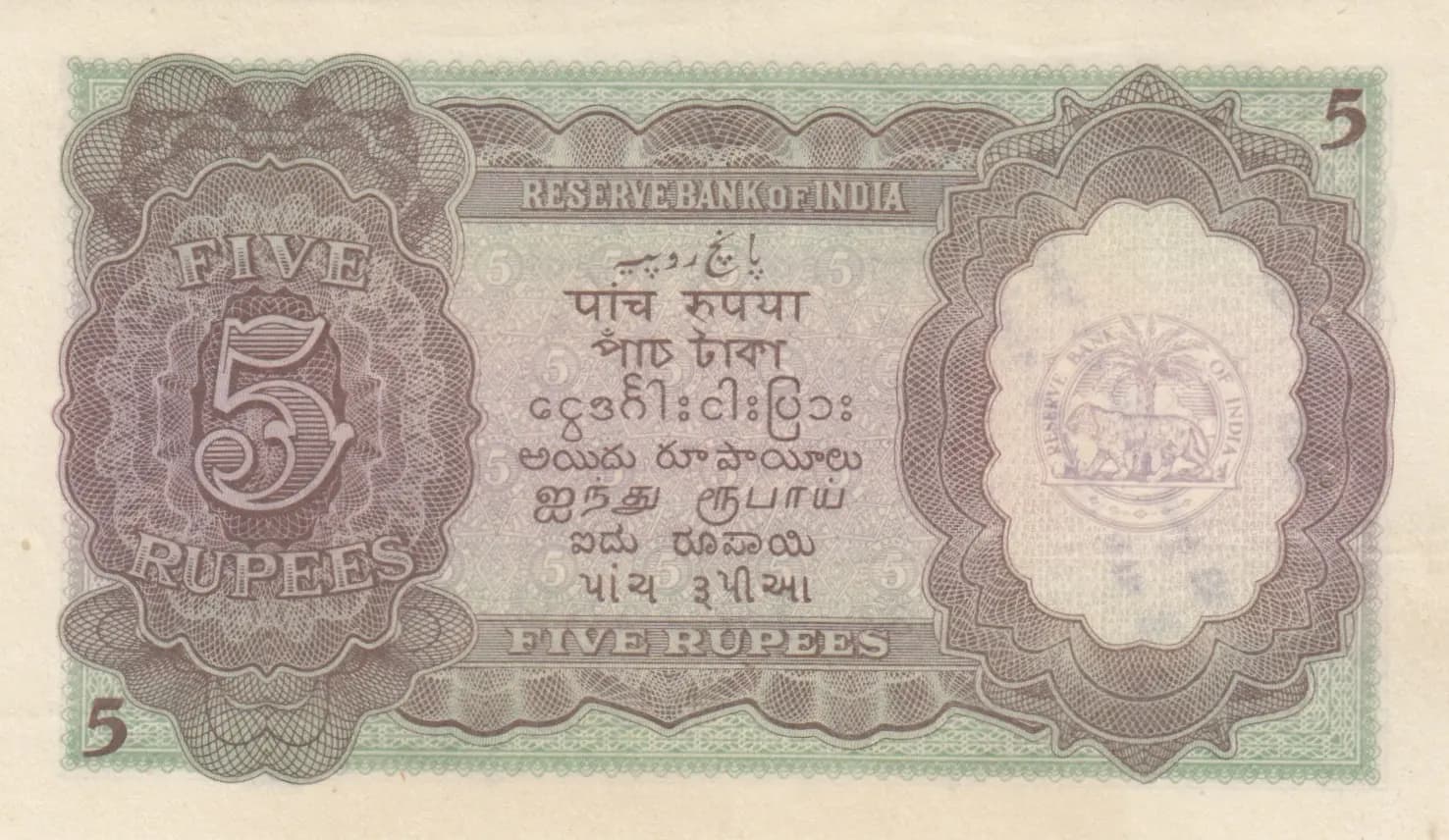
Issued during World War II, this 1943 note reflects India's continued monetary relationship with the British Crown, as evidenced by the prominent profile portrait of King George VI on the obverse. The denomination and design date to the period immediately preceding Indian independence (1947), when the Reserve Bank of India maintained this classical engraved currency design. The multilingual reverse—featuring denominations in English, Hindi, and South Indian scripts (Telugu, Tamil, Kannada, Assamese, and Bengali)—demonstrates the RBI's commitment to serving India's diverse linguistic population during the final years of colonial administration.
The obverse features a right-facing profile portrait of King George VI wearing formal regalia and headwear, positioned prominently on the right side of the note. The design is framed by ornate decorative borders incorporating intricate floral and geometric scrollwork in the corners. Large denomination numerals '5' appear in decorative square frames at the corners. The center contains the RBI's promise to pay text in English. The reverse displays a symmetrical ornamental design with a circular emblem or medallion on the right side (likely representing an architectural or symbolic element of India), surrounded by the same decorative border treatment. The reverse emphasizes multilingual denomination declarations, with the denomination repeated in English and nine Indian language scripts (Hindi, Bengali/Assamese, Telugu, Tamil, Kannada, and others), reflecting the pan-Indian character of the currency. Large denominational numerals '5' in decorative frames appear on both sides.
FRONT SIDE: 'RESERVE BANK OF INDIA' / 'GUARANTEED BY THE CENTRAL GOVERNMENT' / 'I PROMISE TO PAY THE BEARER ON DEMAND THE SUM OF FIVE RUPEES AT ANY OFFICE OF ISSUE' / 'FOR THE RESERVE BANK OF INDIA' / 'GOVERNOR' / Serial number: 33 J143589 / 'FIVE RUPEES' and denomination numeral '5' appear in decorative frames. Purple stamp marks in Indian script (partially legible) appear on the left margin. BACK SIDE: 'RESERVE BANK OF INDIA' / 'FIVE RUPEES' in English / 'पाँच रुपया' (Hindi: Five Rupees) / 'पञ्च रुपया' (Hindi: Five Rupees) / 'ఐదు రూపాయలు' (Telugu: Five Rupees) / 'ஐந்து ரூபாய' (Tamil: Five Rupees) / 'ಐದು ರುಪಾಯ' (Kannada: Five Rupees) / Scripts for Assamese/Bengali also present with rupee denomination.
Intaglio engraving (recess printing), characteristic of British-era Indian currency produced by specialized security printers. The fine line cross-hatching, intricate scrollwork, and detailed security patterns visible throughout the note are consistent with high-security engraved banknote production. The sharp impression and fine detail preservation in the AU-grade example indicate superior paper quality and controlled printing conditions typical of Reserve Bank of India contract printing with established security printers of the era (likely Thomas De La Rue or similar British security printer).
This is cataloged as Pick P-18b, with a known variant P-18a also documented in the PMG population report. The P-18b variant designation likely reflects a specific signature combination or minor design element variation. The serial number prefix '33 J' is consistent with 1943 RBI issuance. The purple stamp marks visible on the obverse are post-issuance markings (possibly a banker's or government office mark) rather than a printing variety, and may indicate official handling or vault storage. No overprints are evident on this specimen.