5 rupees 1937
Market Prices
42 salesAbout This Note
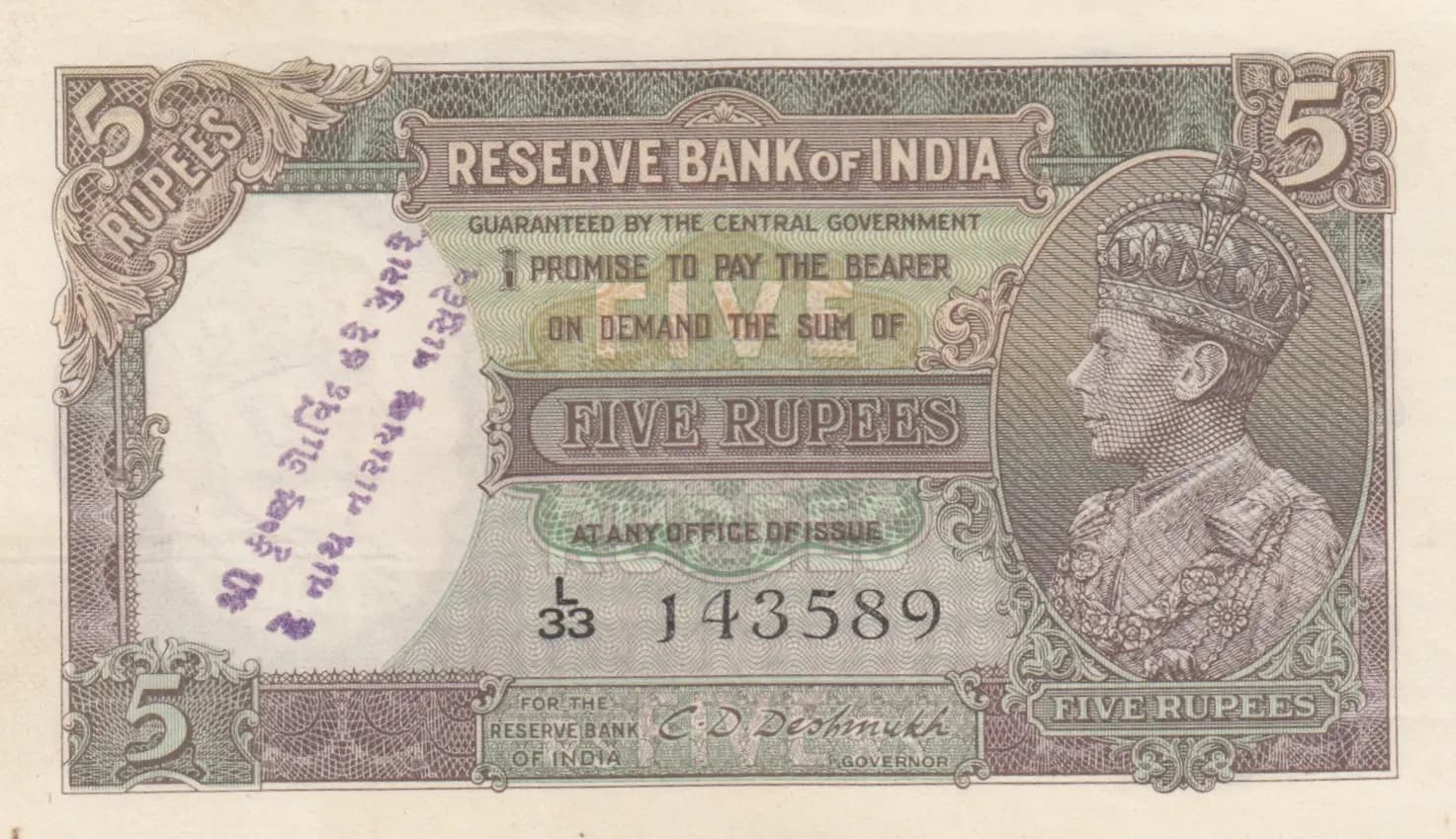
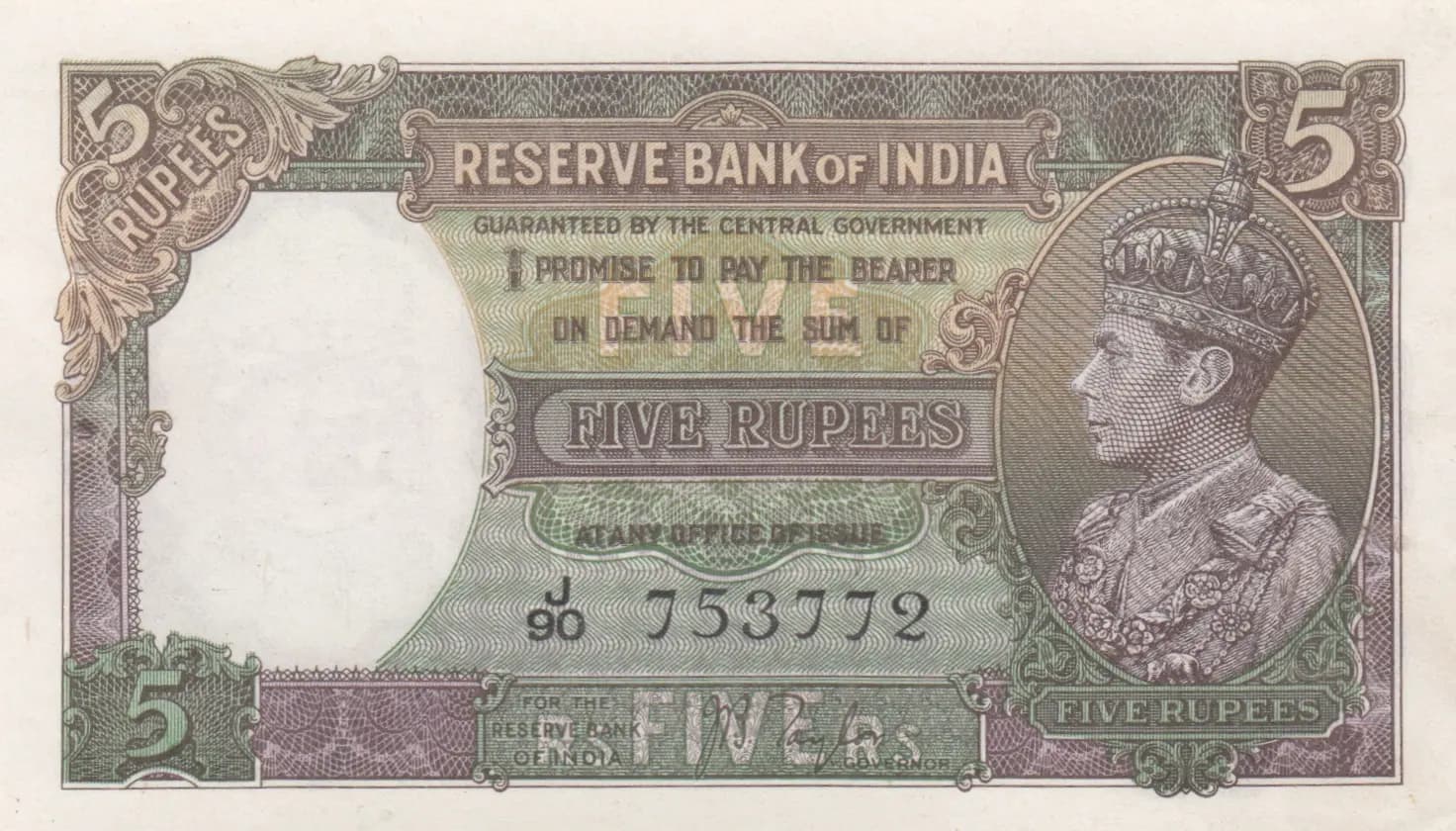
This is an exceptional example of India's first 5 Rupees banknote issued by the Reserve Bank of India in 1937, graded UNC (Uncirculated). The note features a striking portrait of King George VI in profile on the right side, rendered in fine engraved detail against ornate decorative borders with floral and scroll patterns in brown, green, purple, and cream tones. The sharp printing clarity, pristine paper condition, and complete absence of wear or damage make this an outstanding specimen of early Indian currency that would appeal to collectors of British Commonwealth issues and Reserve Bank of India notes.
Common. While this is a historically significant first-issue 5 Rupees note from 1937, eBay auction data shows consistent availability and relatively modest valuations even for graded specimens. Ungraded VF examples regularly sell for $30-60 USD, with PMG-graded UNC specimens (PMG 64-66) commanding $130-260 USD in recent sales. The 2016 catalogue value for UNC is $250, which aligns with observed market activity. The print run of early RBI 5 Rupees notes was substantial, and many examples survive in good condition. This note does not exhibit characteristics of a rare or short-lived issue—it was part of the RBI's standard currency circulation.
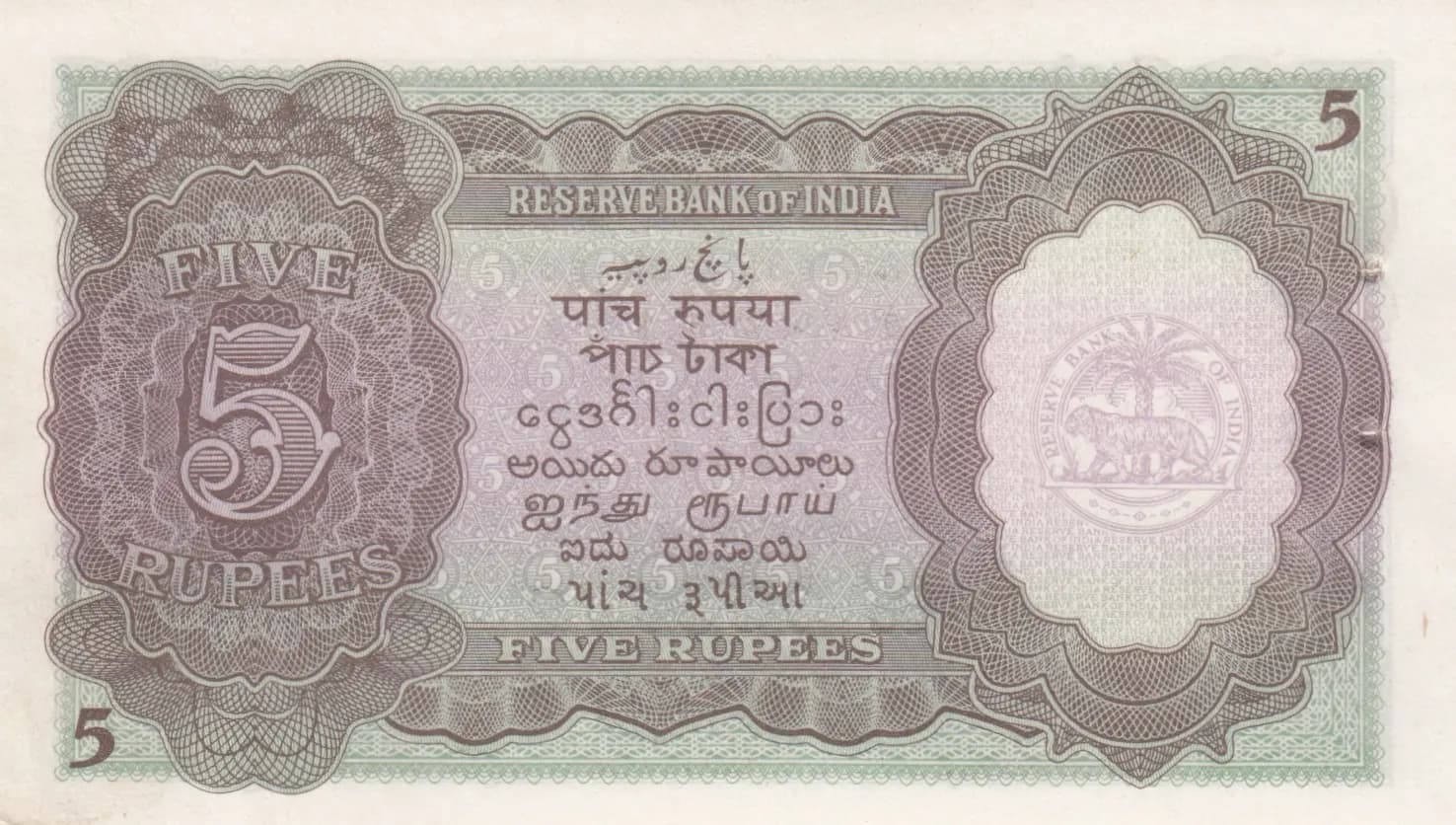
This note was issued during the final decade of British rule in India, when King George VI was the reigning British monarch whose portrait appeared on currency throughout the Commonwealth. The 1937 issue predates India's independence by a decade, representing a transitional period in Indian numismatic history when the Reserve Bank of India (established in 1935) was consolidating its authority over currency issuance. The multilingual inscriptions on the reverse—in Hindi, Telugu, Kannada, Tamil, and Marathi—reflect the RBI's recognition of India's linguistic diversity even during the colonial period.
The obverse prominently features a right-facing profile portrait of King George VI wearing formal regalia including a crown and decorated robes with ornamental patterns. The portrait is rendered in fine engraved line work with delicate crosshatching to create depth and shadow. The note is framed by elaborate decorative borders featuring floral and geometric scroll patterns characteristic of early 20th-century British currency design. The reverse contains a symmetrical layout with ornamental frames: on the left a large decorative square frame containing the denomination '5' and 'FIVE RUPEES', in the center multilingual text of the denomination in five Indian languages arranged vertically, and on the right an ornamental frame with a circular seal or emblem featuring a palm tree motif—likely representing India or the RBI's institutional symbol. The overall color scheme employs brown, green, and purple tones creating a dignified, formal appearance.
FRONT: 'RESERVE BANK OF INDIA' (English), 'RUPEES' (English), 'GUARANTEED BY THE CENTRAL GOVERNMENT' (English), 'I PROMISE TO PAY THE BEARER ON DEMAND THE SUM OF' (English), 'FIVE RUPEES' (English, appears twice), with serial number reference '90 B53392'. REVERSE: 'RESERVE BANK OF INDIA' (English), 'FIVE RUPEES' (English), 'पाँच रुपया' (Hindi: Five Rupees), 'पाँच टाका' (Hindi alternative), 'ఐదు రూపాయలు' (Telugu: Five Rupees), 'ಐದು ರೂಪಾಯಿ' (Kannada: Five Rupees), 'நெய் நூபாய' (Tamil: Five Rupees), 'पाच रुपयां' (Marathi: Five Rupees).
This note was produced using intaglio (engraved) printing, evident from the fine line work, detailed crosshatching in the portrait, and the dimensional quality of the engraved decorative borders. The security features include intricate engraving patterns throughout, multiple layers of detailed border work, and fine line engraving that would be difficult to counterfeit with period printing technology. The RBI's notes from this era were typically produced by the Security Printing Press in Nashik or by established British security printers such as Waterlow & Sons, who had produced many Commonwealth banknotes.
Pick catalog lists two variants: P-18a and P-18b for the 5 Rupees denomination. This specimen is identified as P-18a. Varieties in this series may relate to signature combinations, serial number prefixes, watermark variations, or subtle design changes between issues. The serial number visible on this note is '90 B53392'. Collectors should note that both 1937 and 1943 printings exist under the 1937-1943 ND (No Date) designation, with potential differences in printing characteristics or signatures that would distinguish these variants.