1 rupee 1935
Market Prices
23 salesAbout This Note
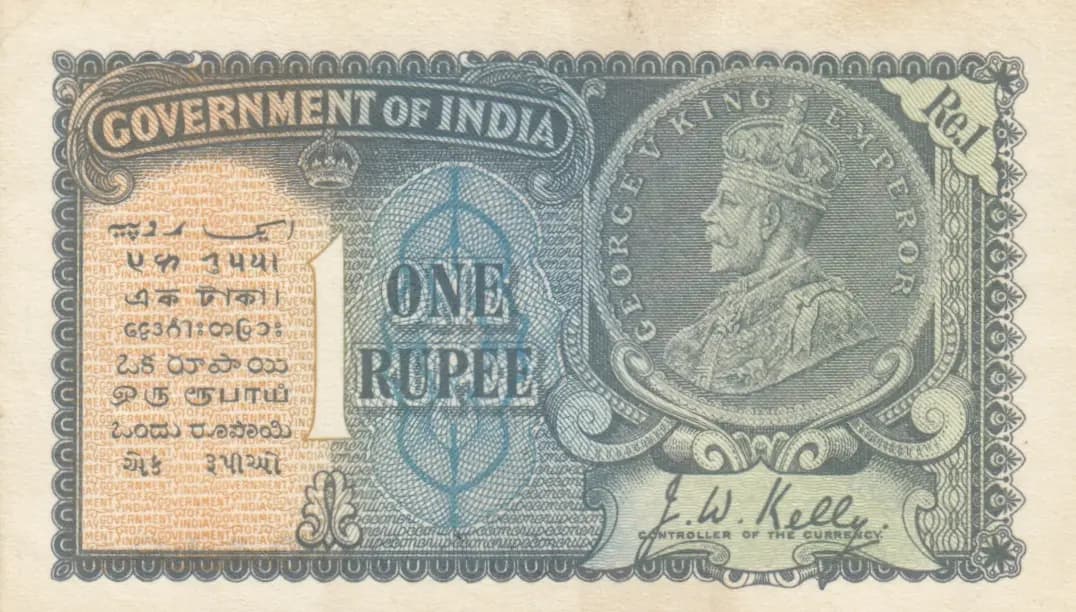
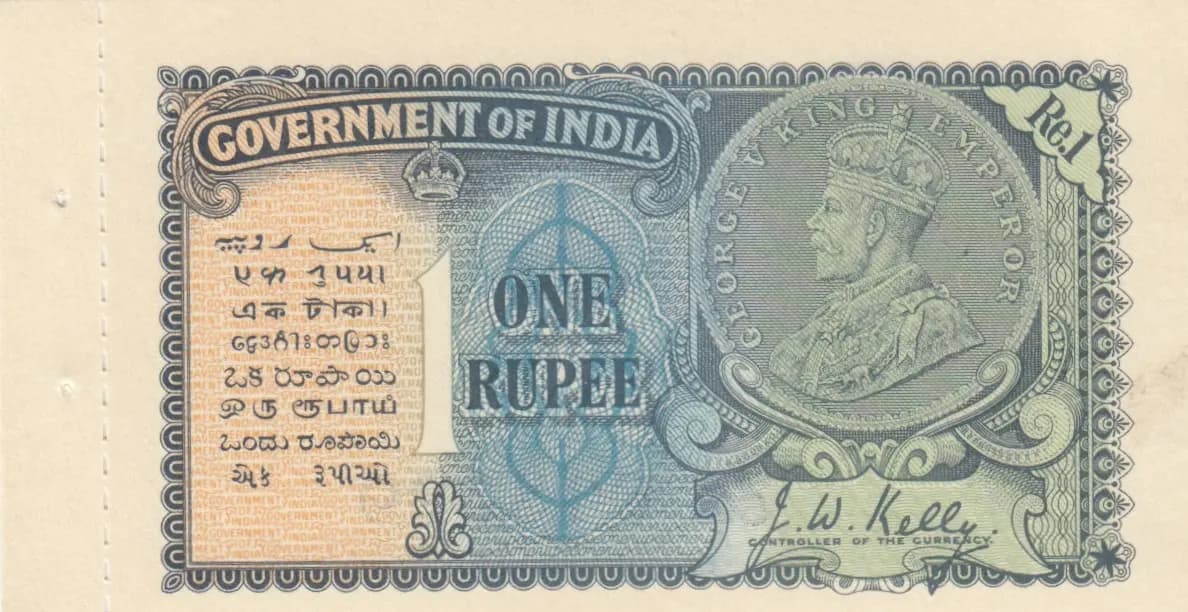
This is a Government of India 1 Rupee note from 1935 (Pick 14b), issued during the British Raj period and featuring a striking profile portrait of King George V in formal regalia with crown. The note displays the characteristic blue-green coloring and ornate decorative borders typical of this issue, with multilingual inscriptions reflecting India's linguistic diversity. Despite visible age-related wear including creases, foxing, and yellowing consistent with circulation, the note retains good definition in its design elements, making it an interesting historical artifact from the pre-Independence era of Indian currency.
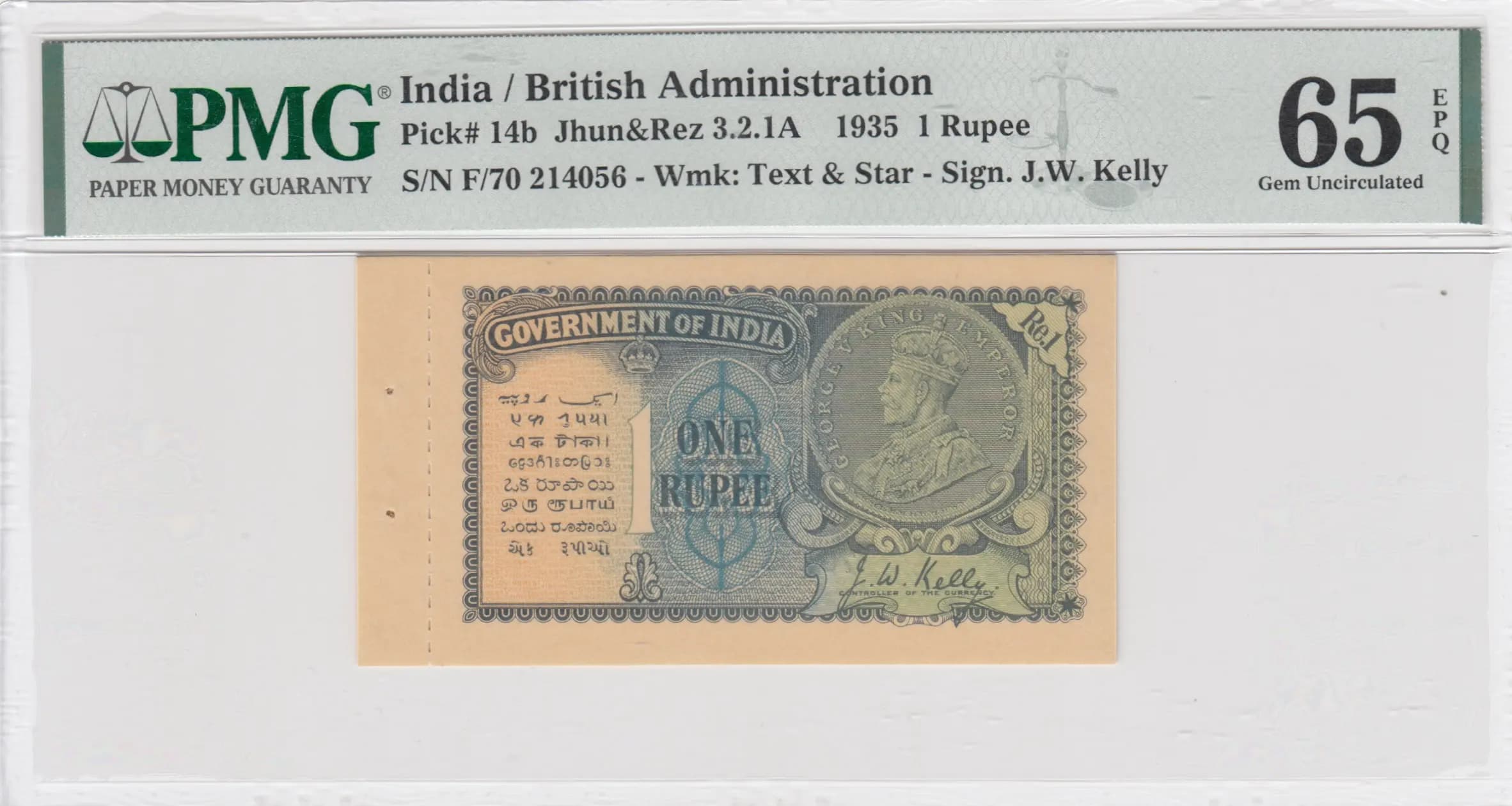
Common. The 1935 1 Rupee (Pick 14b) is a regular issue with substantial print runs typical of currency in circulation during the British Raj period. eBay market data strongly supports commonality: UNC examples regularly sell for $300-$480 range (2014-2016), with even premium PMG 66 grades reaching only $661 maximum. VF and lower grades sell for $50-$125. These moderate price levels and consistent auction activity indicate healthy supply in the market. No print run restrictions, recall history, or limited issuing period apply to this note.
This note was issued by the Government of India during the final years of British colonial rule, featuring King George V whose portrait appeared on Indian currency throughout his reign (1910-1936). The multilingual inscriptions in Devanagari, Bengali, Tamil, Kannada, and Telugu reflect the Indian administration's effort to create currency that spoke to the diverse populations across the subcontinent. This 1935 issue represents a transitional period in Indian monetary history, issued just 12 years before Independence and the establishment of the Reserve Bank of India as the primary currency authority.
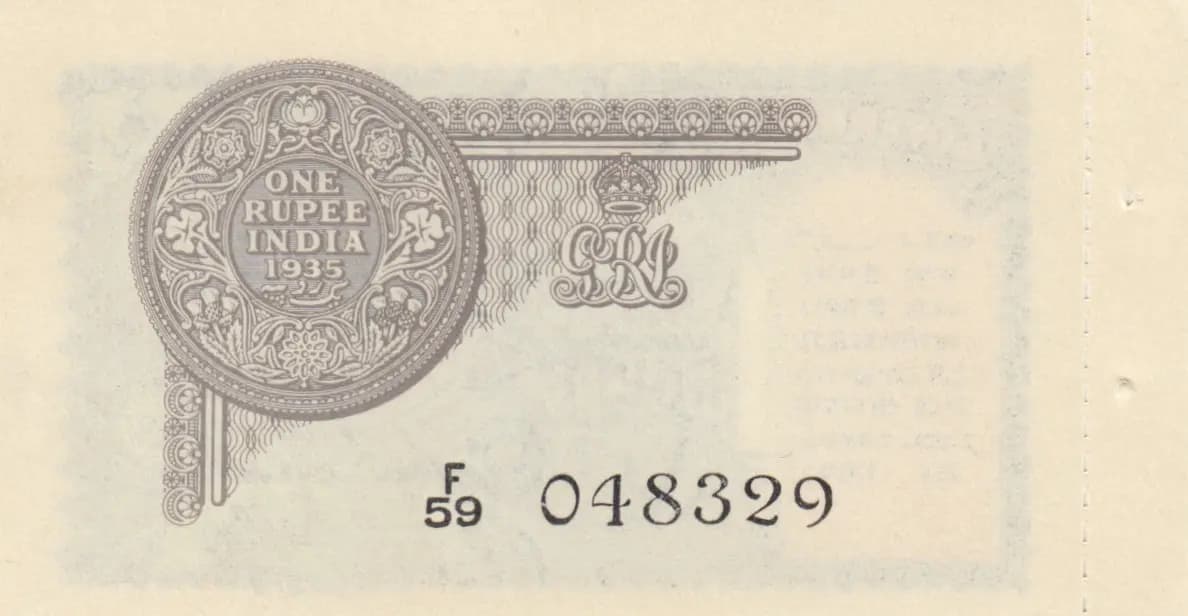
The obverse features a right-facing profile portrait of King George V in formal royal attire, identifiable by the crown and ceremonial dress typical of British imperial coinage and currency of the period. The portrait is positioned in the right-center area and serves as the primary design focus. A crown symbol appears at the top center of the note. An ornate rectangular panel on the left contains multilingual text in various Indian scripts. The reverse displays a large decorative circular medallion or seal containing the denomination and date, with elaborate floral and geometric guilloche patterns forming the border and security design elements throughout. The note is dominantly colored in blue-green with tan/beige, black, and gray accent tones.
FRONT SIDE: 'GOVERNMENT OF INDIA' (English); 'ONE RUPEE' (English, denomination); 'CONTROLLER OF THE CURRENCY' (English); 'L.W. Kelle' (signature of Controller); 'एक रुपया' (Devanagari/Hindi: One Rupee); '१ टाका' (Bengali: One Rupee); '௧ ரூபாய' (Tamil: One Rupee); '೧ ರೂಪಾಯ' (Kannada: One Rupee); 'एक रुपैया' (Devanagari variant: One Rupee); 'ఒక రూపాయ' (Telugu: One Rupee). BACK SIDE: 'ONE RUPEE INDIA 1935' (English, within decorative medallion); 'F 59 048329' (Serial Number).
Intaglio printing (recess printing), evidenced by the precise line work visible in the guilloche patterns, decorative borders, and fine detail definition in the portrait and ornamental elements. The ornate security features including the elaborate border patterns and medallion design are characteristic of high-security currency printing of the 1930s era. This note was likely produced by a British security printer, consistent with Government of India currency practices of the period, though the specific printer is not identified on the note itself.
This specific example carries serial number F 59 048329 with the 'F' prefix, indicating the letter-prefixed serial numbering system used on this issue. The note is signed by L.W. Kelle as Controller of the Currency. The visual analysis does not indicate perforation on the left edge in this example, though catalog references note that some notes from this series were issued in booklets of 25 with left-edge perforation—those perforated varieties may represent a minor sub-variety. No other significant varieties (such as overprints or signature variations beyond different Controllers) are evident from the observed image.