20 rupees 1970
Market Prices
7 salesAbout This Note
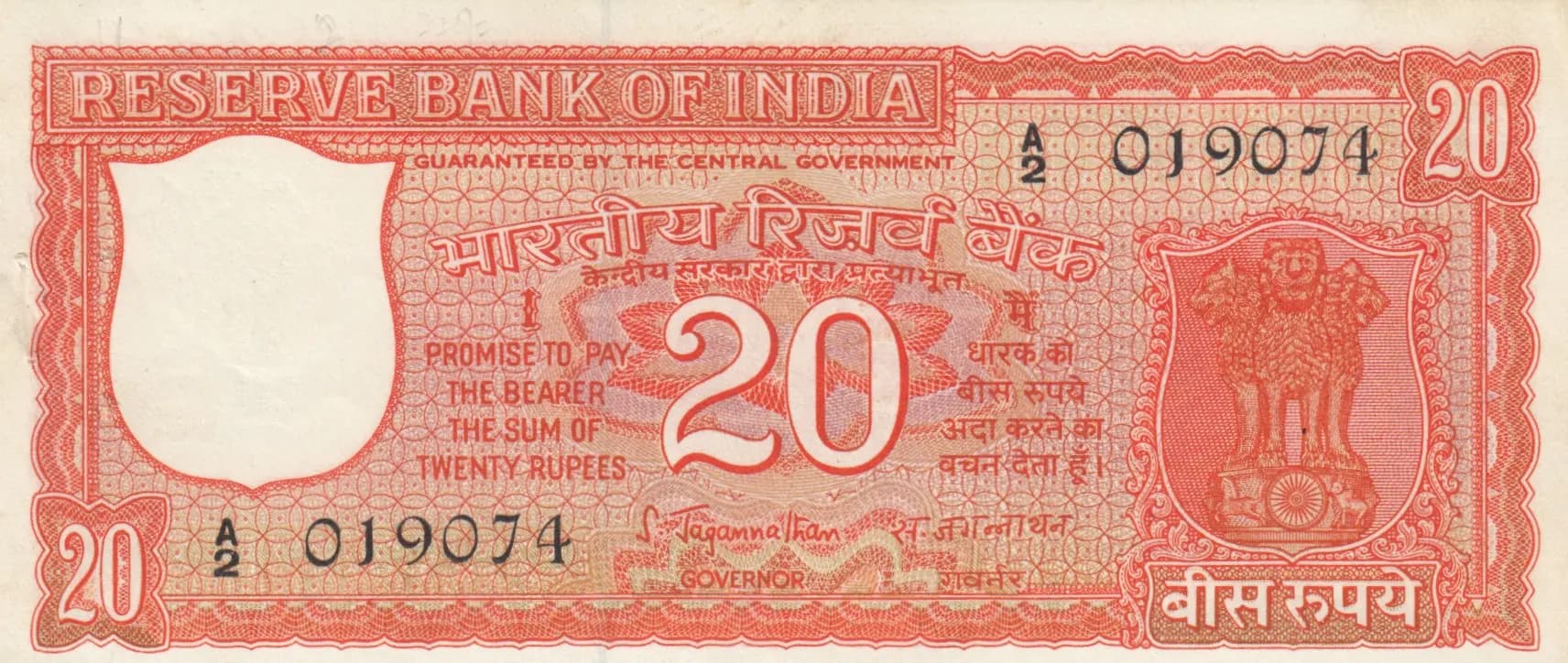
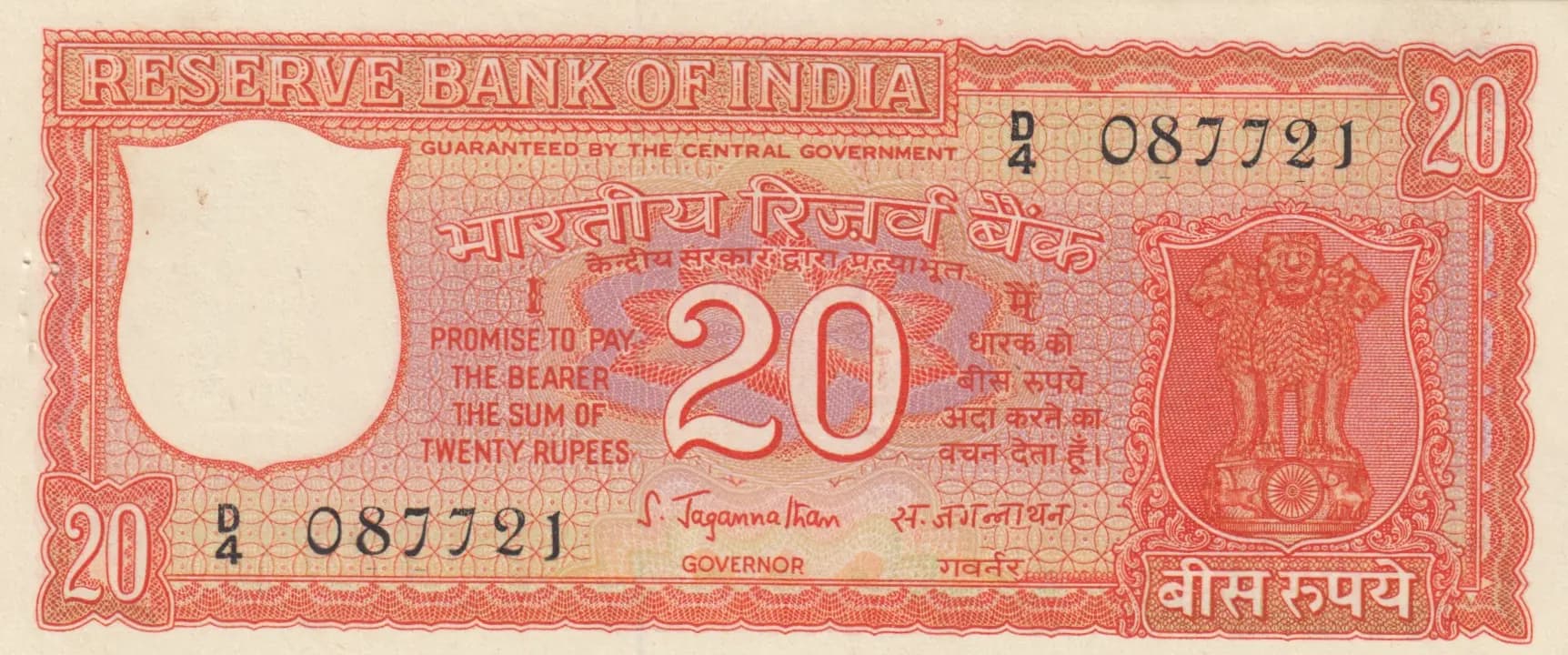
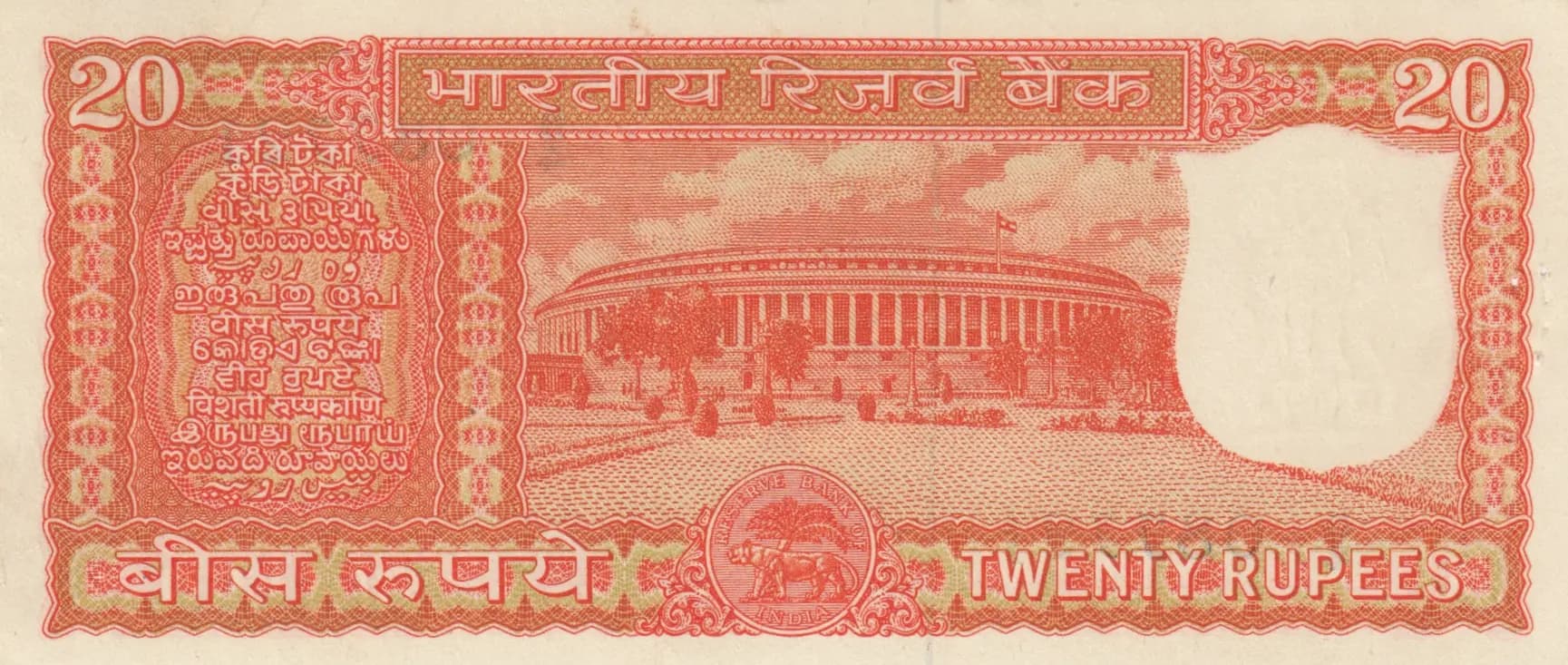
A well-preserved example of India's 20 rupee note from the 1965-1970 period, featuring the iconic Lion Capital of Ashoka on the obverse and Parliament House on the reverse. The note displays the characteristic red/coral and cream coloring of this series with fine engraving throughout. Despite some aging and light foxing consistent with vintage currency, this UNC-graded specimen retains excellent clarity and detail, making it a solid collector's piece from India's early post-independence currency era.
Common. The eBay price tracking data shows consistent sales in the $15-57 range for various grades (2013-2021), with 2019 catalog value of $14 for UNC specimens. The volume of sales across multiple grades and years, combined with modest price levels, indicates this is a readily available note in the collector market. Print runs for Indian 20 rupee notes during the 1965-1970 period were substantial, and this Pick-61b variety (with the Kashmiri error on the reverse) remains commonly encountered.
Issued during India's formative decades following independence, this banknote celebrates two cornerstone symbols of the Indian state: the Lion Capital of Ashoka from the ancient Mauryan Empire, representing India's Buddhist heritage and democratic ideals (adopted as the national emblem in 1950), and Parliament House in New Delhi, the seat of India's democratic government completed in 1927. The 'Promise to Pay' format and Governor's signature reflect the Reserve Bank of India's role as the constitutional issuing authority established in 1935, continued under independent India.
The obverse features the Lion Capital of Ashoka—India's national emblem consisting of four lions standing back-to-back on an abacus bearing the Chakra (wheel of law), visible on the right side of the note with accompanying dharma chakra symbol below. The reverse depicts Parliament House, New Delhi, the modernist circular building designed by Edwin Lutyens and Herbert Baker, rendered with characteristic curved/arched architecture and central flag, positioned centrally under a clouded sky. Both sides feature ornate decorative borders with floral and geometric patterns typical of Indian currency design. A circular Reserve Bank of India seal with Chakra motif appears at the bottom center of the reverse. The note incorporates bilingual text in English and Hindi (Devanagari script), reflecting India's multilingual character.
FRONT SIDE: 'Reserve Bank of India' (English and Hindi/Devanagari: भारतीय रिजर्व बैंक); 'Guaranteed by the Central Government' (English and Hindi: केन्द्रीय सरकार द्वारा गारंटीकृत); 'Promise to Pay the Bearer the Sum of Twenty Rupees' (English); 'Twenty Rupees' (Hindi: बीस रुपये); Denomination: '20' (English numerals); Serial number: 'D/4 087721'; Governor's signature: 'Jagannathan' with title 'GOVERNOR'. BACK SIDE: 'Reserve Bank of India' (Hindi: भारतीय रिजर्व बैंक); 'Twenty Rupees' (English and Hindi: बीस रुपये); Denomination: '20' (English numerals in top corners); Multiple lines of text in Devanagari script along margins (specific content partially unclear in image but consistent with security/issue information).
Intaglio (engraved) printing with fine line engraving throughout, evident from the detailed rendering of the Lion Capital emblem, architectural elements of Parliament House, and intricate border patterns. The sharp detail and depth visible in the images are characteristic of high-quality intaglio work. This note was printed by the Reserve Bank of India's printing facilities (likely the BRBNMPL—Bank Note Press, Nashik, and/or Security Printing Press, Hyderabad, which handled Indian currency production during this period).
This specimen is Pick-61b, specifically identified by the known error in the fifth line of Kashmiri text on the reverse. The corrected version without this Kashmiri error is cataloged as Pick-61a. The visual analysis confirms the note exhibits 'light colors under signature' on the reverse, another distinguishing characteristic of the P-61b variety. The serial number D/4 087721 with Jagannathan's signature (RBI Governor 1968-1970) confirms attribution to the latter part of this series' circulation period.