20 rupees 1970
Market Prices
9 salesAbout This Note
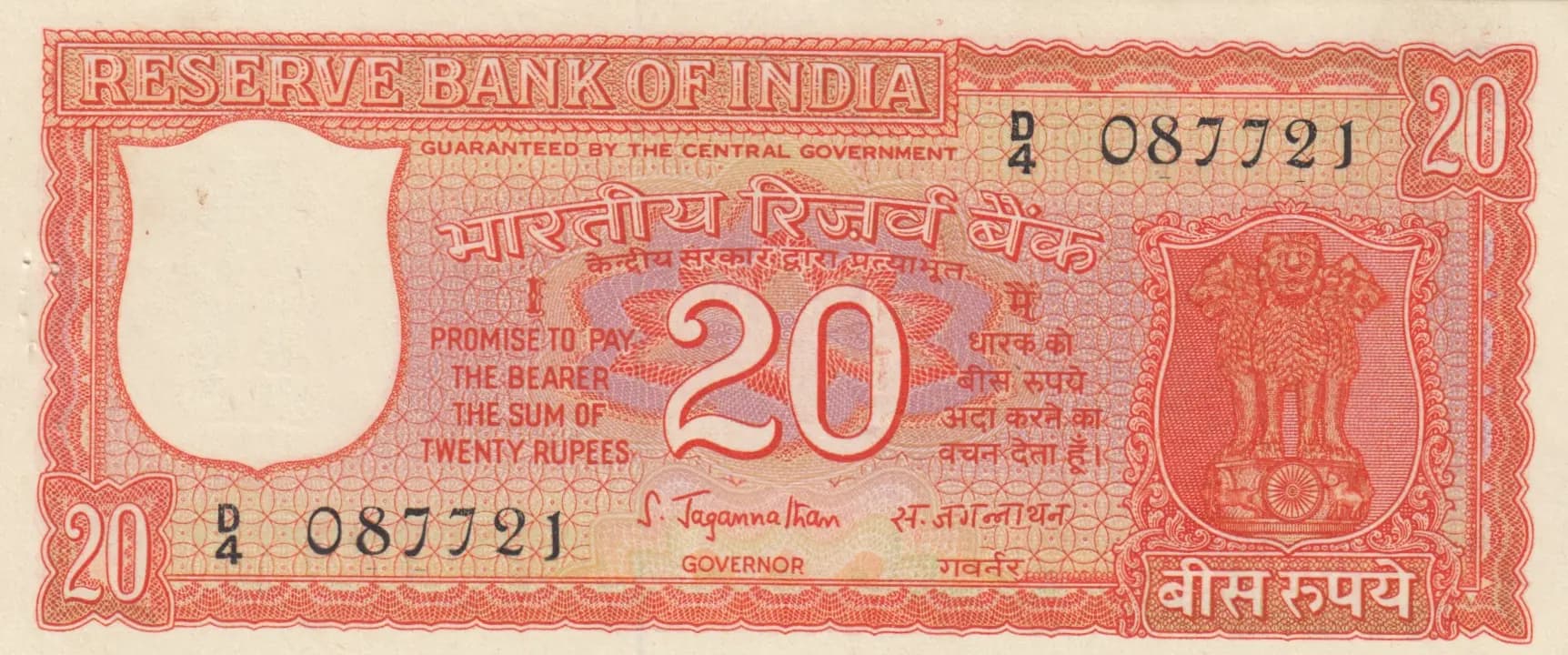
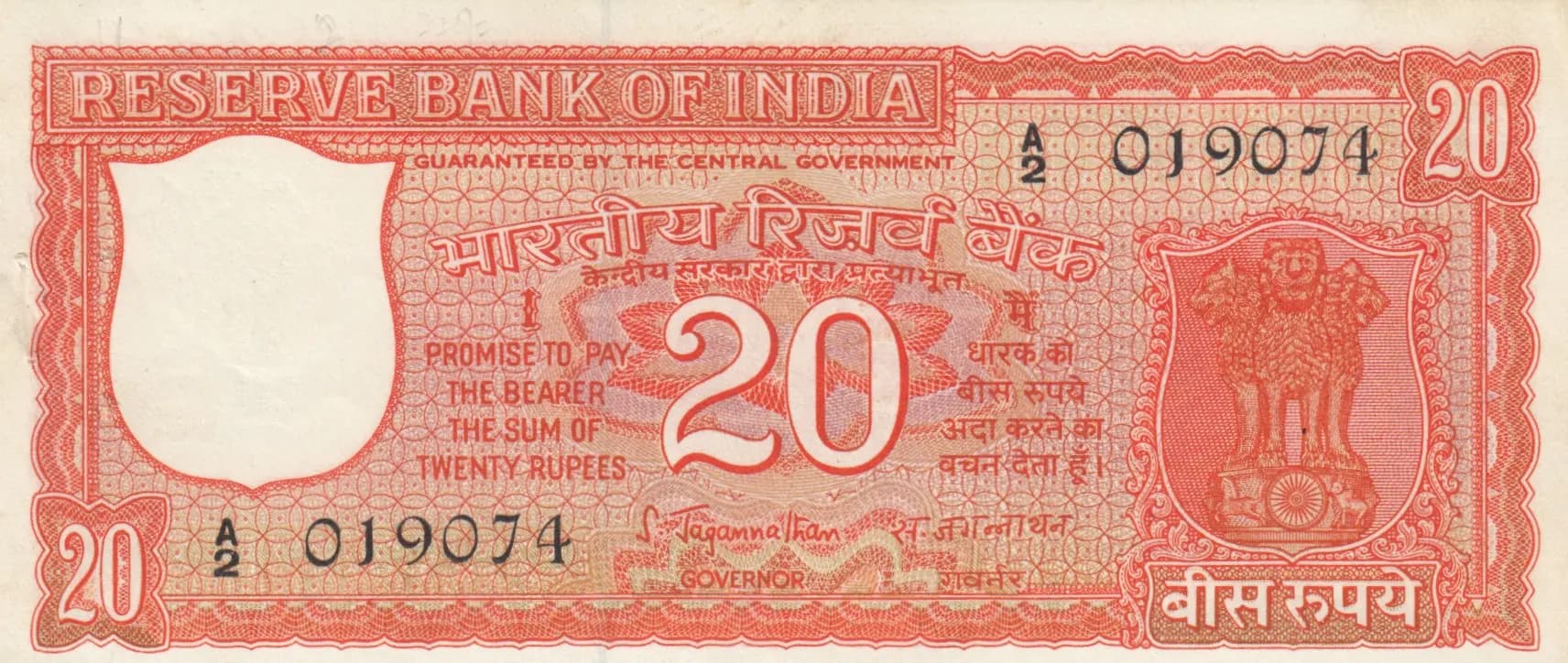
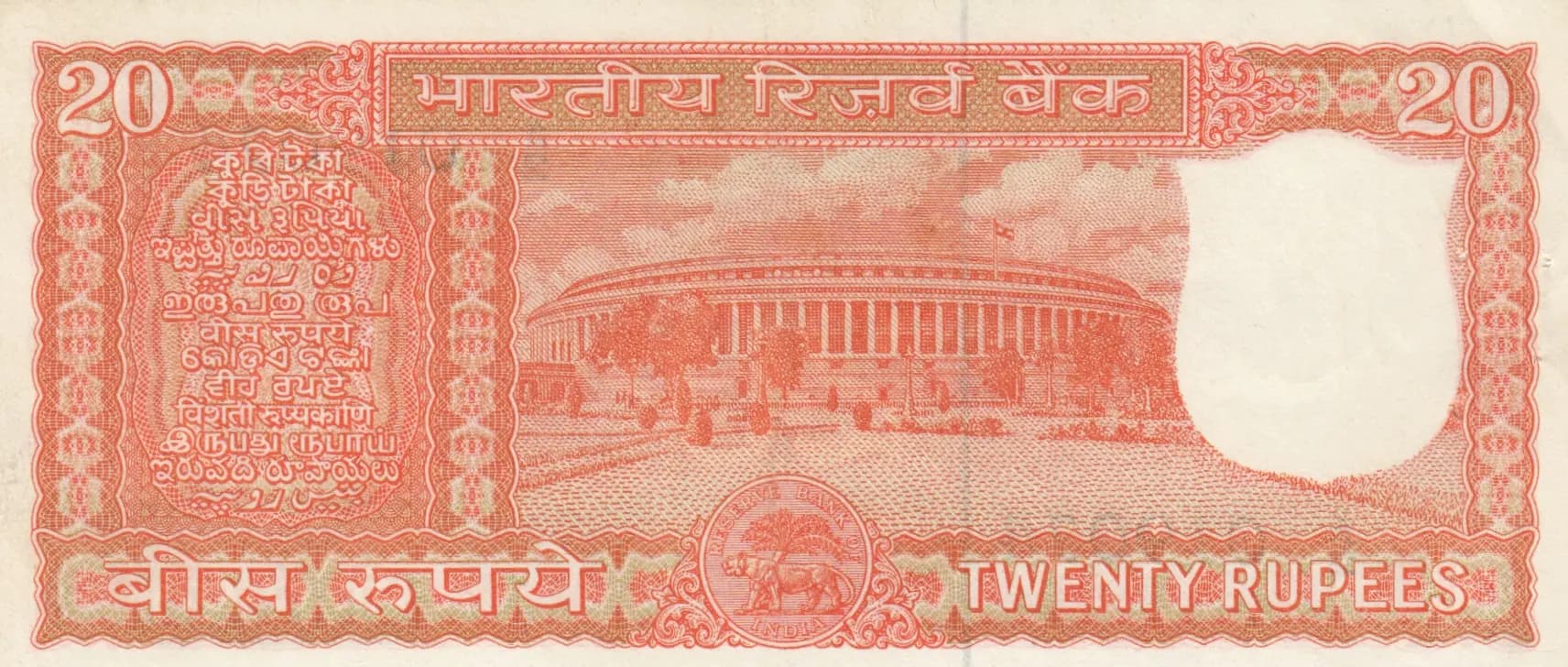
An exceptional AU-grade Reserve Bank of India 20 Rupees note from 1970 (Pick P-61a) featuring the iconic Lion Capital of Ashoka on the obverse and Parliament House, New Delhi on the reverse. The note displays sharp, clear printing throughout with no visible wear, creases, or stains, and is notable for bearing the documented Kashmiri error on the fifth line of the back—a characteristic feature of the P-61a variety that distinguishes it from the corrected P-61 issue.
Common. This note routinely appears on the secondary market at low valuations. eBay transaction data provided shows consistent sales in the $28–$51 range for PMG grades 64–66 (comparable to AU condition), indicating robust circulation and availability. The catalog value for 2019 lists UNC specimens at only $25. Print runs for Indian 20 Rupees notes of the 1965–1970 period were substantial, and this denomination remains readily obtainable in collector markets.
Issued during the post-independence consolidation period of India's monetary system, this note reflects the newly independent nation's pride in its cultural heritage through the prominent display of the Lion Capital of Ashoka, the national emblem sourced from the Sarnath Museum. The reverse depicts Parliament House in New Delhi, symbolizing India's democratic governance and architectural modernization in the 1960s-70s. The dual-language inscriptions in English and Devanagari represent the linguistic unification efforts of post-colonial India.
The obverse features a red/coral and cream color scheme with ornate geometric borders. The left side displays a blank oval watermark area, while the center prominently displays the denomination '20' in large numerals. The right side showcases the Lion Capital of Ashoka—India's national emblem depicting four lions standing back-to-back atop an abacus with a dharma wheel, sourced from the Sarnath Museum in Uttar Pradesh. The reverse maintains the same color scheme and features a large institutional building with columned architecture and a distinctive roof line identified as Parliament House, New Delhi, centrally positioned. Both sides include a circular emblem or seal at the bottom center. Fine decorative line patterns and ornamental borders frame all design elements, with bilingual inscriptions in English and Devanagari script throughout.
FRONT: 'RESERVE BANK OF INDIA' (English) / 'भारतीय रिज़र्व बैंक' (Devanagari: Reserve Bank of India); 'GUARANTEED BY THE CENTRAL GOVERNMENT' (English); 'PROMISE TO PAY THE BEARER THE SUM OF TWENTY RUPEES' (English); 'वीस रुपये' (Devanagari: Twenty rupees); 'GOVERNOR' (English); Serial number 'A2 019974'. BACK: '20' (numerals, top corners); 'TWENTY RUPEES' (English); 'बीस रुपये' (Devanagari: Twenty rupees); 'भारतीय रिज़र्व बैंक' (Devanagari: Reserve Bank of India); ornamental Devanagari text in decorative box on left side containing descriptive/regulatory text (specific content not fully legible from image analysis).
Intaglio (recess) printing, characteristic of high-security banknote production by the Reserve Bank of India's security printers. The sharp print definition visible in the fine decorative patterns, clear inscription lines, and precise architectural details of Parliament House indicate professional intaglio engraving. The security printer for Indian notes of this era was typically the India Security Press (ISP), Nashik, though some notes were also printed by the Government of India Press, Nasik, and British-contracted security printers. The ornate borders and fine line work are hallmarks of intaglio security printing.
This is the P-61a variety, definitively identified by the documented error in Kashmiri text on the fifth line of the reverse. This error distinguishes P-61a from the corrected P-61 variety. The serial number prefix 'A2' is consistent with 1960s-1970s Reserve Bank of India numbering schemes. No other significant varieties (such as signature changes, overprints, or security features) are evident from the visual analysis, though comprehensive variety identification would require examination of signature blocks and watermark details not fully visible in the provided images.