10 rupees 1969
Market Prices
13 salesAbout This Note
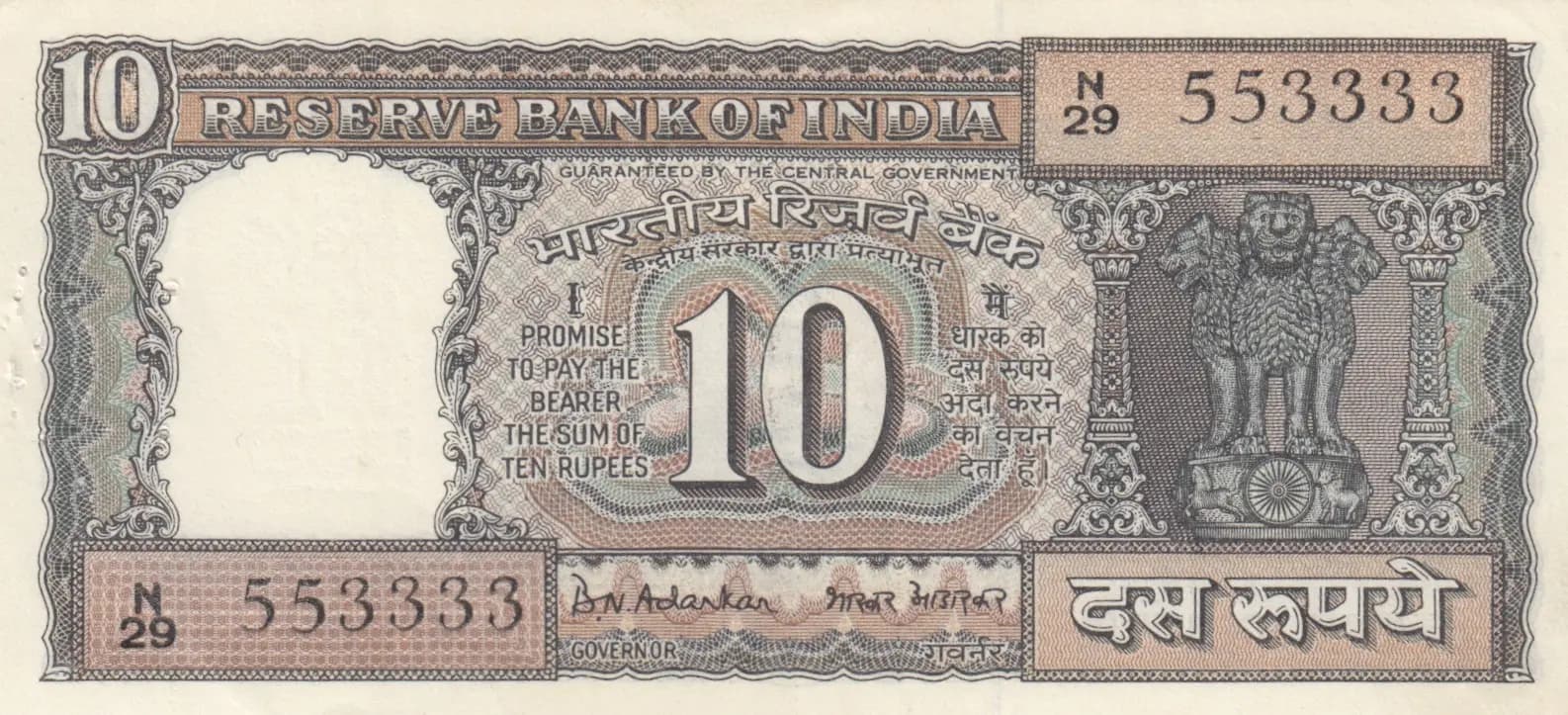
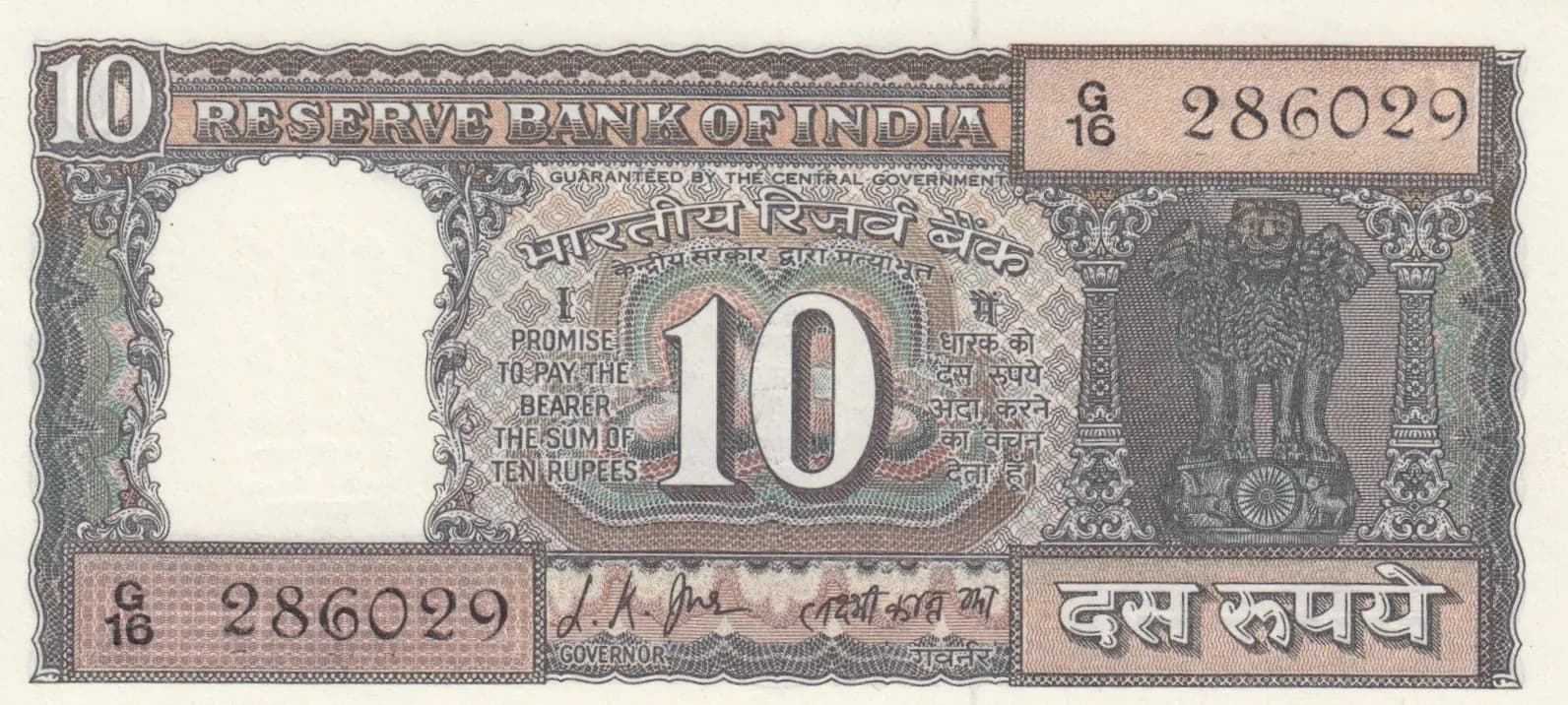
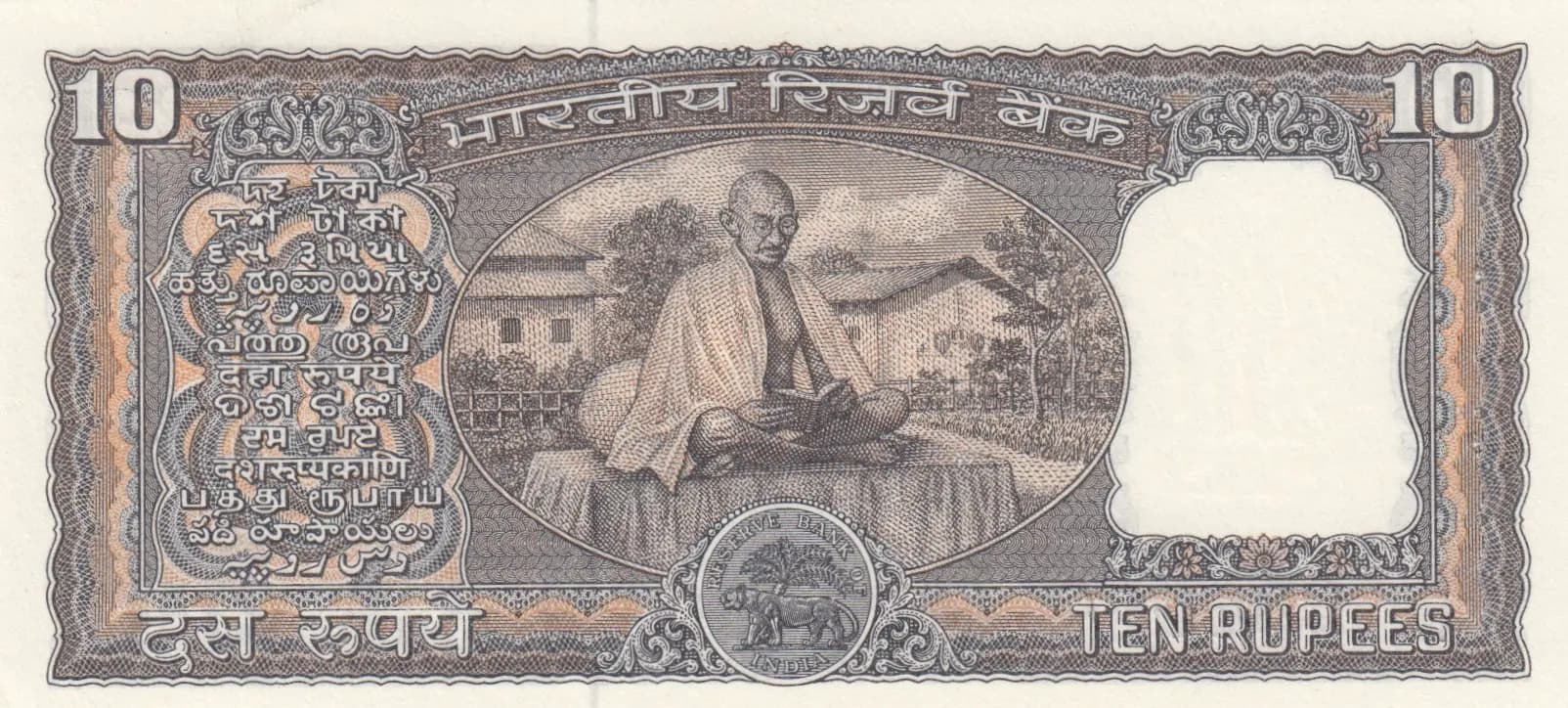
This is an uncirculated 1969 Reserve Bank of India 10 rupee commemorative note honoring the centennial of Mahatma Gandhi's birth. The note features the Lion Capital of Asoka on the obverse and Gandhi at his spinning wheel on the reverse, rendered in brown, tan, and cream tones with intricate engraved detail work. Despite the UNC grade assignment, the visual inspection reveals evidence of age-related yellowing and what appears to be a handwritten mark on the obverse, suggesting this may be a lightly circulated or previously handled specimen rather than pristine.
Common. This commemorative 10 rupee note from 1969 was issued in substantial quantities for circulation during the Gandhi centennial year. Market data from eBay sales shows consistent pricing in the $4-$22 range for this note across various condition grades from 2013-2026, with UNC examples selling for approximately $5-$22. These prices are typical for common, widely-circulated commemorative notes. The note's availability in the secondary market and the frequency of sales indicate a healthy supply, confirming common status.
Issued in 1969 to commemorate the centennial of Mahatma Gandhi's birth (1869-1969), this note represents a significant moment in Indian numismatic history as a commemorative issue from the Reserve Bank of India. The obverse features the Lion Capital of Asoka column—a symbol of Indian sovereignty and the rule of law—while the reverse depicts Gandhi engaged in his iconic spinning wheel (charkha) work, which became a powerful symbol of Indian independence and self-reliance during the nationalist movement. This dual imagery connects India's ancient Buddhist heritage with its modern struggle for independence under Gandhi's leadership.
The obverse features a classical layout with ornate decorative borders incorporating floral and geometric patterns in brown and cream. The denomination '10' is prominently displayed centrally with bilingual text (English and Hindi Devanagari script). The right side displays the Lion Capital of Asoka—the three-lion emblem that serves as India's national emblem, derived from the ancient Mauryan column at Sarnath. The obverse includes the standard promise-to-pay clause and government guarantee text. The reverse presents a detailed oval vignette in the center depicting Mahatma Gandhi seated at a traditional spinning wheel (charkha) in his characteristic dhoti, with a building structure and foliage visible in the background. This vignette is framed by ornate decorative elements and a shield-shaped text panel on the left containing Hindi inscriptions. The bottom features a circular seal of the Reserve Bank of India. The overall design employs fine line engraving with intricate cross-hatching and background patterns characteristic of high-security banknote production.
OBVERSE: 'RESERVE BANK OF INDIA' (English) / 'भारतीय रिज़र्व बैंक' (Hindi: Reserve Bank of India) / 'I PROMISE TO PAY THE BEARER THE SUM OF TEN RUPEES' (English) / 'दस रुपये' (Hindi: Ten Rupees) / 'GUARANTEED BY THE CENTRAL GOVERNMENT' (English) / 'GOVERNOR' (English, for signature line) / Serial number: G 18 286029. REVERSE: 'RESERVE BANK OF INDIA' (English) / 'भारतीय रिज़र्व बैंक' (Hindi: Reserve Bank of India) / 'TEN RUPEES' (English) / 'दस रुपये' (Hindi: Ten Rupees) / Circular seal containing 'RESERVE BANK OF INDIA' and Indian insignia.
This note was produced using intaglio (recess) printing, evident from the deep, fine line work visible in the ornate borders, the detailed vignette of Gandhi at the spinning wheel, and the precise rendering of the Lion Capital. The fine engraved lines, cross-hatching patterns, and the tactile quality suggested by the sharp detail reproduction are all hallmarks of intaglio printing, which was the standard security printing technique for Reserve Bank of India banknotes of this era. The note was likely produced by the Security Printing Press, India (SPPI) or De La Rue, both of which printed Indian banknotes during this period.
The observed serial number G 18 286029 indicates this is from a standard printing series. The note appears to be the standard Pick 69a variety (1969-1970 issue). The handwritten mark visible on the obverse may indicate post-issue handling or marking by a previous owner, but does not constitute an official variety. No significant varieties (different signatures, major overprints, or printing errors) are evident from the visual analysis. The note would be classified within the standard commemorative issue of 1969-1970.