10 rupees 1970
Market Prices
3 salesAbout This Note
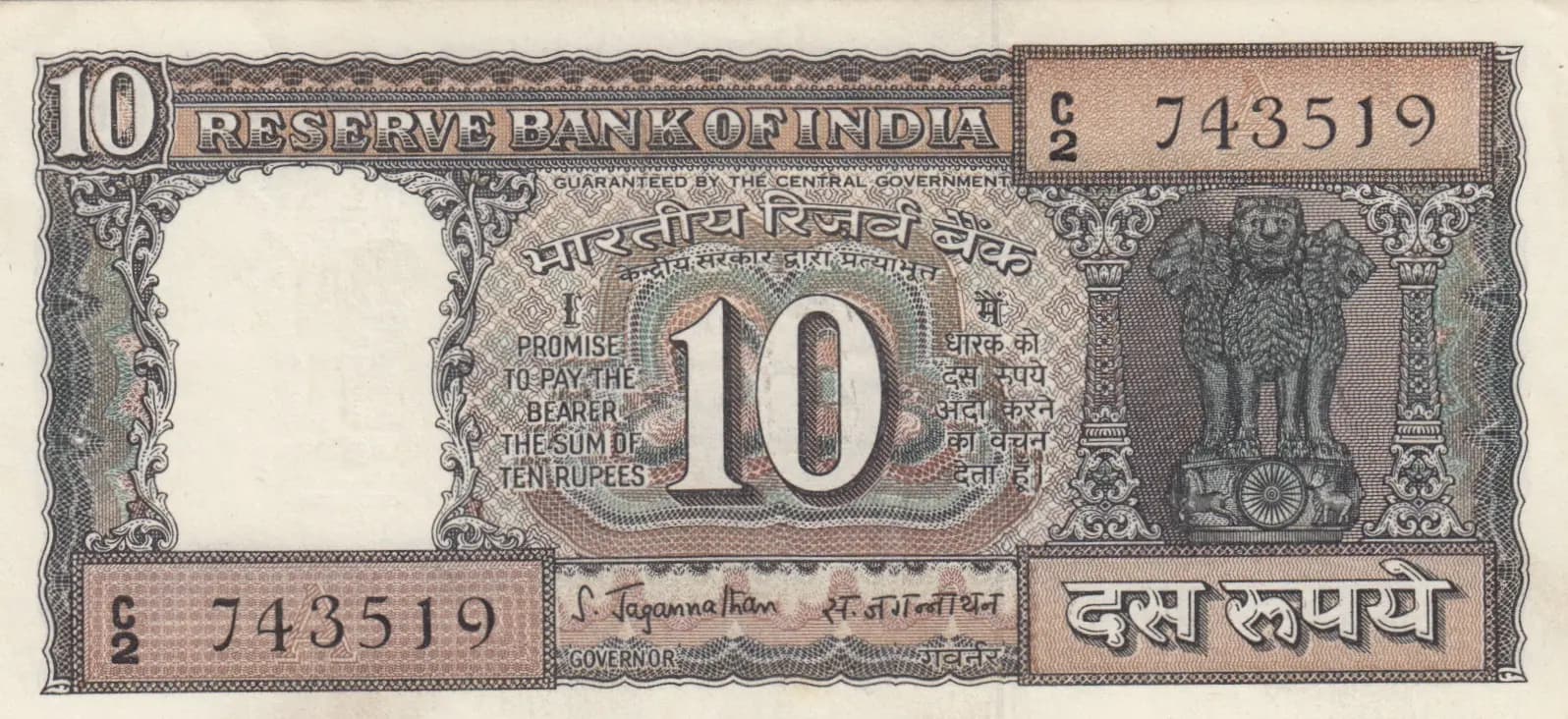
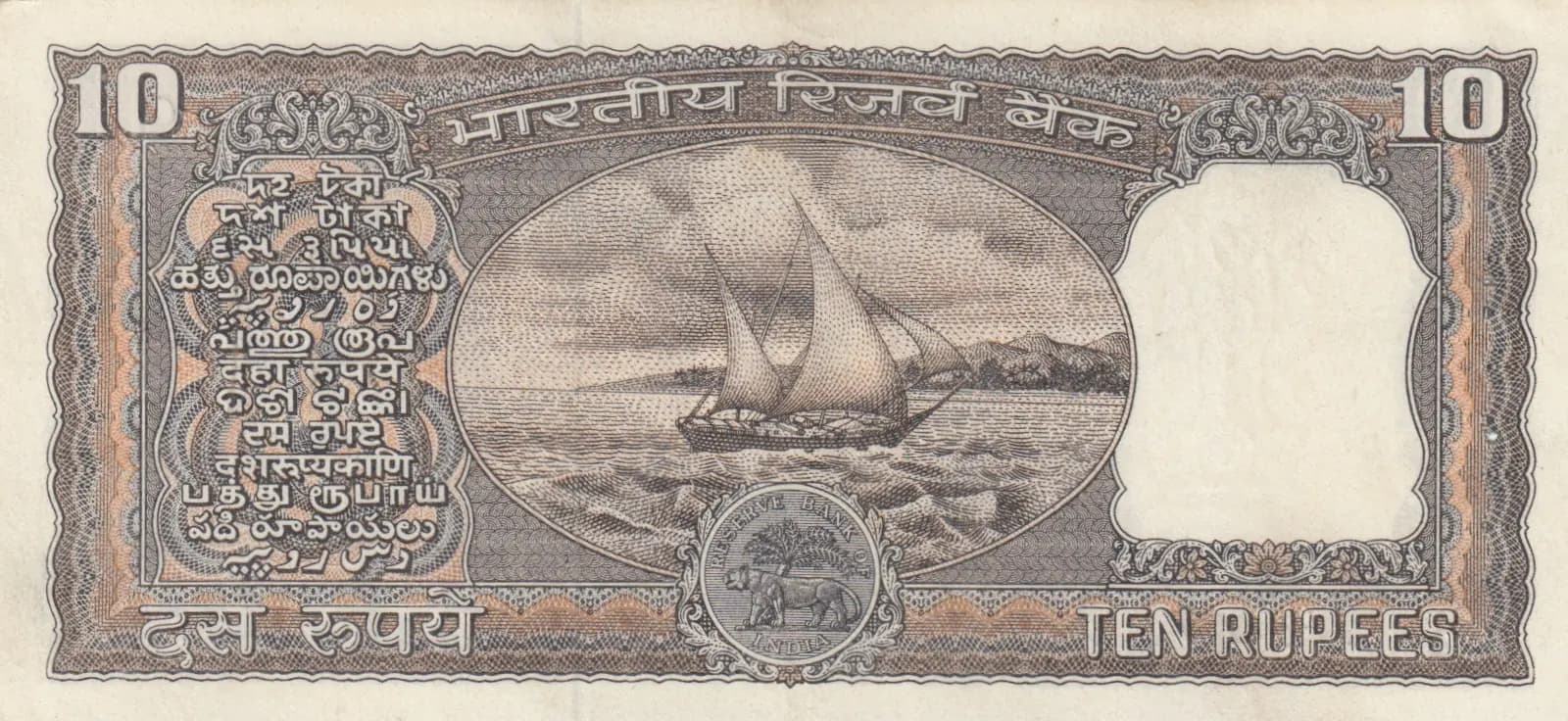
This is a VF-grade 10 Rupee banknote from India, issued in 1970 by the Reserve Bank of India (Pick P-59b). The note features the iconic four-lion Ashoka capital on the obverse and a traditional sailing dhow on the reverse, both rendered in brown and black on a cream background. This specific variety is notable for bearing an incorrect Urdu spelling of 'Rupee' at the lower left of the back, making it a documented printing variant that collectors actively distinguish from the corrected versions (P-60 and P-60A).
Common. Based on eBay market data provided, VF-condition examples of this note consistently sell in the $3-5 range with modest bidding activity, indicating steady collector availability and demand. The catalog value for VF is listed at $3, and multiple examples have circulated through online auctions over the past decade. While the incorrect Urdu spelling makes this a documented variety of numismatic interest, it was a known production variant of this series and does not command premium pricing relative to other notes from the same issue.
Issued during the early post-independence period of India's currency development, this note reflects the nation's cultural identity through its central imagery. The Ashoka capital (Lion Capital of Sarnath), depicted on the obverse, is derived from the historic Mauryan Empire emblem and serves as India's national symbol, appearing on the state seal. The dhow on the reverse represents India's maritime heritage and trade history, connecting to the broader theme of India's cultural and economic significance during this era of currency standardization.
The obverse features a large central denomination '10' flanked by the Four-Lion Ashoka Capital (Lion Capital of Asoka, now housed in the Sarnath Museum) positioned on the right side, which is India's national emblem symbolizing Buddhist heritage and sovereignty. The design incorporates both English and Hindi/Devanagari script throughout, reflecting India's commitment to linguistic inclusivity in currency. The reverse displays a classical sailing vessel (dhow) centered within an ornate oval frame, depicting traditional maritime commerce with detailed engraving showing the vessel under sail on water. Ornate decorative borders and corner flourishes frame both sides, with watermark areas visible on the left (obverse) and right (reverse) margins. The note bears the signature of the Governor and a serial number format indicating the print and plate sequence.
FRONT: 'RESERVE BANK OF INDIA' (English) / 'भारतीय रिजर्व बैंक' (Hindi: Reserve Bank of India) / 'PROMISE TO PAY THE BEARER THE SUM OF TEN RUPEES' (English) / 'दस रुपये' and 'दस रुपया' (Hindi: Ten rupees) / 'GUARANTEED BY THE CENTRAL GOVERNMENT' (English) / 'GOVERNOR' (English) / Serial number 'C/2 743519' / Signature of 'Jaganna Khan' (Governor). BACK: 'भारतीय रिजर्व बैंक' (Hindi: Reserve Bank of India) / 'दस रुपया' (Hindi: Ten rupees) / 'TEN RUPEES' (English) / Multiple instances of numeral '10'.
This note was produced using intaglio engraving and letterpress printing techniques, characteristic of Indian currency production of this era. The fine, detailed engraving visible in the dhow vignette and the Ashoka capital, combined with the sharp, crisp printing observed across both sides, indicates production by the Reserve Bank of India's authorized security printer. The color palette of brown and black on cream paper is consistent with the standard currency production methods of the 1960s-1970s period.
This is Pick P-59b, identified by the incorrect Urdu spelling of 'Rupee' at the lower left on the back, distinguishing it from later corrected versions. Related varieties include P-59a (earlier variant) and the subsequent corrections in P-60 and P-60A, which feature corrected Urdu script and plate modifications. The serial number format 'C/2 743519' with the 'A' letter designation and signature of Jaganna Khan (Governor from 1968-1970) further specify this note's print sequence and issue period within the 1970 production run.