10 rupees 1937
Market Prices
34 salesAbout This Note
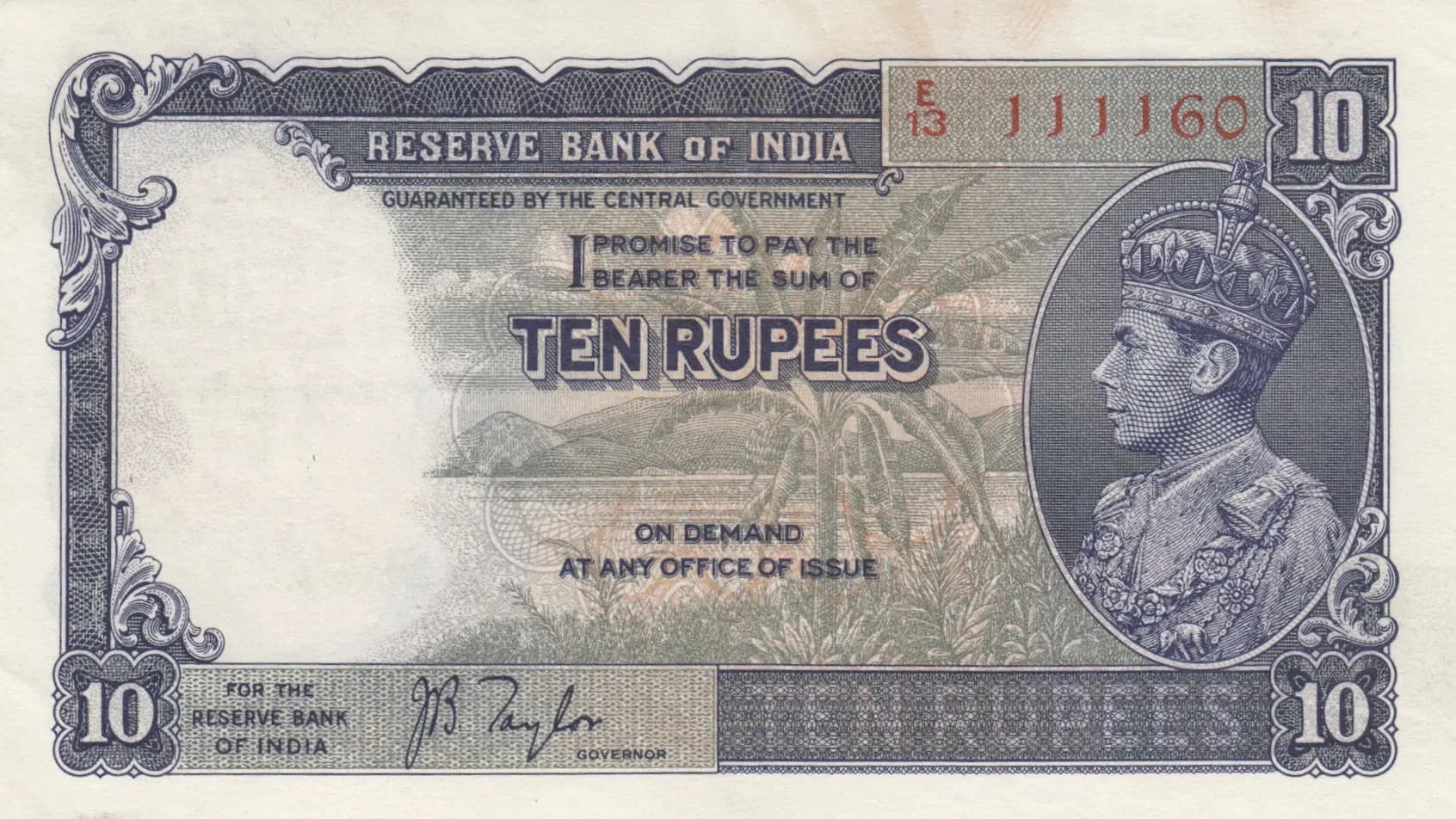
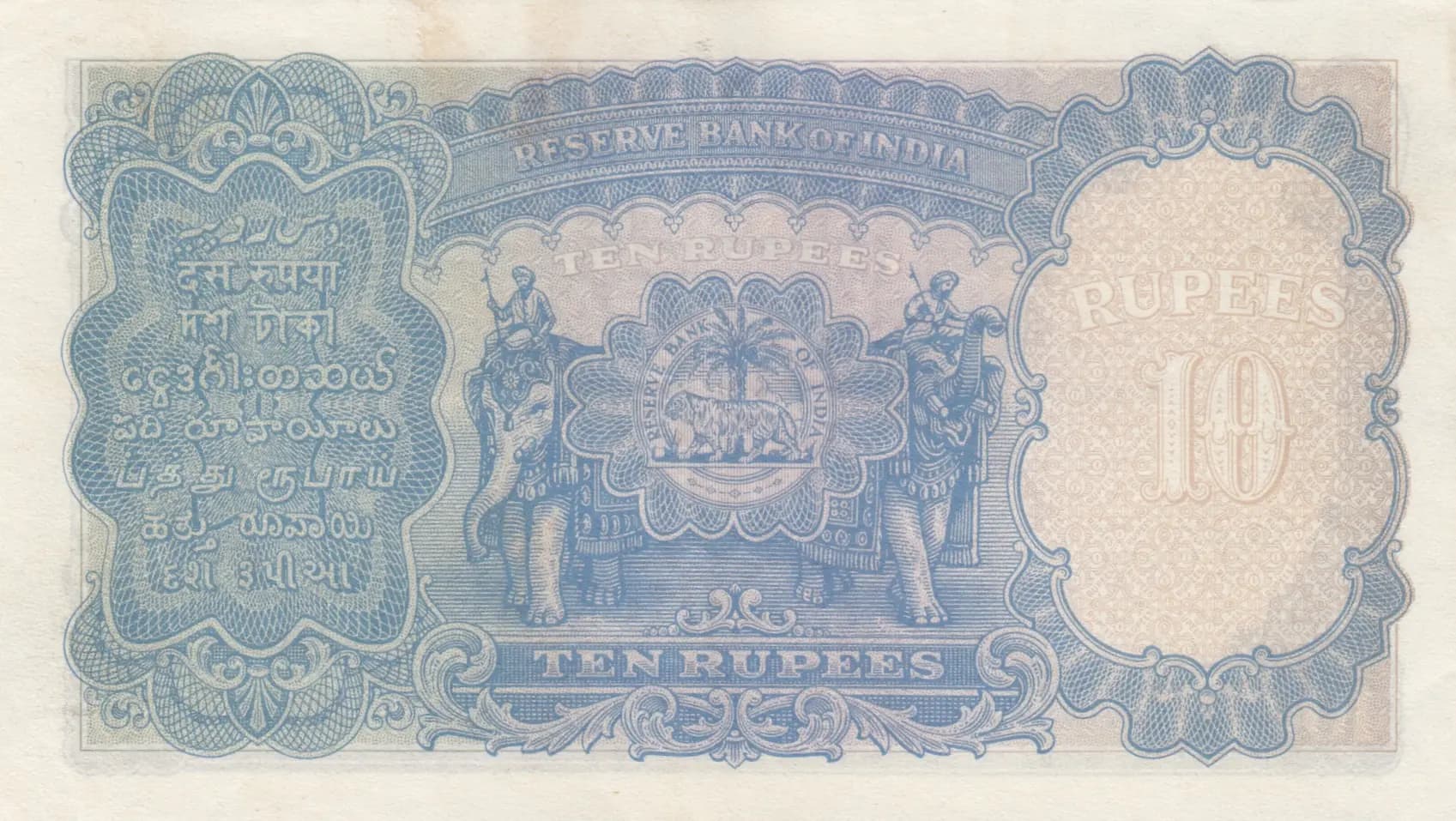
This is a well-preserved example of India's early Reserve Bank currency, the 10 Rupees note of 1937 (Pick 19a) graded EF. The note displays the portrait of King George VI in formal military regalia on the obverse, with the reverse featuring two ornate elephants flanking a central tiger emblem—iconic symbols of Indian sovereignty and British colonial authority during the pre-independence era. Despite moderate age-related foxing and yellowing consistent with an 88-year-old note, the EF condition grade reflects strong structural integrity and retained visual appeal, with crisp engraving details still clearly visible throughout.
Common. Despite the note's age and historical significance, the 10 Rupees 1937 (Pick 19a) is widely available in the collector market. eBay sales data provided shows consistent sales activity across multiple condition grades from VG to UNC, with EF-graded examples regularly selling in the $59–$85 range as recently as 2022, and even lower-grade examples (F, VF) achieving sales of $31–$70. The large print run typical of a major denomination during a stable 6-year issuance period (1937–1943) ensures adequate supply. Current market pricing places EF examples well below the $150+ threshold for scarcer notes, confirming common status despite collector interest driven by historical appeal.
Issued during the reign of King George VI (1936-1952) and the height of the British Raj, this note represents a transitional period in Indian monetary history—the Reserve Bank of India had only been established in 1935, making this 1937 issue among the institution's earliest currency releases. The design's juxtaposition of the British monarch's portrait with distinctly Indian iconography (elephants and tiger) reflects the political complexity of the era, issued just a decade before Indian independence. The note's guarantee by 'the Central Government' and multilingual script (English and Hindi/regional scripts) demonstrate the RBI's conscious effort to create a pan-Indian currency that transcended provincial and linguistic boundaries.
The obverse features a formal three-quarter profile portrait of King George VI, depicted in crowned regalia with ornate military dress adorned with chest insignia, positioned on the right side of the note. The reverse displays a sophisticated central composition: two ceremonially-caparisoned elephants (rendered in fine detail with decorative saddle cloths and ornamental coverings) face inward toward a prominent circular seal containing a tiger in a landscape setting, symbolizing India's natural heritage and power. The architectural framing employs neoclassical scrollwork borders with geometric patterns in all four corners, while the left side contains a decorative cartouche with multi-script text. Agricultural imagery (fields and palm trees) appears subtly in the background of the obverse. Dominant color scheme alternates between dark navy blue, light blue, cream/beige, and gray, with fine engraving throughout providing both aesthetic appeal and security features.
FRONT: 'RESERVE BANK OF INDIA' (header), 'GUARANTEED BY THE CENTRAL GOVERNMENT', 'I PROMISE TO PAY THE BEARER THE SUM OF', 'TEN RUPEES', 'ON DEMAND AT ANY OFFICE OF ISSUE', 'FOR THE RESERVE BANK OF INDIA', 'GOVERNOR' (signature block), serial number 'B 3 J 1 1 1 6 0'. BACK: 'RESERVE BANK OF INDIA', 'TEN RUPEES', denomination '10'; multilingual cartouche containing 'भारतीय रिज़र्व बैंक' (Bhāratīya Riẓarv Baink—Reserve Bank of India in Hindi) and 'दस रुपये' (das rupaye—ten rupees in Hindi), with additional denominations and issuer information in other Indian regional scripts (likely including Marathi, Bengali, or other scripts used across British India).
Steel engraving/intaglio printing on cotton fiber-based currency paper. The note exhibits the characteristic fine-line engraving work typical of British-era Indian currency, produced by De La Rue & Company (the security printer for Reserve Bank of India notes during this period), evidenced by the high-quality geometric patterns, intricate portrait rendering, and complex border designs visible in both the obverse and reverse. The security features rely on engraving depth and line complexity rather than modern security threads, consistent with 1937 printing standards.
This example is cataloged as Pick 19a, representing the standard 1937 issue of the 10 Rupees note (as opposed to the 1943 variant, Pick 19b). The serial number prefix 'B 3 J' suggests this note derives from the later portion of the 1937 print run. No overprints, color variants, or significant printing anomalies are evident from the visual analysis. The single signature visible in the Governor's block is consistent with the standard issue; different governor signatures may denote minor varieties within this Pick number, though such distinctions are not catalogued as separate Pick entries by most standard references.