1 rupee 1951
Market Prices
12 salesAbout This Note
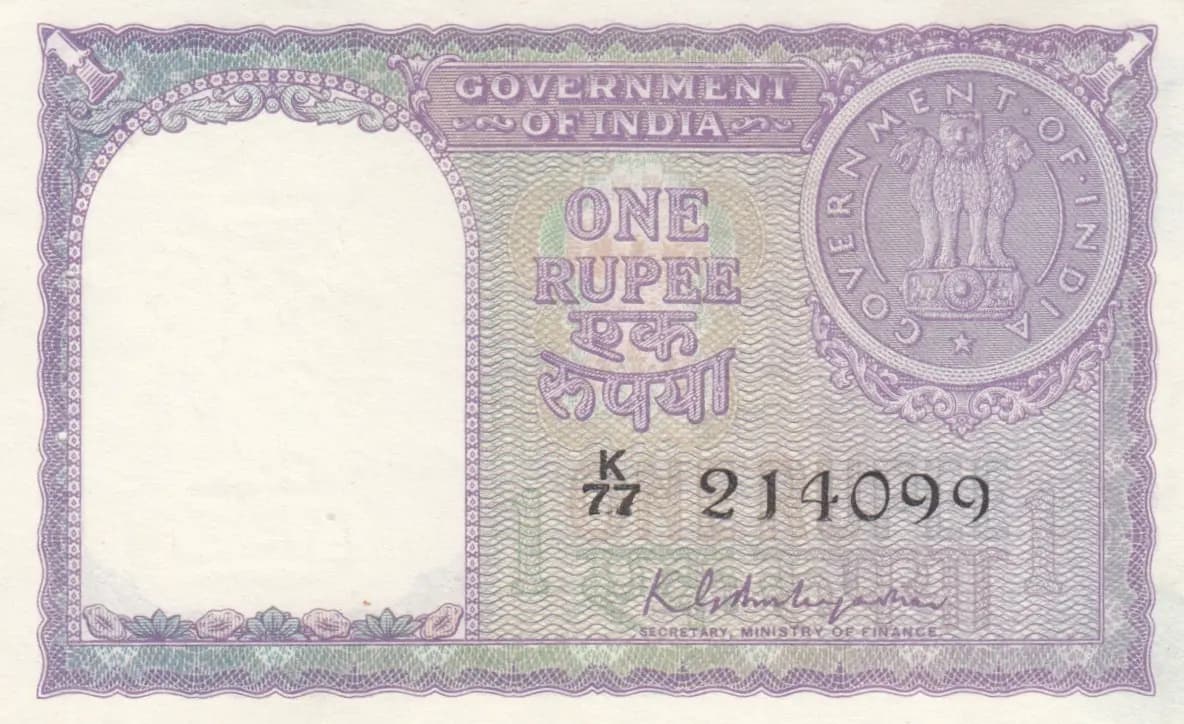
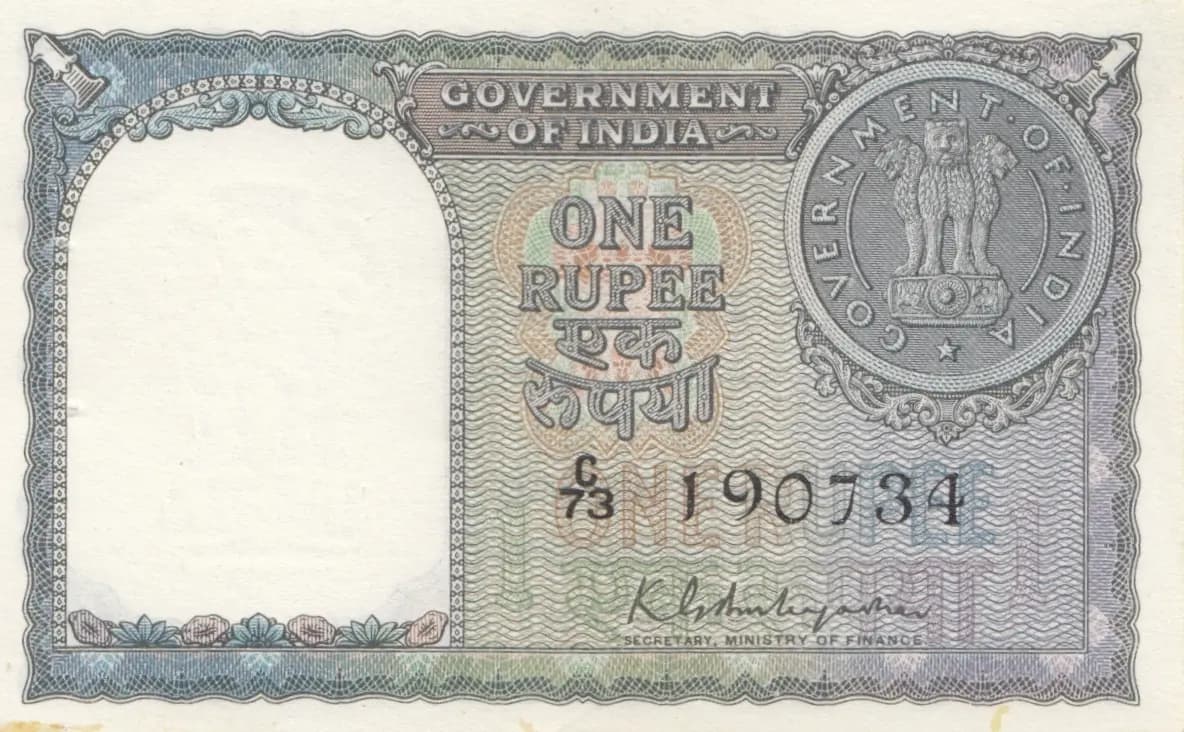
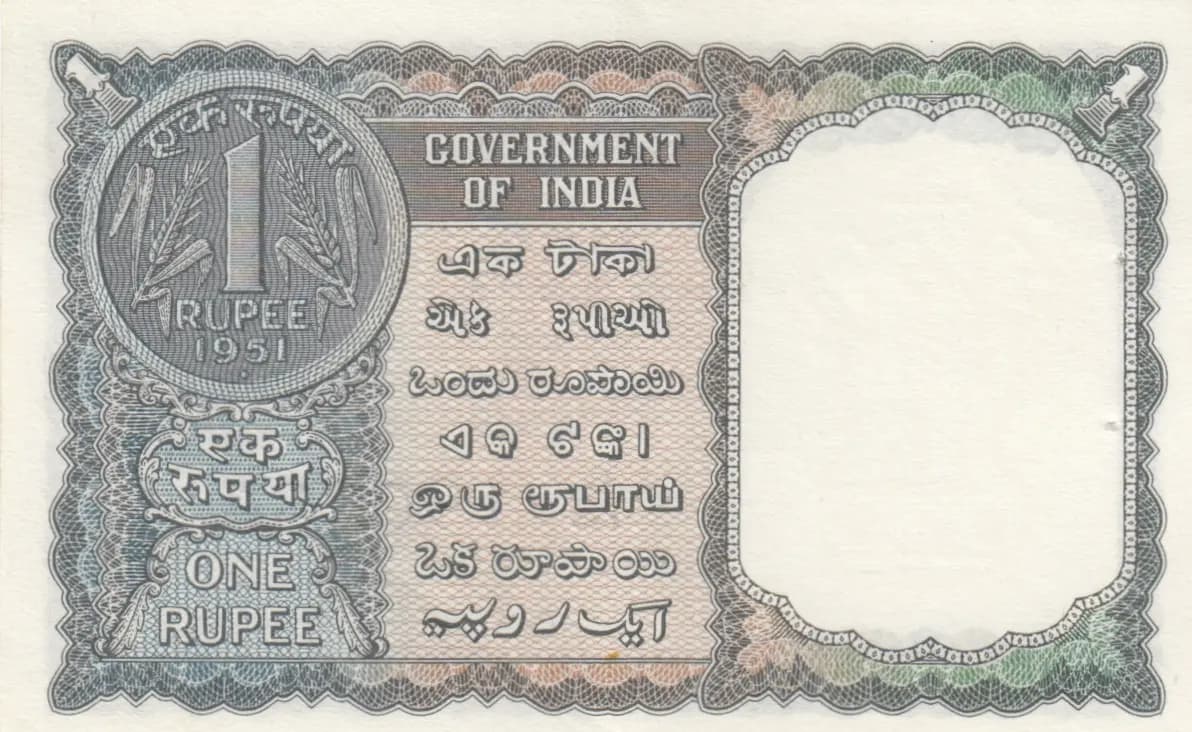
This is a Government of India 1 Rupee note from 1951 (Pick P-72), presented in uncirculated condition with sharp detail and minimal wear. The obverse features a prominent circular coin medallion displaying '1 RUPEE 1951' flanked by wheat leaf designs, while the reverse showcases the iconic Lion Capital of Ashoka seal—a symbol of independent India's newly adopted emblem. The note displays excellent preservation with only light age-related foxing consistent with its 73-year age, making it a desirable early example of India's post-independence currency.
Common. eBay market data shows consistent sales activity across multiple condition grades (VG to UNC) with price ranges from under $1 to $44 for uncirculated examples. The 2016 catalog value for UNC is $6.50, and actual realized prices on eBay confirm the note trades regularly and in reasonable quantities. The 1951 1-rupee note was part of the regular issue for India's early independence period and was printed in substantial quantities to support the nation's currency needs. This Pick number shows no indication of being from a short print run or being subject to recall.
This 1951 note represents India's first regular rupee issue following independence in 1947, marking the transition from British colonial currency to the new Indian Republic's monetary system. The Lion Capital of Ashoka, depicted on the reverse, was officially adopted as India's national emblem in 1950 and appears prominently on this note as a symbol of the newly established Republic. The inclusion of multiple regional language scripts (Hindi, Odia, Kannada, Telugu, Tamil, and Urdu) on the obverse reflects India's commitment to linguistic pluralism and national unity in the multilingual nation.
The obverse (front) features a large circular coin medallion on the left side displaying the denomination '1 RUPEE' with '1951' as the date of issue, flanked by stylized wheat or grain leaf designs symbolizing agricultural prosperity. The center contains the denomination text in multiple Indian regional scripts arranged vertically, representing India's linguistic diversity. The reverse (back) is dominated by the Lion Capital of Ashoka seal positioned on the right side—a circular emblem depicting four lions standing back-to-back on a lotus-decorated pedestal, which serves as the official state emblem of India. Both sides feature decorative ornamental borders with beaded circular patterns and scrollwork typical of early Indian currency design. The note employs a multicolor printing scheme in grey, green, brown, and tan tones with white space elements providing visual balance.
OBVERSE: 'GOVERNMENT OF INDIA' (English), '1 RUPEE' (English), '1951' (English), 'एक रुपया' (Hindi - One Rupee), 'ଏକ ଟଙ୍କା' (Odia - One Rupee), 'ಒಂದು ರೂಪಾಯಿ' (Kannada - One Rupee), 'ఒక రూపాయి' (Telugu - One Rupee), 'ஒரு ரூபாய்' (Tamil - One Rupee), 'ایک روپیہ' (Urdu - One Rupee). REVERSE: 'GOVERNMENT OF INDIA' (English), 'ONE RUPEE' (English), 'एक रुपया' (Hindi - One Rupee), Serial number 'C 190784', Signature 'K Bhattacharya' (Finance official).
Intaglio (engraved) printing, evidenced by the sharp detail definition, fine line work, and dimensional depth visible in the ornamental borders and central emblems. The note was produced by the Government of India's security printing facilities; for this period and denomination, this would typically be the India Security Press in Nashik or the Mint/Currency Note Press facilities. The multiple-script capability and high-quality border work are consistent with advanced intaglio methods used for Indian government currency of the early independence period.
Serial number prefix 'C' observed on this example (C 190784). The signature 'K Bhattacharya' appears to be that of a Finance Secretary or similar official of the period. Early Indian rupee notes exhibit signature varieties based on different officials serving during the 1951-1957 period; collectors may differentiate notes by these signature variants. The note does not appear to have any overprints or special designations indicating a specific sub-variety beyond standard issue characteristics.