1000 kronur 1961 specimen
Market Prices
About This Note
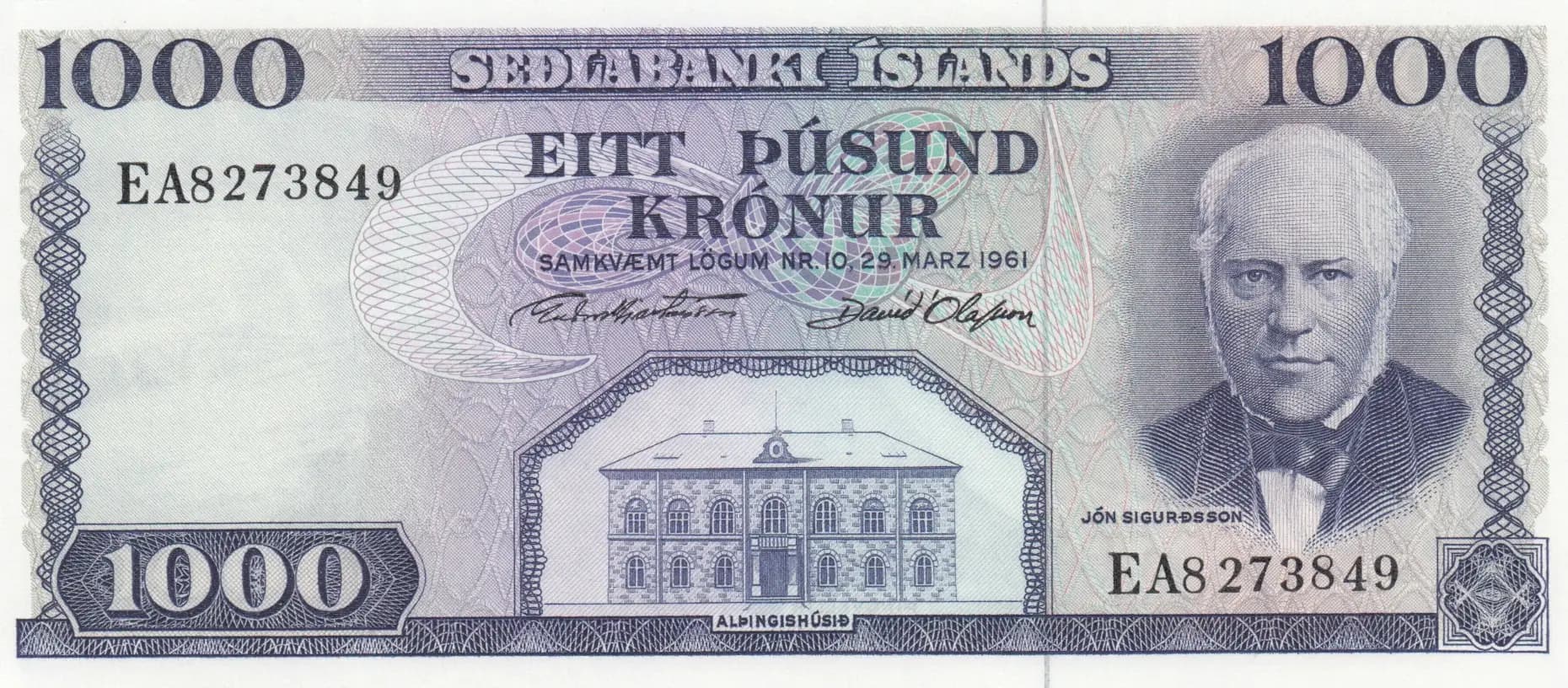
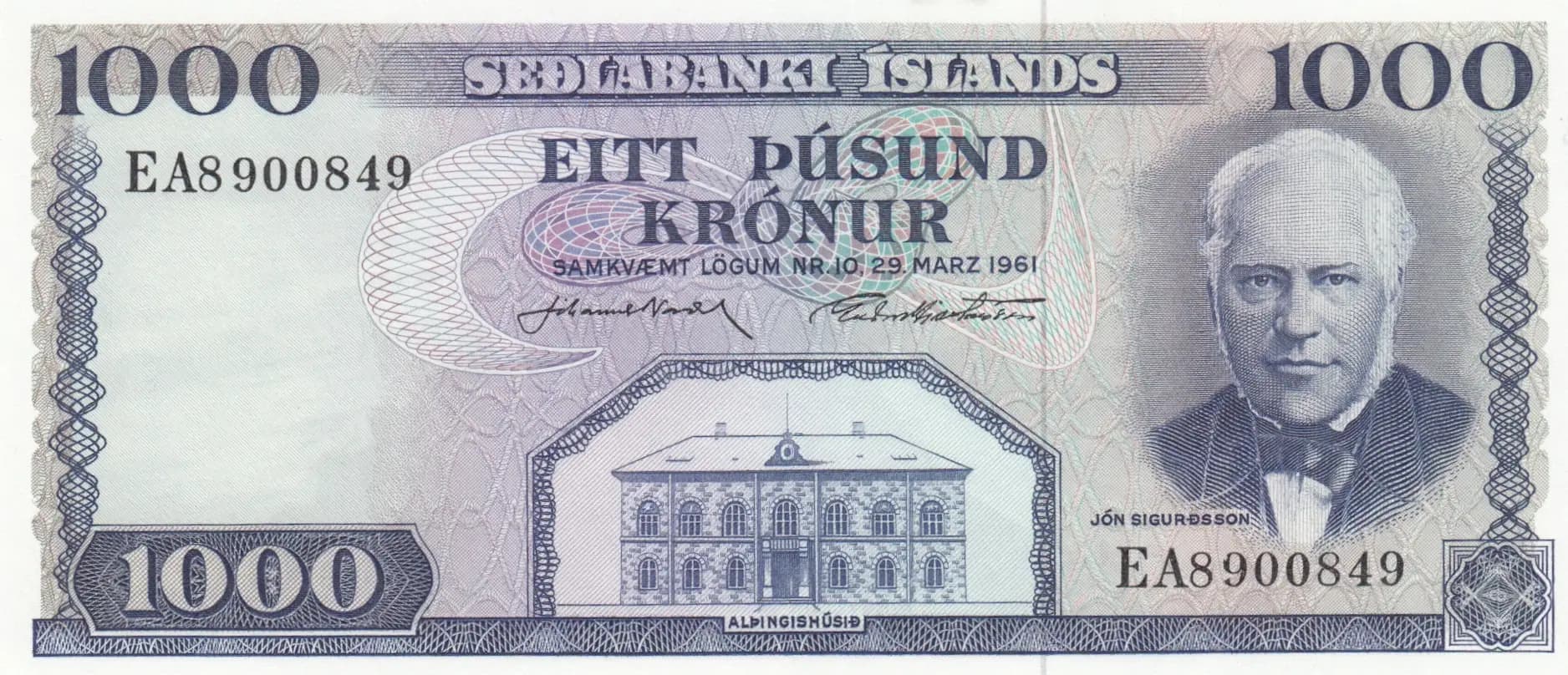
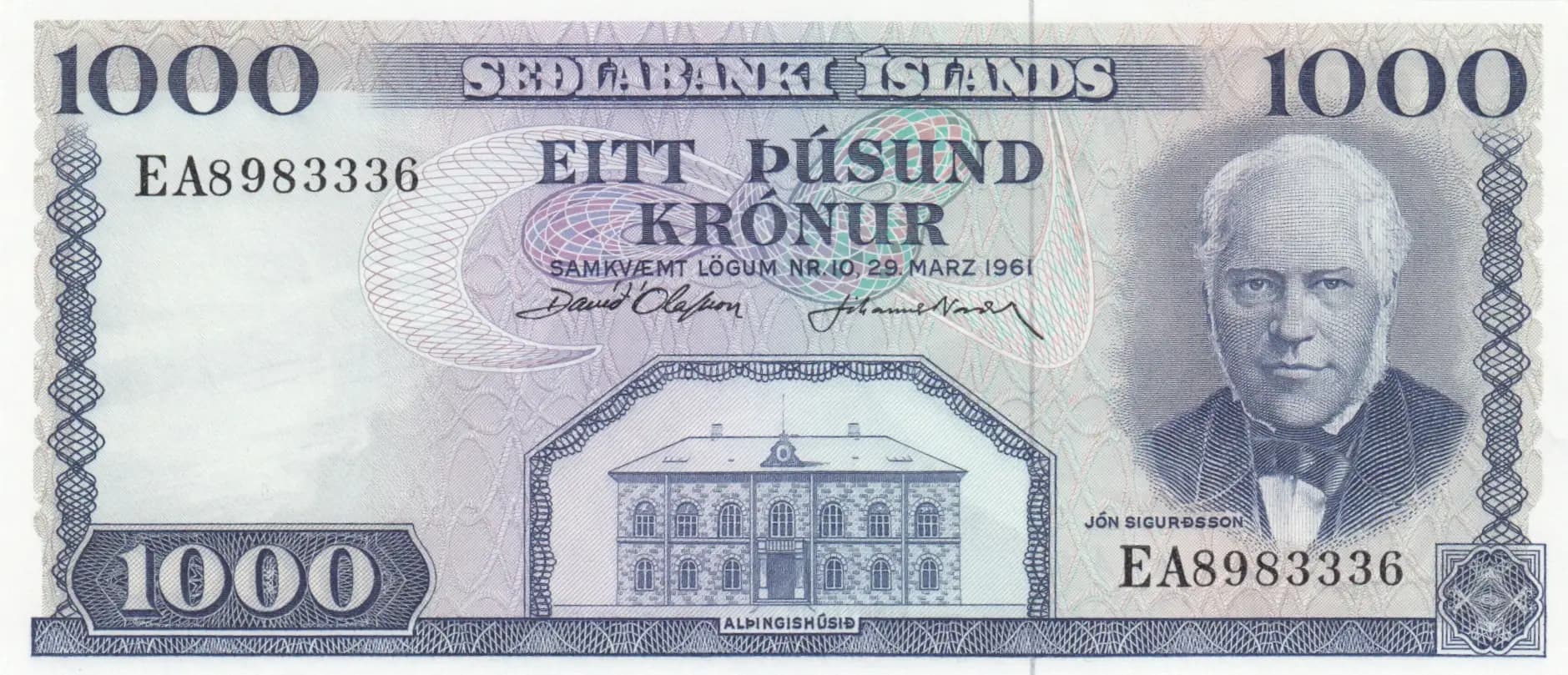
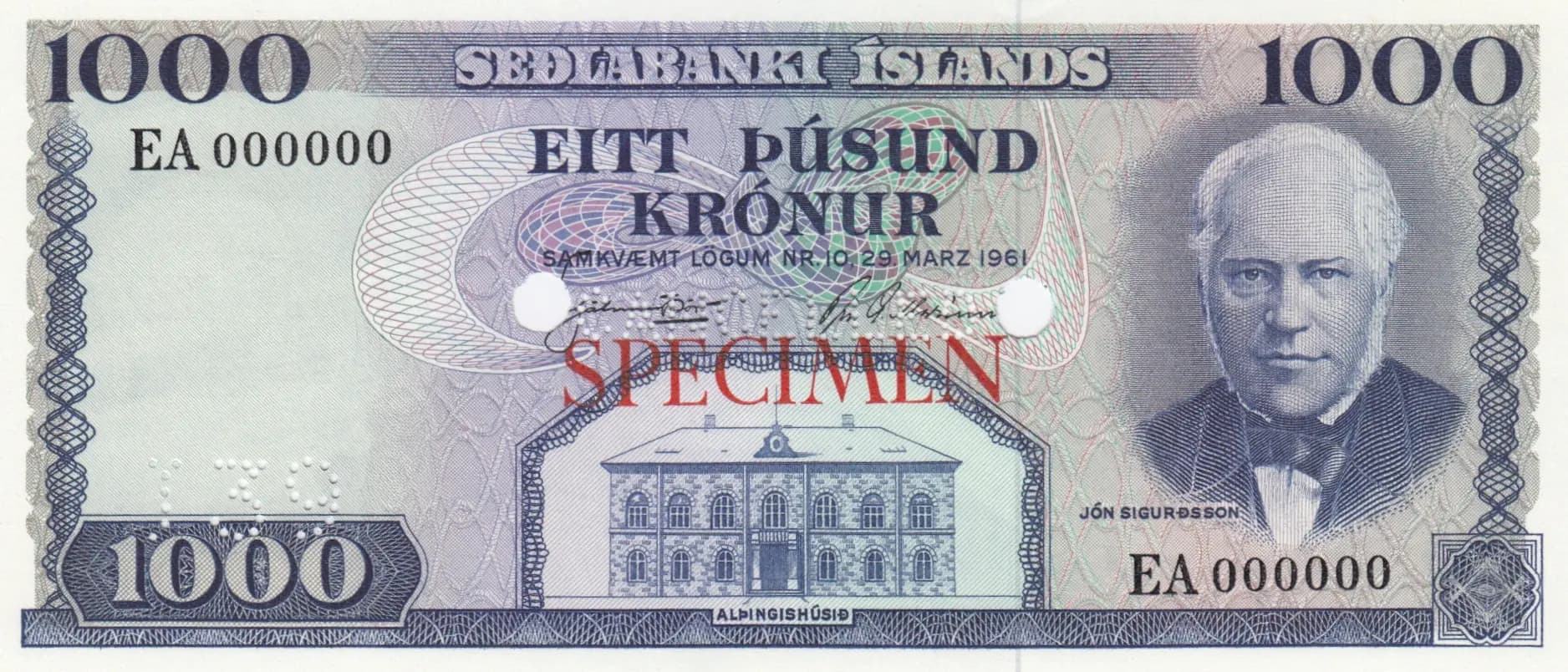
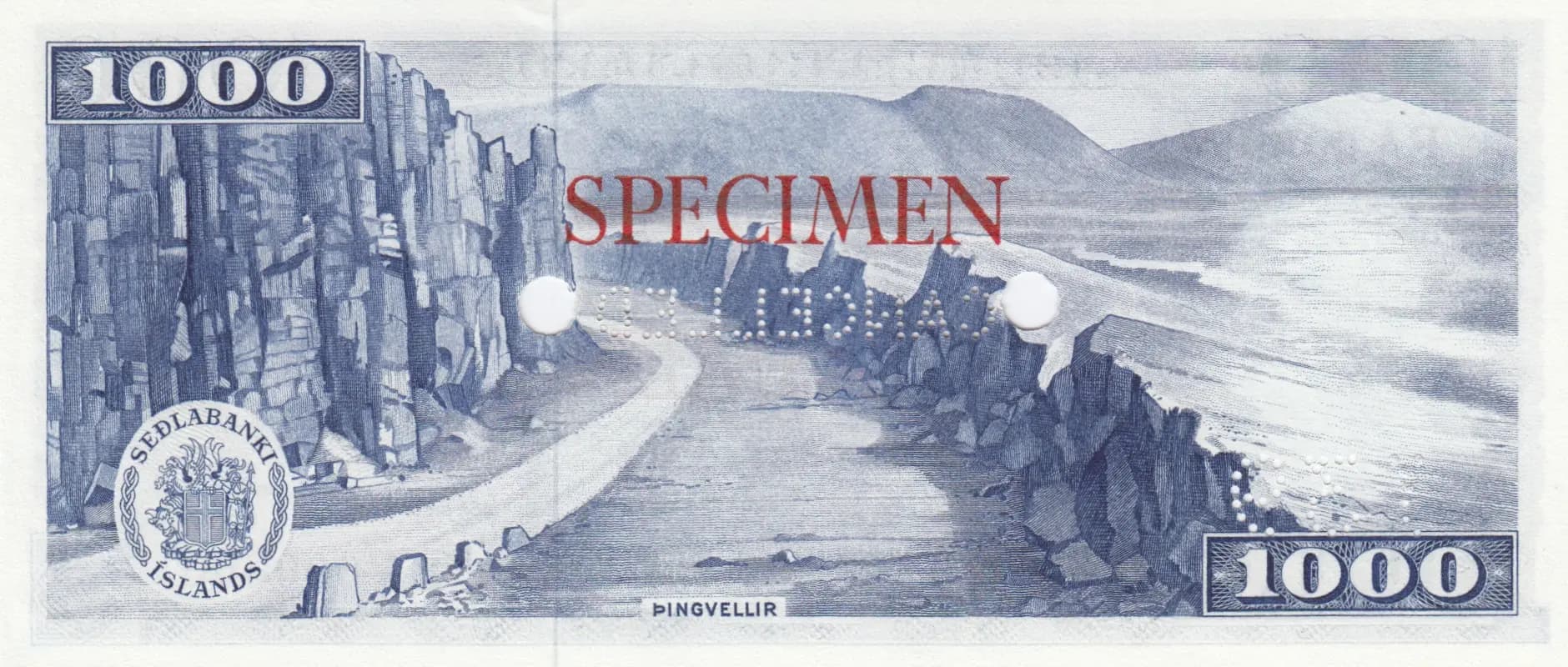
This is a stunning UNC specimen note from Iceland's 1961 currency reform, featuring a portrait of national hero Jón Sigurdsson and the iconic Alþingishúsið (Parliament House) on the obverse, with Þingvellir's dramatic basalt formations dominating the reverse. As a specimen note with characteristic punch holes and red SPECIMEN overprint, this represents a non-circulating collector's item in pristine condition with crisp engraving and no wear, making it an attractive piece for collectors of Scandinavian numismatics and specimen banknote enthusiasts.
Common. While this is a specimen note (which are generally less common than circulating issues), the 1961 1000 kronur denomination was part of Iceland's standard currency series and produced in substantial quantities. The eBay market data shows wide price variance ($3.49–$44.95 USD for UNC examples, averaging around $10–$20), indicating steady but unremarkable collector demand. The 2018 catalog value of $325 USD appears anomalous and likely reflects grading premium or a specific high-grade example; most UNC specimens trade at lower levels. Specimen notes as a category are valued by collectors, but this issue lacks the scarcity factors (short print run, recall, or historical disruption) that would elevate it to rare status.
This 1000 kronur note was issued under Law No. 10 of March 29, 1961, marking a significant monetary reform for the newly independent Icelandic state. The obverse honors Jón Sigurdsson (1811–1879), the founding father of modern Iceland and leader of the independence movement, while the reverse depicts Þingvellir, the historic assembly site of the Alþingi (one of the world's oldest parliaments, established 930 AD), symbolizing Iceland's democratic heritage and connection to its Viking-age roots. The note's imagery reflects Iceland's identity as a nation reclaiming its sovereignty and historical significance.
The obverse features a formal three-quarter portrait of Jón Sigurdsson at right, depicted as a dignified bearded statesman in 19th-century formal attire, with the neoclassical Alþingishúsið building illustrated at lower center—a structure featuring multiple arched windows and classical proportions representing Iceland's democratic institutions. The reverse showcases an intricate engraved landscape of Þingvellir National Park, dominated by distinctive basalt columnar formations (part of the Mid-Atlantic Ridge) rising from a river valley with mountains in the background, capturing Iceland's dramatic geological character. Both sides employ extensive guilloche patterning, Celtic knot-style corner ornaments, and geometric security designs in blue and gray tones, with the red diagonal SPECIMEN overprint marking this as a non-circulating specimen note. The coat of arms of Seðlabanki Íslands (Central Bank of Iceland) appears as a heraldic seal on the reverse.
FRONT: 'SEÐLABANKI ÍSLANDS' (Central Bank of Iceland) | 'EITT ÞÚSUND KRÓNUR' (One Thousand Kronur) | 'SAMKVÆMT LOGUM NR.10 29 MÄRZ 1961' (According to Law No. 10, 29 March 1961) | 'JÓN SIGURDSSON' (portrait identification) | 'ALÞINGISHÚSIÐ' (The Parliament House) | Denomination numerals '1000' | 'SPECIMEN' (red overprint, non-negotiable marker). BACK: '1000' (denomination) | 'PINGVELLIR' (Thingvellir, natural landmark) | 'SEDELABANKI ÍSLANDS' (Central Bank of Iceland) | 'SPECIMEN' (red overprint).
Engraved intaglio printing on a multicolored underprint base, as confirmed by the catalog data identifying BWC (Bradbury, Wilkinson & Company) as the printer. The fine-line guilloche patterns, detailed portrait engraving, intricate landscape work on the reverse, and security elements visible throughout are characteristic of high-security intaglio production. The crisp, detailed nature of all design elements—particularly the basalt formations and architectural details—reflects the precision of mid-20th-century security printing standards.
This note is cataloged as Pick P-46s, the specimen variety. The catalog data indicates two known variants under Pick number P-46: P-46a (regular issue) and P-46s (specimen). Both were printed by BWC. This particular note exhibits the specimen characteristics: red diagonal SPECIMEN overprint, standard specimen punch holes (visible in images), and serial number formatted as 'EA 000000' (typical specimen numbering). No additional signature or date varieties are apparent from the visual analysis, suggesting this represents the standard specimen printing of the 1961 issue.