5 gourdes 1925
Market Prices
About This Note
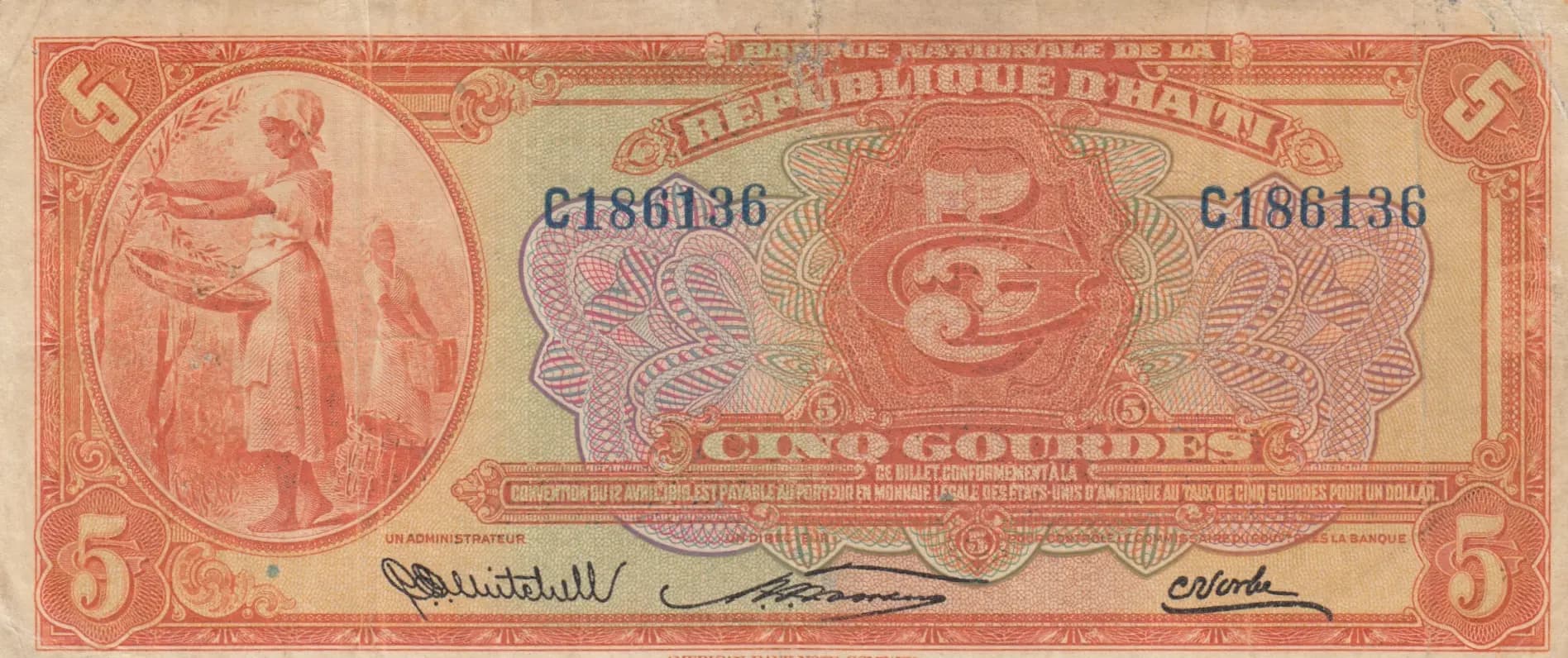
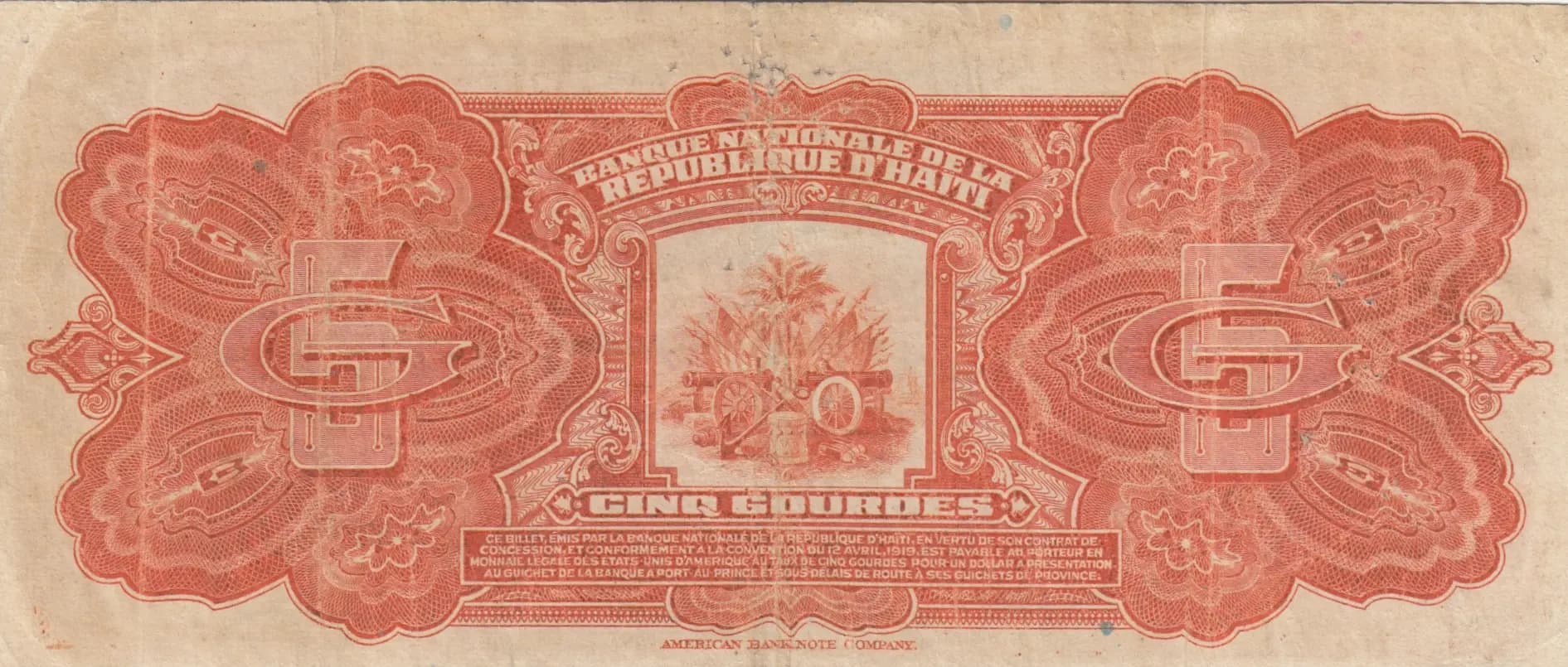
This Haiti 5 Gourdes from 1925 (Pick P-162) presents as a Fine-grade example from the Banque Nationale de la République d'Haiti, printed by the American Bank Note Company. The note displays the characteristic coral/salmon and cream coloring typical of this issue, with visible aging including foxing and discoloration consistent with nearly a century of storage. The front features an elegant classical female allegorical figure in a left-side medallion alongside a winged numeral "5", while the reverse depicts an agricultural harvest scene with tropical crops, making this a visually rich representation of Haiti's economic focus during the 1920s.
Common. The eBay market data provided shows multiple examples trading regularly, with Fine-grade specimens (matching this note's grade) selling in the $41.90–$62.89 range, well below the $75 UNC catalogue value. The 2016 catalogue valuation of $1.50 for VG and $10 for VF further indicates this is a standard circulation note from a substantial print run. The PMG population report shows at least 1 professionally graded variant, suggesting reasonable availability. No evidence of short print runs, recalls, or scarcity issues exists for this Pick number.
Haiti issued this note under the concession agreement of April 12, 1915, a period when the country was under U.S. occupation (1915-1934) and the gourde was explicitly pegged to the U.S. dollar at a fixed rate of five gourdes per dollar. The agricultural vignette on the reverse—depicting what appears to be sugar cane or similar tropical crop harvesting—reflects Haiti's primary economic activity during this era, while the allegorical Liberty figure on the obverse represents the nation's republican ideals. The American Bank Note Company's involvement as printer underscores the close financial ties between Haiti and the United States during this strategic period.
The obverse features a classical allegorical female figure—representing Liberty or national virtue—positioned in an ornate oval medallion on the left side, rendered in profile with draped classical clothing. The center is dominated by an elaborate winged numeral "5" with decorative flourishes, flanked by ornamental scrollwork. Decorative swastika motifs appear in the top corners as traditional geometric ornaments (pre-dating their later associations). The design employs coral/salmon and cream tones with fine engraving detail throughout. The reverse depicts a agricultural vignette in the center showing a tropical harvest scene with what appears to be sugar cane or similar crops being harvested, symbolizing Haiti's agrarian economy. Large decorative numerals "5" appear on either side of the central vignette, and ornamental medallions featuring the letter "G" (for Gourdes) are positioned on the left and right margins. The entire design is enclosed within elaborate geometric and floral borders reflecting fine intaglio craftsmanship.
FRONT SIDE: 'BANQUE D'HAITI' (Bank of Haiti), 'CINQ GOURDES' (Five Gourdes), 'UN ADMINISTRATEUR' (An Administrator), 'LA BANQUE' (The Bank), and the redemption clause: 'Condition du 12 avril 1915 est payable au Porteur en Monnaie Legale des Etats-Unis d'Amerique au taux de cinq gourdes pour un dollar' (Condition of April 12, 1915 is payable to bearer in legal currency of the United States of America at the rate of five gourdes per dollar). BACK SIDE: 'BANQUE NATIONALE DE LA REPUBLIQUE D'HAITI' (National Bank of the Republic of Haiti), 'CINQ GOURDES' (Five Gourdes), full redemption text: 'CE BILLET, EMIS PAR LA BANQUE NATIONALE DE LA REPUBLIQUE D'HAITI, EN VERTU DE SON CONTRAT DE CONCESSION ET CONFORMEMENT A LA LOI DU 12 AVRIL 1915, EST PAYABLE AU PORTEUR EN MONNAIE LEGALE DES ETATS-UNIS D'AMERIQUE AU TAUX DE CINQ GOURDES, POUR UN DOLLAR A PRESENTATION AU GUICHET DE LA BANQUE A PORT-AU-PRINCE ET AUX SUCCURSALES DE ROUTE A SES GUICHETS EN PROVINCE' (This note, issued by the National Bank of the Republic of Haiti, by virtue of its concession contract and in accordance with the Law of April 12, 1915, is payable to bearer in legal currency of the United States of America at the rate of five gourdes per dollar, upon presentation at the bank counter in Port-au-Prince and at its branch counters along the route in the provinces), and printer attribution: 'AMERICAN BANK NOTE COMPANY' (American Bank Note Company).
Intaglio (engraved) printing, the standard security printing method for banknotes of this era. The American Bank Note Company, one of the world's premier security printers, executed the design with multiple layers of fine line engraving, intricate geometric patterns, and ornamental vignettes characteristic of high-security currency production. The precision detail visible in the decorative borders, portrait work, and background patterns demonstrates the company's mastery of the intaglio process. Blue overprinted serial numbers and text were applied in a separate printing operation.
The visual analysis documents serial number C186136 with prefix letter 'C', consistent with the documented prefix varieties (C and D noted in references). This note exhibits the standard design with three known signature varieties according to catalog data. The overprinted text 'Pour Controle...' with black signatures and blue security overprints is consistent with the standard regular issue variant for P-162. The note dates from the 1919 authorization law (convention dated April 12, 1919) but was issued throughout the 1920s; this specific example is cataloged as 1925.