1 piastre 1875
Market Prices
9 salesAbout This Note
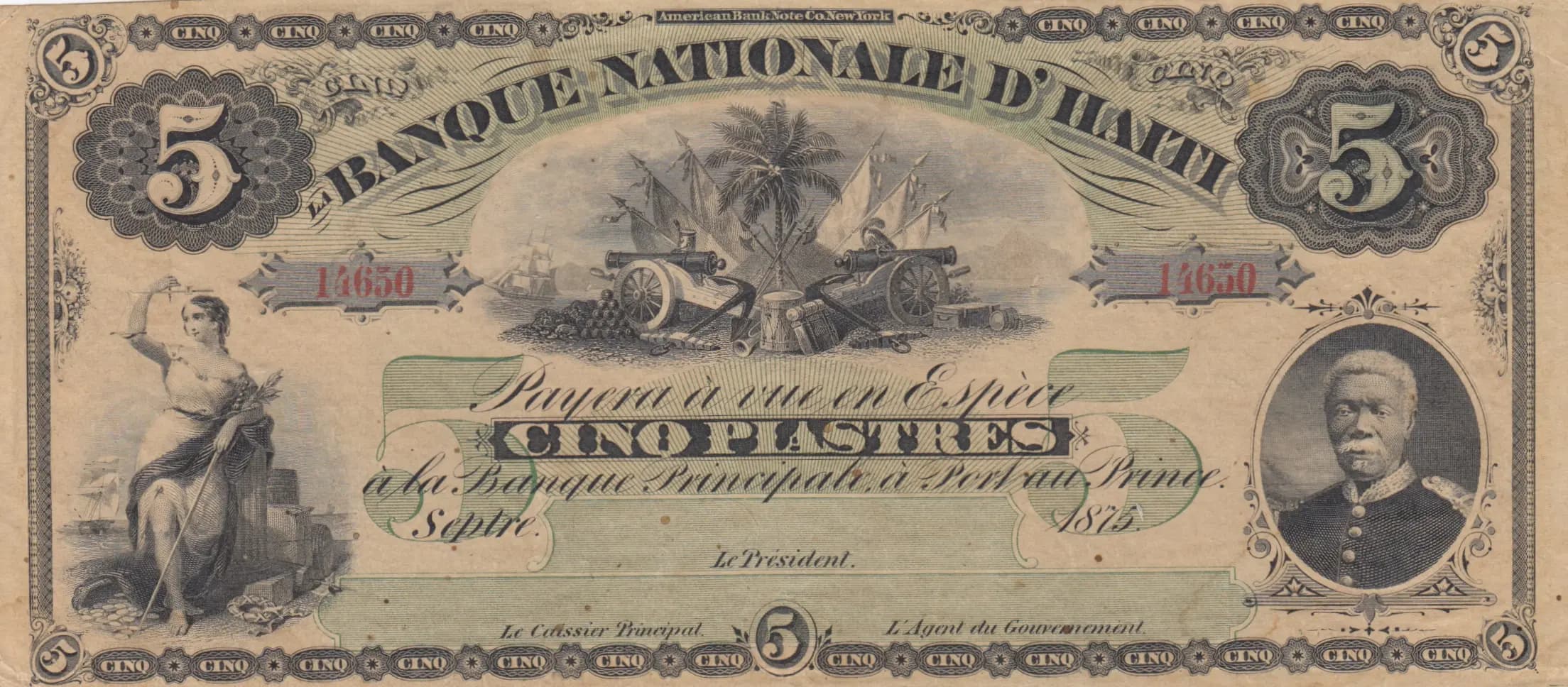
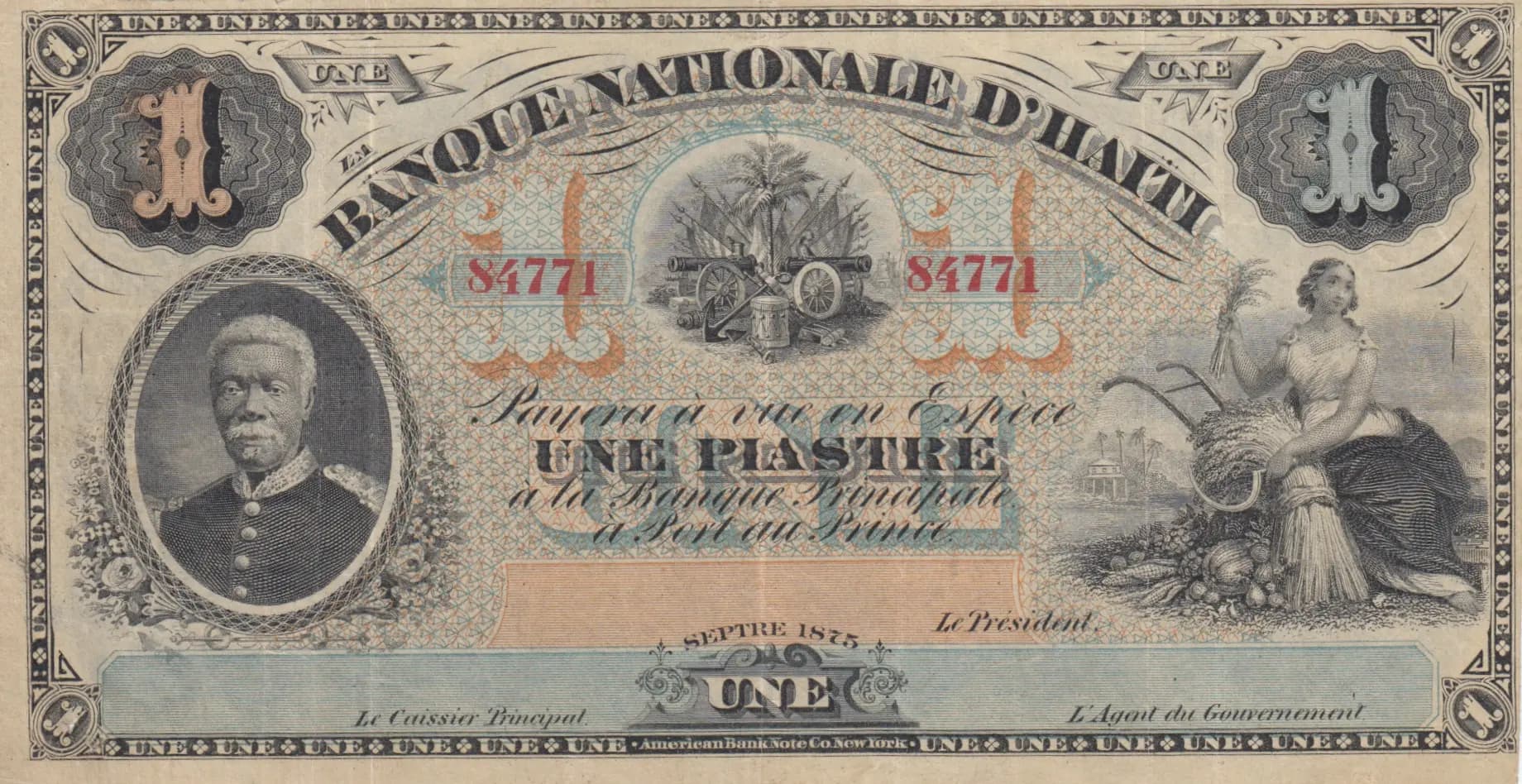
This is a VF-grade 1 Piastre from Haiti's Banque Nationale, issued in September 1875 by the American Bank Note Company. The note displays the classic dual-portrait composition with President Michel Domingue in military dress on the left and an allegorical female figure (Agriculture) seated on the right, separated by Haiti's heraldic arms featuring crossed cannons and palm fronds. Despite over 145 years of age, the note retains good detail in its intricate engraved borders and ornamental patterns, though foxing and age-related discoloration are evident throughout, consistent with circulation and storage in a tropical climate.
Common. The eBay sales history provided shows consistent circulation of this note in various condition grades (VG, F, EF), with prices ranging from $20 to $93, and 2016 catalogue values of $35 (F) and $100 (EF). The frequent appearance on the secondary market, multiple sales records over more than a decade, and reasonable price points all indicate this is a standard issue with adequate surviving examples. The Banque Nationale d'Haiti had a significant print run for this 1 Piastre denomination in 1875, and the note was in active circulation, making survivors reasonably available to collectors.
This note was issued during the presidency of Michel Domingue (1874–1876), a period of relative stability following Haiti's turbulent post-independence era. The crossed cannons and palm fronds in the central heraldic design symbolize Haiti's military struggle for independence and the nation's tropical identity. The prominence of the allegorical Agriculture figure reflects Haiti's economic foundation in agricultural production during the 19th century, emphasizing the nation's wealth and national values to both domestic and international users of the currency.
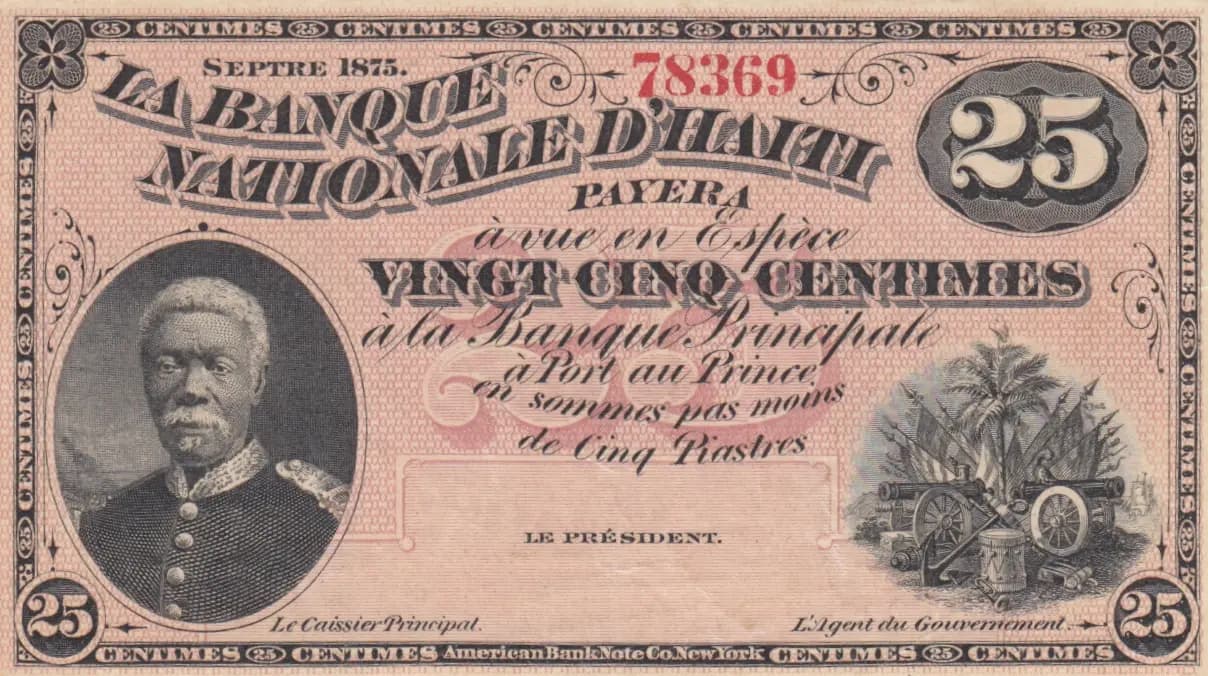
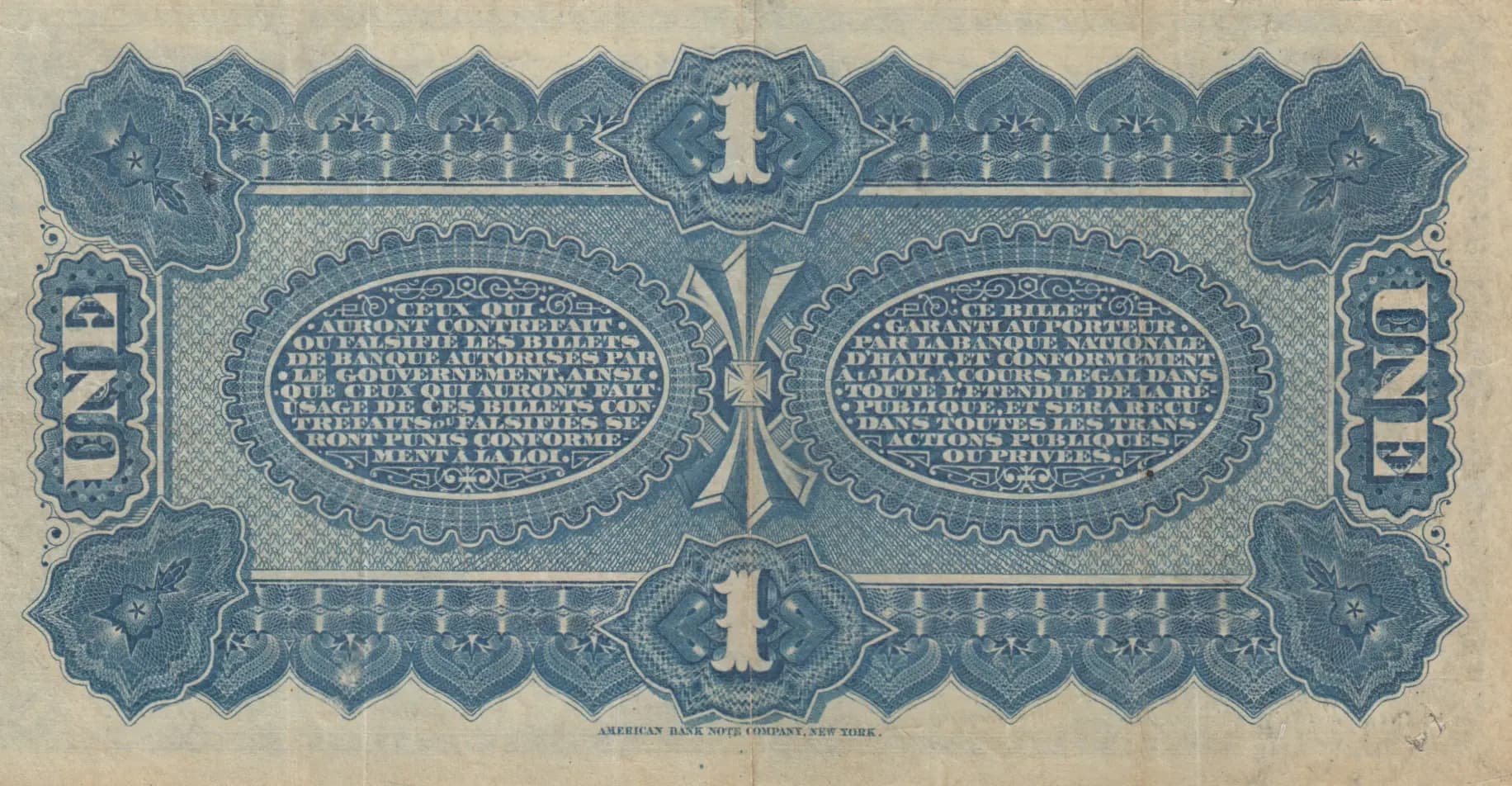
The obverse features a formal three-figure composition: President Michel Domingue occupies the left side in formal military dress with decorative collar, rendered in fine portrait engraving. The center features Haiti's national heraldic arms with crossed cannons and interlaced palm fronds, symbolizing military heritage and national identity. On the right, an allegorical female figure representing Agriculture sits in classical pose, embodying the nation's economic foundation. The entire design is framed by elaborate ornamental borders with repeated geometric and floral motifs, including corner rosettes and decorative cartouches. The reverse presents a formal legal-text composition with symmetrical design elements: two central oval medallions containing the legal guarantee text, surrounded by ornamental corner designs featuring fleur-de-lis elements and scalloped borders. The color scheme transitions from tan/beige with black and red accents on the obverse to predominantly blue tones on the reverse, a common 19th-century banknote design practice.
FRONT: 'LA BANQUE NATIONALE D'HAITI' (The National Bank of Haiti); 'UNE PIASTRE' (One Piastre); 'SEPTEMBRE 1875' (September 1875); 'le Caissier Principal' (The Principal Cashier); 'Le President' (The President); 'L'Agent du Gouvernement' (The Government Agent); 'American Bank Note Co. New York' (printer attribution); Serial number: S4771. BACK: 'UNE' (One); 'CE BILLET GARANTIT PAR LA BANQUE NATIONALE D'HAITI QUE CELUI QUI L'APPORTERA AURA LA COURS LEGAL DANS TOUTE L'ETENDUE DE LA REPUBLIQUE ET PARTOUT OU L'USAGE DES BILLETS DE BANQUE CONVENUS PRIVES' (This note is guaranteed by the National Bank of Haiti that whoever brings it will have legal tender status throughout the entire extent of the Republic and everywhere where the use of agreed private banknotes is accepted); 'AMERICAN BANK NOTE COMPANY, NEW YORK' (printer attribution).
Intaglio engraving (line engraving), the standard security printing method of the era. The note was produced by the American Bank Note Company, New York, one of the world's foremost security printers of the 19th century. The intricate ornamental borders, detailed portraiture, and complex geometric background patterns are characteristic of fine-line intaglio work designed to prevent counterfeiting. The multi-color printing (tan/beige, black, red on obverse; blue on reverse) employed separate plates, a standard ABNC practice for notes of this period and denomination.
This specimen is identified as Pick 70 (P-70), the standard 1 Piastre note. The PMG population report indicates a P-70p variant (proof) exists, but this is a circulated example of the regular issue (P-70). The observed serial number S4771 in red indicates this is from a standard printing run. No overprints, color variations, or signature varieties are apparent in this specimen. Dating to September 1875, this note falls within the initial issue period of the Banque Nationale d'Haiti under Michel Domingue's administration.