2 gourdes 1980
Market Prices
15 salesAbout This Note
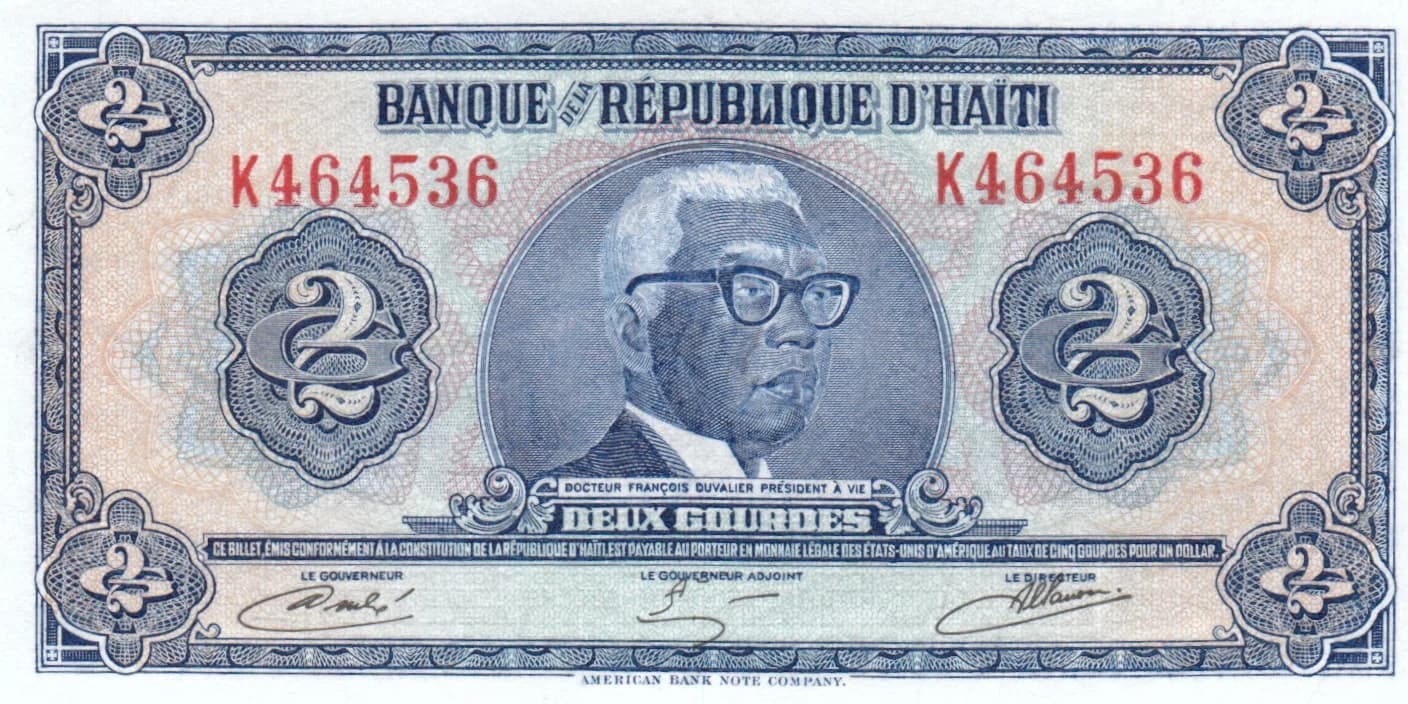
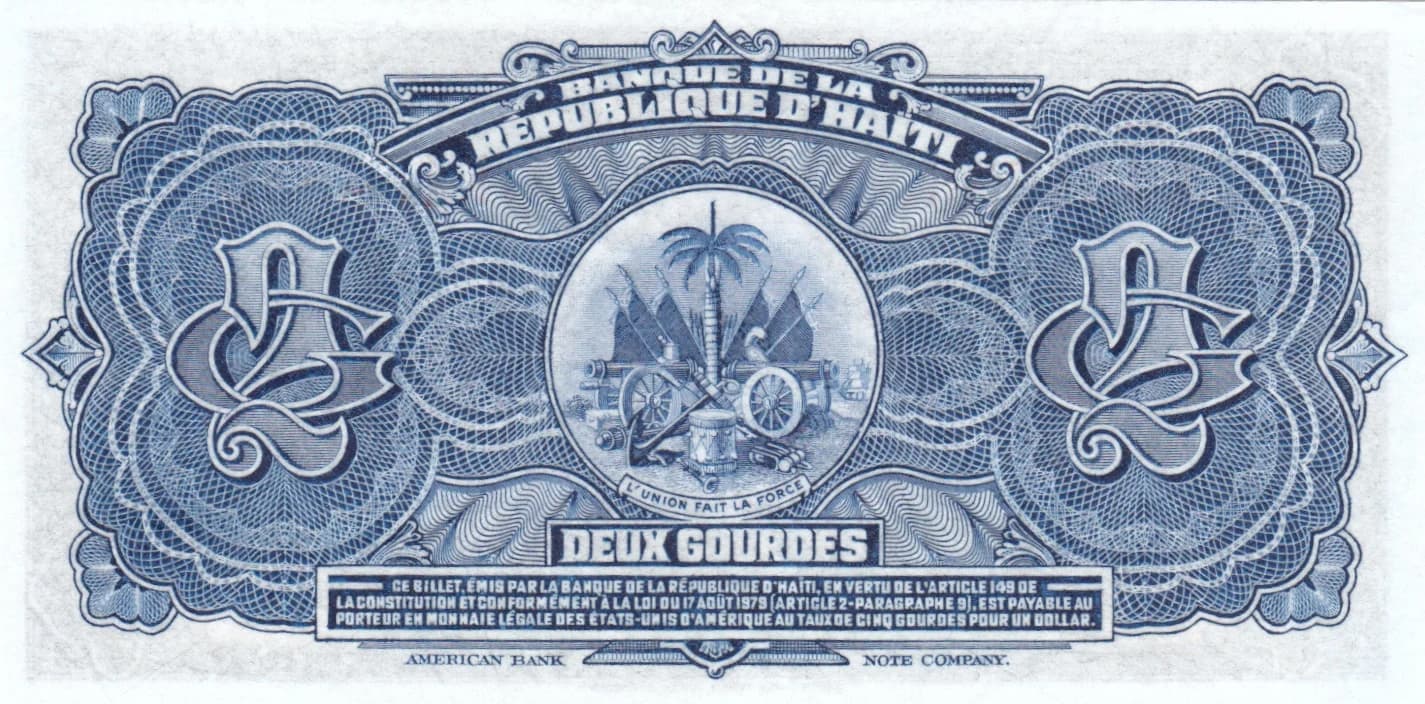
This is a 1980 Haitian 2 Gourdes note (Pick P-231A) in Uncirculated condition, featuring the iconic portrait of President François Duvalier wearing glasses on the obverse and Haiti's national coat of arms on the reverse. The note exhibits pristine condition with no visible wear, creases, or stains, displaying the fine blue and tan color scheme with ornate guilloché patterns and decorative corner medallions characteristic of American Bank Note Company's work. The serial number K464536 and the presence of small numerals confirm this as the later printing variant of this denomination.
Common. Based on the eBay market data provided, UNC examples of this note have consistently sold in the $2.25–$15.50 range over the 2014–2019 period, with recent 2019 catalog values listing UNC at $4. These price levels and sustained market presence indicate this was a regular, widely-circulated issue with substantial print runs. The P-231A variant represents a standard printing of this denomination with no evidence of scarcity or special demand.
This note was issued during the later years of François Duvalier's presidency (he died in 1971, but his image continued on currency issued under his successor), reflecting Haiti's continued political and economic ties to the United States, as evidenced by the explicit exchange rate printed on the note (5 gourdes per US dollar). The coat of arms depicted on the reverse—featuring the palm tree, crossed cannons, drums, and the national motto 'Union Fait la Force' (Union Makes Strength)—represents Haiti's identity as the first successful black republic, though the currency remained pegged to American currency reflecting economic dependency.
The obverse features a formal portrait of President François Duvalier ('Papa Doc') positioned centrally, depicted wearing eyeglasses and formal attire, surrounded by ornate circular frames and decorative floral medallions in all four corners containing the numeral '2'. The reverse displays Haiti's national coat of arms in a central circular medallion, incorporating symbolic elements including a palm tree (representing Haiti's natural wealth), crossed cannons and drums (military heritage and cultural identity), an anchor, and crossed flags behind the shield. Both sides employ an elaborate ornamental border design with geometric and floral patterns in guilloché style, maintaining a consistent blue and tan/white color palette. The serial number appears in red in the upper portions of the obverse.
FRONT: 'BANQUE REPUBLIQUE D'HAITI' (Bank of the Republic of Haiti), 'DEUX GOURDES' (Two Gourdes), 'DOCTEUR FRANÇOIS DUVALIER PRÉSIDENT À VIE' (Doctor François Duvalier President for Life), 'CE BILLET ÉMIS CONFORMÉMENT À LA CONSTITUTION DE LA RÉPUBLIQUE D'HAITI EST PAYABLE AU PORTEUR EN MONNAIE LÉGALE DES ÉTATS-UNIS D'AMÉRIQUE AU TAUX DE CINQ GOURDES POUR UN DOLLAR' (This note is issued in accordance with the Constitution of the Republic of Haiti and is payable to the bearer in legal currency of the United States of America at the rate of five gourdes per dollar), 'LE GOUVERNEUR' (The Governor), 'LE GOUVERNEUR ADJOINT' (The Deputy Governor), 'LE DIRECTEUR' (The Director), 'AMERICAN BANK NOTE COMPANY' (American Bank Note Company). BACK: 'BANQUE REPUBLIQUE D'HAITI' (Bank of the Republic of Haiti), 'UNION FAIT LA FORCE' (Union Makes Strength), 'DEUX GOURDES' (Two Gourdes), 'CE BILLET ÉMIS PAR LA BANQUE DE LA RÉPUBLIQUE D'HAITI, EN VERTU DE L'ARTICLE 149 DE LA CONSTITUTION ET CONFORME EN LA LOI DU 4 AOÛT 1973 (ARTICLE 2-ALINÉA 1ère) EST PAYABLE AU PORTEUR EN MONNAIE LÉGALE DES ÉTATS-UNIS D'AMÉRIQUE AU TAUX DE CINQ GOURDES POUR UN DOLLAR' (This note issued by the Bank of the Republic of Haiti, pursuant to Article 149 of the Constitution and in conformity with the Law of August 4, 1973 (Article 2, first paragraph) is payable to the bearer in legal currency of the United States of America at the rate of five gourdes per dollar), 'AMERICAN BANK NOTE COMPANY' (American Bank Note Company).
Intaglio engraving, executed by the American Bank Note Company of New York. The note demonstrates characteristic fine-line engraving with complex guilloché background patterns serving as anti-counterfeiting measures. The detailed ornamental designs, precise border work, and layered security patterns are all indicative of professional intaglio production from this era. The note was printed on paper with security planchettes as noted in catalogs.
This example is identified as Pick P-231A, representing one of two catalogued variants for the 2 Gourdes 1980 issue (P-231 and P-231A exist). The distinguishing features of the A variety include small-size numerals in the serial number, as observed on this note (K464536). The note may or may not carry a prefix letter in the serial number—both versions are documented. The legal reference on the back (Law of August 4, 1973) and the engraving date 'L. 17.08.1979' further confirm the cataloguing details.