10 gourdes 1951
Market Prices
1 saleAbout This Note
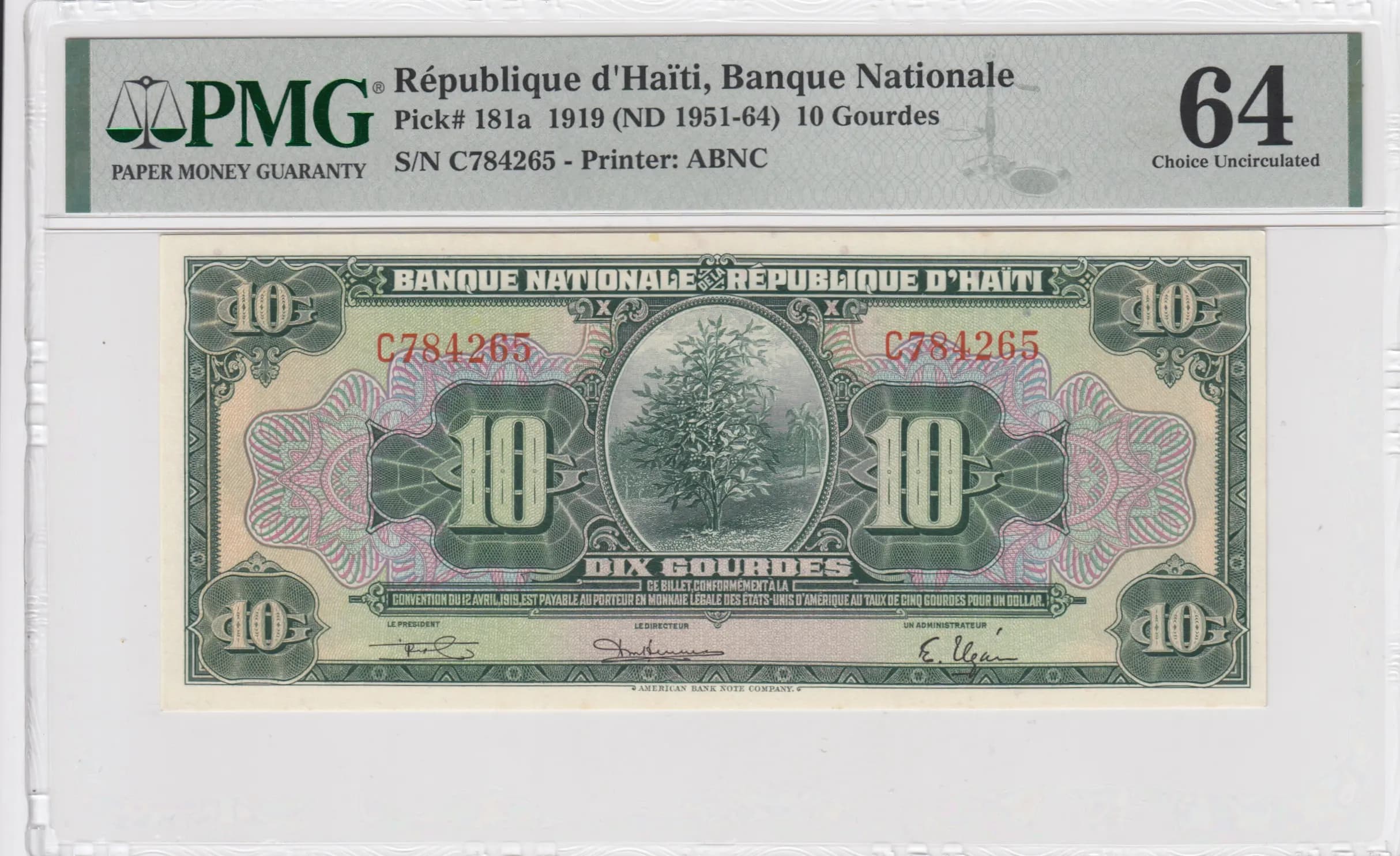
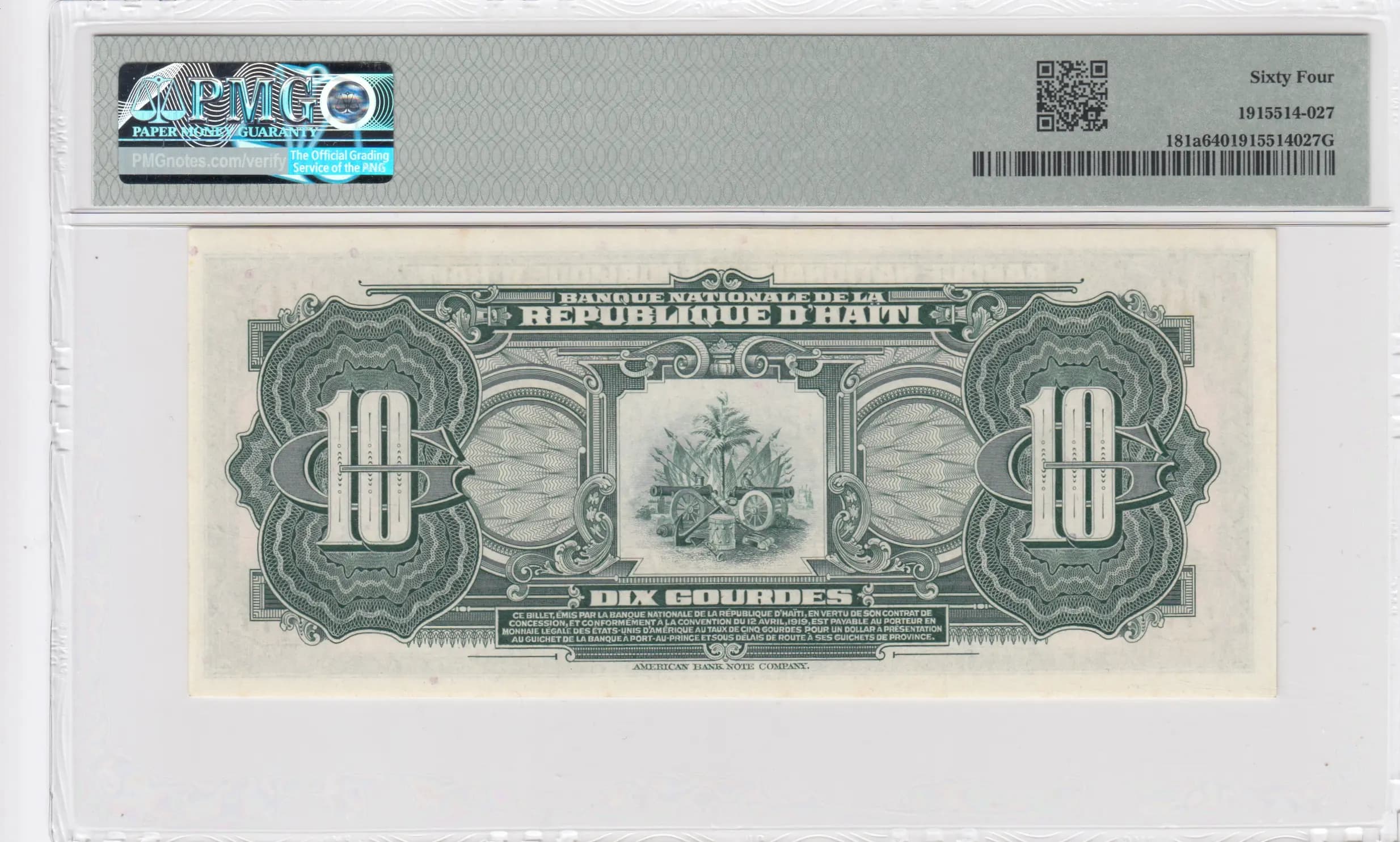
This is a PMG-graded 64 (Choice Uncirculated) example of the Haiti 10 Gourdes issued in 1951 under the Banque Nationale de la République d'Haiti. The note exhibits vibrant green and multicolored printing with fresh, crisp appearance and no signs of circulation. The central vignette features a tropical coffee plant on the obverse, reflecting Haiti's significant agricultural heritage, while the reverse displays colonial-era agricultural imagery, making this an attractive specimen of mid-20th century Caribbean currency design.
Common. This note was issued as a regular issue of the Banque Nationale de la République d'Haiti during a period of standard currency circulation (1951). The referenced eBay price data shows similar examples in VF condition selling for approximately $12.50–$26, which is consistent with common, readily available banknotes. The PMG population report indicates this is a standard cataloged variant with normal availability. No evidence suggests limited print runs, recall status, or short-lived issuing authority. While the PMG 64 grade represents an above-average condition specimen (versus lower grades more commonly encountered in circulation), the note itself is not scarce.
This note was issued under the Convention of April 12, 1919, which established Haiti's monetary framework and pegged the gourde to the U.S. dollar at a rate of five gourdes per dollar, reflecting Haiti's historical economic ties to the United States. The 1951 issue date places this note during Haiti's post-occupation period following the withdrawal of U.S. Marines in 1934, representing a time when Haiti was reasserting its monetary independence through the Banque Nationale. The prominence of the coffee plant and agricultural imagery on both sides underscores the critical importance of coffee exports to Haiti's 20th-century economy.
The obverse features a well-balanced composition with the denomination '10' in ornate, decorative frames positioned in all four corners. The central vignette displays a botanically detailed tropical coffee plant (Coffea arabica), symbolizing Haiti's primary agricultural export and economic foundation. Three signature lines appear at the bottom—labeled 'LE PRESIDENT' (The President), 'LE DIRECTEUR' (The Director), and 'UN ADMINISTRATEUR' (An Administrator)—representing the hierarchical authorization structure of the Banque Nationale. The reverse mirrors the aesthetic with matching corner denomination markers and presents a colonial-era allegorical scene depicting agricultural implements and tropical vegetation within a central oval vignette, symbolizing Haiti's productive capacity and colonial heritage. Throughout both sides, elaborate scrollwork, floral patterns in pink/red and green, and fine geometric borders create an intricate, engraved appearance intended to deter counterfeiting.
FRONT SIDE: 'Banque Nationale Republique d'Haiti' (National Bank of the Republic of Haiti) / 'DIX GOURDES' (Ten Gourdes) / 'Convention du 12 Avril 1919 est payable au porteur en monnaie legale des Etats-Unis d'Amerique au taux de cinq gourdes pour un dollar' (Convention of April 12, 1919 is payable to bearer in legal currency of the United States of America at the rate of five gourdes for one dollar) / 'American Bank Note Company' (printer attribution) / Serial number: C784265. BACK SIDE: 'Banque Nationale de la Republique d'Haiti' (National Bank of the Republic of Haiti) / 'DIX GOURDES' (Ten Gourdes) / 'American Bank Note Company' (printer attribution) / Legal tender specifications regarding currency redemption (fine print, partially legible).
Intaglio engraving (line engraving), executed by the American Bank Note Company of New York, as indicated by the printer attribution visible on both sides. The fine detail, crisp lines, ornate scrollwork, and complex geometric patterns are characteristic of ABNC's high-security engraving standards of the mid-20th century. The multi-color printing technique—combining green, red/pink, black, and cream tones—was achieved through successive passes typical of ABNC's color intaglio process.
This example is cataloged as Pick P-181a and bears the prefix letter 'C' in the serial number (C784265), indicating a specific printing batch from the 1951 issue. The visual analysis notes prefix letters B-D are documented for this issue type. The three-signature configuration with titles 'LE PRESIDENT,' 'LE DIRECTEUR,' and 'UN ADMINISTRATEUR' is consistent with the standard 1951 issue format. No overprints, date markings, or other variant indicators are visible on this specimen. The PMG holder confirms this is a single-variant cataloging (P-181s as the base Pick number), suggesting minimal variant differentiation within this issue.