1 gourde 1964
Market Prices
6 salesAbout This Note
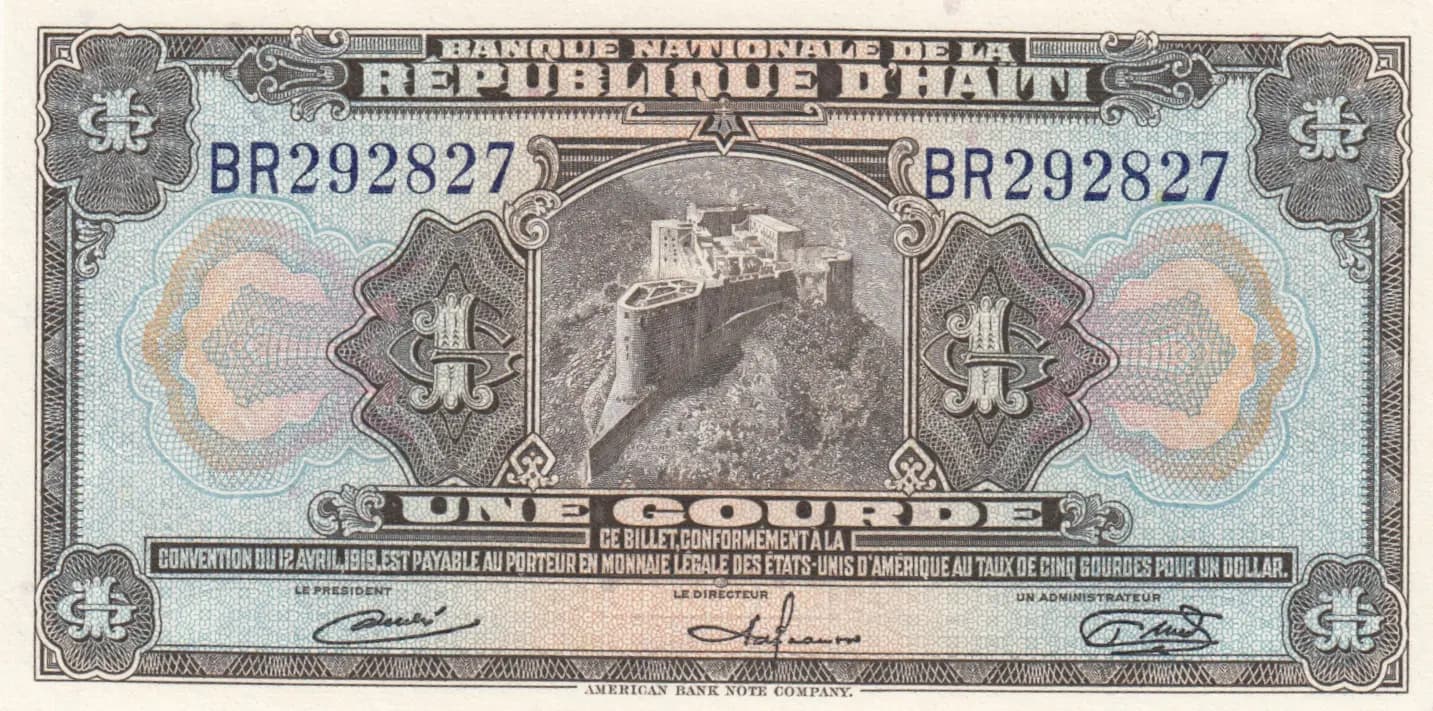
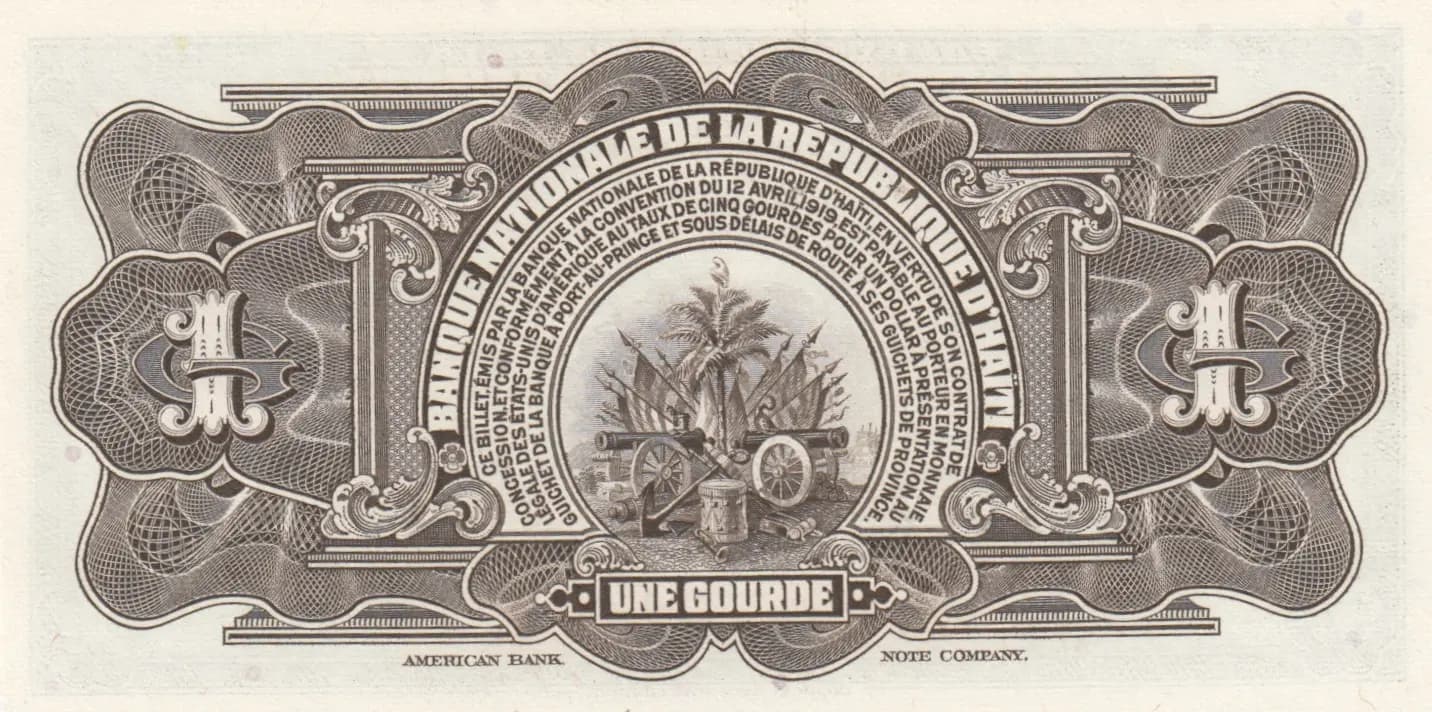
This is a striking 1964 Haitian 1 gourde note in uncirculated condition, featuring the iconic Henry Citadel (Citadelle Laferrière) at Milot on the obverse and Haiti's national coat of arms on the reverse. The note displays excellent preservation with sharp engraving, vibrant multicolored printing in light blue-green and brown tones, and no signs of circulation—making it an exemplary specimen of this regular issue from the American Bank Note Company.
Common. This is a regular-issue note from 1964 with substantial print run, evidenced by the availability of multiple serial number prefixes (BK-BT range noted in catalogs) and frequent market appearances. Recent eBay market data shows UNC specimens consistently selling in the $12–$20.50 range (2014–2024), with catalog values of $7.50 for UNC as of 2019. Notes at this price point and with this level of market liquidity are standard common-grade issues. No print run restrictions, no recall history, and no supply scarcity indicators apply to this Pick number.
Issued under the framework of the April 12, 1919 Convention between Haiti and the United States, this note reflects Haiti's monetary system of that era, which pegged the gourde to the US dollar at a fixed rate of five gourdes per dollar. The prominence of the Henry Citadel—the massive fortress built by King Henry Christophe in the early 19th century—celebrates Haiti's revolutionary heritage and independence, while the reverse's allegorical imagery with palm trees, cannons, and agricultural symbols emphasizes the nation's sovereignty and natural wealth.
The obverse features the Citadelle Laferrière (Henry Citadel), the monumental fortress located at Milot in northern Haiti, depicted on elevated terrain as a symbol of national strength and independence. The reverse displays Haiti's national coat of arms rendered allegorically within an ornate oval medallion, incorporating a palm tree, cannons, and agricultural implements to represent the nation's defense, natural resources, and agrarian foundation. Both sides are framed by elaborate baroque-style borders with fleur-de-lis designs in all four corners and ornamental scrollwork with cross symbols flanking the central vignettes. The note employs fine-line engraving throughout with a sophisticated color palette of light blue-green, brown, and gray on the front and black-on-cream on the back, with serial numbers appearing in the top corners of the obverse.
FRONT: 'BANQUE NATIONALE DE LA REPUBLIQUE D'HAITI' (National Bank of the Republic of Haiti); 'UNE GOURDE' (One Gourde); 'CE BILLET, CONFORMEMENT A LA CONVENTION DU 12 AVRIL, 1919, EST PAYABLE AU PORTEUR EN MONNAIE LEGALE DES ETATS-UNIS D'AMERIQUE AU TAUX DE CINQ GOURDES POUR UN DOLLAR' (This note, in accordance with the Convention of April 12, 1919, is payable to bearer in legal currency of the United States of America at the rate of five gourdes per dollar); 'LE PRESIDENT' (The President); 'LE DIRECTEUR' (The Director); 'UN ADMINISTRATEUR' (An Administrator); 'AMERICAN BANK NOTE COMPANY.' BACK: 'L'UNION FAIT LA FORCE DE LA REPUBLIQUE D'HAITI' (Union makes the strength of the Republic of Haiti); 'CONCORDIA RES PARVAE CRESCUNT DISCORDIA MAXIMA DILABUNTUR' (Small things grow by harmony, great things fall apart by discord—Latin motto); 'UNE GOURDE' (One Gourde); 'AMERICAN BANK NOTE COMPANY.'
Intaglio/engraved printing by the American Bank Note Company, New York. The note exhibits characteristic fine-line engraving with intricate guilloche patterns (described as new guilloche patterns with green underprint elements), complex decorative scrollwork, and detailed border work typical of ABNC's high-security banknote production. The multicolor printing on the obverse involved multiple passes to achieve the light blue-green background with brown and gray overlays, demonstrating advanced mid-20th-century banknote printing technology.
Serial number prefix BK observed on this specimen. The catalog notes variable prefix letters BK-BT for this issue, indicating multiple printing batches. The 1964 date and modified guilloche pattern distinguish it from the earlier P-178 variety (similar design, different guilloche) and later P-190. The specific serial format and prefix letter can help distinguish printing sessions, though all are considered the same Pick 185 variety. No signature varieties or significant overprint variations are documented for this issue.