1 gourde 1951
Market Prices
15 salesAbout This Note
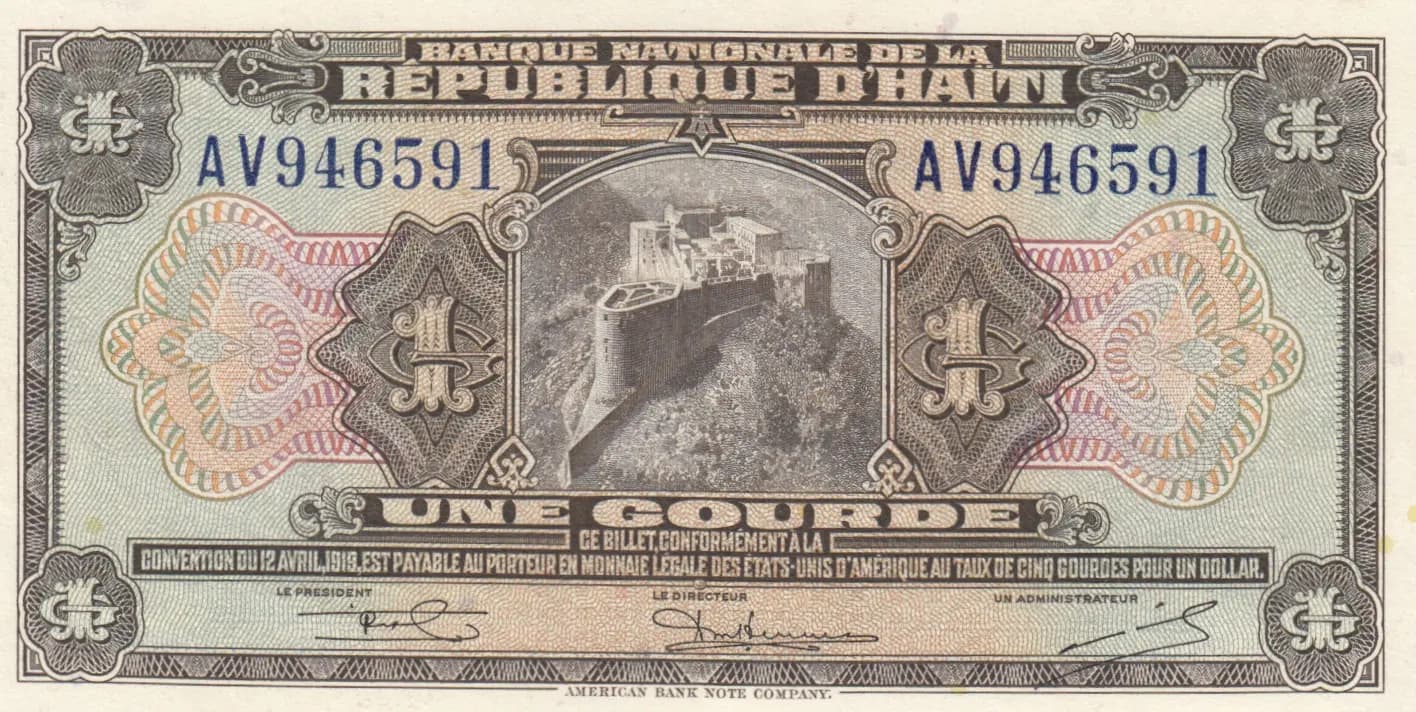
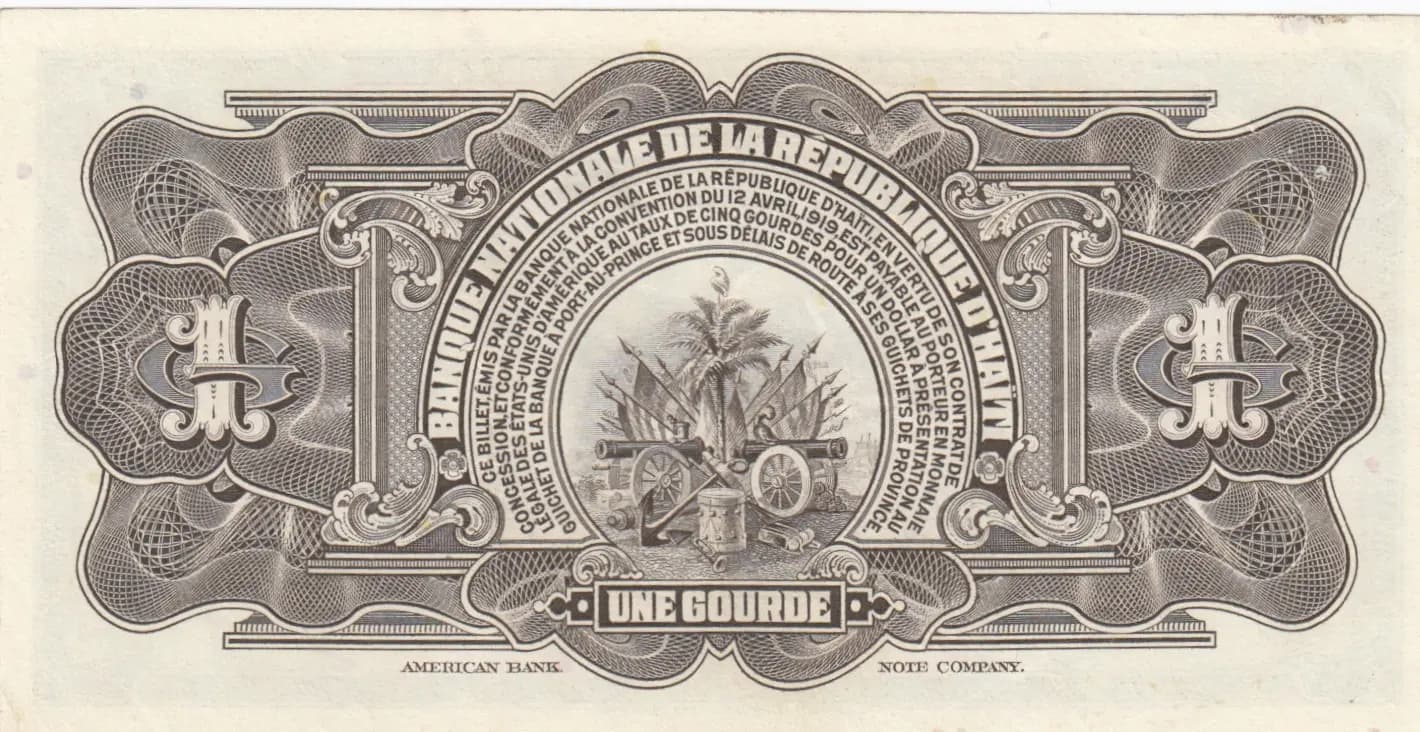
This Haiti 1 Gourde from 1951 (Pick P-178) is presented in UNC condition, displaying crisp printing quality with minimal wear throughout. The note features a striking Art Deco design with ornate corner elements and a central vignette of the Citadel of Henry, Haiti's most iconic fortress, rendered in tan, brown, and multicolored underprinting on the obverse. The reverse presents an allegorical design with agricultural and military implements within an ornate circular medallion, executed in fine black and white engraving.
Common. Secondary market data shows multiple UNC examples selling in the $6–$17.50 range across multiple decades (2009–2024), with VF examples consistently trading at $2–$12. This indicates a substantial surviving population of this note. The Pick catalog does not indicate a particularly short print run, and the note is readily available in the collector market at modest prices, typical of mid-20th-century Haitian currency.
This banknote reflects Haiti's monetary history under the 1919 Convention with the United States, during a period when the Haitian gourde was pegged to the U.S. dollar at a fixed rate of five gourdes per dollar. The prominent depiction of the Citadel of Henry (Citadelle Laferrière) on the obverse honors Haiti's colonial-era fortress built in the early 19th century as a symbol of national independence and sovereignty. The allegorical reverse design incorporating palm fronds, cannons, and agricultural tools represents Haiti's identity as an agricultural nation with a proud military heritage during the post-occupation period.
The obverse features a commanding central vignette of the Citadelle Laferrière (Citadel of Henry), Haiti's famous hilltop fortress located in Milot in the Nord Department, depicted as a fortified structure on a hillside. The design is framed by elaborate baroque-style scrollwork and geometric ornamentation, with fleur-de-lis symbols anchoring all four corners—a recurring heraldic motif reflecting Haiti's French colonial heritage. The color scheme employs tan and beige tones with dark brown engraving and red/pink accents, creating visual depth. The reverse presents an allegorical composition within a circular wreath, incorporating palm fronds (symbolizing Haiti's tropical agriculture), military cannons, and agricultural implements, rendered entirely in fine black engraving. Serial numbers appear in both top corners, with prefix letters AS-BM noted in catalog references.
FRONT: 'Banque Nationale de la République d'Haiti' (National Bank of the Republic of Haiti) | 'Une Gourde' (One Gourde) | 'Ce billet conformément à la Convention du 12 Avril 1918, est payable au porteur en monnaie légale des États-Unis d'Amérique au taux de cinq gourdes pour un dollar.' (This note, in conformity with the Convention of April 12, 1918, is payable to bearer in legal currency of the United States of America at the rate of five gourdes per dollar.) | Signature titles: 'Le Président' (The President), 'Le Directeur' (The Director), 'Un Administrateur' (An Administrator) | 'American Bank Note Company'. BACK: 'Banque Nationale de la République d'Haiti' (National Bank of the Republic of Haiti) | 'Une Gourde' (One Gourde) | 'American Bank Note Company'
Intaglio engraving (line engraving) by the American Bank Note Company of New York, as indicated by the printer's mark on both sides of the note. The fine line work, intricate geometric patterns, ornate scrollwork, and detailed allegorical imagery are characteristic of high-quality intaglio production from this era. The precise registration and crisp impression visible in the UNC example demonstrate the superior quality of ABNC's security printing work.
This example exhibits serial number prefix AS-BM as documented in the catalog reference. The note conforms to the 1951 issuance under the 1919 Convention framework. The 'Law of 1919' designation printed on the obverse identifies this as part of the standardized post-Convention issue series. A later modification with altered guilloche patterns exists as Pick P-185, making this P-178 example the standard earlier variety of this denomination and design.