1 gourde 1919
Market Prices
6 salesAbout This Note
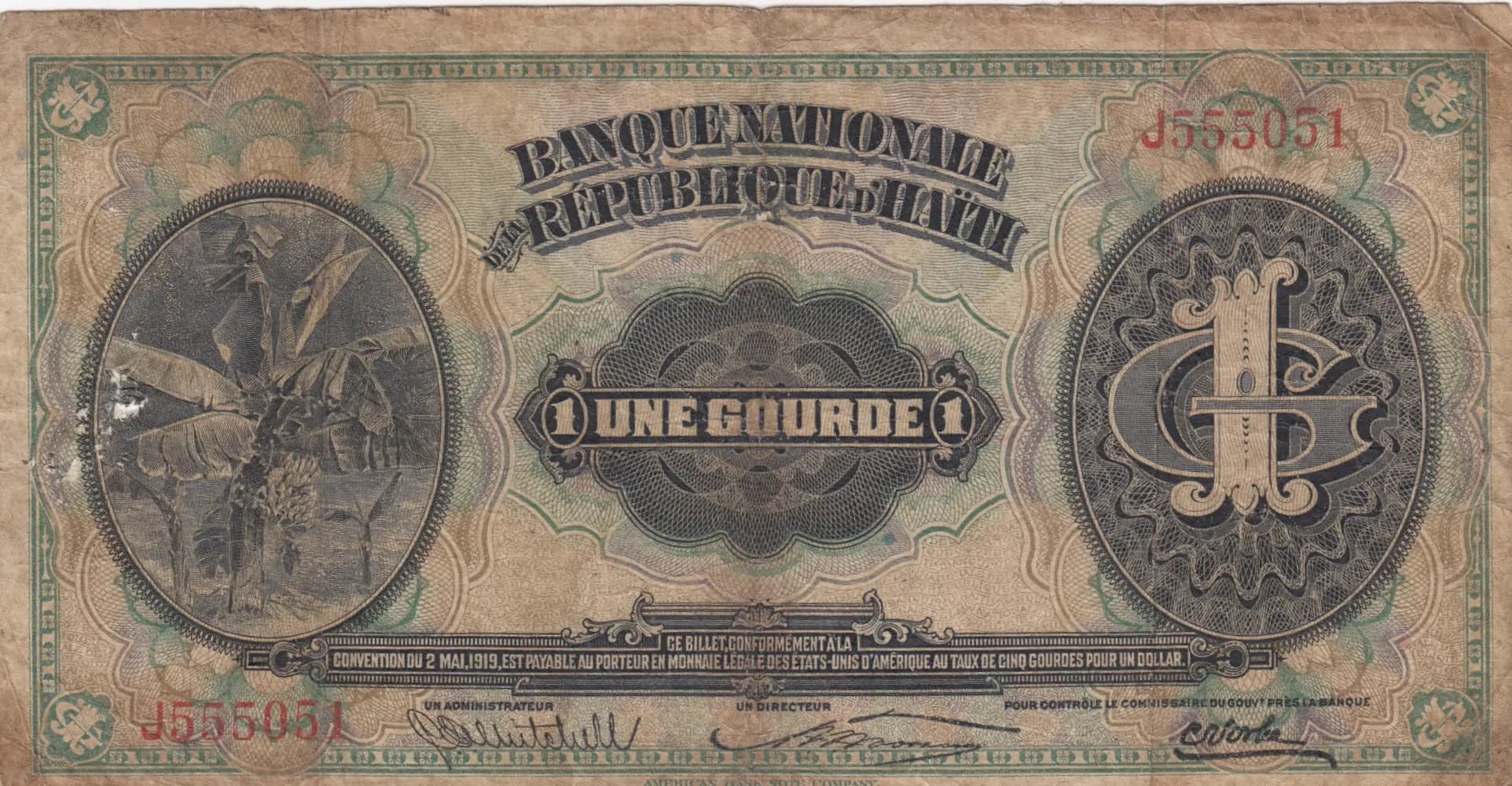
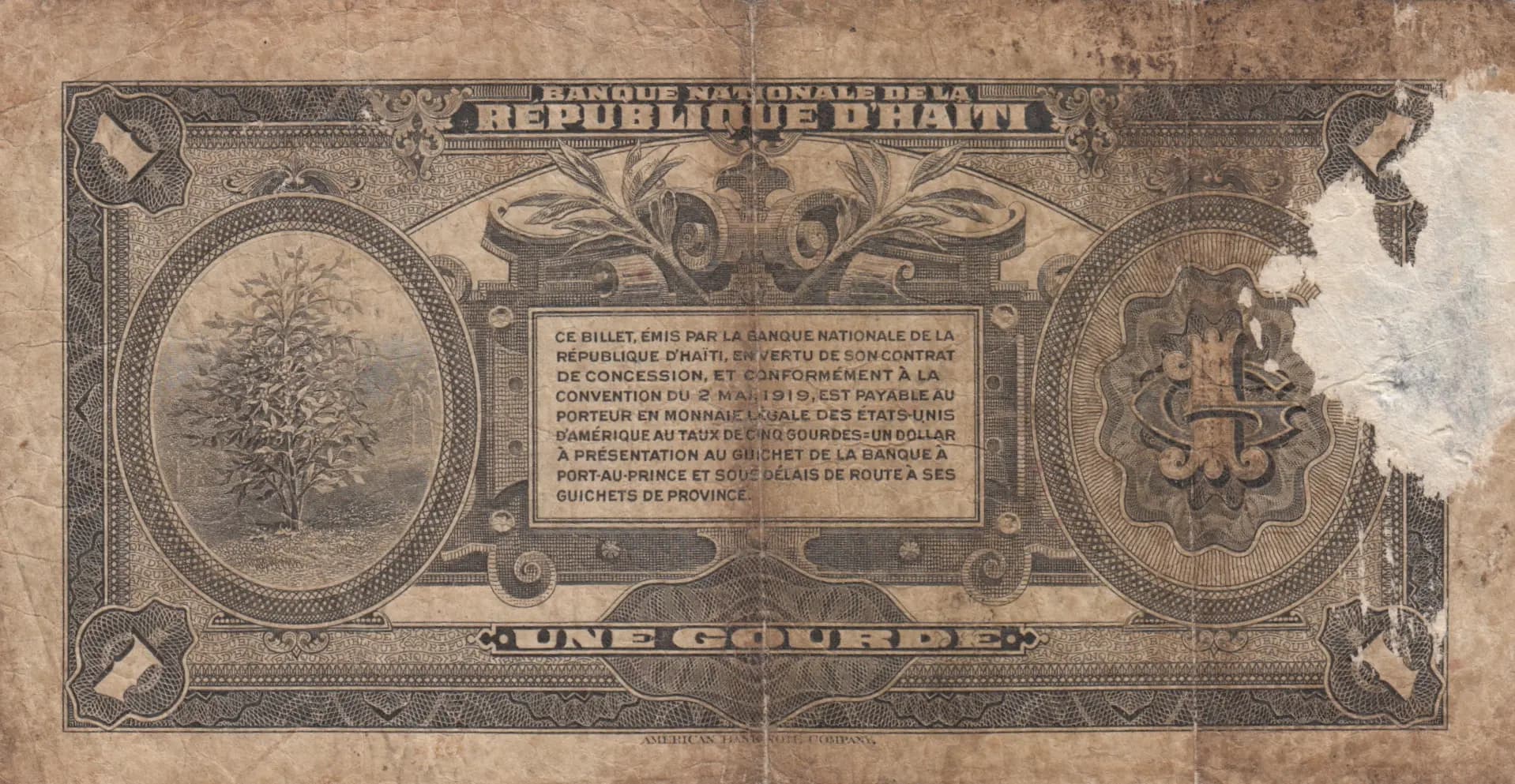
This 1919 Haiti 1 Gourde note (P-150) presents a classic example of early 20th-century Haitian currency featuring ornate Art Nouveau-style borders and dual medallion portraits on both sides. The note displays the characteristic green and brown color scheme with period-appropriate engraved security features, though it shows significant age-related wear including foxing, creasing, and discoloration consistent with its VG grade. The presence of the May 2, 1919 Convention text linking Haitian currency to U.S. dollar parity makes this a historically significant piece documenting Haiti's monetary relationship with the United States during the American occupation period.
Common. While no recent professional grading data from PMG is available for comparison, the eBay market history shows consistent sales activity with VG-grade examples selling for $3-$5 range in recent transactions, and Fine examples consistently achieving $18-$39. The print run of 1919 Haitian 1 gourdes appears to have been substantial, and no evidence suggests scarcity or recall. This is a standard-issue banknote from a stable issuing authority during a defined printing period, with no indicators of rarity despite its historical significance.
This note was issued during the Haitian-American financial reorganization period following the 1915 U.S. occupation, as evidenced by the prominent reference to the Convention of May 2, 1919, which established the fixed exchange rate of five gourdes per U.S. dollar. The dual imagery—featuring both a military portrait and heraldic symbols on the front, alongside a naturalistic vegetation scene on the reverse—reflects Haiti's attempt to assert national sovereignty and agricultural identity while operating under the constraints of American financial oversight. The Banque Nationale de la République d'Haïti's reliance on American Bank Note Company (New York) for printing underscores the practical dominance of U.S. banking infrastructure during this transitional period in Haitian monetary history.
The front of the note features a symmetrical design anchored by two oval medallions: the left contains a military portrait (likely a Haitian national or military figure from the period), rendered in fine engraved detail with formal uniform dress; the right displays the national coat of arms with elaborate heraldic flourishes. Between these medallions sits a central cartouche bearing 'UNE GOURDE' in bold text. The overall composition is framed by intricate Art Nouveau-influenced decorative borders combining floral and geometric patterns in green and beige tones. The reverse maintains this formal symmetry with a landscape medallion on the left depicting tropical vegetation and natural scenery (consistent with the catalog reference to a coffee plant or banana tree design), balanced by the coat of arms on the right. The extensive French-language legal text dominating the reverse explains the monetary convention and redemption terms. All design elements reflect the high standards of American Bank Note Company's late-19th/early-20th century engraving work.
FRONT SIDE: 'Banque Nationale de la République d'Haïti' (National Bank of the Republic of Haiti) | 'Une Gourde' (One Gourde) | 'UN ADMINISTRATEUR' (An Administrator) | 'UN DIRECTEUR' (A Director) | 'Pour Contrôle le Commissaire du Gouvernement près la Banque' (For Control the Government Commissioner Near the Bank) | 'Le présent billet, conformément à la convention du 2 mai 1919, est payable au porteur en monnaie légale des États-Unis d'Amérique au taux de cinq gourdes pour un dollar.' (This present note, in accordance with the Convention of May 2, 1919, is payable to the bearer in legal currency of the United States of America at the rate of five gourdes per dollar.) | Serial number J5755011. BACK SIDE: 'Banque Nationale de la République d'Haïti' (National Bank of the Republic of Haiti) | 'Une Gourde' (One Gourde) | 'Ce billet, émis par la Banque Nationale de la République d'Haïti, en vertu de son contrat de concession, et conformément à la convention du 2 mai 1919, est payable au porteur en monnaie légale des États-Unis d'Amérique au taux de cinq gourdes-un dollar à présentation au guichet de la Banque à Port-au-Prince et sous délais de route à ses guichets de province.' (This note, issued by the National Bank of the Republic of Haiti, by virtue of its concession contract, and in accordance with the Convention of May 2, 1919, is payable to the bearer in legal currency of the United States of America at the rate of five gourdes per dollar upon presentation at the counter of the Bank in Port-au-Prince and within the time limit of travel to its provincial counters.) | 'American Bank Note Company' (printer attribution).
This note was produced using intaglio engraving (copperplate/steel plate engraving), the standard security printing method employed by American Bank Note Company. Evidence includes the sharp, fine line work visible in the border patterns, portrait medallions, and heraldic imagery; the complex cross-hatching and stippling techniques used for tonal gradation; and the dimensional relief characteristic of engraved currency. The multi-color printing (black, green, brown) was applied through successive passes of engraved plates, a technique perfected by ABNC for high-security banknote production. Security features integrated into the engraving—such as the intricate border designs and fine line network—served to deter counterfeiting.
The PMG population report indicates two cataloged variants exist for this Pick number (P-150a and P-150s), suggesting the possibility of signature varieties or other minor variations. The visual analysis identifies serial number J5755011 with an unclear prefix letter, falling within the documented A-L prefix range noted in external references. The note carries '2 signature varieties' according to catalog data, though specific signature identification is not determinable from the image quality provided. The 'L. 1919' date designation on some references may indicate a legal/legislative date distinct from the printing date.