1 gourde 1916
Market Prices
5 salesAbout This Note
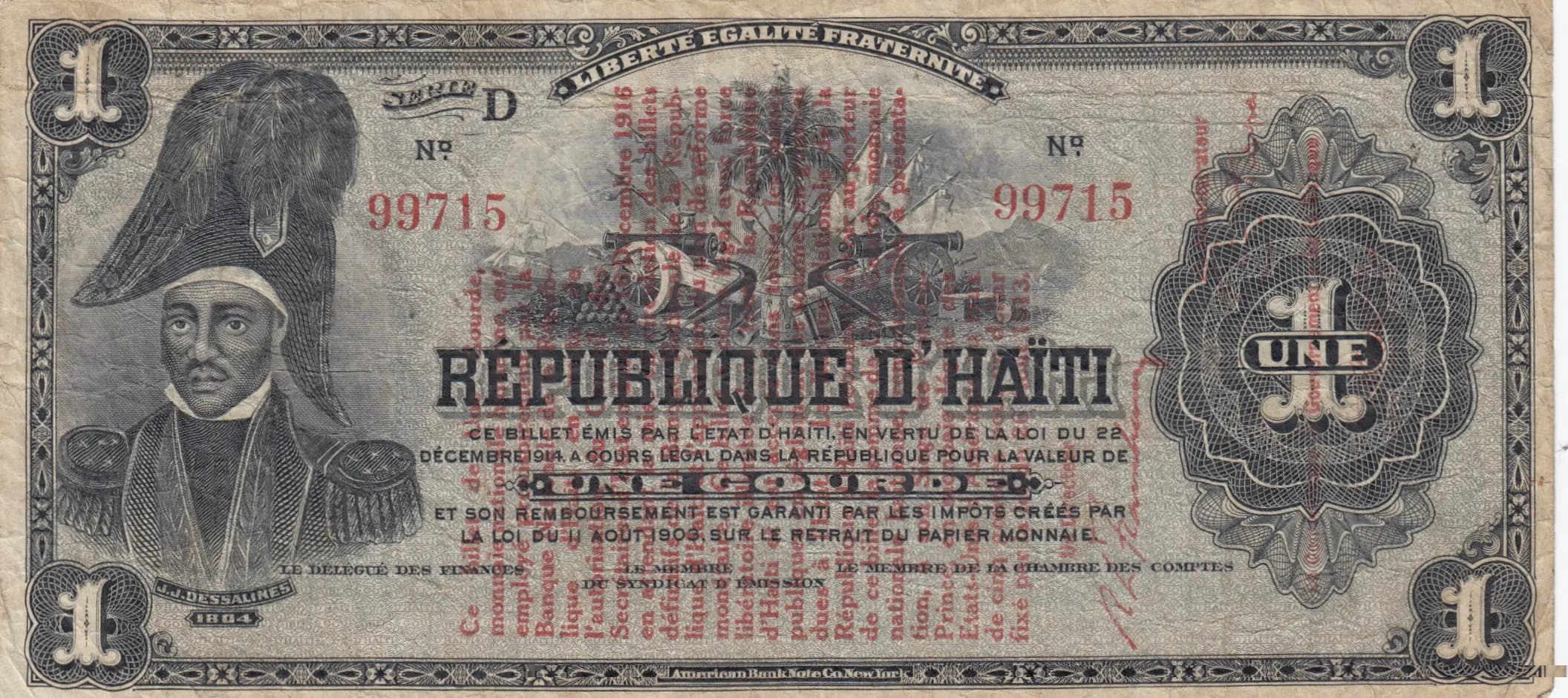
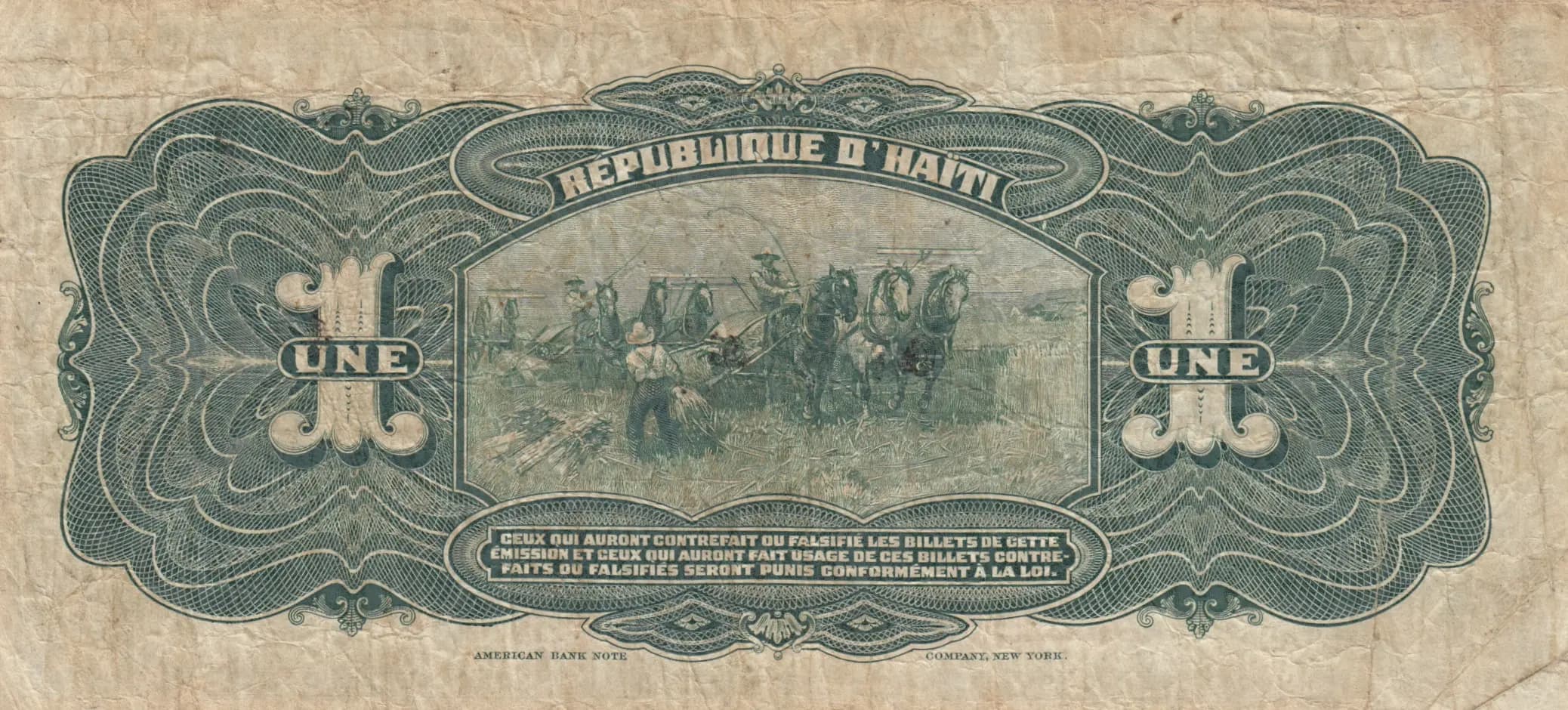
This 1916 Haiti 1 gourde banknote (Pick P-137) presents a well-preserved example of early 20th-century Haitian currency issued by the Banque Nationale de la République d'Haïti. The note features ornate engraved designs with a portrait of Jean-Jacques Dessalines on the obverse and a historical fieldwork scene on the reverse, printed in red/black on the front and blue-green on the back. In Fine condition, this note shows appropriate aging with yellowed paper and visible wear, yet retains clear legibility of its intricate borders, security text, and the distinctive red overprint characteristic of the 1916 issue.
Common. The eBay price history provided shows consistent sales ranging from $11.50 to $41.00 across multiple grades (F to VF) over more than a decade, with typical auction activity of 8-28 bids per sale. The catalog value in Fine condition is listed at $50, and this note's Fine grade falls squarely within normal market expectations. Haiti's 1 gourde denominations from 1916 were produced in substantial quantities by ABNC and remain readily available in the collector market. The absence of any population scarcity data or special remarks in the PMG catalog, combined with consistent low-to-moderate market pricing, confirms this is a common issue.
This banknote was issued under the Law of December 22, 1914, during a period of significant political and economic restructuring in Haiti following the U.S. occupation that began in 1915. The prominent depiction of Jean-Jacques Dessalines, Haiti's founding emperor and national hero, reinforces state identity and legitimacy during a turbulent period. The reverse vignette depicting fieldwork and agricultural labor reflects Haiti's economy and the labor-based wealth that underpinned the nation's early development in the post-colonial era.
The obverse features a military portrait of Jean-Jacques Dessalines (1758-1806), Haiti's founding Emperor Jacques I, depicted on the left side in early 19th-century military dress with a distinctive tall plumed hat, military uniform with epaulettes, befitting his status as the general who led Haiti to independence. The center contains a detailed historical vignette showing a military encampment or battlefield scene with armed soldiers and cannons, evoking Haiti's revolutionary struggle for independence. The design is framed by elaborate ornamental borders with floral and geometric patterns in the corners, incorporating shield emblems marked with denomination indicators. The entire note employs red and black engraving on a cream background. The reverse depicts a historical or colonial gathering scene with multiple figures and mounted horsemen in a landscape setting, representing fieldwork and agricultural or administrative activities central to Haiti's economy. This central vignette is surrounded by extensive ornamental scrollwork and flourishes in all four corners. The reverse employs predominantly blue-green tones on the cream background, with symmetrical denomination cartouches on both sides.
FRONT SIDE: 'Liberté Égalité Fraternité' (Liberty, Equality, Fraternity) — the French revolutionary motto. 'République d'Haïti' (Republic of Haiti). 'Ce billet émis par l'État d'Haïti en vertu de la Loi du 22 Décembre 1914 à cours légal dans la République pour la valeur de Une Gourde' (This banknote issued by the State of Haiti under the Law of December 22, 1914, having legal currency in the Republic for the value of One Gourde). 'Et son remboursement est garanti par les impôts créés par la Loi du 11 Août 1903, sur le retrait du papier monnaie' (And its reimbursement is guaranteed by taxes created by the Law of August 11, 1903, on the withdrawal of paper money). 'Le Délégué des Finances' (The Finance Delegate). 'Le Membre de la Chambre des Comptes' (The Member of the Chamber of Accounts). 'American Bank Note Co. New York' (printer attribution). Serial number designation 'D' with serial number 99715. REVERSE SIDE: 'République d'Haïti' (Republic of Haiti). Denomination markers 'ONE' and 'UNE' in decorative cartouches. 'Ceux qui auraient contrefait ou falsifié les billets de cette émission et ceux qui auraient fait usage de ces faits du falsifiés seront punis conformément à la Loi' (Those who would have counterfeited or falsified the banknotes of this emission and those who would have made use of these counterfeits will be punished in accordance with the law). 'American Bank Note Company, New York' (printer attribution).
This banknote was produced by the American Bank Note Company, New York, using engraved intaglio printing (line engraving), the standard security printing method for banknotes in this era. The intricate border designs, fine-line work visible in the portraits and vignettes, and the multi-color printing (red/black obverse, blue-green reverse) are characteristic of high-security intaglio engraving. The red security overprint text and serial numbers were applied as additional security measures. No evidence of modern printing techniques; the visual characteristics confirm traditional engraved plate production.
This specific note bears the letter designation 'D' on the obverse and serial number 99715. The 1916 issue (L. 16.12.1916) represents an overprint variety on the earlier HAITI P-131 design, as noted in the external reference. The red overprint text 'Banque Nationale de la République d'Haïti' distinguishes this from the previous issue and from the later 1919 overprint variant (P-140). No significant signature or date varieties are observed beyond the standard 1916 dating. The note conforms to the standard P-137 variety without indication of unusual serial number prefixes or printing anomalies that would denote a distinct sub-variety.