5000 francs 1958
Market Prices
2 salesAbout This Note
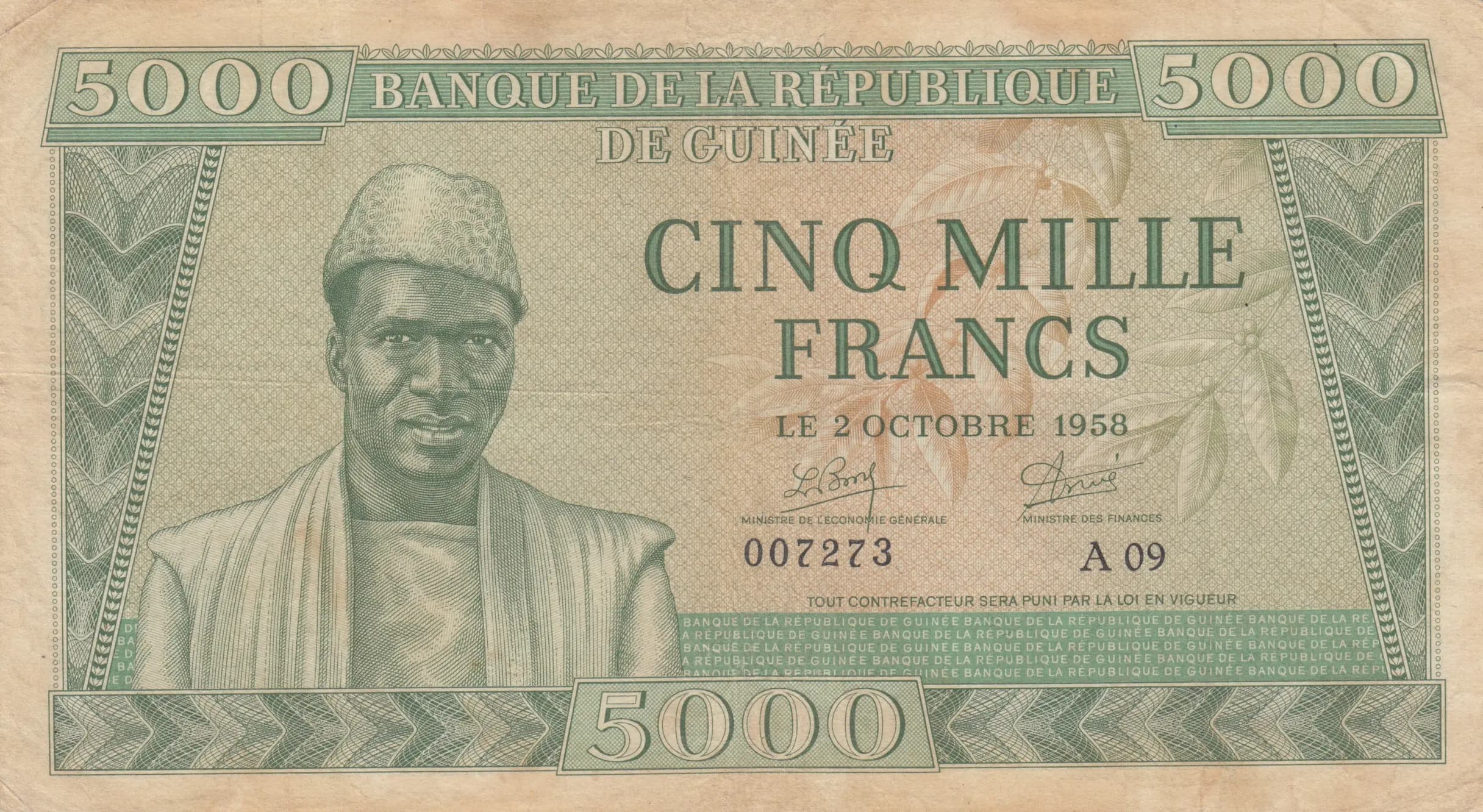
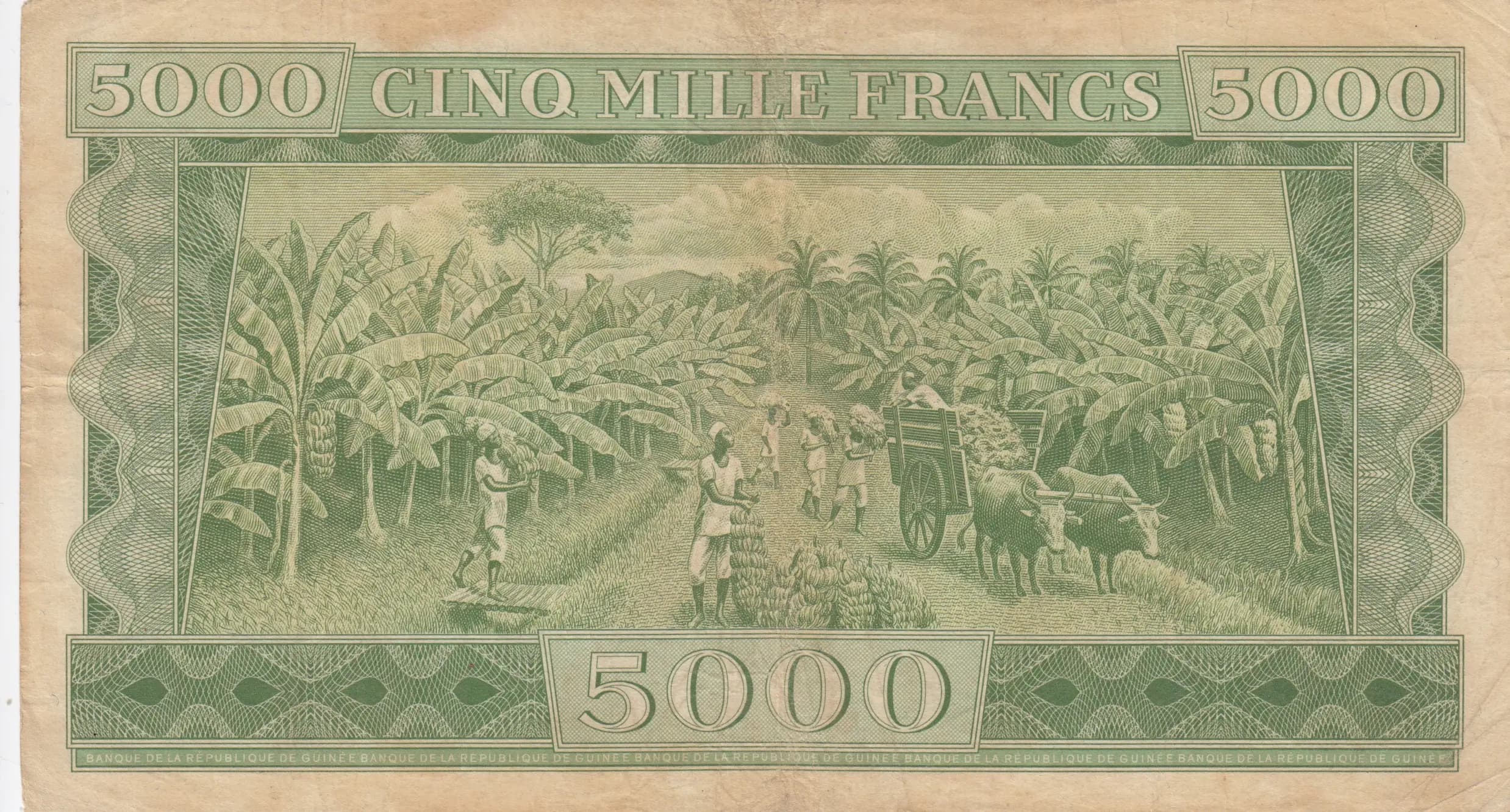
This is a Fine grade example of Guinea's first post-independence banknote, the 5000 Francs issued October 2, 1958, featuring President Ahmed Sékou Touré in traditional boubou attire on the obverse and a detailed agricultural scene depicting banana harvesting on the reverse. The note exhibits the typical tan-cream patina and light foxing consistent with age, with clear engraving and no major damage, making it a desirable early example of Guinea's numismatic heritage from the crucial moment of independence.
Common. While early post-independence currency is historically significant, the 5000 Francs Pick-10 from 1958 was issued in quantities consistent with regular circulation. The eBay price data indicates F-grade examples sold for $382.77 (2013) and VF grades for $154.49 (2020), with 2016 catalogue values of $75 (VG) to $400 (VF), suggesting moderate collector interest but steady availability. The note is neither scarce nor rare in typical circulated grades and appears regularly in dealer stocks and auction listings.
This note was issued on October 2, 1958, the very date Guinea declared independence from France, making it historically significant as the first currency of the newly sovereign nation. The portraiture of Ahmed Sékou Touré, Guinea's founding president, and the prominence of agricultural imagery reflecting banana harvest scenes underscore the young nation's economic foundations and Touré's leadership during a transformative period. The French language inscriptions and institutional naming reflect the transitional nature of Guinea's early post-colonial monetary system.
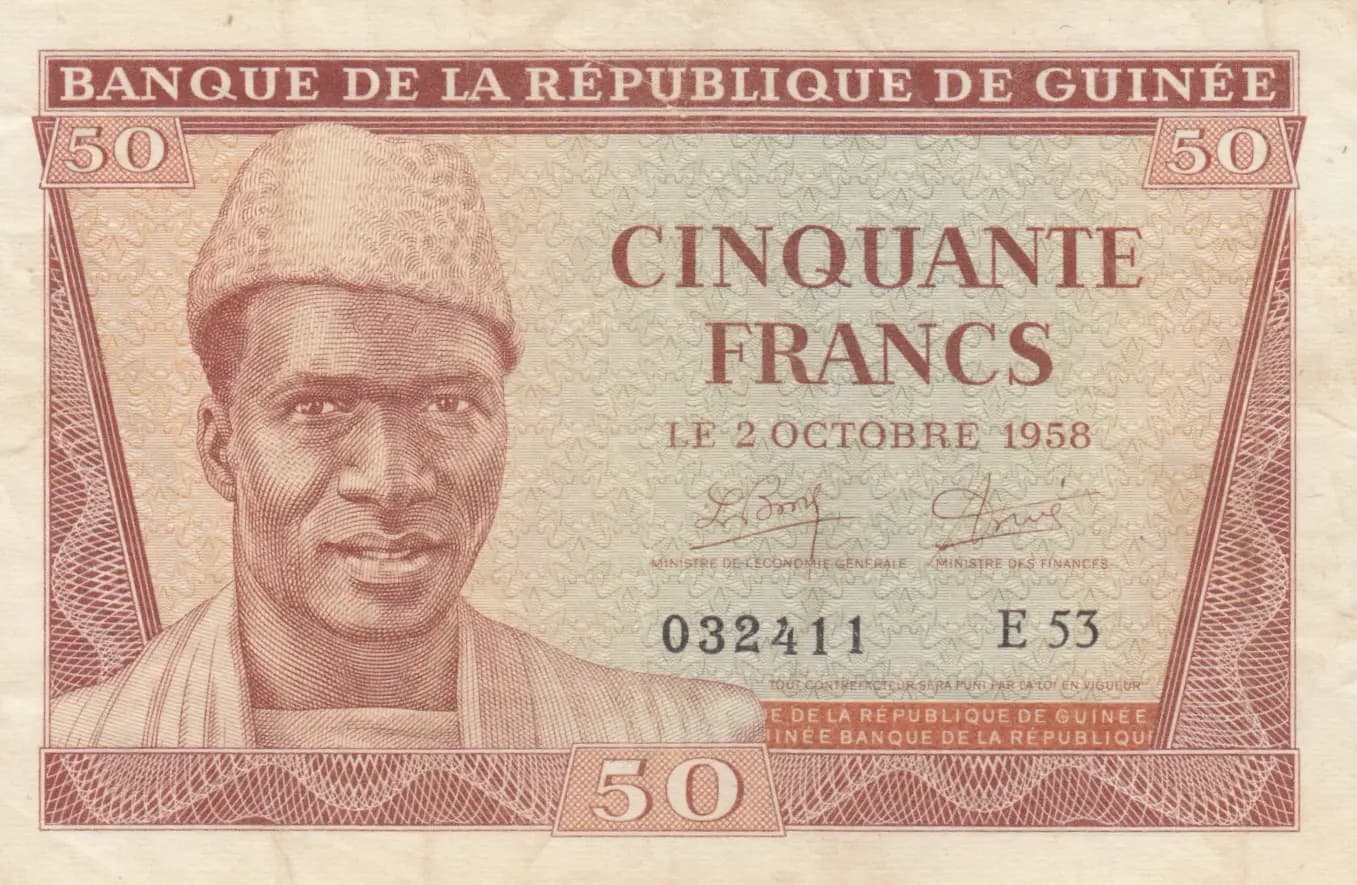
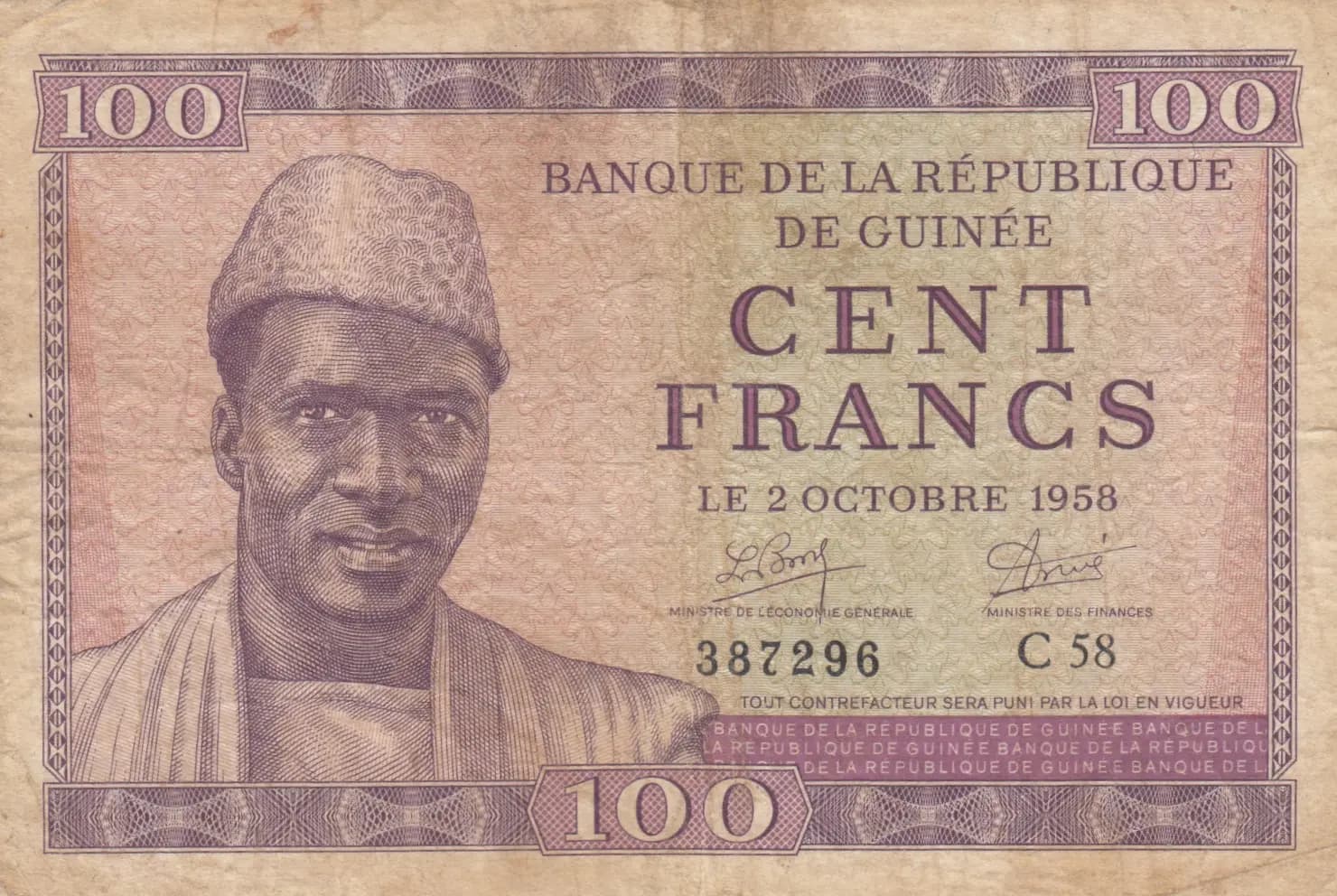
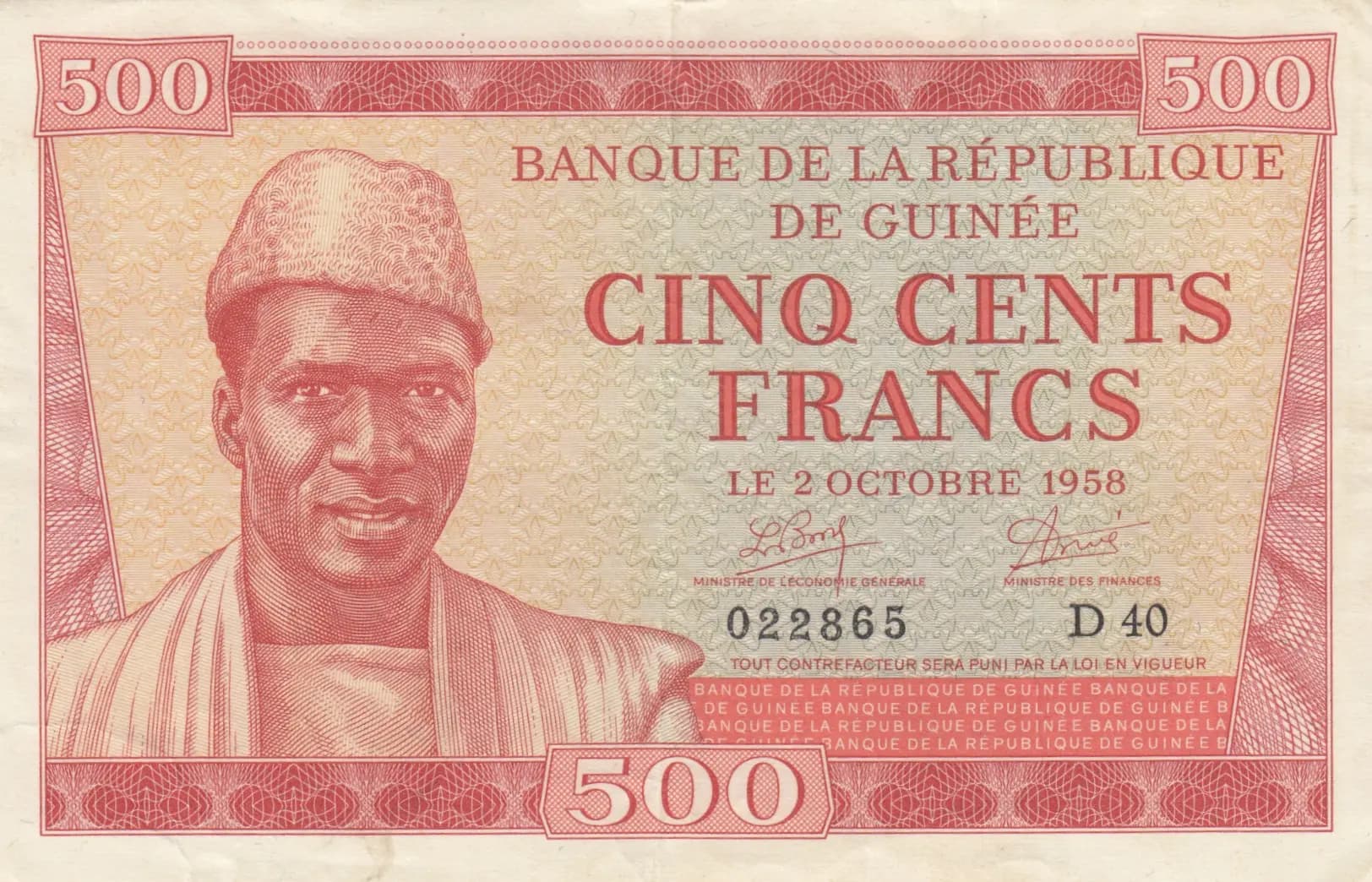
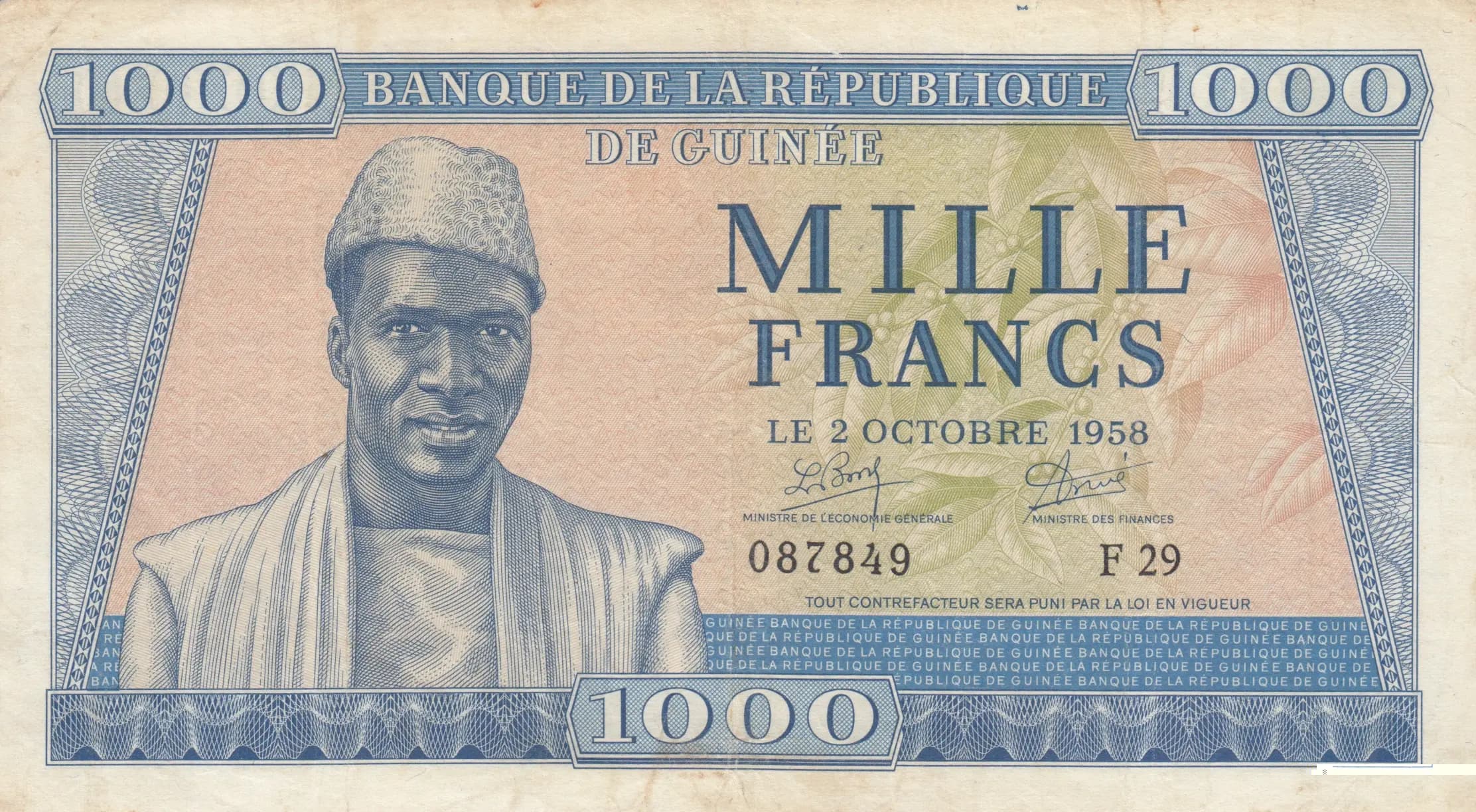
The obverse features a formal portrait of President Ahmed Sékou Touré rendered in fine engraving, depicted wearing traditional Guinean boubou clothing with an elaborate head wrap, positioned centrally within an ornate geometric border frame composed of leaf and vine patterns. The reverse displays an expansive allegorical agricultural landscape scene emphasizing Guinea's economic base, with multiple workers engaged in banana harvesting among banana plants and palm trees, with a traditional cart or agricultural implement visible, set against a backdrop of rolling tropical terrain. Both sides employ symmetrical decorative geometric patterns as border elements and incorporate repeated institutional text as security measures. The color scheme throughout utilizes green and tan-beige tones characteristic of 1950s currency engraving.
FRONT SIDE: 'BANQUE DE LA REPUBLIQUE DE GUINÉE' (Bank of the Republic of Guinea) / '5000' and 'CINQ MILLE FRANCS' (5000 and Five Thousand Francs) / 'LE 2 OCTOBRE 1958' (October 2, 1958) / 'MINISTRE DE L'ECONOMIE GENERALE' (Minister of General Economy) / 'MINISTRE DES FINANCES' (Minister of Finance) / 'A 09' (Series designation) / '007273' (Serial number portion) / 'TOUT CONTREFACTEUR SERA PUNI PAR LA LOI EN VIGUEUR' (All counterfeiters will be punished by law in force). BACK SIDE: '5000' and 'CINQ MILLE FRANCS' (5000 and Five Thousand Francs) / 'BANQUE DE LA REPUBLIQUE DE GUINEE' repeated in border pattern (Bank of the Republic of Guinea).
This note was produced using intaglio (engraved) printing, the standard security printing method for the era, evidenced by the fine line work visible throughout the portraits, landscape details, and decorative borders. The technical quality of the engraving, particularly the complex agricultural scene with multiple figures and landscape elements, and the fine geometric pattern work, indicates professional security printer production. The specific printer for Banque Centrale de la Republique de Guinee's first issue is not definitively documented in standard references, though such notes were typically produced by established European security printers serving post-colonial African central banks.
The observed example exhibits series designation 'A 09' with serial number portion '007273', indicating an early printing from the first series of this issue. Early series numbers (A 01 through A 09) represent the initial print run of October 1958. No major varieties (such as overprints, signature variations, or date variants) are documented for Pick-10, making this a standard example of the standard variety. The condition grade F places this specimen in the typical range for surviving examples of this nearly 70-year-old banknote.