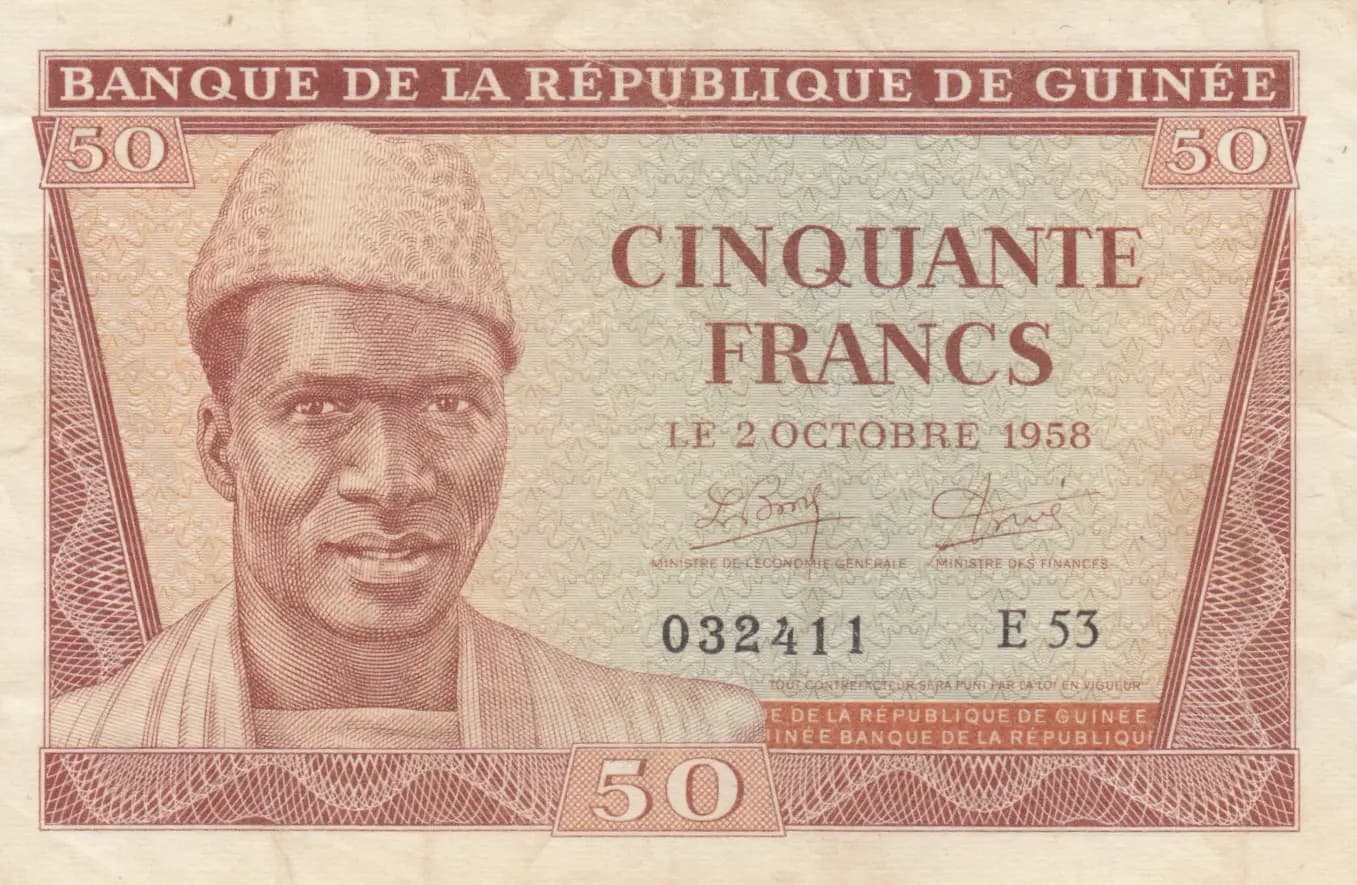
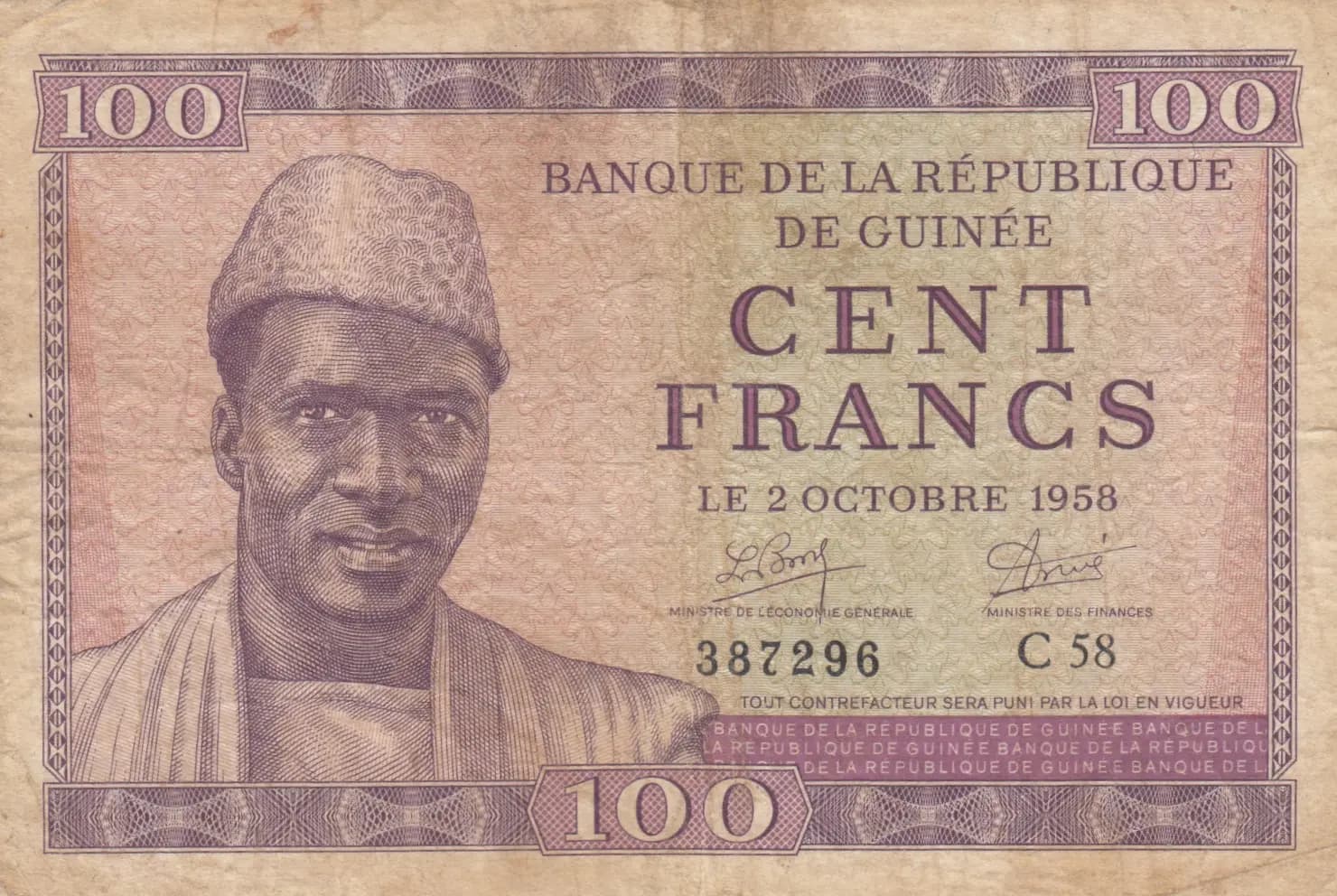
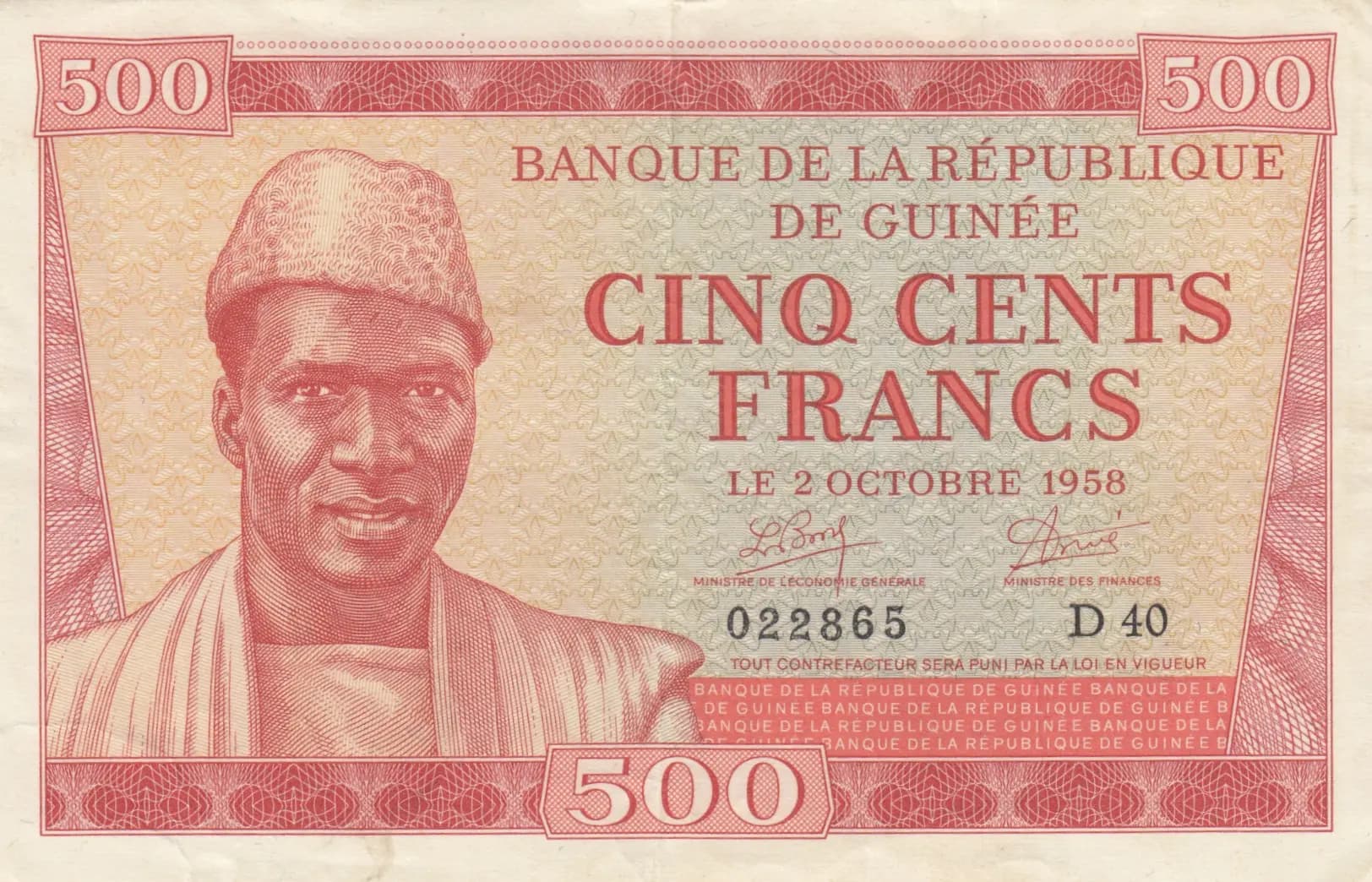
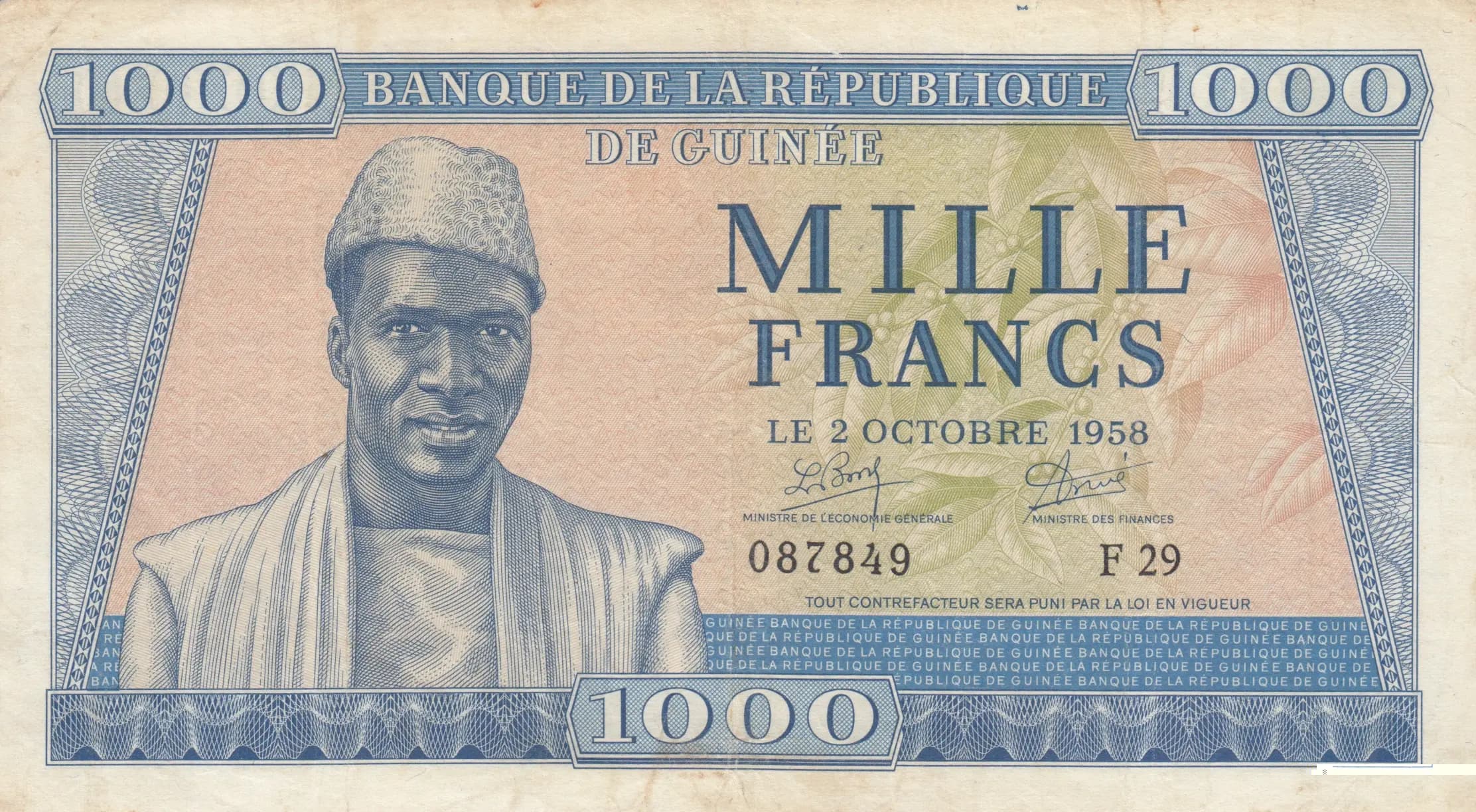
500 francs 1960
Market Prices
20 salesAbout This Note
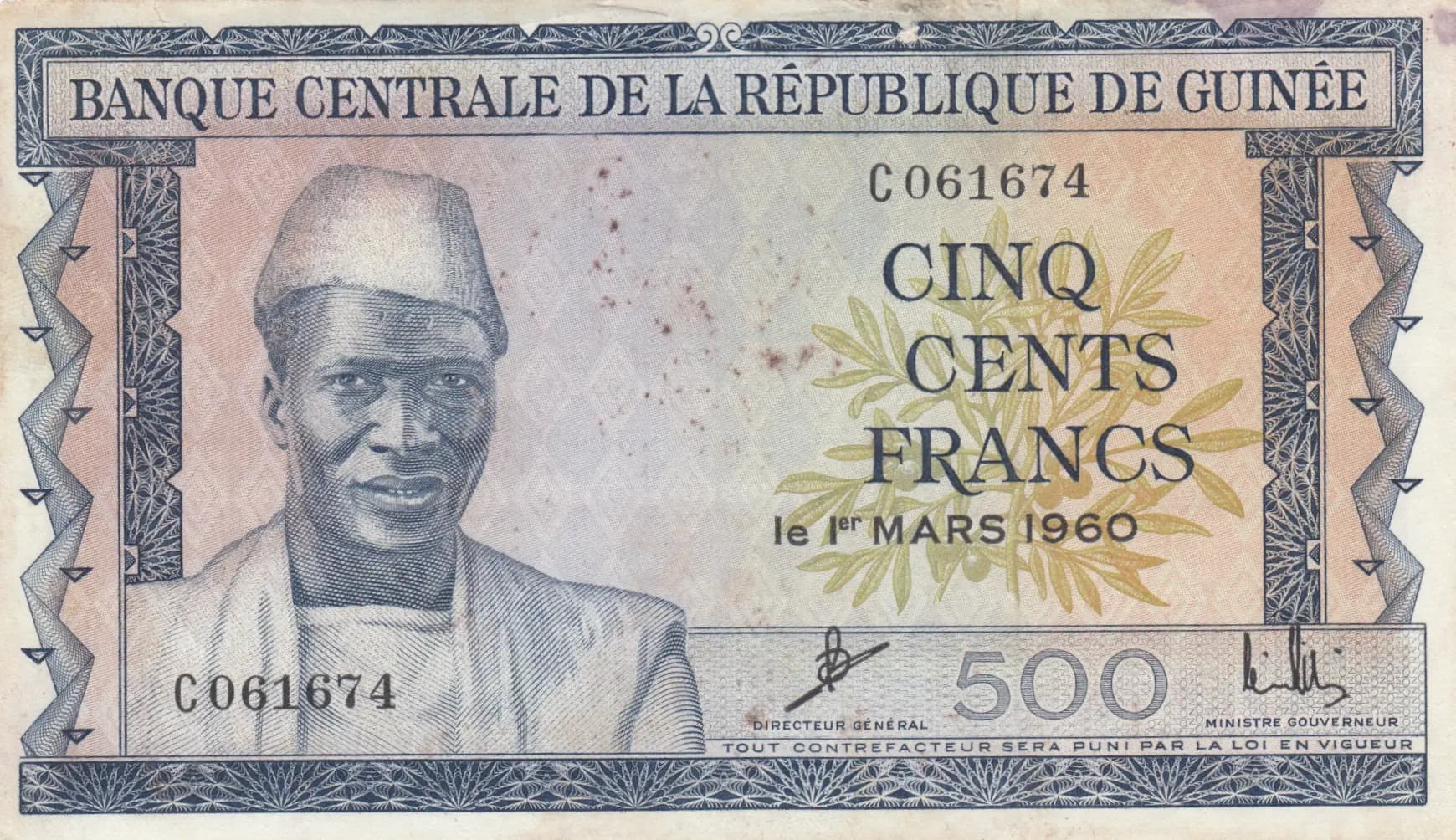
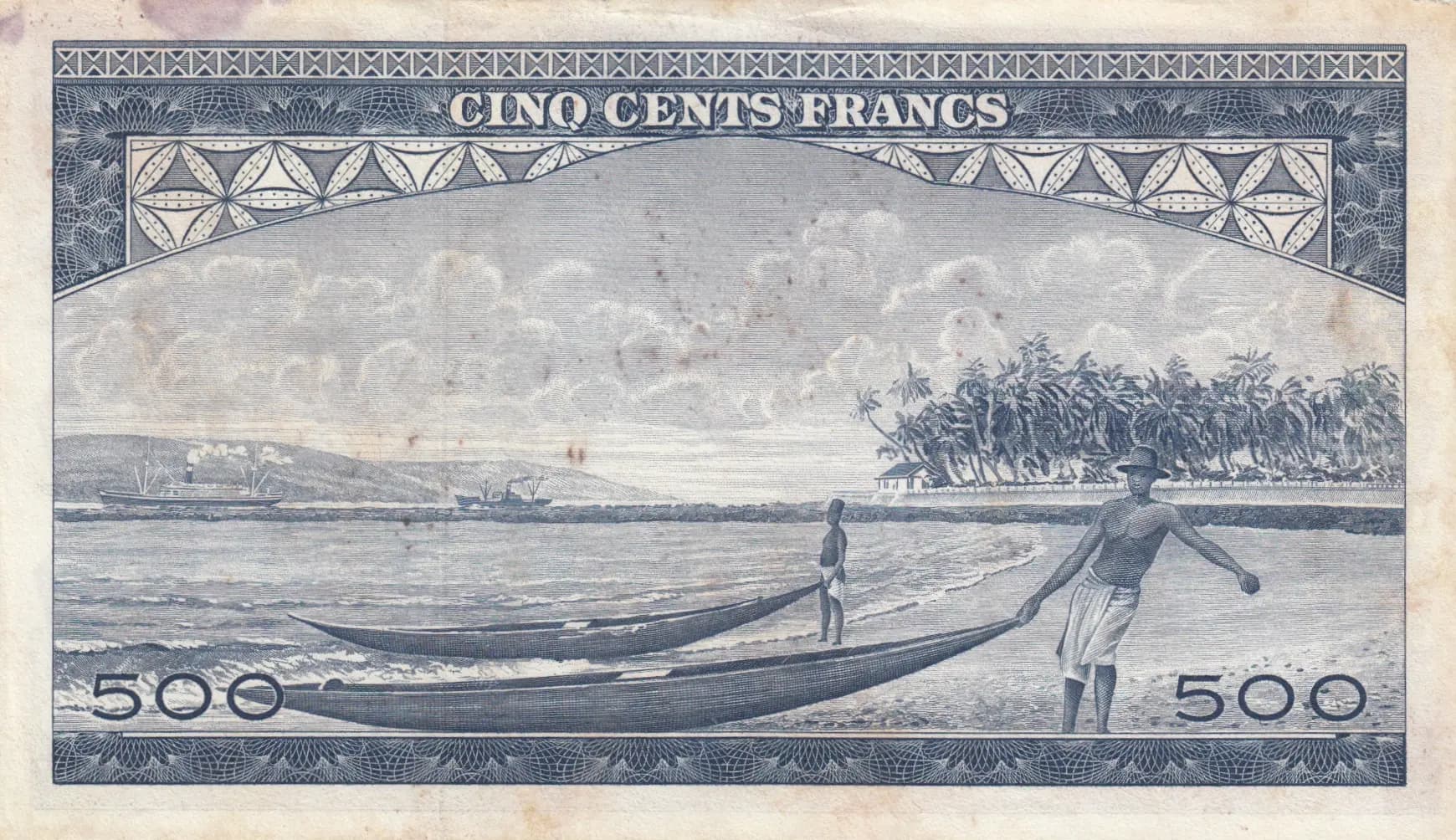
This is a Guinea 500 Francs note from the inaugural 1960 issue, graded in Fine condition, showing the characteristic blue-on-multicolor design featuring President Ahmed Sékou Touré in traditional dress on the obverse. The reverse depicts a compelling scene of fishermen with their boats and palm trees, illustrating Guinea's maritime heritage. While moderately circulated with visible foxing and age-related discoloration, the note retains excellent detail in its fine-line engraving and represents an important early issue from Guinea's newly independent Central Bank.
Common. Secondary market data from 2012-2021 shows consistent availability of Fine-graded examples, with typical eBay sales ranging from $7-$22 for F-grade notes, indicating steady collector demand but substantial supply. The note was issued in substantial quantities befitting a regular-issue 500-franc denomination from a national Central Bank. Modern catalog values (2019: $20 VF, $150 UNC) reflect normal circulation-grade pricing. The absence of any withdrawal notice, recall designation, or limited print run documentation further supports a common classification.
Issued on March 1, 1960, this note marks Guinea's declaration of independence and the establishment of the Banque Centrale de la République de Guinée under President Ahmed Sékou Touré's leadership. The obverse portrait honors the nation's founding president, while the reverse's depiction of fishermen working boats along a palm-lined waterway reflects Guinea's economic reliance on fishing and agriculture in this post-colonial period. This inaugural currency issue symbolizes Guinea's sovereignty following its separation from French West Africa.
The obverse features a left-facing profile portrait of President Ahmed Sékou Touré wearing a traditional white cap and West African ceremonial dress, rendered in fine engraving against a blue-gray background with pink/beige underprinting. A distinctive gold/yellow sunburst or fan-like ornamental motif anchors the center-right design. The reverse depicts a dynamic scene of Guinean fishermen pulling long boats ashore, with palm trees framing the tropical coastal setting and distant hills visible in the background—a scene rendered in blue-gray and cream tones with meticulous cross-hatching and line work. Both sides are framed by repeating geometric border patterns in triangular and diamond motifs, emphasizing the note's security design.
FRONT SIDE: 'BANQUE CENTRALE DE LA RÉPUBLIQUE DE GUINÉE' (Central Bank of the Republic of Guinea); 'CINQ CENTS FRANCS' (Five Hundred Francs); 'le 1er MARS 1960' (March 1, 1960); 'DIRECTEUR GÉNÉRAL' (General Director); 'MINISTRE GOUVERNEUR' (Minister Governor); 'TOUT CONTREFACTEUR SERA PUNI PAR LA LOI EN VIGUEUR' (Any counterfeiter will be punished by the law in force); Serial number 'C061674' (appears twice). BACK SIDE: 'CINQ CENTS FRANCS' (Five Hundred Francs); Denomination '500' (appears in lower left and lower right corners).
Intaglio engraving (line engraving) with multicolor printing, evidenced by the fine-line detail work, detailed cross-hatching in landscape elements, and the precise geometric border patterns visible throughout both sides. The printer for the P-14a variety is identified as TDLR (Bradbury Wilkinson or similar British security printer typical of the era, though TDLR specifically requires verification). The integration of multiple color layers—blue, pink, beige, gold, and white—demonstrates advanced multicolor intaglio technology characteristic of 1960-era Central Bank production.
This note corresponds to Pick-14a (TDLR printer variant). PMG has catalogued two main varieties for Pick-14: P-14a and P-14s, both produced by TDLR. The observed serial number format 'C061674' is consistent with the standard issue. No overprints, significant signature variations, or date variants are noted in the visual analysis. The March 1, 1960 date is the standard and sole issue date for this denomination.