1000 francs 1960
Market Prices
42 salesAbout This Note
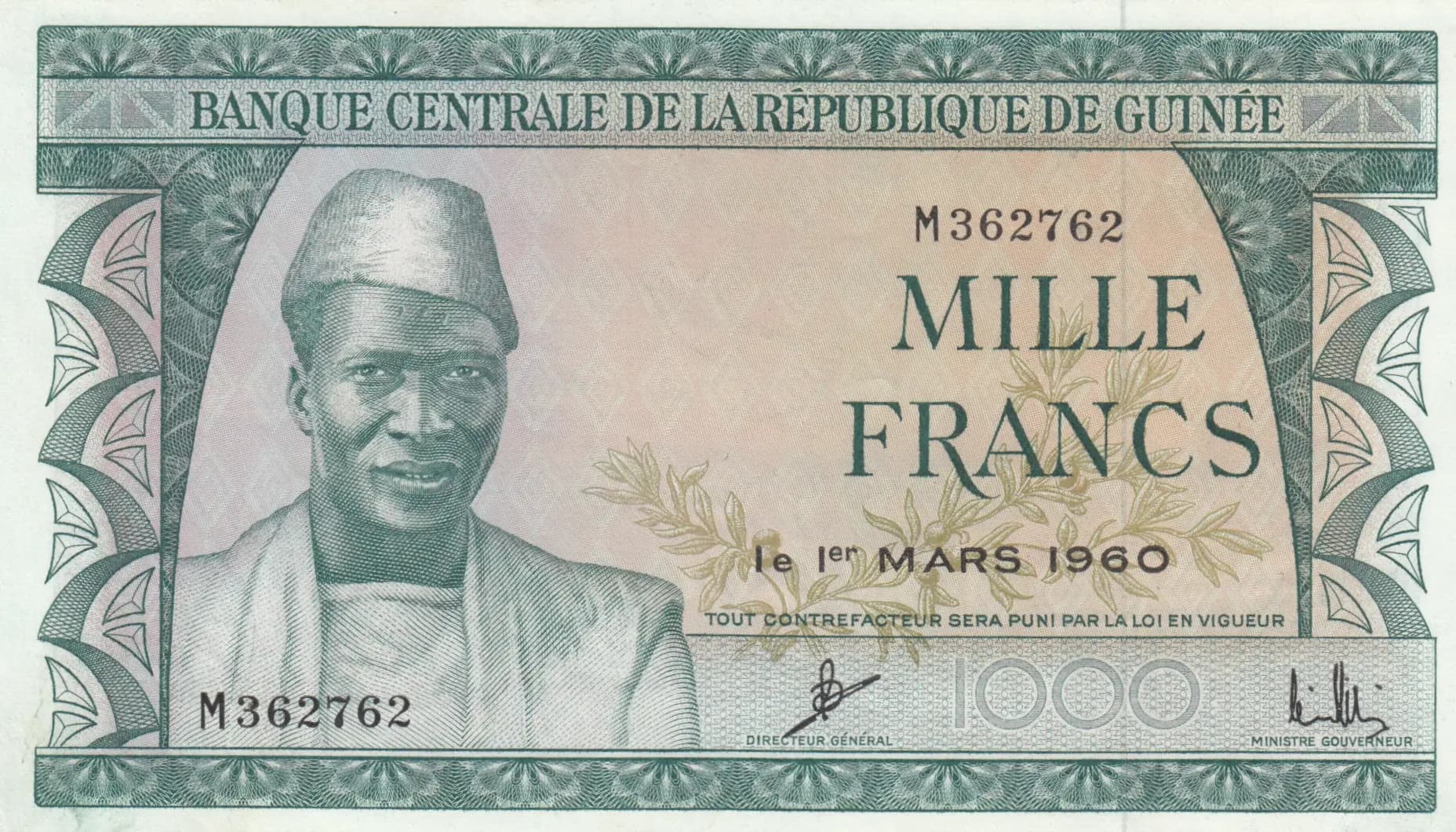
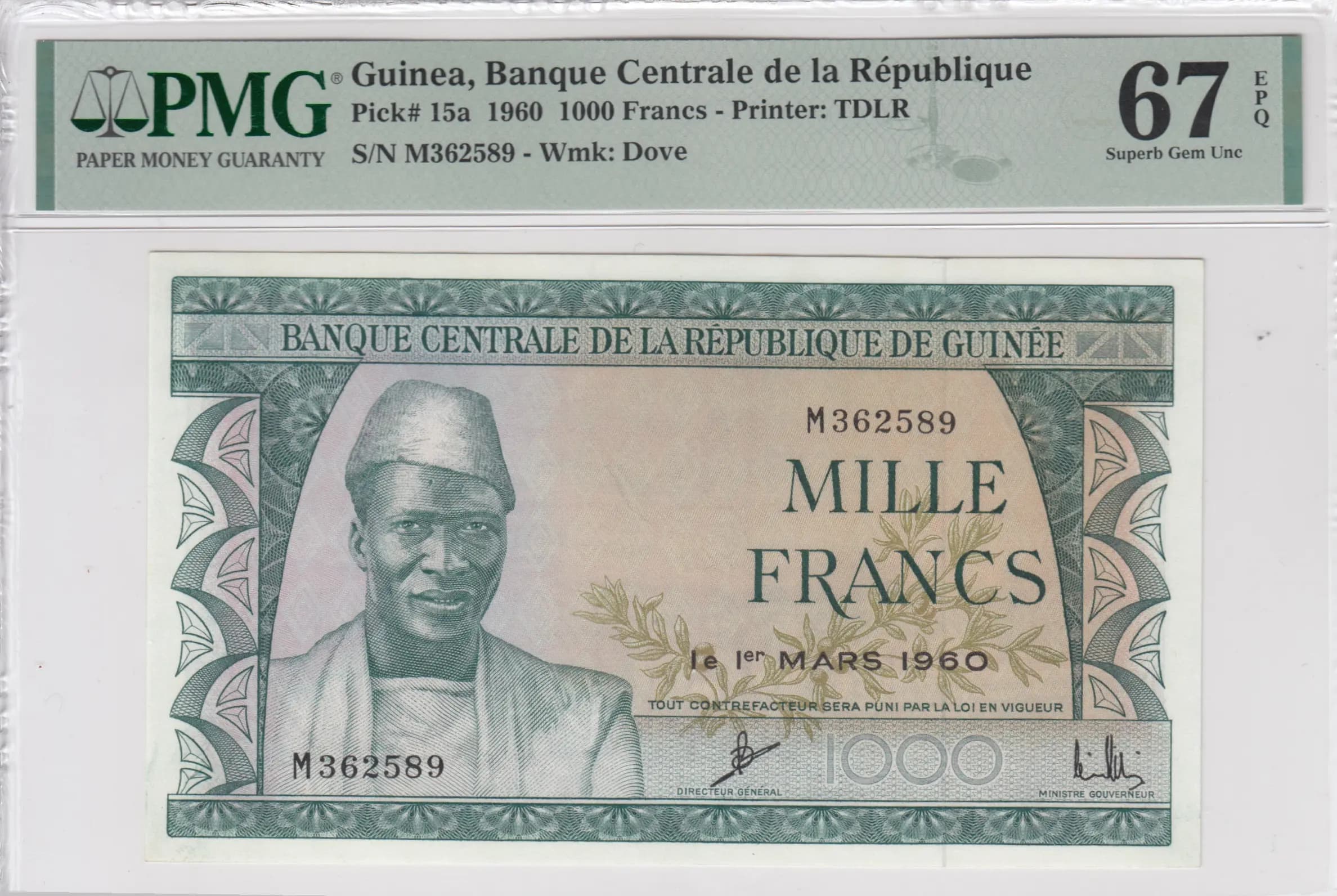
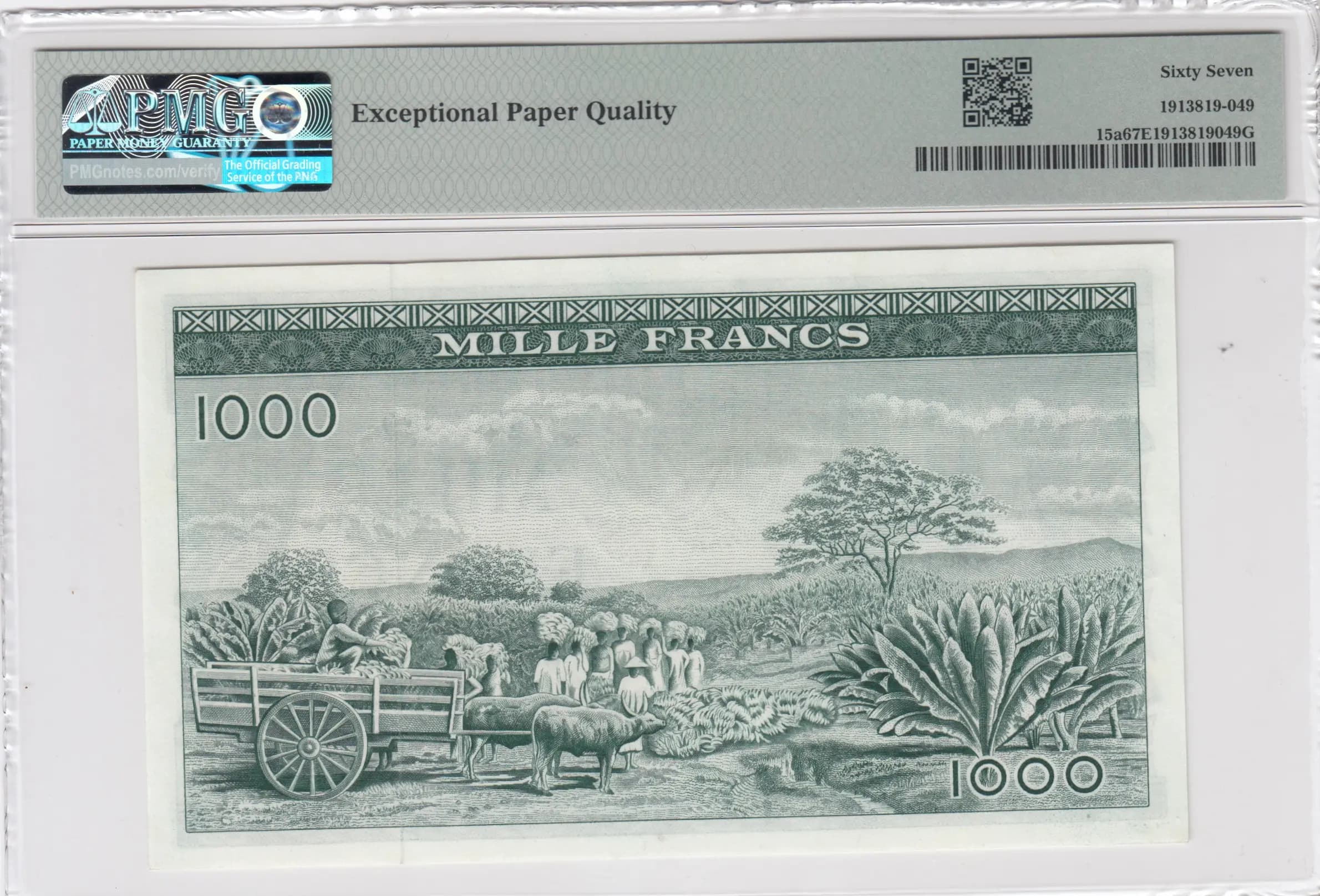
This is an exceptional example of Guinea's first banknote issue, the 1000 Francs from March 1, 1960, graded PMG 67 EPQ (Superb Gem Uncirculated). The note features President Ahmed Sékou Touré in traditional dress on the obverse and a detailed agricultural scene depicting oxen and workers on the reverse, reflecting Guinea's pastoral economy. In this superior condition with pristine paper quality and sharp engraving, it represents the finest examples of this historically significant first independence-era currency.
Common. While historically significant as Guinea's first banknote issue, this denomination and type appear regularly in the collector market. eBay sales data shows consistent trading volume with VF examples selling for $7-15 in recent years, and even higher-grade EF specimens reaching $20-50. Print runs for this 1960 issue were substantial enough to supply a newly independent nation's currency needs. The PMG 67 EPQ grade is exceptional and commands a premium over typical circulated examples, but the underlying note type itself is not scarce.
Issued on March 1, 1960, shortly after Guinea's independence from France, this banknote represents the Central Bank of the Republic of Guinea's first monetary issue under Sékou Touré's leadership. The reverse design depicting agricultural workers and oxen-drawn transport directly reflects Guinea's economy at independence, rooted in subsistence farming and pastoral activities in the West African savanna and forest regions. The note's French inscriptions and classical European banknote design conventions reflect the transitional period as the newly independent nation established its sovereign financial institutions.
The obverse features a left-facing portrait of President Ahmed Sékou Touré wearing a traditional tall cylindrical cap (typical of West African leadership dress) and light-colored traditional garment. The portrait is positioned on the left side of the note, surrounded by ornamental geometric fan-like border patterns and floral/botanical elements including olive branch designs. The denomination 'Mille Francs' is prominently displayed with decorative floral elements. The reverse depicts a detailed pastoral landscape scene characteristic of Guinea's rural economy: oxen or cattle pulling a wooden cart, agricultural workers engaged in labor, and lush tropical vegetation with distinctive broad-leafed plants, trees, and mountains in the background, representing the savanna and agricultural zones of Guinea. Decorative geometric borders frame the top of the reverse design.
OBVERSE: 'Banque Centrale de la République de Guinée' (Central Bank of the Republic of Guinea); 'Mille Francs' (One Thousand Francs); 'le 1er Mars 1960' (the 1st of March 1960); 'Tout contrefacteur sera puni par la loi en vigueur' (All counterfeiters will be punished by the law in force); 'Directeur Général' (General Director); 'Ministre Gouverneur' (Minister Governor); Serial number 'M362589'. REVERSE: 'Mille Francs' (One Thousand Francs); Denomination numerals '1000' in upper left and lower right corners.
Intaglio (copperplate) engraving, as evidenced by the fine-line work, detailed landscape scene, and sharp ornamental patterns visible on both sides. The complex layered design with geometric borders and intricate agricultural scenes would have been produced using traditional engraving techniques. According to PMG catalog data, this note was printed by TDLR (Thomas de la Rue), a premier security printer known for high-quality intaglio banknote production.
Pick number P-15s identifies this as the standard variety of the 1000 Francs 1960 issue. The serial number prefix 'M' and specific number 'M362589' indicate this is a standard circulation note from the initial print run. No overprints, color variations, or other documented varieties are evident in this example. The March 1, 1960 date is consistent with Guinea's independence and the Central Bank's inaugural currency issue.