1000 francs 1960
Market Prices
42 salesAbout This Note
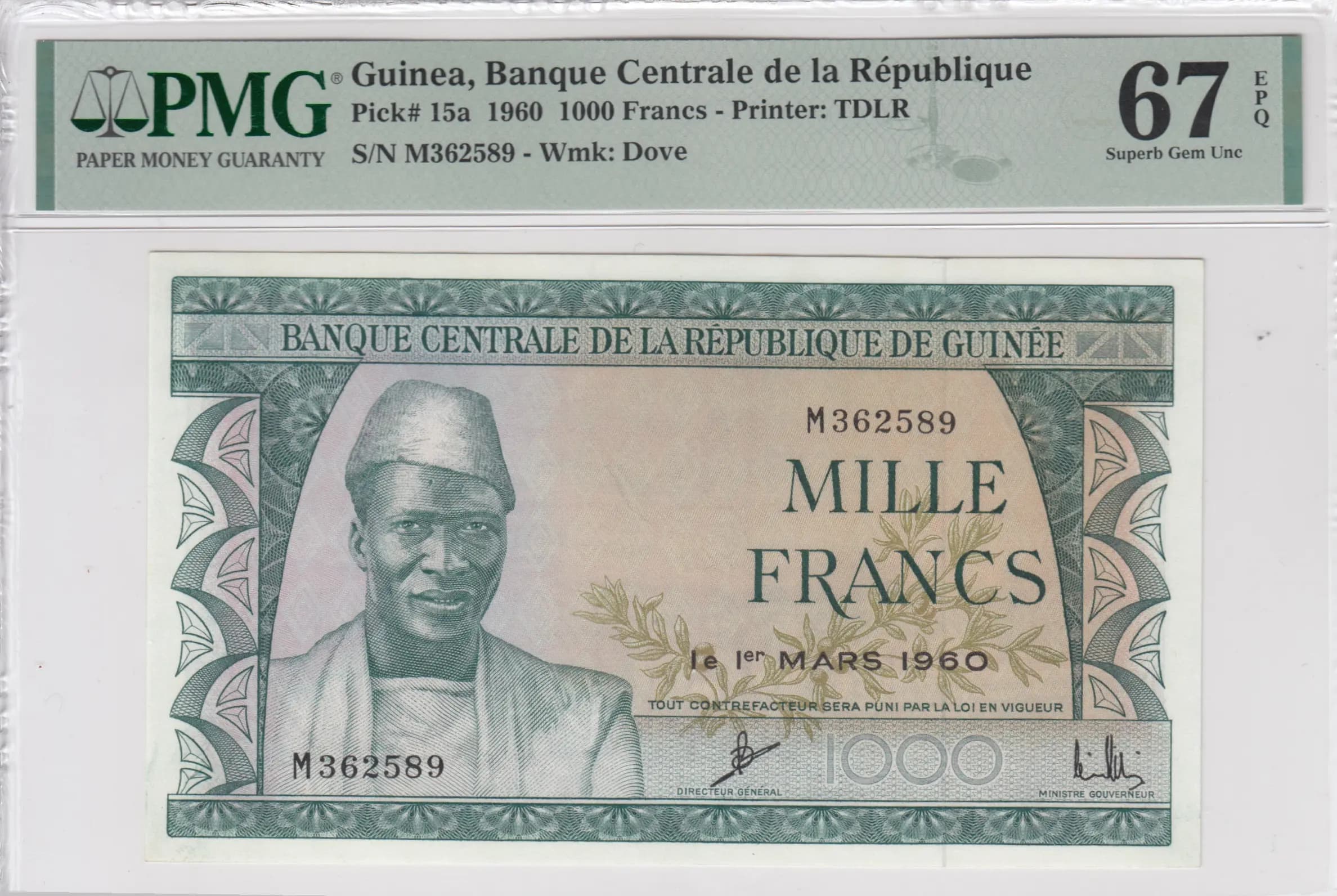
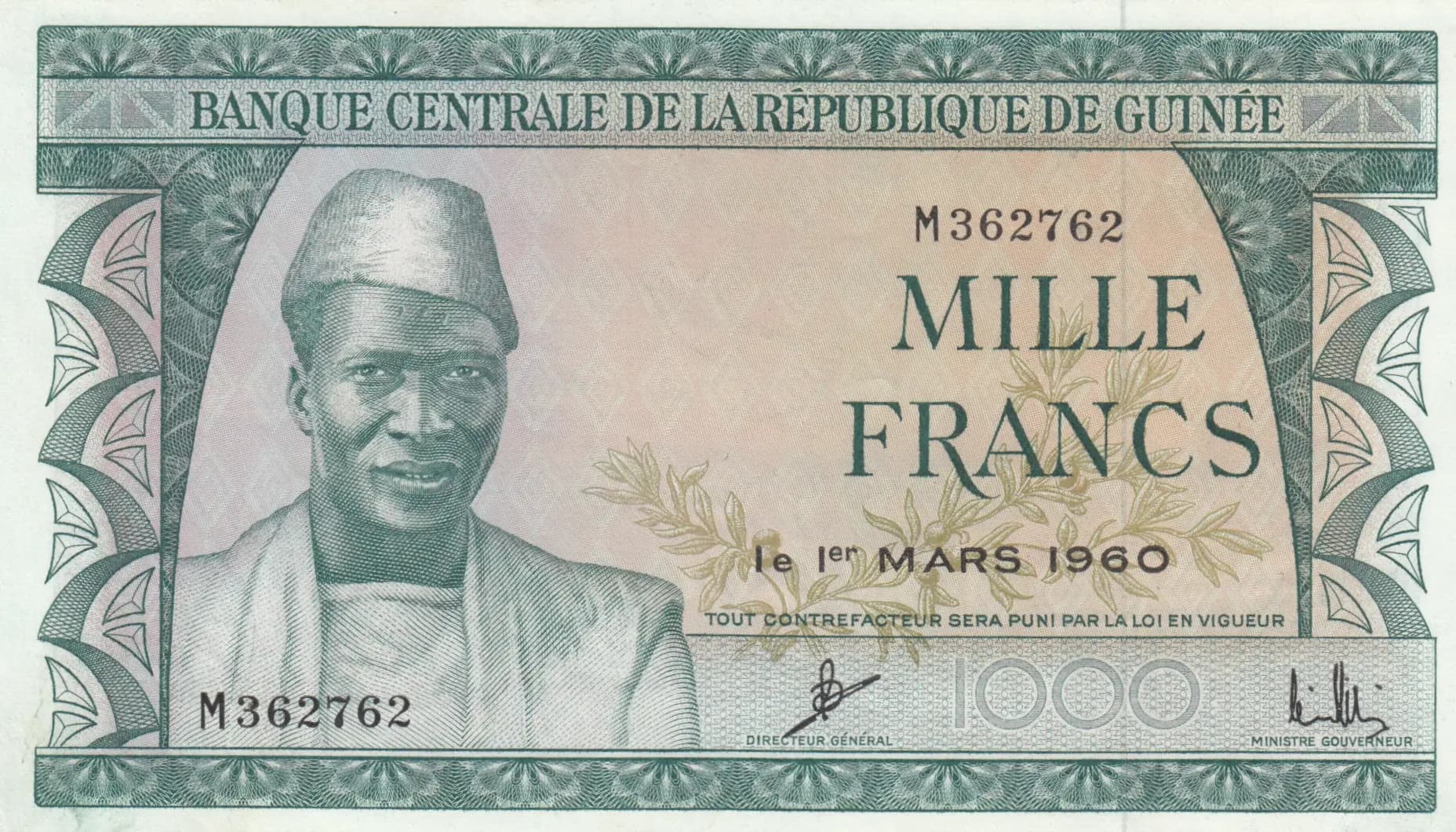
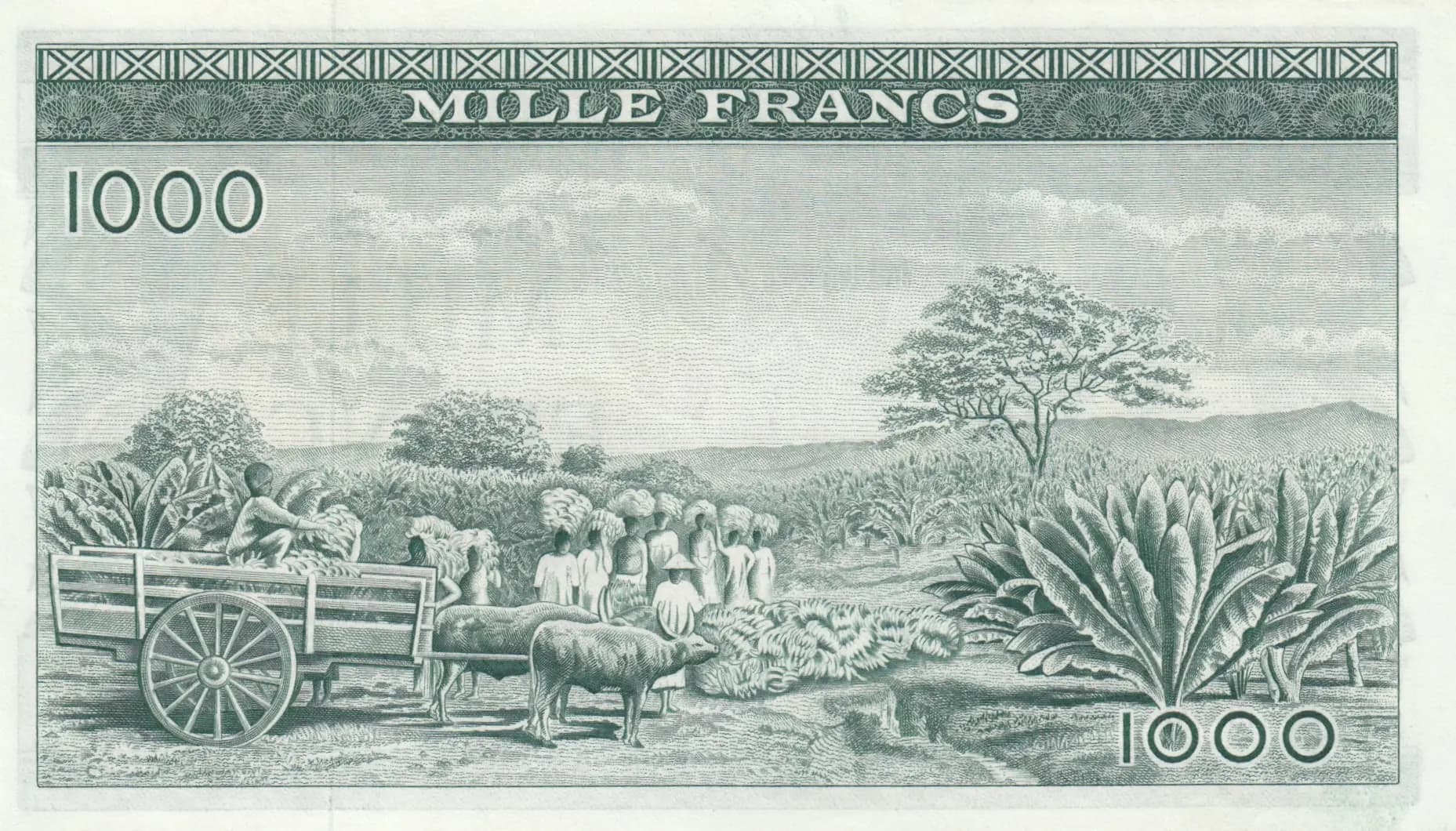
A pristine example of Guinea's first independent banknote, this 1000 Francs from March 1, 1960 showcases the Central Bank's commitment to commemorating the nation's agricultural heritage and new political leadership. The obverse features President Ahmed Sékou Touré in traditional dress, while the reverse depicts a dynamic rural harvest scene with workers and a laden cart, rendered in fine engraved detail. Graded AU and displaying no visible wear, creases, or stains, this note represents an important piece of post-colonial African numismatic history in exceptional preservation.
Common. This note is frequently encountered in the secondary market, with extensive eBay sales data showing consistent availability across multiple condition grades (F through EF) from 2011 through 2025. Market prices typically range from $5.50 to $15 for Fine-VF examples, with only exceptional grades (EF/AUNC) commanding premiums above $30. The large print run typical of a nation's primary currency issue and the note's lack of scarcity indicators (no recalled series, standard issue period) confirm common status despite its historical significance.
Issued on March 1, 1960, this note marks Guinea's transition to independence and the establishment of the Banque Centrale de la République de Guinée under President Ahmed Sékou Touré's leadership. The reverse design's emphasis on banana harvesting and agricultural labor reflects Guinea's economic foundation and the government's desire to celebrate the nation's primary export and rural workforce. The formal French inscriptions and European printing standards demonstrate Guinea's integration into the franc currency zone during this pivotal period of African decolonization.
The obverse features a left-facing profile portrait of President Ahmed Sékou Touré wearing a tall, intricately wrapped traditional Guinean turban, rendered in fine engraved line-work characteristic of security currency production. The portrait is framed by ornamental geometric fan-like patterns and decorative borders in Art Deco style, with a central botanical motif. The reverse displays a meticulously detailed rural agricultural landscape depicting banana or plantain harvesting, with workers and a horse-drawn wooden cart laden with produce positioned centrally, flanked by large tropical broad-leafed plants in the foreground, with scattered trees and rolling hills in the background. The entire composition employs fine parallel line engraving to create depth, texture, and shading throughout the landscape scene.
FRONT: 'BANQUE CENTRALE DE LA REPUBLIQUE DE GUINEE' (Central Bank of the Republic of Guinea) | 'MILLE FRANCS' (One Thousand Francs) | 'le 1er MARS 1960' (March 1st, 1960) | 'TOUT CONTREFACTEUR SERA PUNI PAR LA LOI EN VIGUEUR' (Any counterfeiter will be punished by the law in force) | 'DIRECTEUR GÉNÉRAL' (General Director) | 'MINISTRE GOUVERNEUR' (Minister Governor) | Serial number: M362762 (printed twice). BACK: 'MILLE FRANCS' (One Thousand Francs) | '1000' (denomination in numerals, repeated top and bottom).
Intaglio (engraved) printing on banknote paper with security features including fine-line engraving throughout, dual serial number placement, and complex engraved patterns serving as anti-counterfeiting measures. Printed by TDLR (Banque de France's security printer) as confirmed by PMG population data for Pick-15s variant.
This example is the standard Pick-15 issue dated March 1, 1960. PMG catalogs one variant (P-15s) printed by TDLR. The serial number M362762 appears in the standard position. No overprints, signature varieties, or printing anomalies are evident in this specimen. Standard first-issue note with no known sub-varieties affecting collector value significantly.