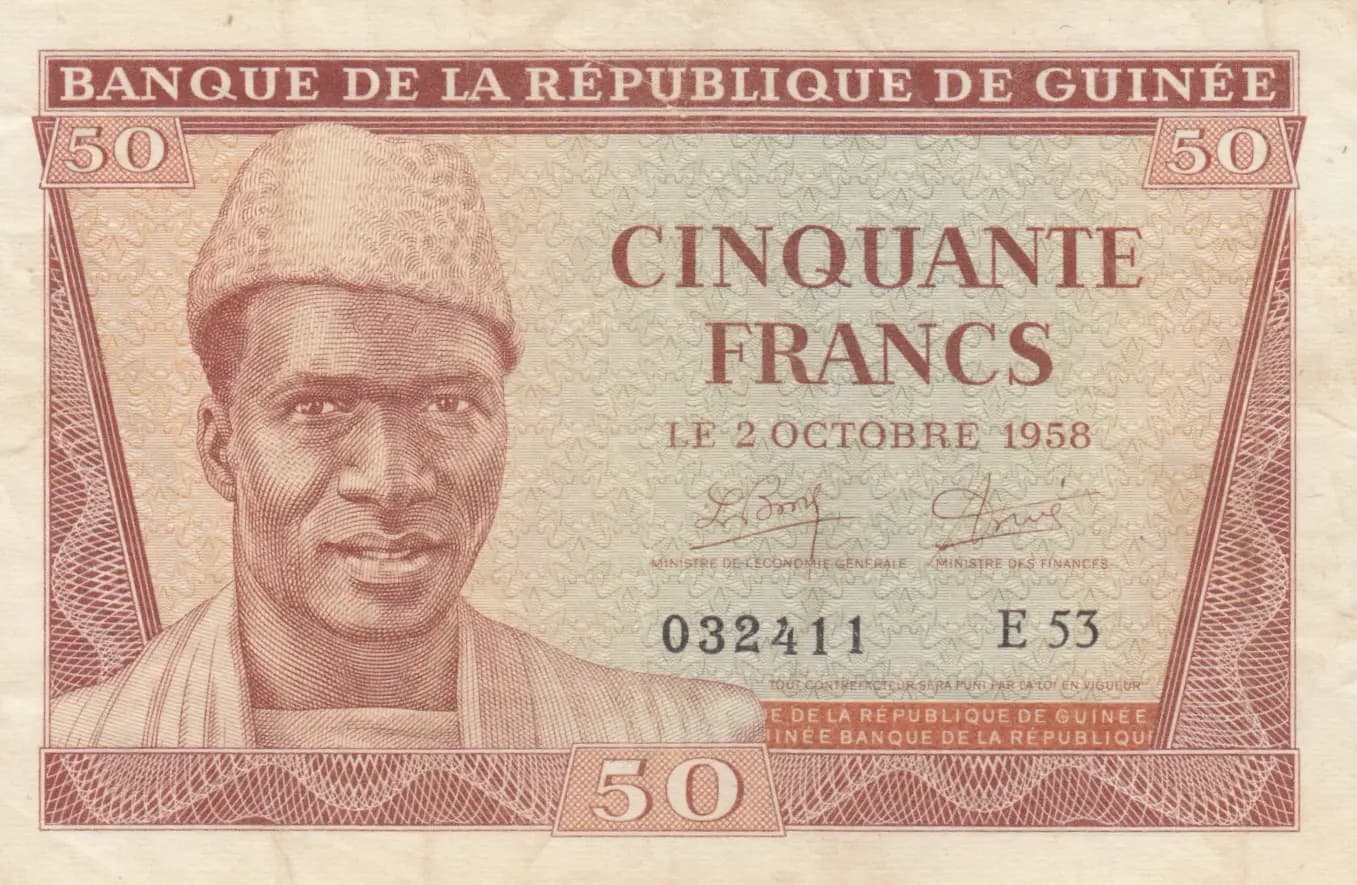
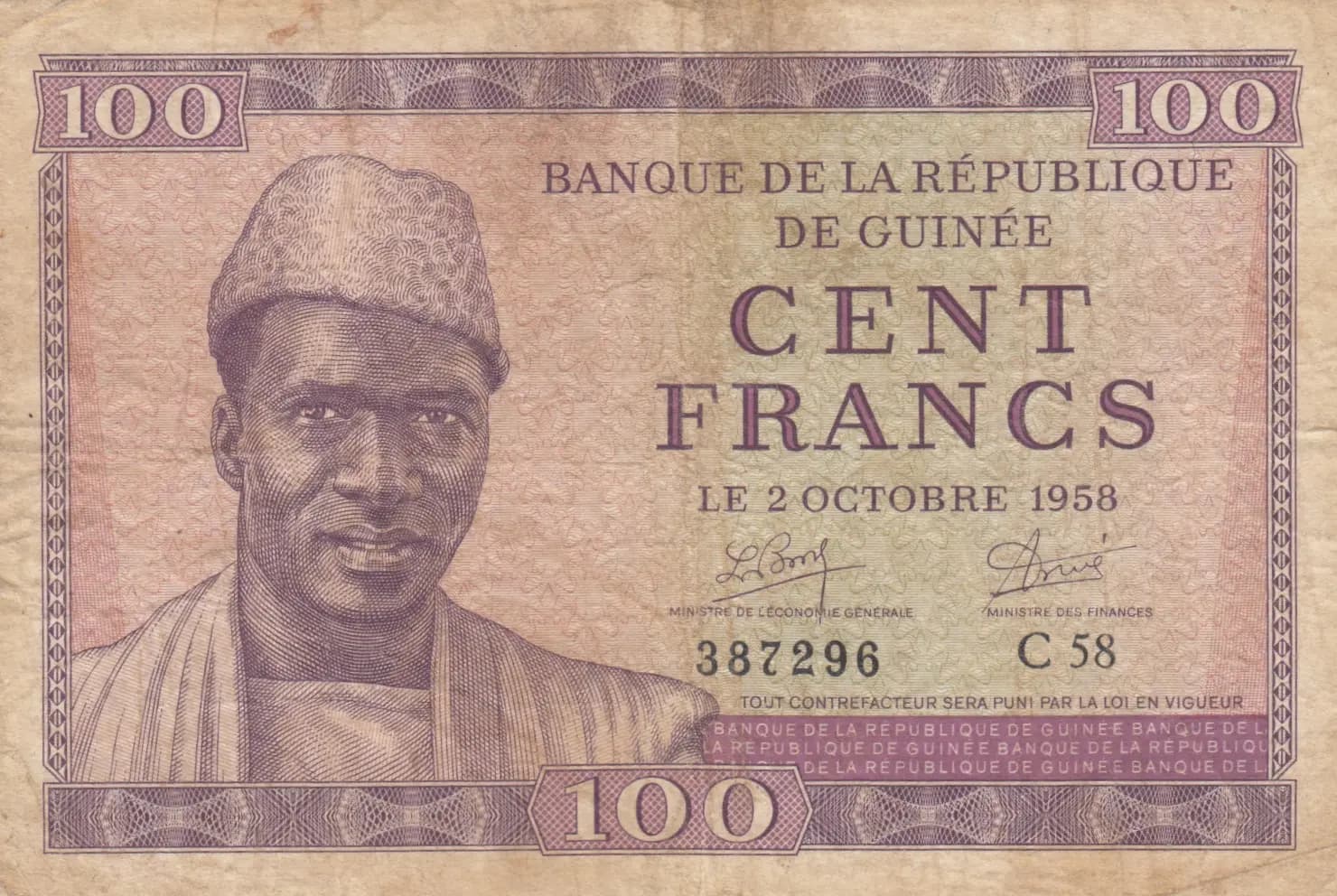
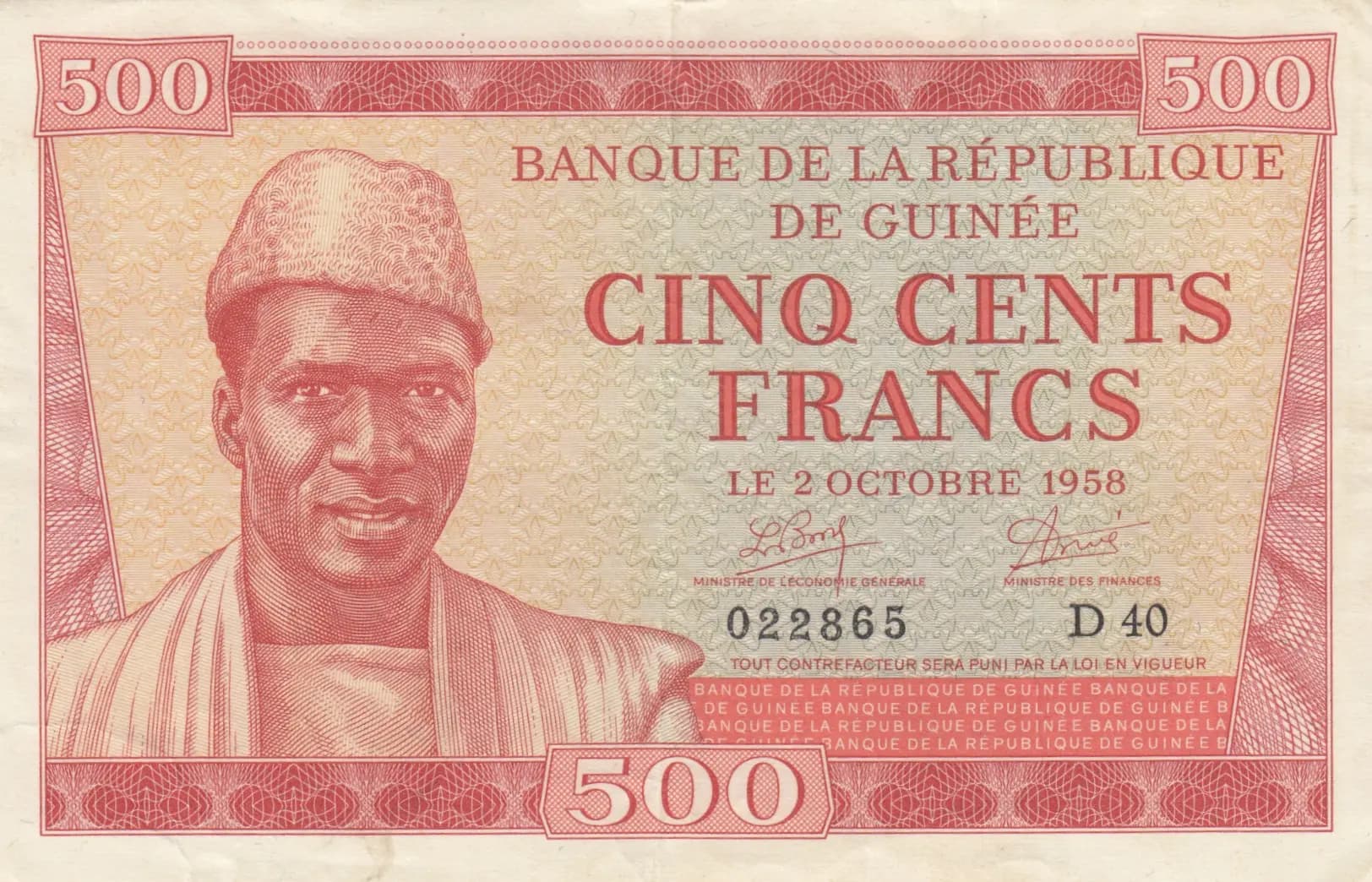
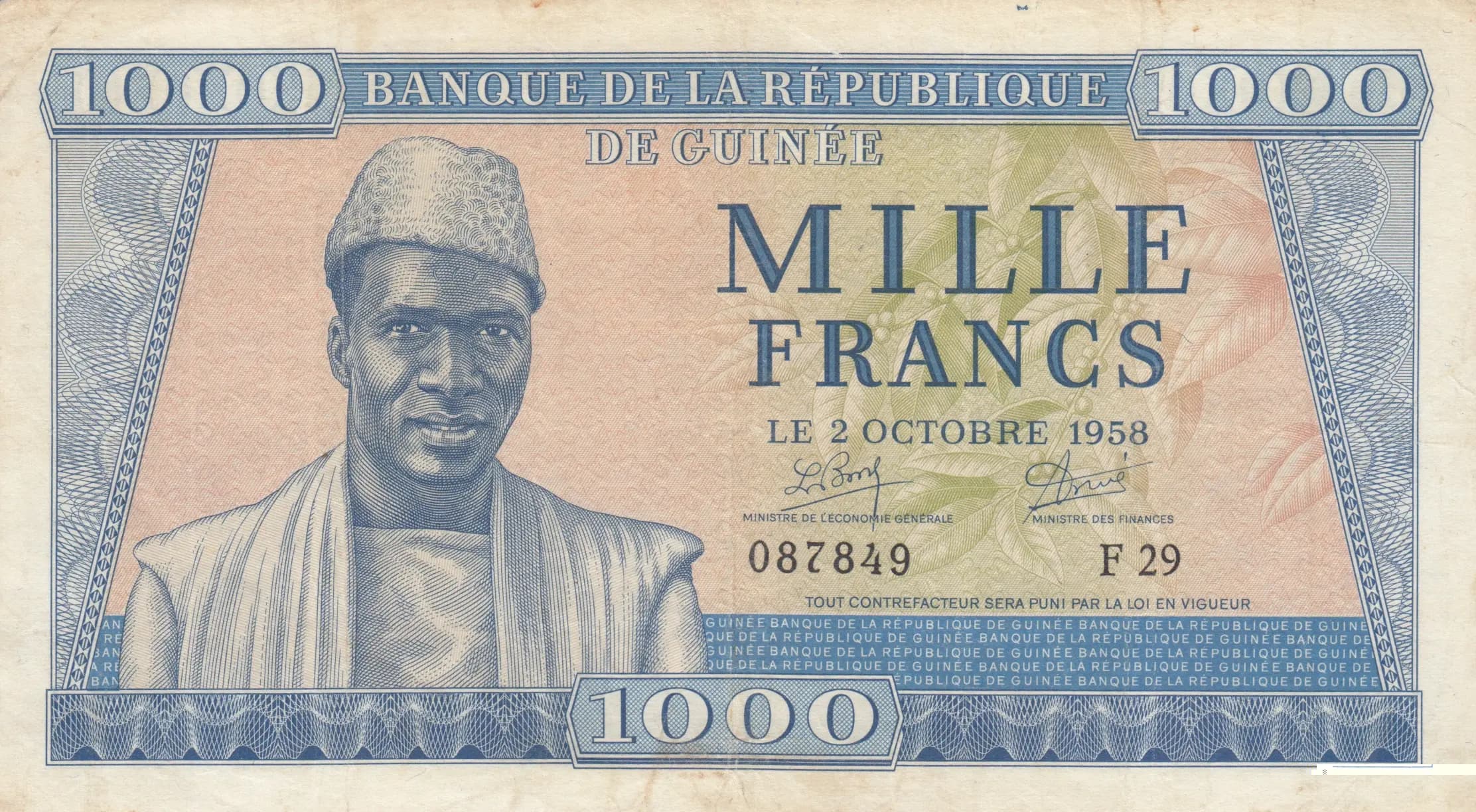
100 francs 1960
Market Prices
31 salesAbout This Note
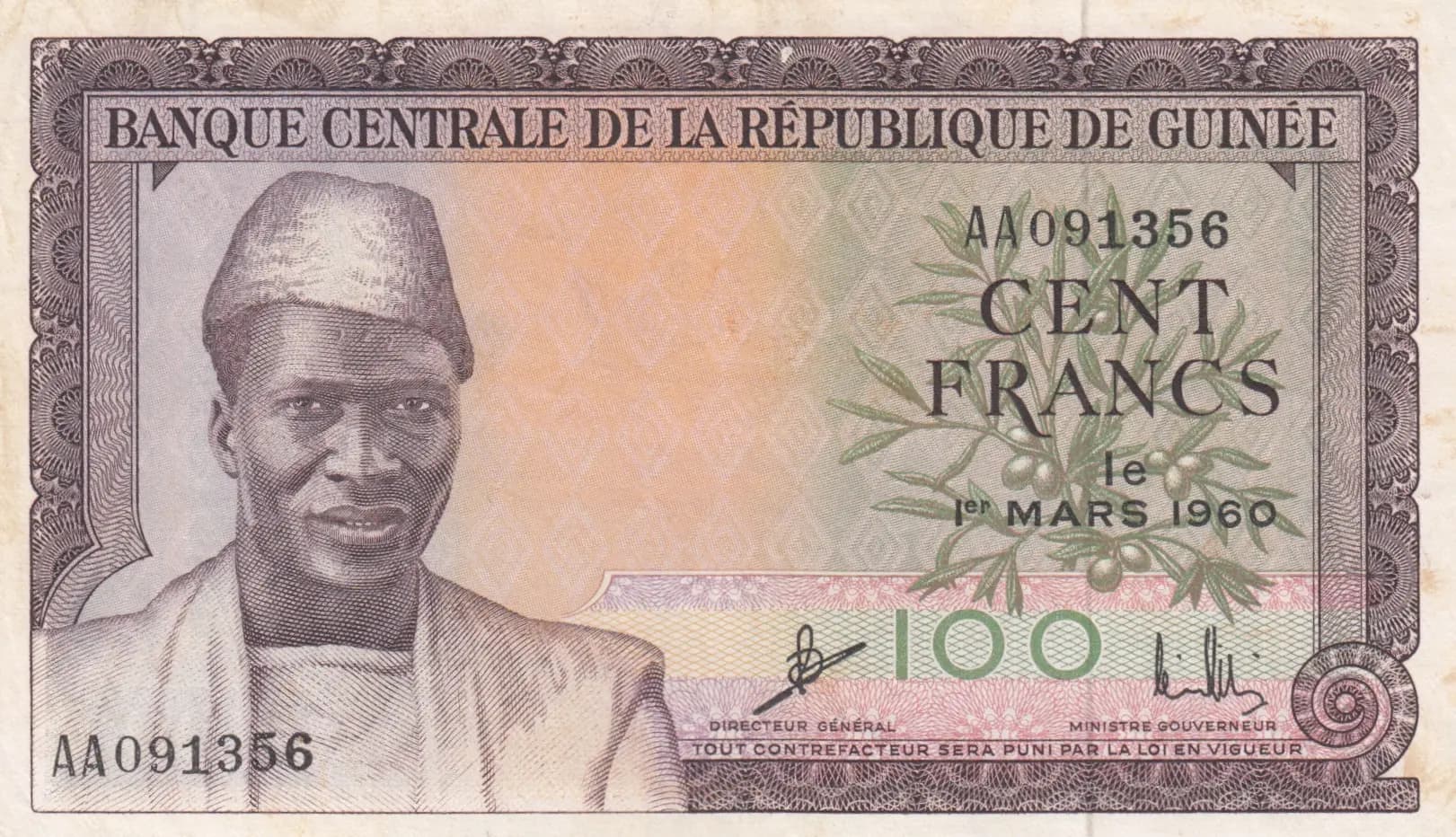
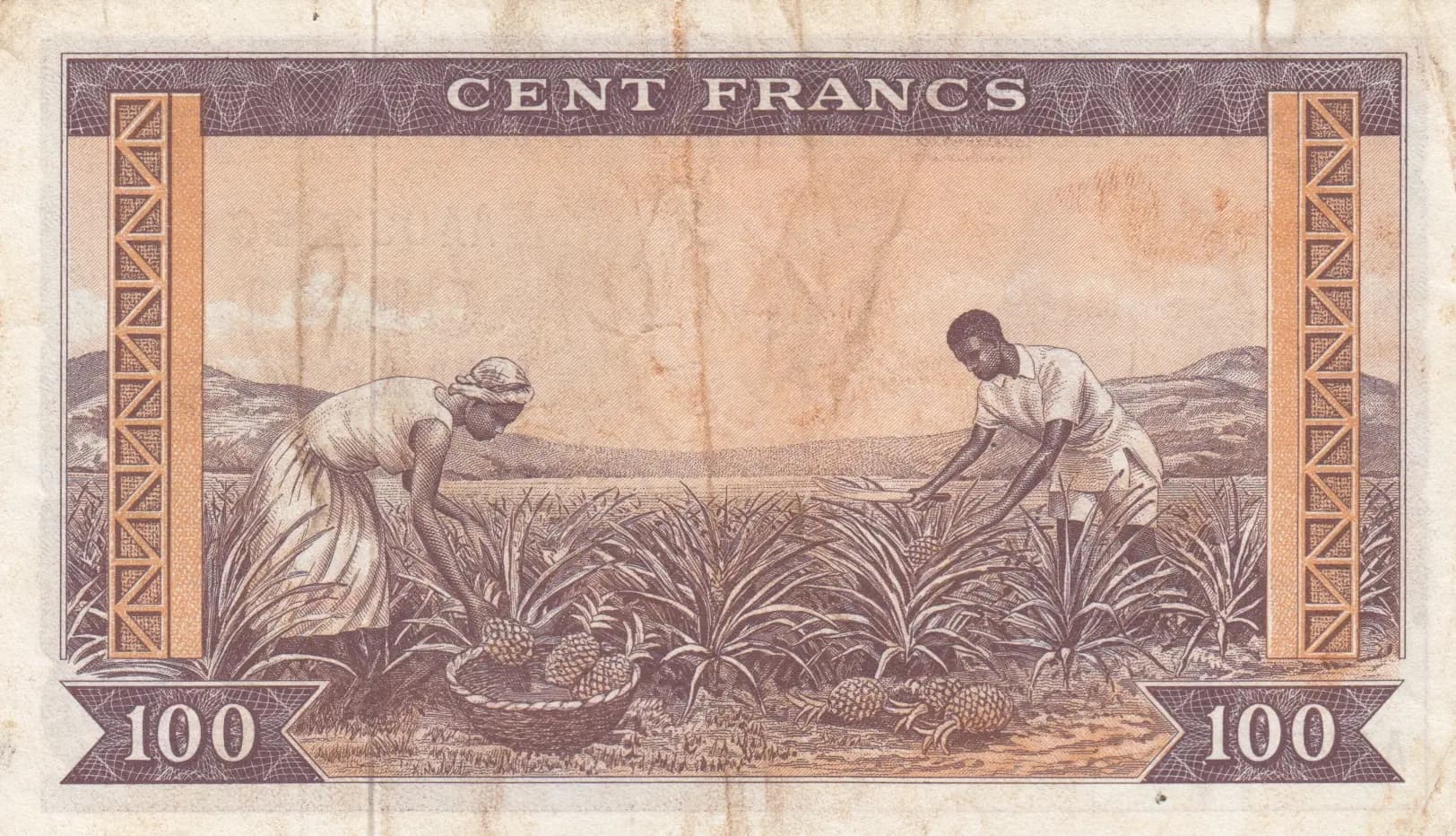
This is a VF-graded 100 Francs banknote from Guinea's first independent currency issue, dated March 1, 1960, featuring President Ahmed Sékou Touré in traditional headwear on the obverse and agricultural workers harvesting pineapples on the reverse. The note displays the characteristic wear of a well-circulated piece with visible creases, fold marks, and age-related foxing, yet retains good definition in the fine engraving and ornamental border work. This inaugural issue represents Guinea's monetary sovereignty following independence and remains a popular collector item for African numismatists.
Common. eBay market data shows consistent sales across multiple condition grades from 2012-2025, with VF examples trading between $2.25 and $15.61, averaging around $4-6 for this grade. The note appears regularly in the market, indicating a substantial original print run and steady collector demand without supply scarcity. No evidence of a recalled issue or limited production run exists.
This note marks Guinea's transition to independence under President Ahmed Sékou Touré in 1960, with the Banque Centrale de la République de Guinée assuming control of currency issuance. The reverse design celebrating pineapple harvest workers reflects the nation's agricultural foundation and socialist ideology emphasizing labor and economic self-sufficiency during the early post-colonial period. The inclusion of Touré's portrait underscores his role as the founding president and symbol of Guinean national identity.
The obverse depicts President Ahmed Sékou Touré in three-quarter profile wearing traditional headwear, rendered in brown/sepia engraving on the left portion of the note. The design incorporates an olive branch with leaves and fruit on the right side, symbolizing peace and agricultural prosperity. Ornate radiating fan-like motifs form decorative borders along the top and bottom edges, with a spiral seal element in the lower right corner. The reverse presents two agricultural laborers in bent postures harvesting pineapples in rows, with a landscape background suggesting Guinea's agricultural landscape, flanked by geometric triangular border patterns in tan and gold tones. The color scheme transitions from purple-brown on the left to beige-green on the right on the obverse, with tan, gold, and brown dominating the reverse.
FRONT: 'BANQUE CENTRALE DE LA RÉPUBLIQUE DE GUINÉE' (Central Bank of the Republic of Guinea) | 'CENT FRANCS' (One Hundred Francs) | '1er MARS 1960' (March 1, 1960) | '100' (denomination) | 'AA091356' (serial number, printed twice) | 'DIRECTEUR GÉNÉRAL' (Director General) | 'MINISTRE GOUVERNEUR' (Minister Governor) | 'TOUT CONTREFACTEUR SERA PUNI PAR LA LOI EN VIGUEUR' (Any counterfeiter will be punished by law in force). BACK: 'CENT FRANCS' (One Hundred Francs) | '100' (denomination).
Intaglio engraving (line engraving), evidenced by the fine parallel line work, ornate border patterns, and detailed portraiture and agricultural scene throughout both sides. The printer is identified in PMG records as TDLR (Tableau, Desmazieres, Lahure, Renault—a consortium of French security printers). This was typical of early African central bank issues produced by established European security printing firms.
This is catalogued as Pick P-13a, the primary variety for this denomination and date, printed by TDLR. The observed serial number AA091356 suggests this is within the standard production range. No overprints, color variants, or signature varieties are noted in the visual analysis. Standard issue characteristics consistent with the single documented variant for this Pick number.