10 sylis 1971
Market Prices
38 salesAbout This Note
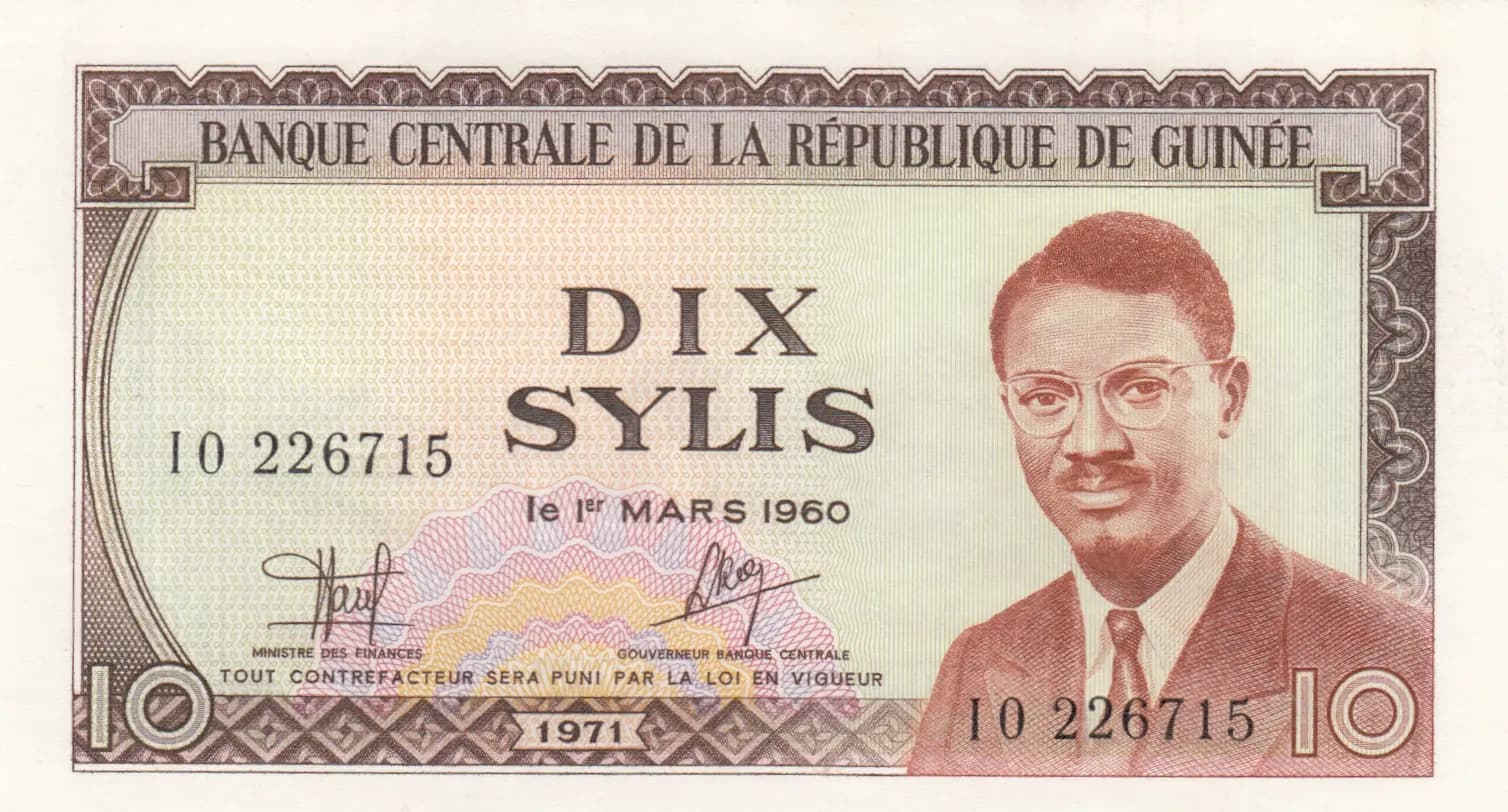
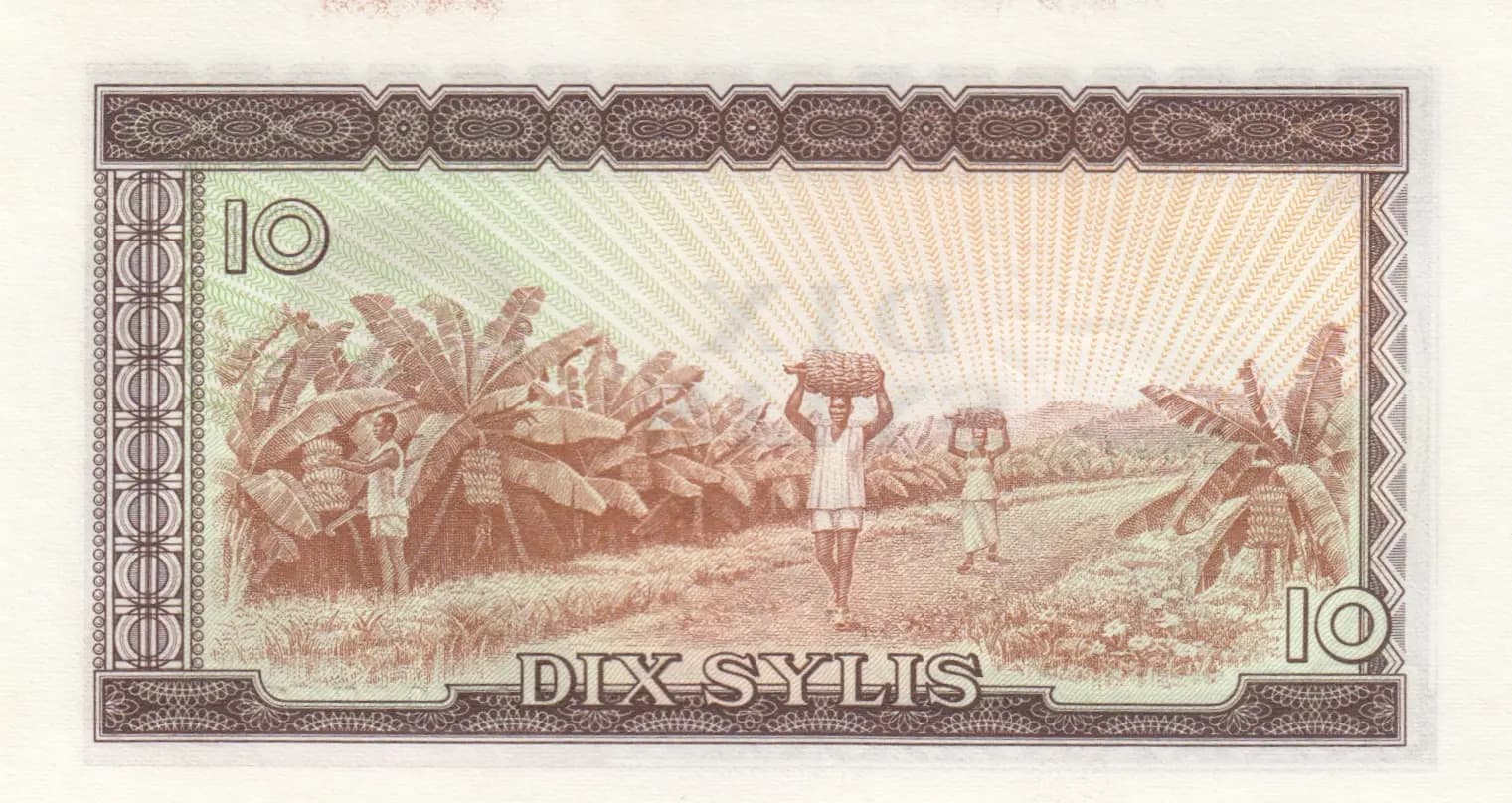
This is an exceptionally well-preserved UNC example of Guinea's 1971 10 Sylis note (Pick P-16), featuring a striking portrait of Patrice Lumumba on the obverse and a vibrant agricultural scene depicting banana harvest workers on the reverse. The note displays pristine condition with no visible wear, creases, or stains, showcasing the intricate guilloche patterns and fine engraving characteristic of this Central Bank of Guinea issue. The cream and brown color scheme with multicolored accents creates a visually compelling design that reflects Guinea's post-independence economic and cultural identity.
Common. Secondary market data from eBay sales spanning 2010-2025 demonstrates consistent availability with regular transactions, including multiple UNC sales ranging from $2.25 to $10.26, averaging approximately $3-5 in uncirculated condition. The note's Print Run was substantial enough to supply Guinea's monetary circulation for over a decade, and survival rates in all grades remain high. Professional grading instances (PMG 66 and PMG 67) sold for $17-52, representing a premium for professionally certified examples rather than evidence of scarcity. The denomination, being a lower-value note, had higher circulation and production volumes compared to higher denominations.
Issued in 1971 under the authority of the Banque Centrale de la République de Guinée, this note commemorates Patrice Lumumba, the first Prime Minister of the Democratic Republic of Congo and a pan-African independence icon whose legacy resonated throughout newly independent African nations. The reverse design, depicting workers harvesting bananas in traditional dress, reflects Guinea's agricultural economy and national pride in its rural workforce during the early years following Guinea's 1958 independence from France. This note represents the currency reform period following Guinea's adoption of the Syli as its currency unit, replacing the Guinean franc in 1971.
The obverse features a three-quarter portrait of Patrice Lumumba wearing eyeglasses, formal suit jacket, and tie, positioned on the right side of the note against a cream and brown background. The design incorporates elaborate ornamental borders with intricate guilloche patterns and geometric decorative elements in the corners, typical of high-security currency design of the era. The reverse depicts a rural agricultural scene showing two figures in traditional dress working in a banana plantation, with large tropical leaves and a radiating sun in the background, symbolizing Guinea's agricultural heritage and post-colonial national identity. Both sides feature circular denomination numerals ('10') positioned on the left and right edges, with the overall composition utilizing fine line work and detailed engraving to create visual depth and security against counterfeiting.
FRONT SIDE: 'BANQUE CENTRALE DE LA RÉPUBLIQUE DE GUINÉE' (Central Bank of the Republic of Guinea); 'DIX SYLIS' (Ten Sylis); 'le 1er MARS 1960' (the 1st of March 1960 — reference date for the authorizing law); 'MINISTRE DES FINANCES' (Minister of Finance); 'GOUVERNEUR BANQUE CENTRALE' (Governor Central Bank); 'TOUT CONTREFACTEUR SERA PUNI PAR LA LOI EN VIGUEUR' (Any counterfeiter will be punished by law in force); Serial numbers: '10 226715' (appears twice); Year: '1971'. BACK SIDE: 'DIX SYLIS' (Ten Sylis); Numeral '10' (denomination marking).
Intaglio engraving (relief printing) combined with multi-color lithography. The note exhibits characteristic features of professional currency production from the early 1970s, including fine guilloche patterns, detailed line work in the background vignettes, and intricate border ornamentation typical of Central Bank security printing standards. The multicolored underprint visible beneath the brown primary design suggests an advanced multi-pass printing process. While the specific security printer is not identified in available catalog data, the quality and sophistication indicate production by a major international currency printer, likely a European or American security printing firm contracted by the Banque Centrale de Guinée.
This example carries serial number 10 226715 and is from the standard 1971 printing authorized under the Law of March 1, 1960. The Pick catalog identifies only one variant for the P-16 designation. No overprints, prefix variations, or significant printing varieties have been documented for this base Pick number. Standard signature blocks for the Minister of Finance and Governor of the Central Bank are present as expected for the 1971 issue, though specific signature identification requires additional research. The consistent design elements and serial number formatting indicate this represents the standard variety of the P-16 issue.