5000 drachmai 1932
Market Prices
51 salesAbout This Note
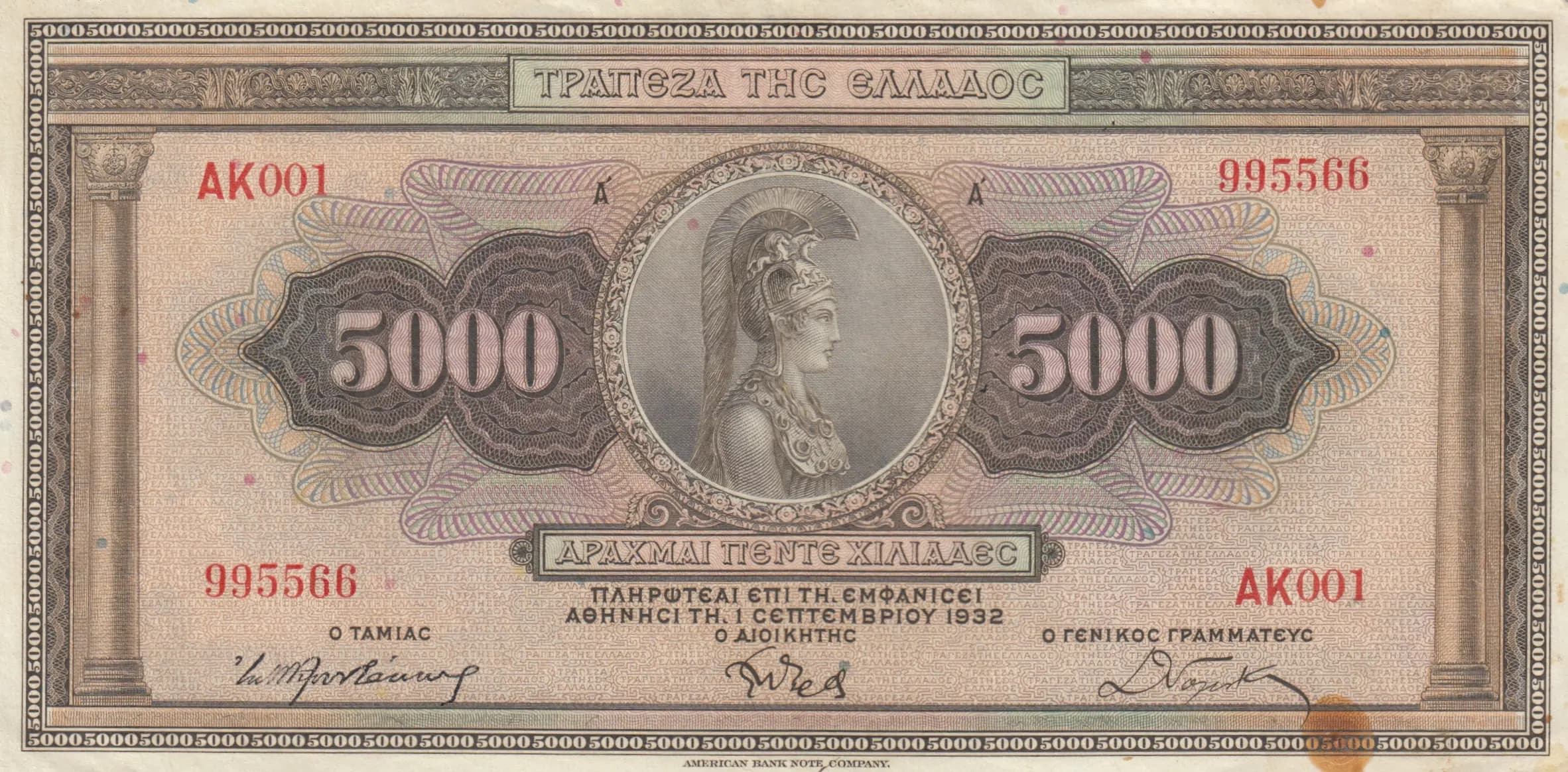
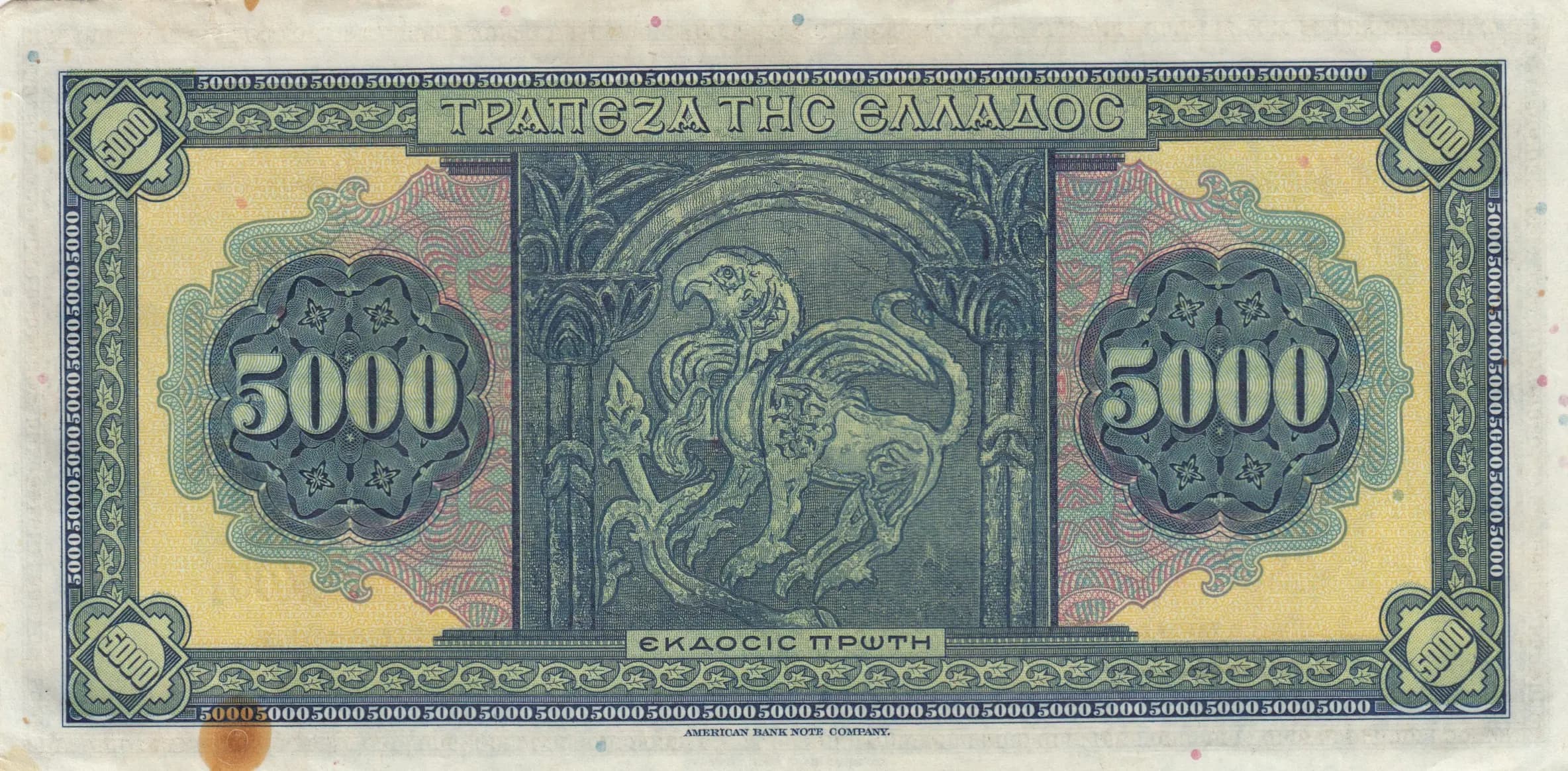
This 5000 Drachmai note from 1932 exemplifies the artistic quality of Greek interwar currency, produced by the American Bank Note Company. The front features a classically-styled portrait in profile wearing a Corinthian helmet, while the reverse depicts allegorical figures in an architectural setting with blue-gray and multi-colored tones. In VF condition, the note shows expected age-related patina with scattered foxing and minor creasing, representing a well-preserved example of this important Greek denomination from the early 20th century.
Common. Market data from realbanknotes.com shows consistent sales in the $2–$10 range for VF-graded examples from 2010–2026, with ungraded VF specimens regularly selling for $2–$7. Even professionally graded examples in higher grades (PMG 64–67) typically realize $60–$130, indicating healthy supply. The 1932 5000 Drachmai is a regular issue with substantial print run and remains readily available in the collector market across multiple condition grades.
This note was issued on September 1, 1932, during a critical period in Greek monetary history, shortly after the country's economic stabilization following World War I and the Asia Minor Catastrophe. The classical imagery—the helmeted figure (likely Athena, goddess of wisdom) on the obverse and mythological scenes on the reverse—reflects Greece's deliberate evocation of its Classical heritage to project national identity and stability during the interwar period. The American Bank Note Company's involvement underscores Greece's reliance on established international printing firms to produce secure, high-quality currency during this era of economic recovery.
The obverse presents a right-facing classical profile portrait identified as Athena, Greece's patron goddess of wisdom, adorned with a detailed Corinthian-style helmet and draped in classical garments. She is enclosed within an elaborate circular ornamental frame with repeated denomination numerals '5000' positioned on both left and right sides. The reverse features a more complex allegorical composition depicting classical female figures in flowing drapery within a classical architectural setting with columns and arches, representing the mythological and cultural patrimony of Greece. Both sides employ intricate scrollwork, geometric border patterns, and ornamental classical columns at the margins, with the entire composition rendered in fine engraved line work characteristic of high-security currency design. The color scheme transitions from warm beige, brown, and pink tones on the obverse to cooler blue-gray, yellow, and multi-colored hues on the reverse.
FRONT: 'ΤΡΑΠΕΖΑ ΤΗΣ ΕΛΛΑΔΟΣ' (Bank of Greece); '5000' (denomination); 'ΔΡΑΧΜΑΙ ΠΕΝΤΕ ΧΙΛΙΑΔΕΣ' (Five Thousand Drachmai); 'ΠΑΡΝΟΤΕΑΙ ΕΠΙ ΤΗ. ΕΜΦΑΝΙΣΕΙ ΑΘΗΝΗΣΙ ΤΗ. Ι ΣΕΠΤΕΜΒΡΙΟΥ 1932' (Issued in Athens on 1 September 1932); 'Ο ΤΑΜΙΑΣ' (The Treasurer); 'Ο ΓΕΝΙΚΟΣ ΓΡΑΜΜΑΤΕΥΣ' (The General Secretary); 'AMERICAN BANK NOTE COMPANY' (printer designation). BACK: 'ΤΡΑΠΕΖΑ ΤΗΣ ΕΛΛΑΔΟΣ' (Bank of Greece); '5000' (denomination); 'ΣΚΛΟΣΙΣ ΠΡΩΤΗ' (First Issue); 'AMERICAN BANK NOTE COMPANY' (printer designation).
Intaglio (engraved) printing using multiple color passes, produced by the American Bank Note Company of New York. The fine line work, intricate geometric patterns, complex portrait rendering, and sharp detail visible throughout both sides are characteristic of high-quality steel or copper engraving combined with careful multicolor registration. Security features include the complexity of the engraved design itself, the fine line work in borders and frames, and the precision required to reproduce the classical allegorical imagery, all standard anti-counterfeiting measures for banknote production in the 1930s.
This is the first issue (regular 1932 release) as indicated by 'ΣΚΛΟΣΙΣ ΠΡΩΤΗ' on the reverse. Per the external catalog reference, a later reissue with punch holes exists (Pick P-115A, 1941), representing a distinct variety created during WWII occupation. The observed serial number prefix 'ΑΚ001' and serial '995566' are consistent with the 1932 regular issue production sequence. No overprints or additional markings beyond standard printing are apparent on this example.