50 drachmai 1941
Market Prices
10 salesAbout This Note
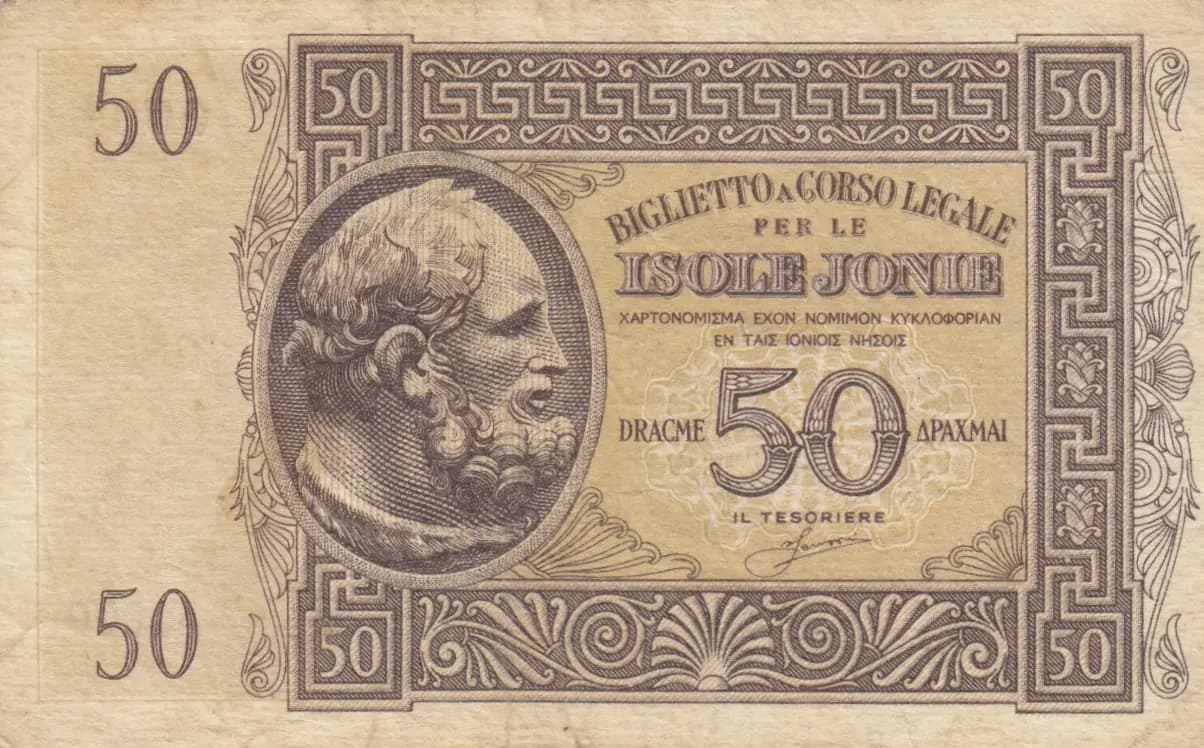
This 50 drachmai note from 1941 is a scarce Italian-issued military payment note for the Ionian Islands, featuring classical Greek design elements including a Hellenistic male portrait in profile and ornate Greek key pattern borders rendered in cream and sepia tones. The specimen in Fine condition shows typical aging characteristics of 1940s-era currency with foxing and discoloration, yet maintains legible serial numbers and clear engraving details, representing an interesting piece of WWII-era numismatic history.
Common. EBay sales data shows consistent trading in the F-VF range at $5.50-$17.50, with average prices around $10-15 for Fine specimens. The 2008 catalog value for F grade ($7.50) aligns with recent auction activity, indicating stable demand but no scarcity premium. While these are occupation-era military notes with historical interest, the apparent print run of 768,000 notes (evidenced by the serial number 768000 on the reverse) was substantial for a limited-circulation military issue, resulting in adequate supply in the collector market today.
This note was issued by 'Biglietti Corso Legale per le Isole Jonie' (Legal Currency Notes for the Ionian Islands) during Italy's occupation and administration of the Greek Ionian Islands in 1941. The dual Italian and Greek language inscriptions—including 'BIGLIETTO A CORSO LEGALE PER LE ISOLE IONI E' and the Greek equivalent 'ΧΑΡΤΟΝΟΜΙΣΜΑ ΕΧΟΝ ΝΟΜΙΜΟΝ ΚΥΚΛΟΦΟΡΙΑΝ ΕΝ ΤΑΙΣ ΙΟΝΙΟΙΣ ΝΗΣΟΙΣ'—reflect the occupying administration's attempt to maintain nominal Greek sovereignty while imposing Italian fiscal control. The classical Greek portrait and geometric patterns were deliberately chosen to appeal to local populations while projecting Italian cultural authority.
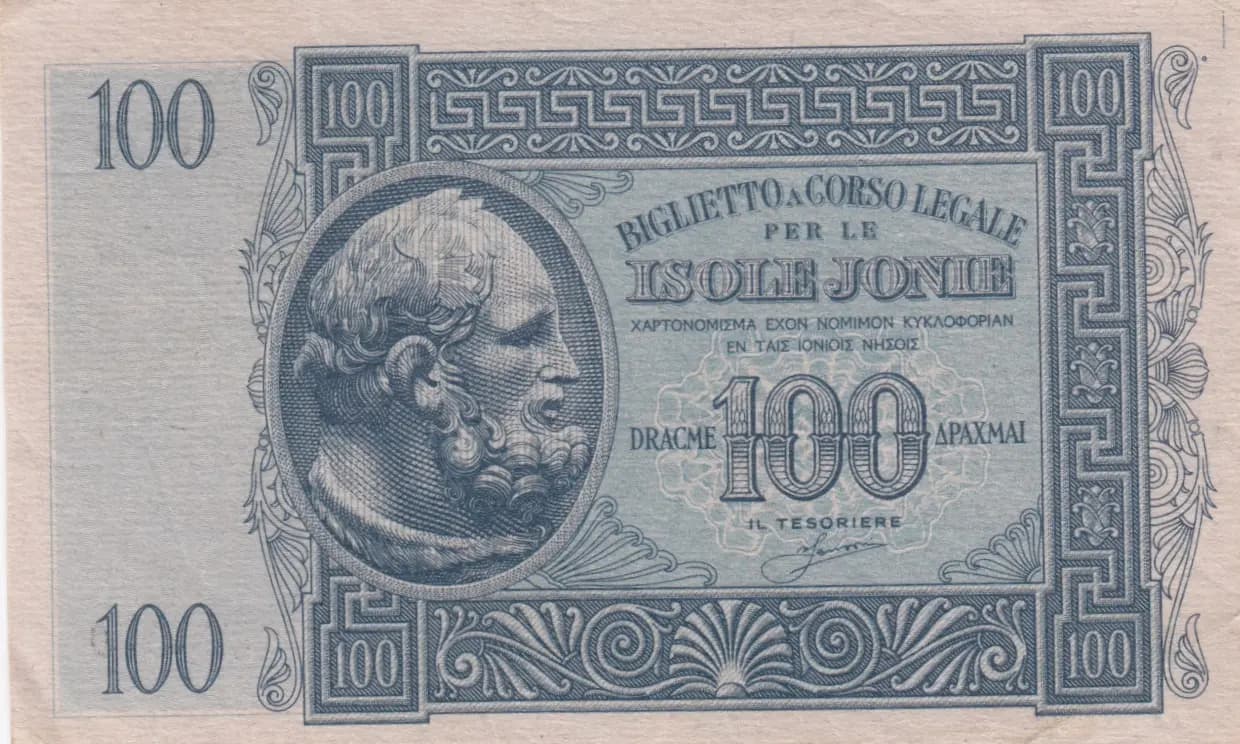
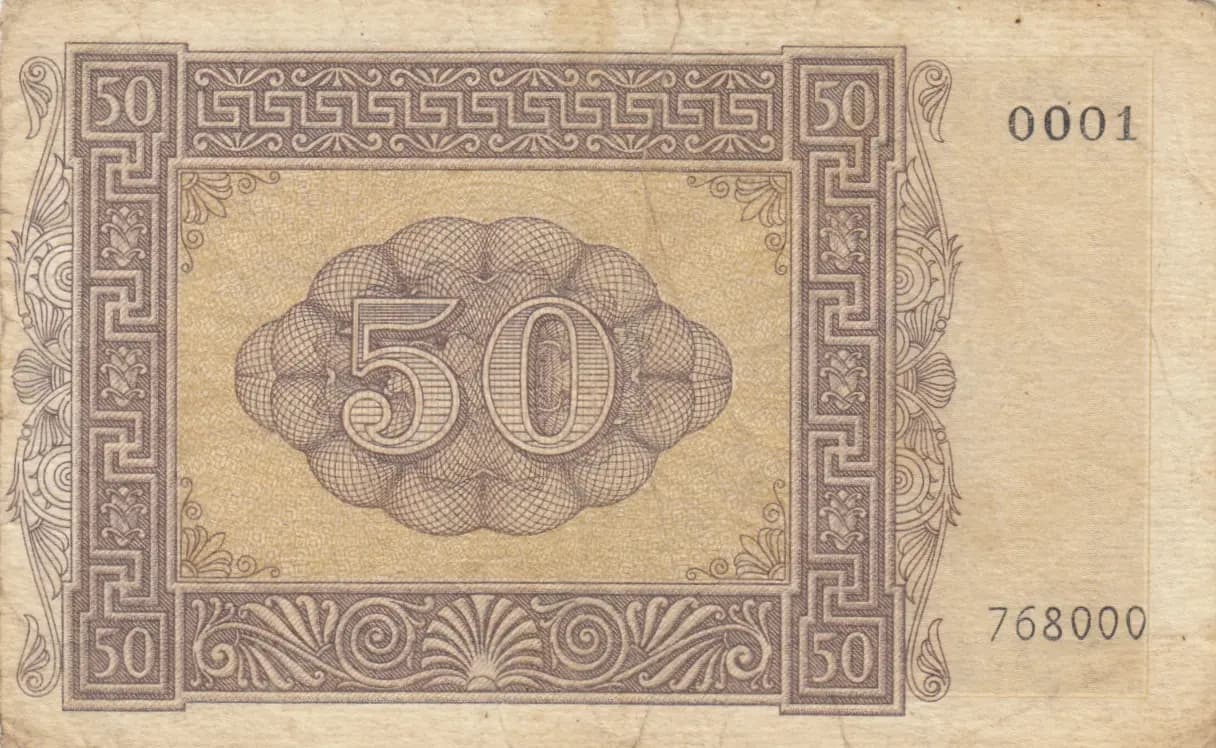
The obverse features a classical male portrait in the Hellenistic style, shown in right profile within an oval frame, depicting what appears to be an idealized ancient Greek figure with curled hair and beard—chosen to evoke classical Greek heritage while under Italian occupation. The portrait is flanked by elaborate ornamental borders incorporating Greek key patterns and acanthus scroll ornaments, all executed in fine line engraving. The reverse presents a purely ornamental design centered on a decorative rosette or flower-shaped frame composed of interlocking geometric curved lines, creating a classical medallion effect, surrounded by the same Greek key pattern borders. The cream and sepia color scheme and delicate engraving throughout reflect the high production standards typical of Italian security printing during this period.
FRONT SIDE: Main inscriptions include 'BIGLIETTO A CORSO LEGALE PER LE ISOLE JONI E' (Legal Tender Note for the Ionian Islands), '50 DRACME' (50 Dracmas) in Italian, and the Greek parallel text 'ΧΑΡΤΟΝΟΜΙΣΜΑ ΕΧΟΝ ΝΟΜΙΜΟΝ ΚΥΚΛΟΦΟΡΙΑΝ ΕΝ ΤΑΙΣ ΙΟΝΙΟΙΣ ΝΗΣΟΙΣ' (Banknote having legal circulation in the Ionian Islands) and 'ΔΡΑΧΜΑΙ' (Dracmas). The note is signed 'IL TESORIERE' (The Treasurer). BACK SIDE: Features the denomination '50' centered within a decorative rosette frame, with serial numbers visible: '0001' and '768000', indicating this is from the first serial number batch of the 768,000-note issue.
Steel plate engraving with intaglio printing, characteristic of Italian military payment certificate production during WWII. The fine line engraving visible throughout—particularly in the portrait details, geometric patterns, and ornamental borders—indicates professional security printing. The printer for Biglietti Corso Legale per le Isole Jonie notes was the Italian state security printer, producing these notes with the sophisticated anti-counterfeiting engraving techniques standard for occupation-era military currency.
The observed serial numbers (0001 and 768000) suggest this specimen is from the earliest portion of the print run, with the serial number 0001 indicating it may be from a low serial number block. The dual Italian-Greek bilingual inscriptions are standard for all notes of this issue. No varieties involving different signatures, date variations, or overprints are documented for Pick M14; the issue appears to be a single standard printing without documented varieties.