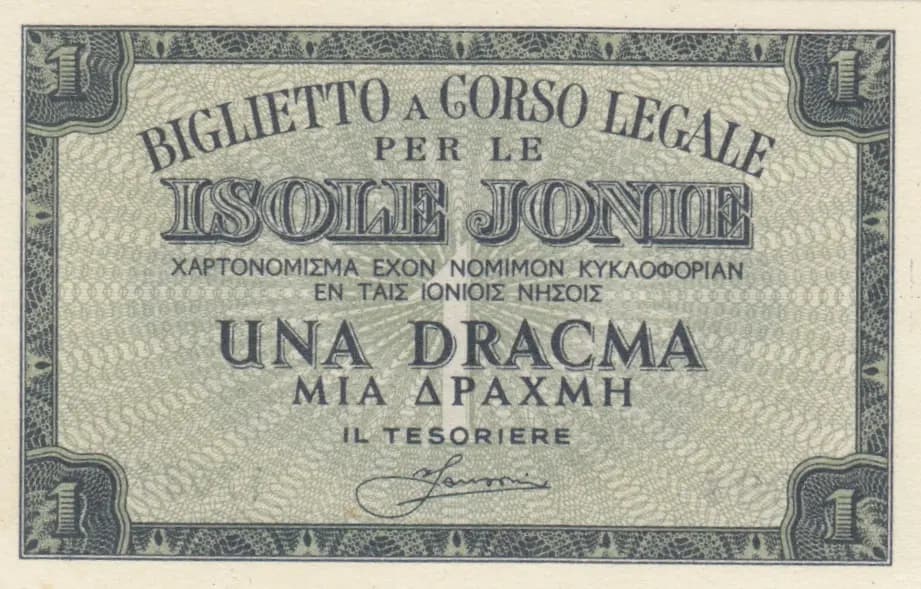
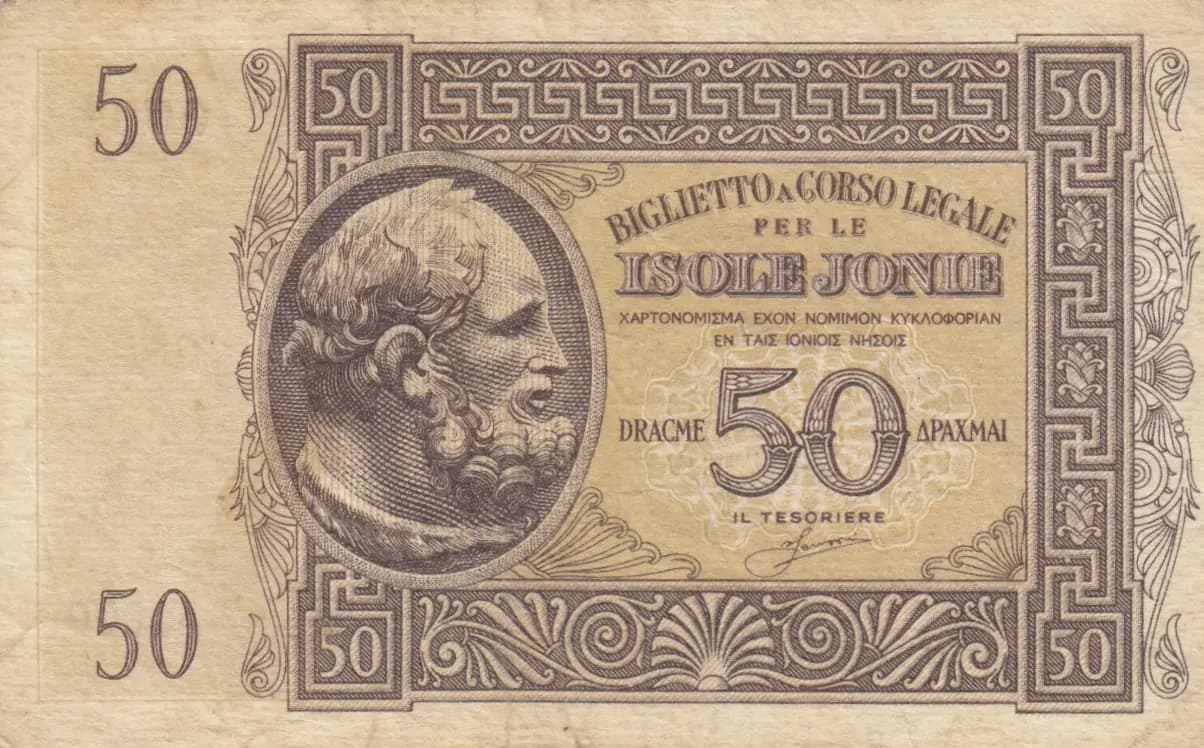
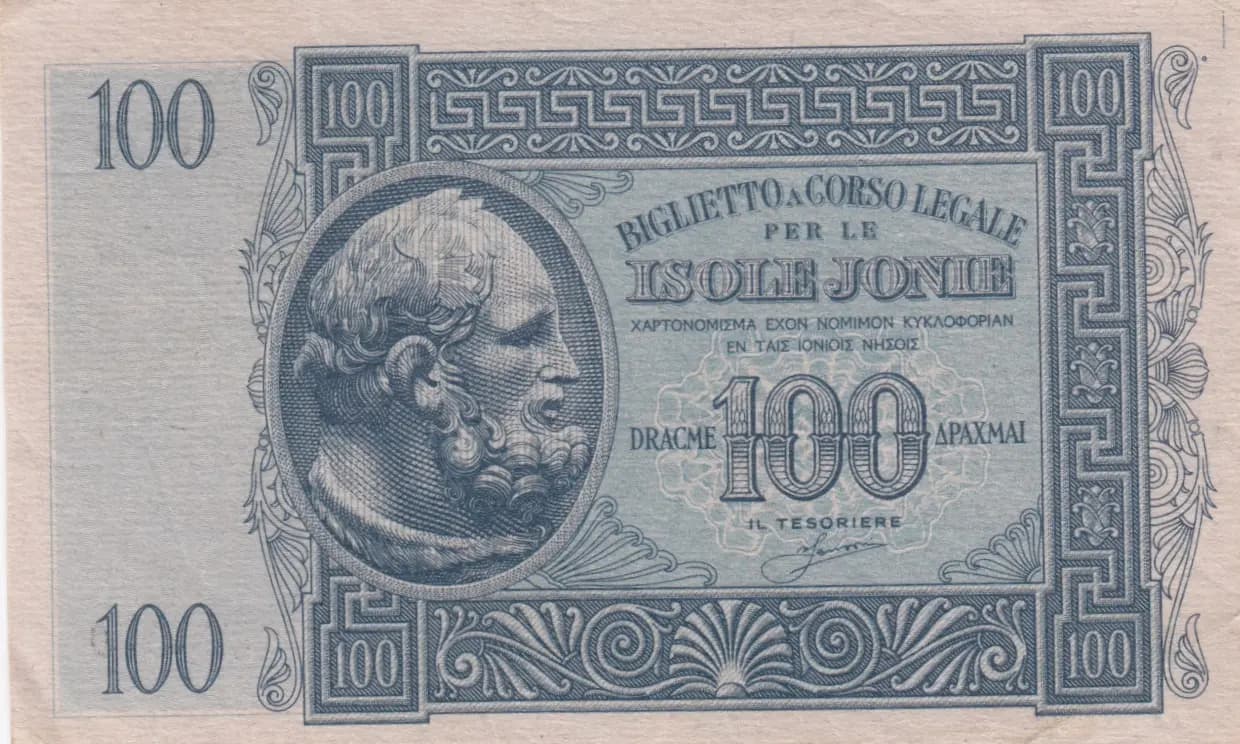
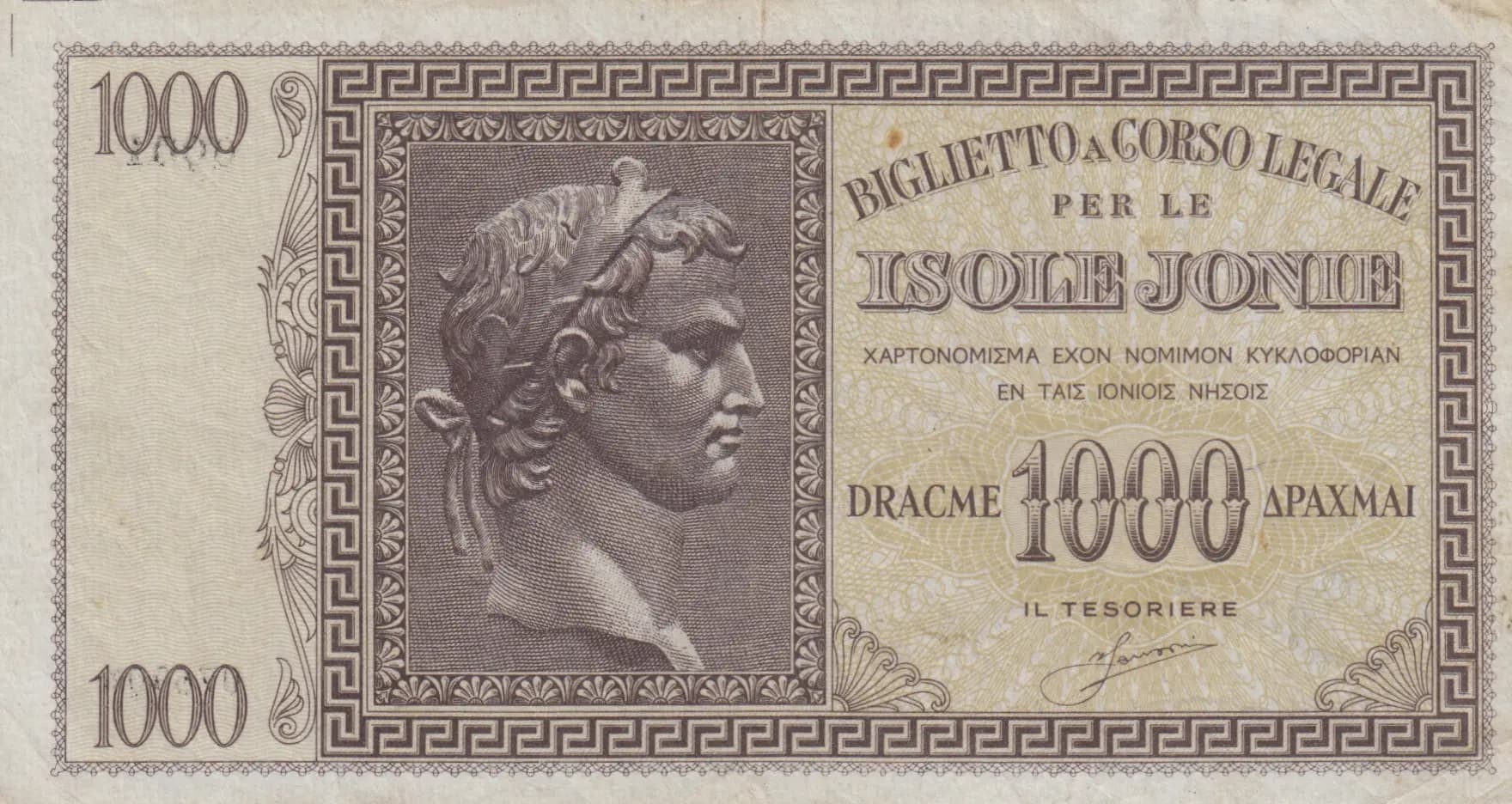
500 drachmai 1941
Market Prices
16 salesAbout This Note
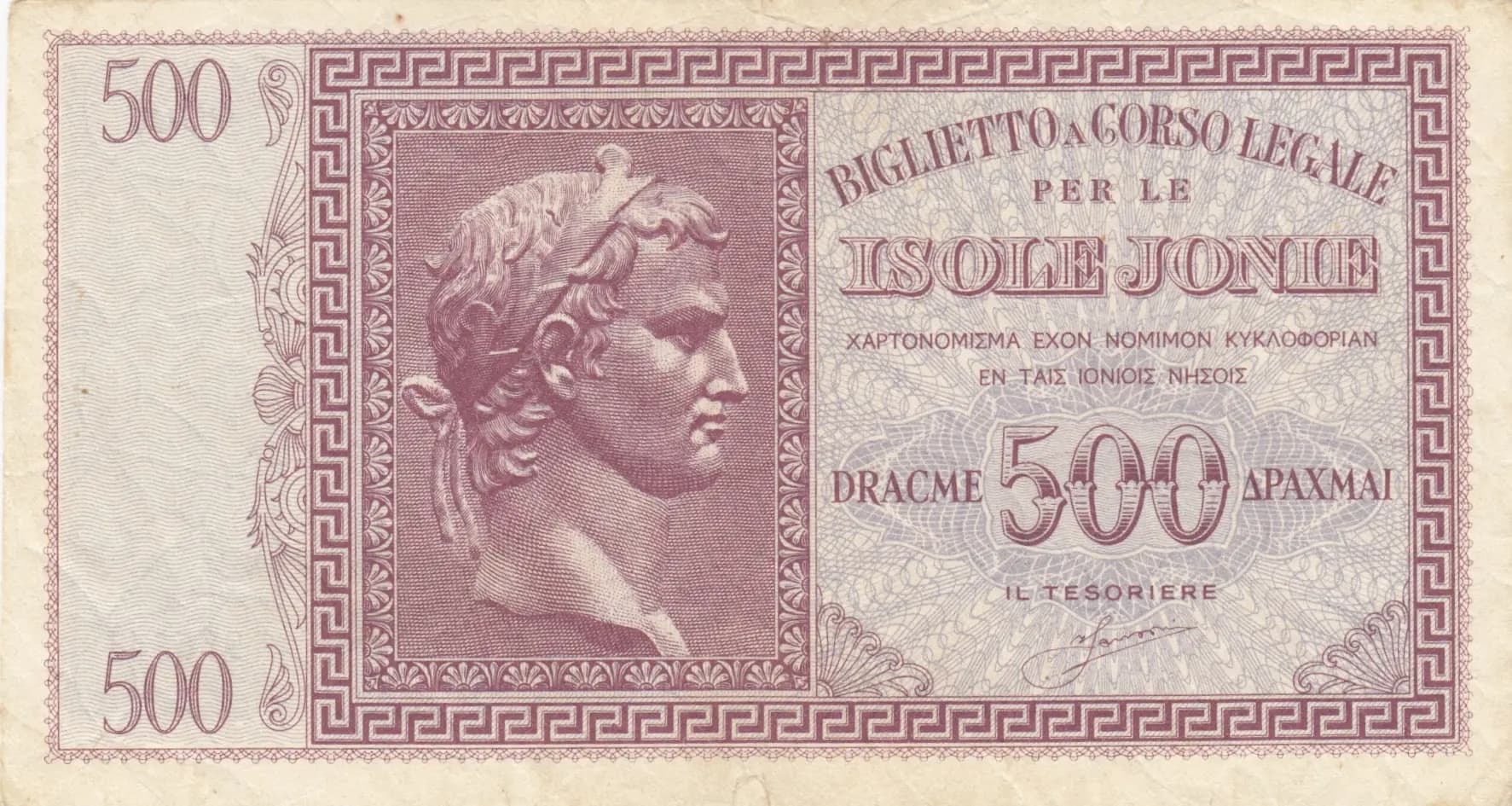
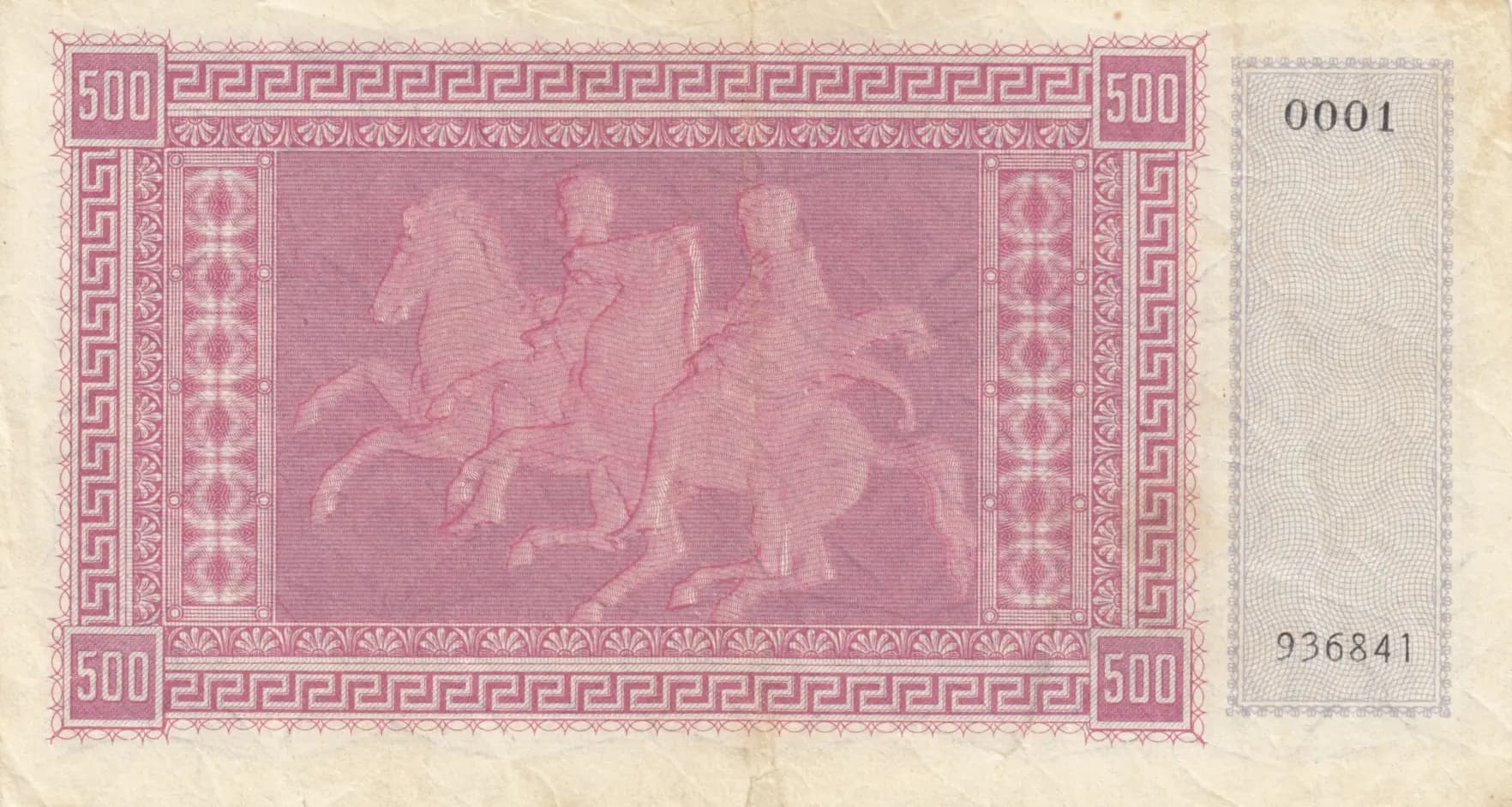
This 500 drachmai note from 1941 is a striking example of Italian military occupation currency issued for the Ionian Islands during World War II. The obverse features a classical male portrait in profile with intricate Greek key pattern borders and mauve-purple coloring, while the reverse depicts an ancient Greek frieze of classical figures in relief-style engraving. The note shows honest age-related wear with foxing and discoloration consistent with VF condition, presenting an important historical artifact from a brief and distinctive currency issue.
Common. Secondary market evidence strongly indicates this is a common note in VF condition. eBay sales data shows consistent VF sales in the $10-$33 range (2020-2025), with more recent sales at $10-$21, indicating stable but modest demand. The 2008 catalog VF value of $50 has not materialized in recent market sales. The PMG population data shows only 2 variants cataloged (P-M16a and P-M16b), but without specific population numbers, combined with the consistent and plentiful eBay sales history spanning multiple years, this indicates a reasonably well-printed issue with adequate surviving examples.
This note was issued by the Biglietti Corso Legale per le Isole Jonie (Legal Tender Banknotes for the Ionian Islands) during the Italian occupation of the Ionian Islands in 1941, following Greece's invasion by Axis powers. The bilingual Italian-Greek inscriptions reflect the occupying administration's attempt to establish monetary control in the region. The classical Greek imagery—including the portrait styled after ancient coins and the ancient frieze depicted on the reverse—ironically invokes Greek cultural heritage while representing a period of foreign occupation and wartime emergency currency.
The obverse features a classical male portrait in the style of ancient Greek or Roman numismatic portraiture, showing a figure with curled hair in right-facing profile, framed within elaborate Greek meander (key pattern) borders with decorative shell and floral motifs in the corners. The reverse depicts an ancient Greek frieze scene with three classical figures rendered in relief-style engraving, creating a historically evocative composition. Both sides employ ornamental scrollwork and classical architectural design elements throughout, with denomination numerals '500' prominently displayed in the corners. The mauve and purple coloring scheme creates a sophisticated, authoritative appearance typical of occupation-era military payment currency. The overall design synthesizes classical Greek aesthetics with Italian administrative authority.
FRONT: 'BIGLIETTO A CORSO LEGALE PER LE ISOLE JONI' (Legal tender banknote for the Ionian Islands); 'DRACME 500' (500 Drachmas); 'ΧΑΡΤΟΝΟΜΙΣΜΑ ΕΧΟΝ ΝΟΜΙΜΟΝ ΚΥΚΛΟΦΟΡΙΑΝ ΕΝ ΤΑΙΣ ΙΟΝΙΟΙΣ ΝΗΣΟΙΣ' (Banknote having legal circulation in the Ionian Islands); 'ΑΡΑΧΜΑΙ' (Drachmas); 'IL TESORIERE' (The Treasurer). BACK: Denomination '500' in all four corners; serial numbers visible on right margin (0001, 936841).
Intaglio engraving (steel plate engraving), characterized by the fine line work, intricate geometric border patterns, detailed portrait rendering, and the complex frieze composition visible in the visual analysis. The microprint-style fine details in decorative elements and the precise reproduction of classical artistic elements confirm professional engraving by an Italian security printer. This was standard for Italian government banknotes and military currency of the era.
This note is cataloged as Pick P-M16a (500 drachmai). The visual analysis confirms this is the 'a' variety based on the described design characteristics. A 'b' variety (P-M16b) exists in the PMG catalog. Without higher-resolution serial number analysis or color variant documentation, the specific distinguishing characteristics between P-M16a and P-M16b cannot be definitively determined from the images provided, though signature varieties or minor design elements may differentiate them. The serial numbers visible (0001 and 936841) suggest this is a mid-range serial from the issue run.