2 drachmai 1941
Market Prices
68 salesAbout This Note
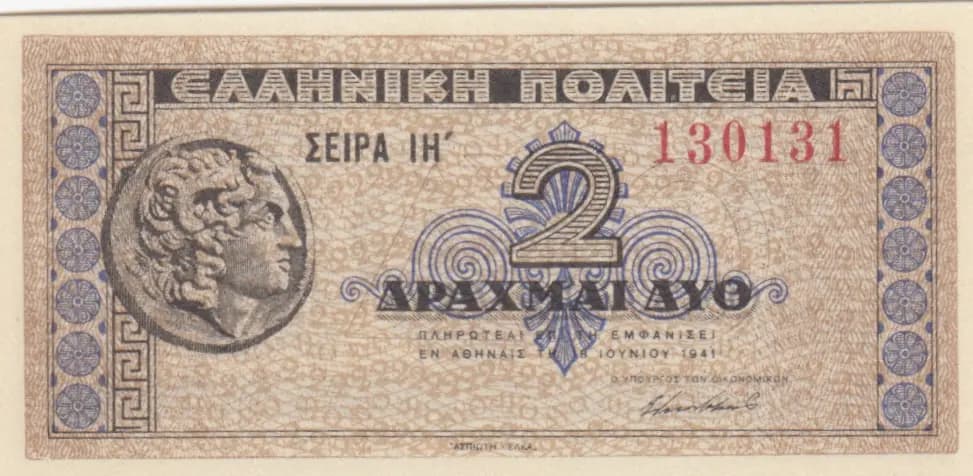
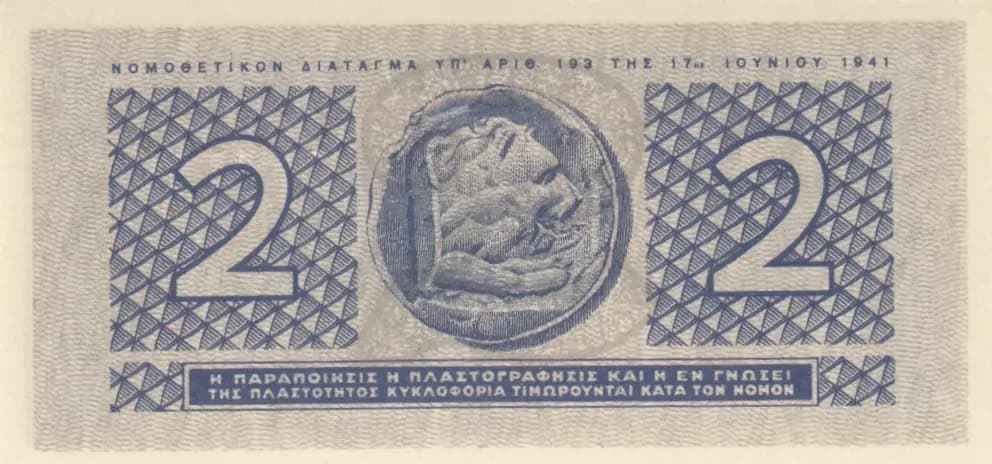
A stunning uncirculated 1941 Greek 2 Drachmai note issued under the Hellenic State during the Nazi occupation period. The obverse features a classical male portrait in profile within a circular medallion, set against a beige background with elegant Greek key pattern borders, while the reverse displays a sculptural relief within an oval frame set against fine lattice work. The note exhibits exceptional preservation with no visible wear, creases, or foxing, representing a premium example of this wartime denomination.
Common. The eBay sales data provided shows consistent market pricing in the $2–$27 range across multiple grades from 2013–2026, with ungraded UNC examples selling for approximately $2–$5.60 and PMG-graded examples (PMG 63–66) typically realizing $15–$25. No evidence of scarcity is apparent in this market data. While the note was issued during a specific wartime period under occupation, the print run was evidently sufficient to ensure adequate supplies remain in the collector market today. The lack of any exceptional price premiums or bidding wars indicates this is a routinely available issue.
This 2 Drachmai note was issued on June 17, 1941, during Greece's occupation in World War II, under Legislative Decree No. 193 of the Hellenic State (Elliniki Politia). The classical Greek imagery—featuring what appears to be Alexander the Great on the obverse and ancient Greek sculptural elements on the reverse—reflects the Greek government's attempt to maintain cultural and national identity during the occupation period. The note's design emphasizes Greece's classical heritage as a source of continuity and legitimacy during a period of political upheaval.
The obverse features a classical male portrait believed to represent Alexander the Great, rendered in profile facing right and enclosed within an ornamental circular medallion. The portrait is flanked by decorative Greek key pattern (meander) borders on both edges, a design element referencing ancient Greek artistic traditions. The denomination '2' is prominently centered with ornamental flourishes, and the issuer is identified as the Hellenic State (Elliniki Politia) at the top in Greek capitals. The reverse displays a larger sculptural relief, possibly representing another classical Greek figure or deity, contained within an oval medallion and centered on the note. Both sides of the denomination numeral '2' appear in decorative lattice frames. The background throughout employs a fine crosshatch/lattice pattern as an anti-counterfeiting security measure. The color scheme combines warm beige and tan tones on the obverse with cream and blue-gray tones on the reverse, creating visual distinction between the two sides.
Front Side: 'ΕΛΛΗΝΙΚΗ ΠΟΛΙΤΕΙΑ' (Hellenic State); 'ΣΕΙΡΑ Ι'' (Series I); 'ΔΡΑΧΜΑΙ' (Drachmai); Serial number '1301131'. Back Side: 'ΝΟΜΟΘΕΤΙΚΟΝ ΔΙΑΤΑΓΜΑ ΥΠ'ΑΡΙΟ 193 ΤΗΣ 17ης ΙΟΥΝΙΟΥ 1941' (Legislative Decree No. 193 of June 17, 1941); 'Η ΠΑΡΑΠΟΙΗΣΕΙΣ Η ΠΛΑΣΤΟΓΡΑΦΕΙΕ ΚΑΙ Η ΕΝ ΓΕΝΟΣΕΙ ΤΗΣ ΠΛΑΣΤΟΤΗΤΟΥ ΚΥΚΛΟΦΟΡΙΑ ΤΙΜΠΡΟΥΝΤΑΙ ΚΑΤΑ ΤΟΝ ΝΟΜΟΝ' (Counterfeiting, forgery, and general circulation of forgeries are punishable according to law).
This note was produced by Aspioti-ELKA (also referenced as Aspioti-Ellinika), a Greek security printer. The printing technique employed is high-quality intaglio (engraved) printing, evidenced by the fine line work visible in the portrait details, decorative borders, and the intricate crosshatch background pattern. The detailed circular medallion framing, ornamental flourishes, and sculptural relief rendering are characteristic of classical intaglio engraving. The multi-color printing (black, blue-gray, red accents on tan/beige stock) indicates the use of multiple printing plates and passes, standard practice for security printing of the era.
This note is identified as Pick P-318 from the 1941 issue under the Hellenic State. The visual analysis indicates this is Series I (ΣΕΙΡΑ Ι'). The serial number shown is 1301131. No obvious signatures, overprints, or date variations are evident from the images provided. For comprehensive variety information on this Pick number (such as signature combinations, serial number prefixes, or minor printing varieties), consultation of specialized Greek drachmai catalogs would be required; however, the standard 1941 2 Drachmai appears to represent the primary issued variety.