2 000 000 000 drachmai 1944
Market Prices
29 salesAbout This Note
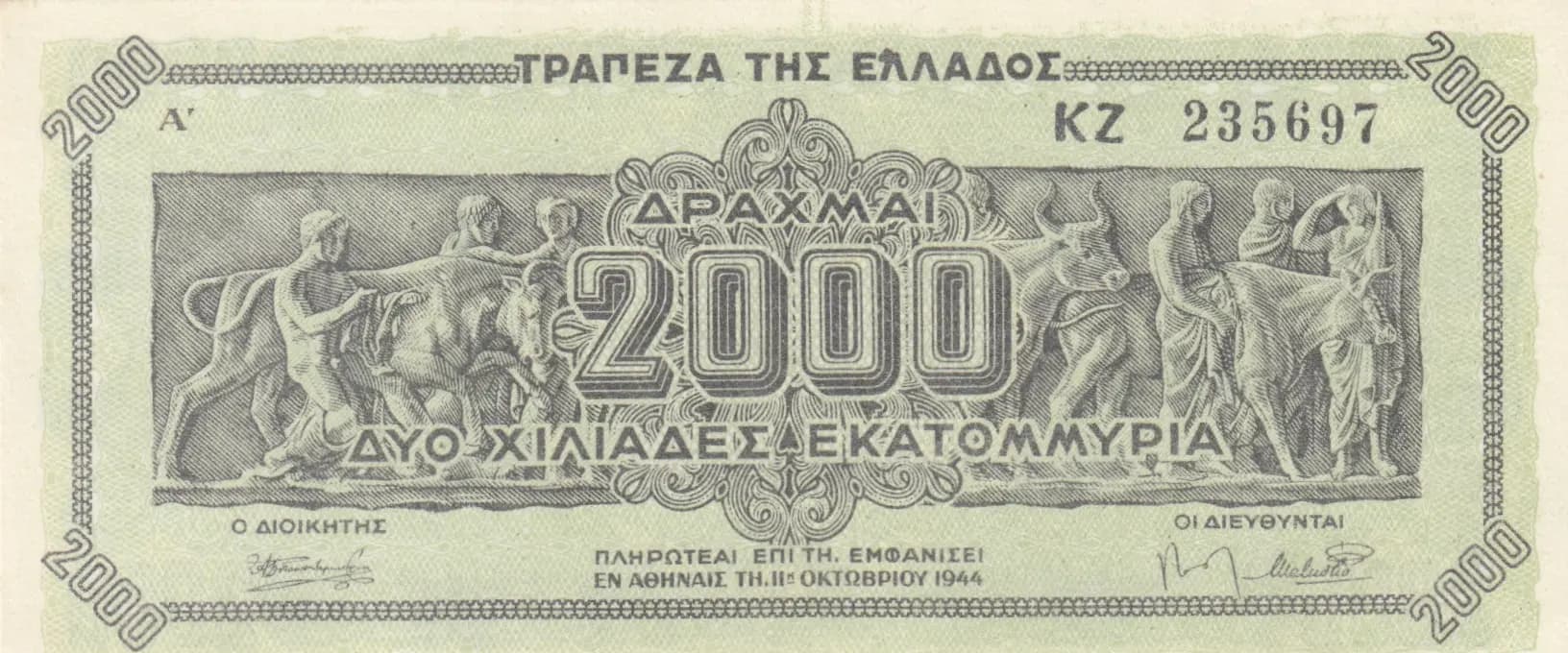
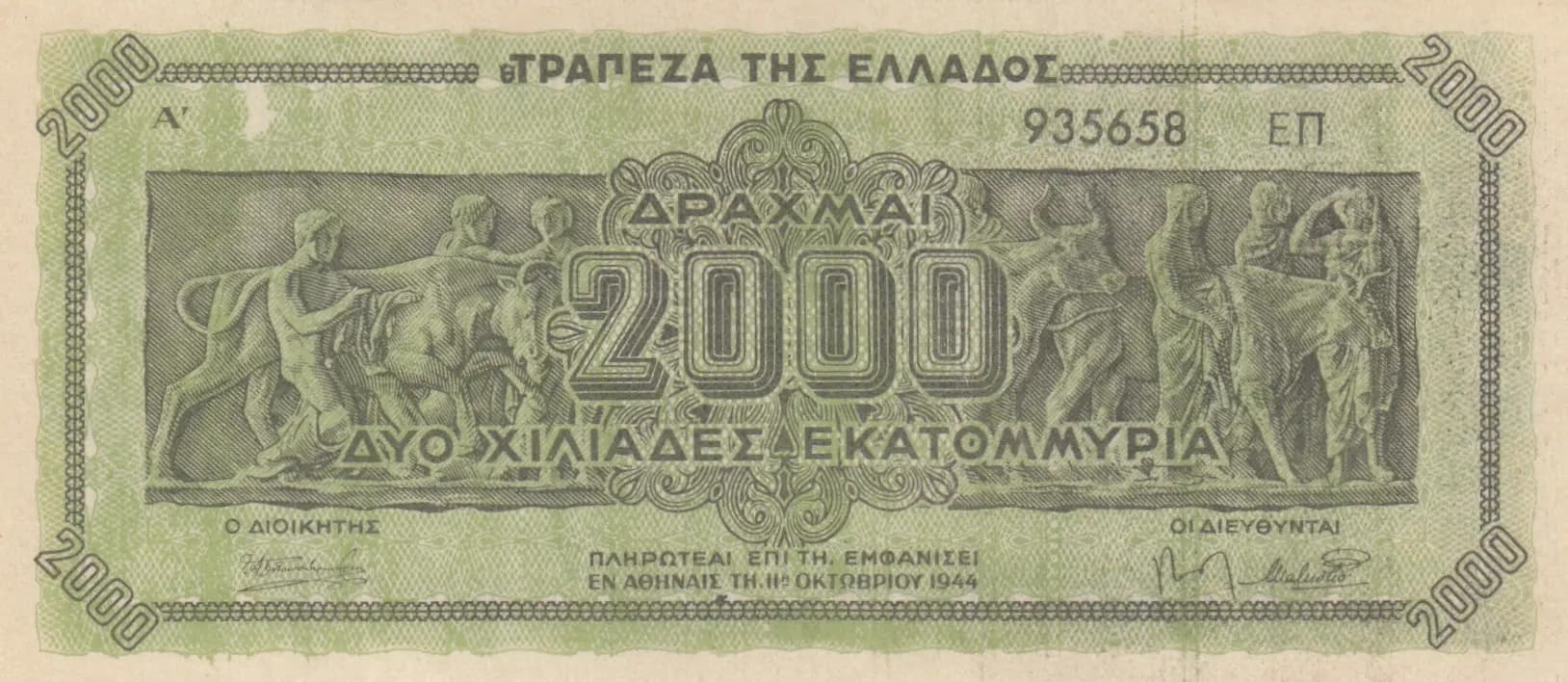
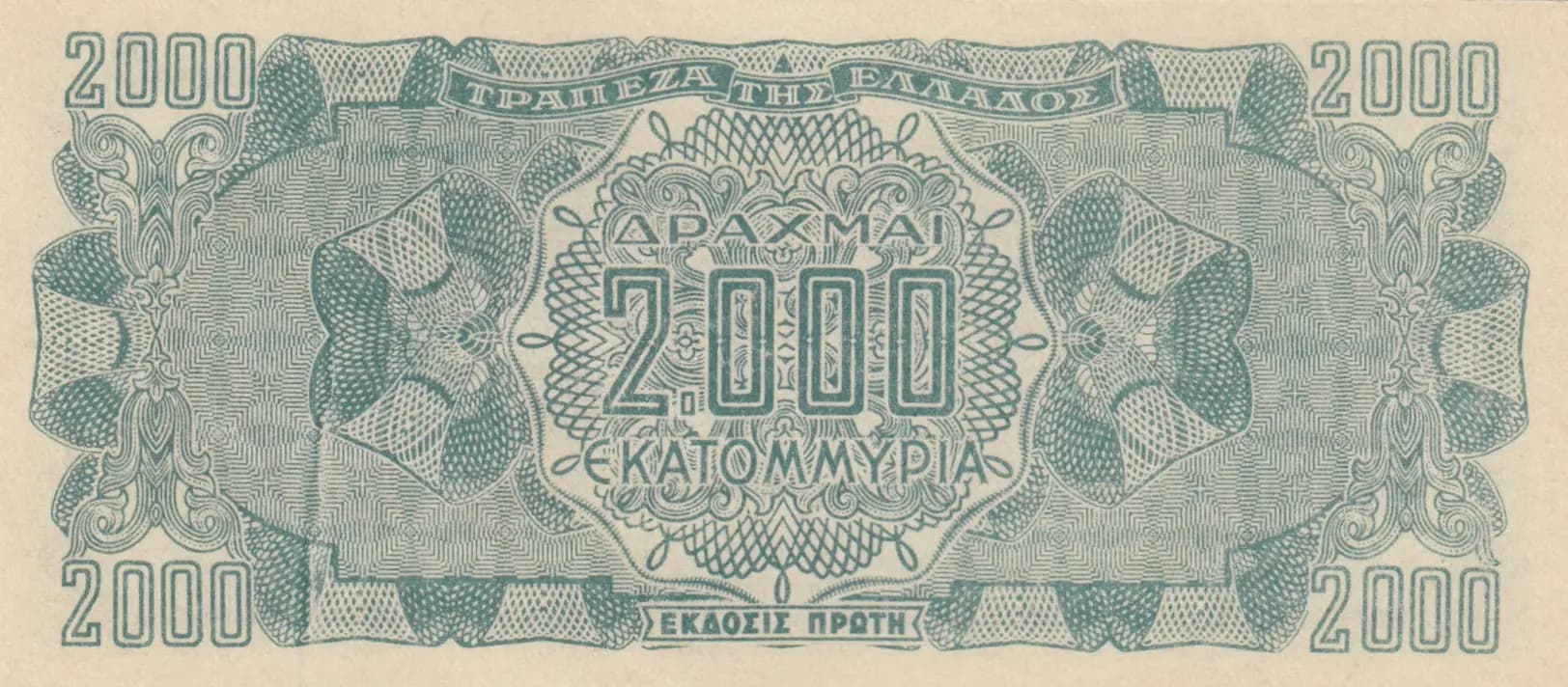
This is a Greek 2,000,000,000 Drachmai note from October 1944, issued during the German occupation and liberation period. The UNC example displays crisp printing with light green obverse and teal reverse, featuring classical Greek allegorical figures and ornamental designs characteristic of wartime emergency currency. Despite its massive nominal value reflecting severe hyperinflation, the note retains excellent condition with intact margins and minimal foxing, making it an attractive example of this historically significant hyperinflation-era issue.
Common. This is a regular issue from a high-denomination hyperinflation series with substantial print runs. eBay market data shows consistent sales in the $1.30–$5.10 range for circulated to AUNC examples over more than a decade, with even graded PMG 65–66 specimens typically bringing $25–$70. Catalog values from 2016 list UNC at only $3, confirming wide availability. The denomination was necessary due to extreme inflation, so millions were printed. No evidence of short-lived issue, rarity, or recall status exists for Pick 133b.
This note was issued on 11 October 1944 by the Bank of Greece (Τράπεζα της Ελλάδος) during the final stages of German occupation and the beginning of Greece's liberation. The classical Greek allegorical imagery—featuring female and male classical figures flanking the denomination—reflects the Bank's effort to invoke national heritage and continuity during a period of severe economic dislocation. The extraordinary denomination of two billion drachmai documents the complete collapse of the drachma's value, with the wartime occupation period producing some of the most extreme hyperinflation in European history.
The obverse features a balanced classical composition with allegorical representations of Greece personified as both female (left) and male (right) classical figures in the neoclassical style. The central vignette prominently displays the denomination '2000' surrounded by additional classical figures and ornamental elements including a decorative crown with floral motifs. The design employs light greenish toning with olive-brown accents. The reverse presents a more restrained design centered on the denomination within an ornamental wreath-like cartouche with laurel or olive branch motifs, rendered in teal and blue-green on a cream background. Both sides feature intricate geometric border patterns and cross-hatch security printing characteristic of Greek Bank notes from this period. The classical aesthetic throughout emphasizes continuity of Hellenic civilization despite the catastrophic economic circumstances of 1944.
OBVERSE: 'ΤΡΑΠΕΖΑ ΤΗΣ ΕΛΛΑΔΟΣ' (Bank of Greece); '2000' (denomination); 'ΔΡΑΧΜΑΙ' (Drachmai); 'ΔΥΟ ΧΙΛΙΑΔΕΣ ΕΚΑΤΟΜΜΥΡΙΑ' (Two Thousand Million); Serial number '935658' with suffix 'ΕΠ'; 'Ο ΔΙΟΙΚΗΤΗΣ' (The Director); 'ΟΙ ΔΙΕΥΘΥΝΤΑΙ' (The Managers); 'ΠΛΗΡΩΤΕΑΙ ΕΠΙ ΤΗ ΕΜΦΑΝΙΣΕΙ ΕΝ ΑΘΗΝΑΙ ΤΗΝ ΟΚΤΩΒΡΙΟΥ 1944' (Payable upon presentation in Athens in October 1944). REVERSE: 'ΤΡΑΠΕΖΑ ΤΗΣ ΕΛΛΑΔΟΣ' (Bank of Greece); '2000' (denomination repeated); 'ΔΡΑΧΜΑΙ' (Drachmai); '2000 ΕΚΑΤΟΜΜΥΡΙΑ' (2000 Million); 'ΕΚΔΟΣΙΣ ΠΡΩΤΗ' (First Issue).
Intaglio/line engraving, evidenced by the fine line work in ornamental borders, complex geometric patterns, and the precision of the allegorical figure rendering visible in the images. The note displays sophisticated anti-counterfeiting measures including intricate cross-hatch background patterns, fine-line geometric borders, and detailed ornamental work consistent with high-quality security printing. The color schemes (light green/olive obverse; teal/blue-green reverse) were applied through multi-plate color printing techniques. The printer for this series was the Bank of Greece's own security printing operations.
Pick 133b denotes the second printing variant of this 2,000,000,000 Drachmai denomination. The serial number format visible ('935658' with suffix letters 'ΕΠ') is consistent with the b-variant classification. The notation 'ΕΚΔΟΣΙΣ ΠΡΩΤΗ' (First Issue) on the reverse appears on this variant. Varieties of this note are distinguished primarily by serial number prefixes, plate identifiers (such as the 'ΕΠ' visible here), and minor design state changes between printings. The October 1944 date represents the initial authorization, though multiple printings extended through the immediate post-war period.