1000 drachmai 1939
Market Prices
134 salesAbout This Note
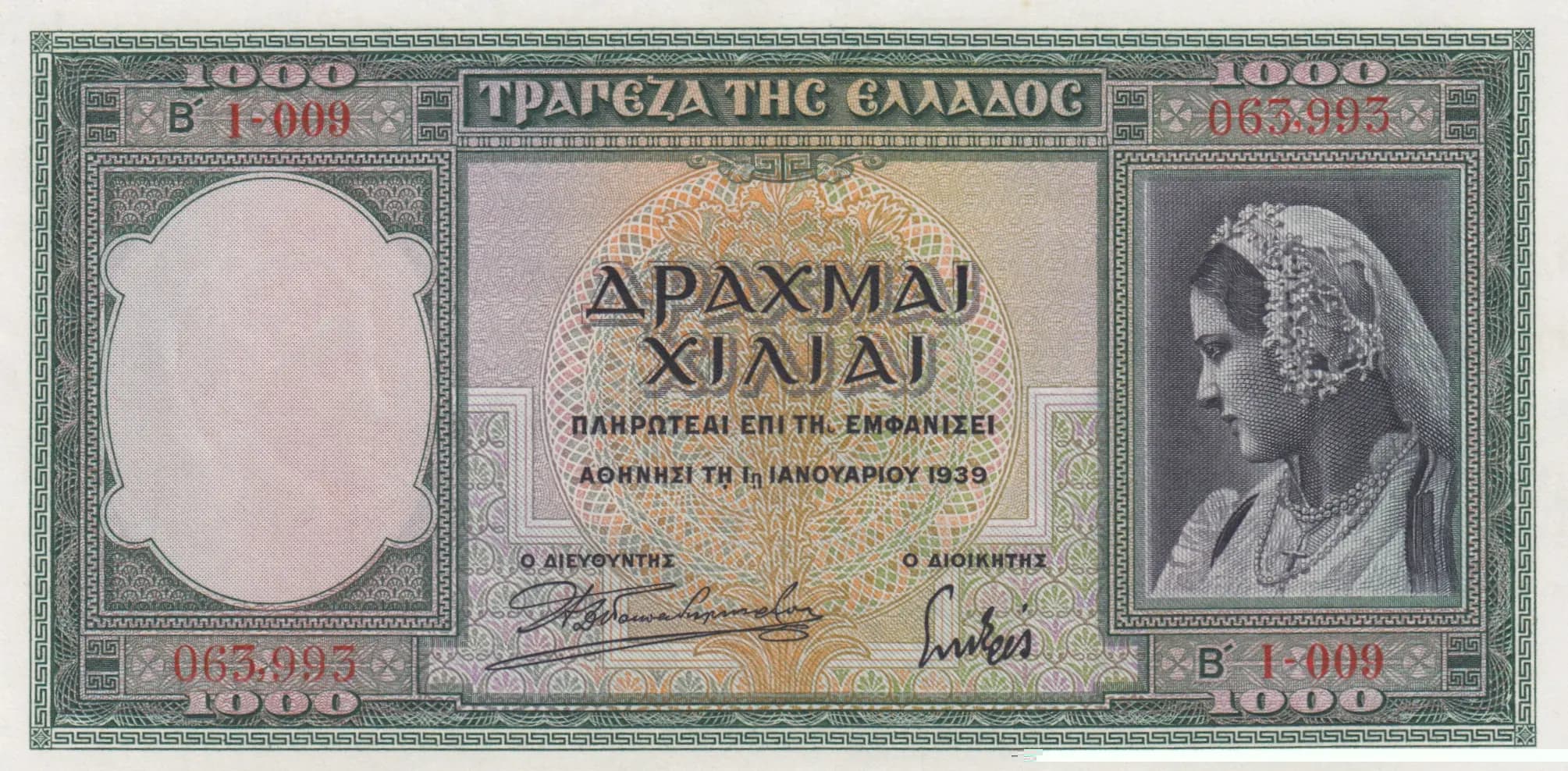
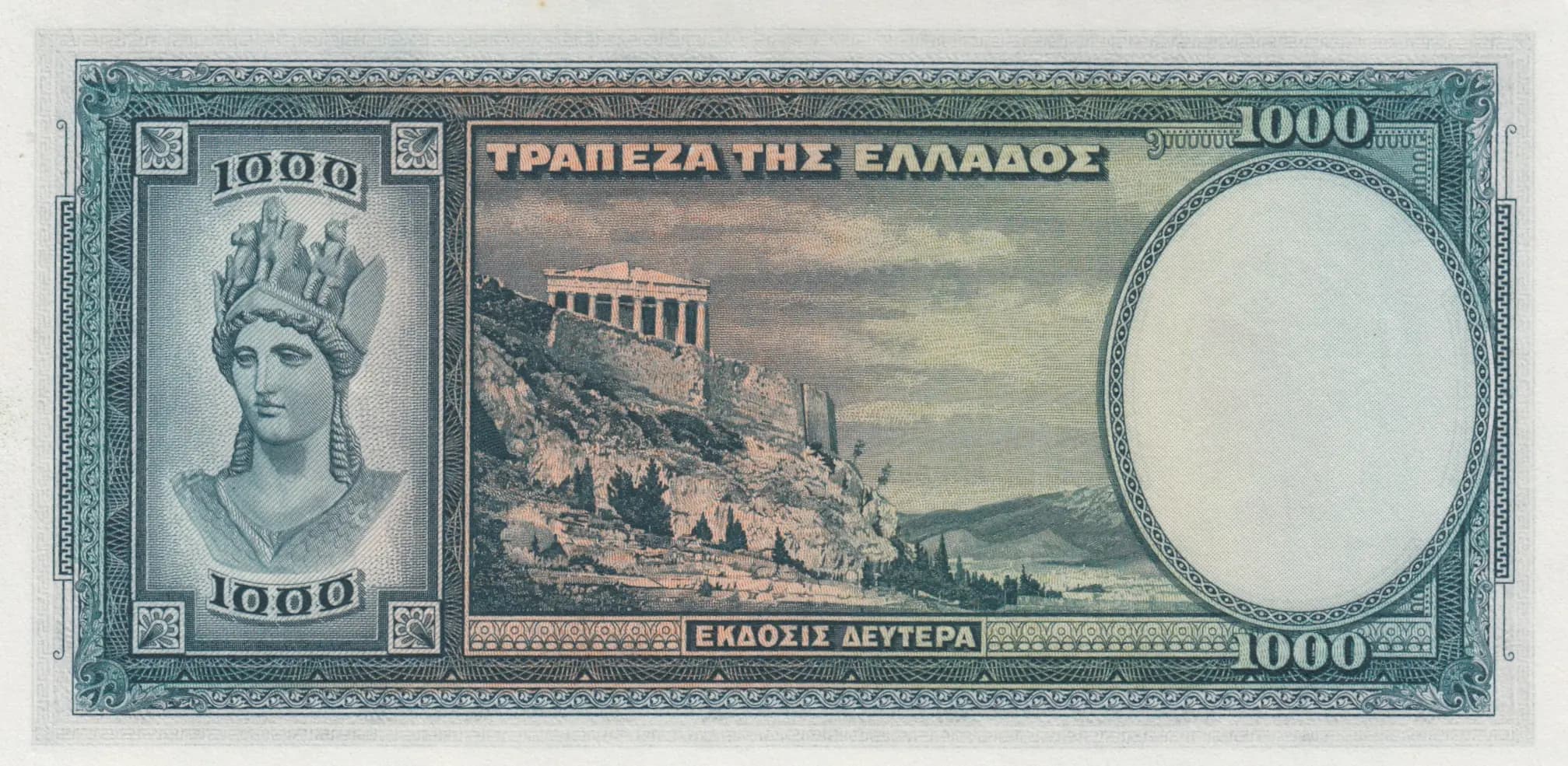
This 1000 Drachmai note from 1939 represents a beautiful example of Greek interwar currency design, featuring classical iconography reflecting Greece's cultural heritage. The obverse displays an elegant female portrait in profile with ornate headdressing, while the reverse showcases the Parthenon on the Acropolis—a potent national symbol during a period of Greek political and economic transition. The note exhibits characteristics consistent with uncirculated condition, with crisp printing, vibrant color palette, and minimal wear visible throughout.
Common. The extensive eBay sales data provided demonstrates consistent market presence with numerous transactions over more than a decade (2009-2026). Even high-grade examples (PMG 65-67) typically sell in the $35-90 range, while lower grades trade for $1-10. A single UNC example sold for $203.50 in 2009, but this represents an outlier rather than consistent market value. The 2016 catalogue valuation of $15 UNC aligns with contemporary market behavior. The note's consistent availability in the secondary market and modest price points across all conditions indicate this was a substantial regular-issue printing with no scarcity premium.
Issued on January 18, 1939, by the Bank of Greece (Trapeza tis Ellados), this note emerged during a pivotal moment in Greek history—just before World War II and during the authoritarian regime of Ioannis Metaxas. The deliberate selection of classical imagery, particularly the female figure (likely representing Athena or Greek democracy) and the Parthenon, reflects the Greek state's effort to anchor modern national identity in ancient Hellenic civilization during a period of political instability and international tension.
The obverse features a classically-rendered female portrait in left profile, depicted wearing an elaborate headdress with fine mesh or lace detailing and draped Greco-Roman drapery, rendered in black and white stippled engraving. The portrait is framed within a blank oval cartouche with ornate Greek key (meander) pattern borders—a classical motif repeated throughout the note's frame. An ornate circular geometric design in orange and green tones occupies the central area, containing Greek text. The reverse displays a classical sculptural bust (likely representing Athena, the patron goddess of Athens) in three-quarter frontal view, wearing an ornate crown or helmet. To the right of this bust is a landscape vignette depicting the Parthenon temple on the rocky Acropolis hilltop, rendered with fine detail including cypress trees and distant mountains in muted green-teal, brown, and tan tones. The architectural rendering shows the Parthenon in pink-orange tones against a gray-blue sky. Both sides employ Greek key pattern borders throughout, reinforcing classical Greek aesthetic principles.
FRONT: 'ΤΡΑΠΕΖΑ ΤΗΣ ΕΛΛΑΔΟΣ' (Bank of Greece); 'ΔΡΑΧΜΑΙ ΧΙΛΙΑΙ' (One Thousand Drachmai); 'ΠΛΗΡΟΤΕΑΙ ΕΠΙ ΤΗ ΕΜΦΑΝΙΣΕΙ' (Payable upon presentation); 'ΑΘΗΝΗΣΙ ΤΗ ΙΗ ΙΑΝΟΥΑΡΙΟΥ 1939' (Athens, January 18, 1939); 'Ο ΔΙΕΥΘΥΝΤΗΣ' (The Director); 'Ο ΔΙΟΙΚΗΤΗΣ' (The Governor); Serial number 'Β 1-009' (Series B); Reference number '063.993'. BACK: 'ΤΡΑΠΕΖΑ ΤΗΣ ΕΛΛΑΔΟΣ' (Bank of Greece); 'ΕΚΔΟΣΙΣ ΔΕΥΤΕΡΑ' (Second Issue); Denomination '1000'.
This note was produced using intaglio engraving (copperplate printing), evident from the fine line work, detailed cross-hatching in the portrait, and precise geometric patterns observable throughout. The multi-color printing in orange, green, brown, and blue tones indicates separate intaglio passes or hand-colored elements typical of Bank of Greece productions from this era. Security printing was likely executed by a prominent European security printer, though specific attribution for this 1939 Greek issue requires consultation of Bank of Greece archival records.
This example represents the 'ΕΚΔΟΣΙΣ ΔΕΥΤΕΡΑ' (Second Issue) as explicitly noted on the reverse. Series identification 'Β 1-009' is visible, indicating Series B of the first range. Serial number prefix and specific numbering (063.993) should be cross-referenced against Bank of Greece serial number records to determine if this note falls within a known variety or sub-type. The January 18, 1939 date is consistent with the initial issue date of this denomination. Collectors should note that different series prefixes (A, B, C, etc.) and signature varieties (Director and Governor) exist for this Pick-110 issue and may command modest premiums, though no major varieties are known to be significantly scarcer.