100 drachmai 1967
Market Prices
62 salesAbout This Note
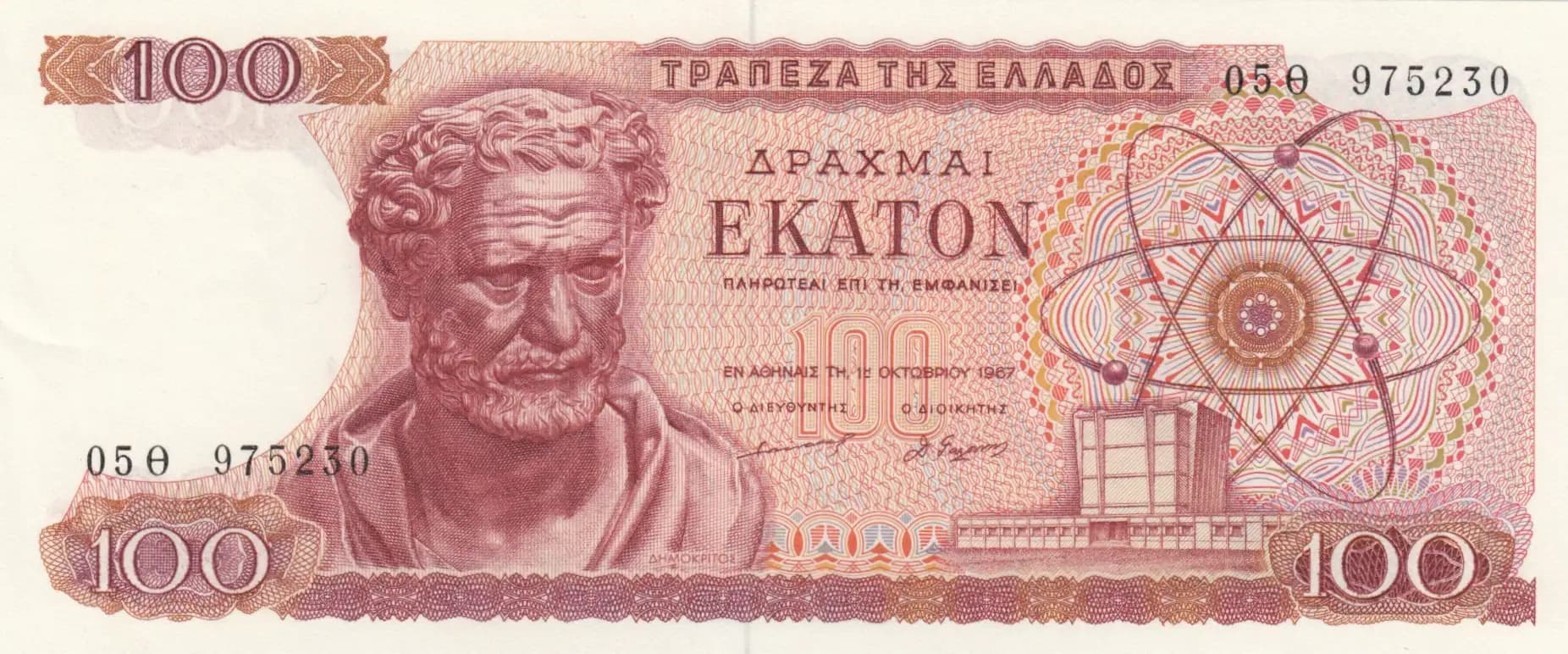
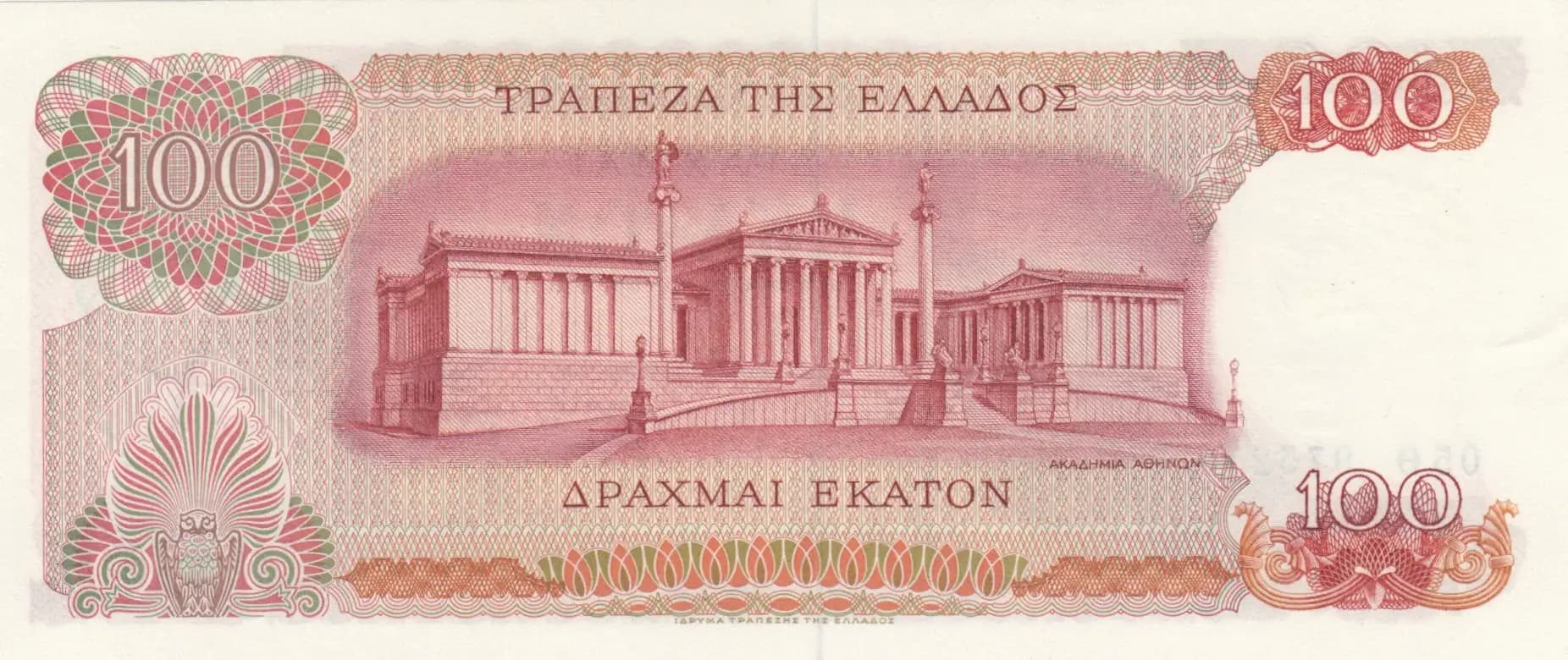
This is a Greek 100 drachmai banknote from 1967, graded AU (Almost Uncirculated), featuring the classical Greek philosopher Demokritos on the obverse and the Academy of Athens on the reverse. The note displays exceptional preservation with no visible wear, creases, or stains, showcasing the intricate mauve, pink, and brown color palette with extensive guilloche security patterns typical of Bank of Greece issues from this period. The note commemorates the Universal Exhibitions held in Athens on October 1st, 1967, making it a historically significant piece from a transformative year in Greece.
Common. This is a standard circulation issue from a major European central bank with substantial print runs during the 1960s. eBay market data confirms its common status, with consistent sales in the $1-$10 range across multiple condition grades over the past 15 years. Even premium grades (PMG 67) rarely exceed $80, and uncirculated examples regularly sell for $5-$15. The AU grade specified here typically trades in the $4-$8 range based on recent comparable sales, indicating widespread availability in the collector market.
Issued during the height of the Greek military junta (1967-1974), this 100 drachmai note represents the Bank of Greece's modernization of its currency designs during a politically turbulent period. The selection of Demokritos, the ancient atomist philosopher, and the Academy of Athens as central motifs reflects Greece's cultural heritage and intellectual tradition, serving as symbols of national identity and continuity despite contemporary political upheaval. The October 1967 date on the obverse directly commemorates the Universal Exhibitions held in Athens, positioning Greece on the international stage during a period of strict authoritarian control.
The obverse features a classical bust of Demokritos (460-370 BCE), the ancient Greek philosopher and founder of atomic theory, positioned on the left side with fine curly hair and beard rendered in fine line engraving. The right side displays an ornate geometric rosette pattern incorporating what appears to be an atomic symbol, representing Demokritos's scientific legacy. The reverse showcases the neoclassical Academy of Athens building in the center, featuring Doric columns, porticos, and a classical triangular pediment, flanked by elaborate decorative motifs including eagle emblems in ornate circles and peacock-feather radiating patterns. The entire note is framed by extensive guilloche patterns and fine line engraving, with color security elements including green and red decorative rosettes in the upper portions.
{"obverse":{"100":"Denomination indicator","ΤΡΑΠΕΖΑ ΤΗΣ ΕΛΛΑΔΟΣ":"Bank of Greece","ΔΡΑΧΜΑΙ":"Drachmai","ΕΚΑΤΟΝ":"One Hundred","ΠΑΓΚΟΣΜΕΙΑΙ ΕΚΘΕΣΕΙΣ":"Universal Exhibitions","ΕΝ ΑΘΗΝΑΙ ΤΗ 1ε ΟΚΤΩΒΡΙΟΥ 1967":"In Athens on 1st October 1967","Ο ΑΥΘΟΥΝΤΗΣ":"Governor","Ο ΔΙΟΙΚΗΤΗΣ":"Director"},"reverse":{"100":"Denomination indicator","ΤΡΑΠΕΖΑ ΤΗΣ ΕΛΛΑΔΟΣ":"Bank of Greece","ΔΡΑΧΜΑΙ ΕΚΑΤΟΝ":"Hundred Drachmai","ΑΚΑΔΗΜΙΑ ΑΘΗΝΩΝ":"Academy of Athens","ΤΡΥΜΜΑ ΤΡΑΠΕΖΗΣ ΤΗΣ ΕΛΛΑΔΟΣ":"Bank of Greece Printing"}}
Intaglio (steel engraving) with multi-color offset printing. The note was produced by the Bank of Greece's printing facility (Idryma Trapezis tis Ellados), utilizing traditional security printing methods including extensive fine-line guilloche patterns, careful color separation, and precision registration typical of mid-20th century European central bank currency production. The watermark (Head of Ephebus) was incorporated during the papermaking process.
This is Pick-196b, the 1967 issue date variety (Distinguished from Pick-196a, the 1966 issue). The visual analysis confirms the October 1, 1967 date inscription on the obverse. The serial number shown (050 975230) appears to be a standard printing variety without special significance. No overprints, security features variations, or signature varieties are apparent that would distinguish this as a notable sub-variety.