100 000 000 000 drachmai 1944
About This Note
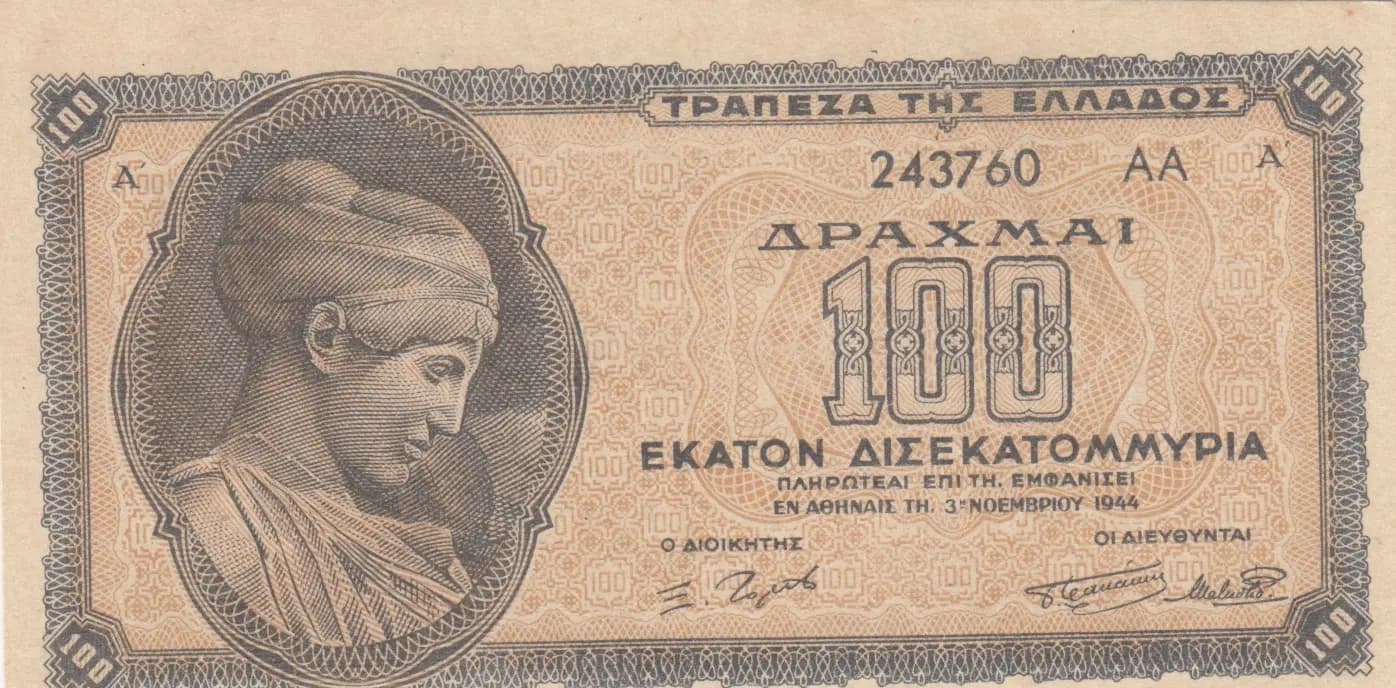
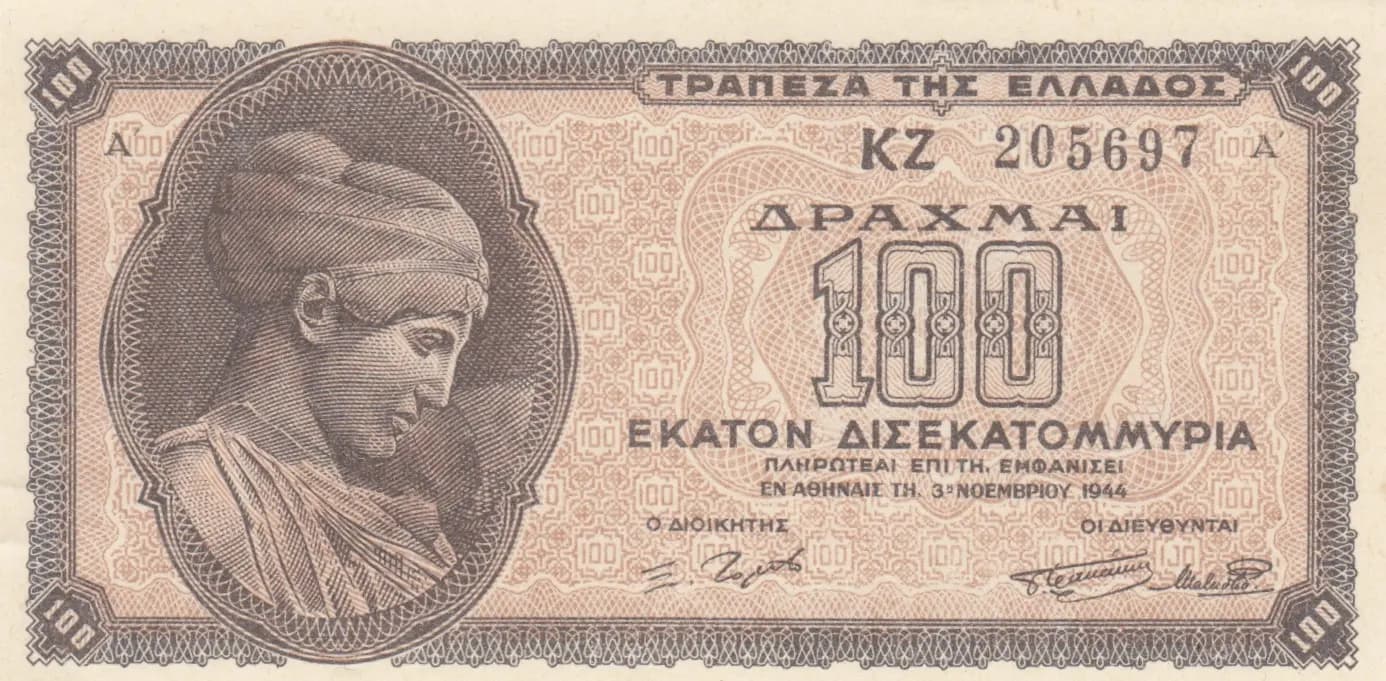
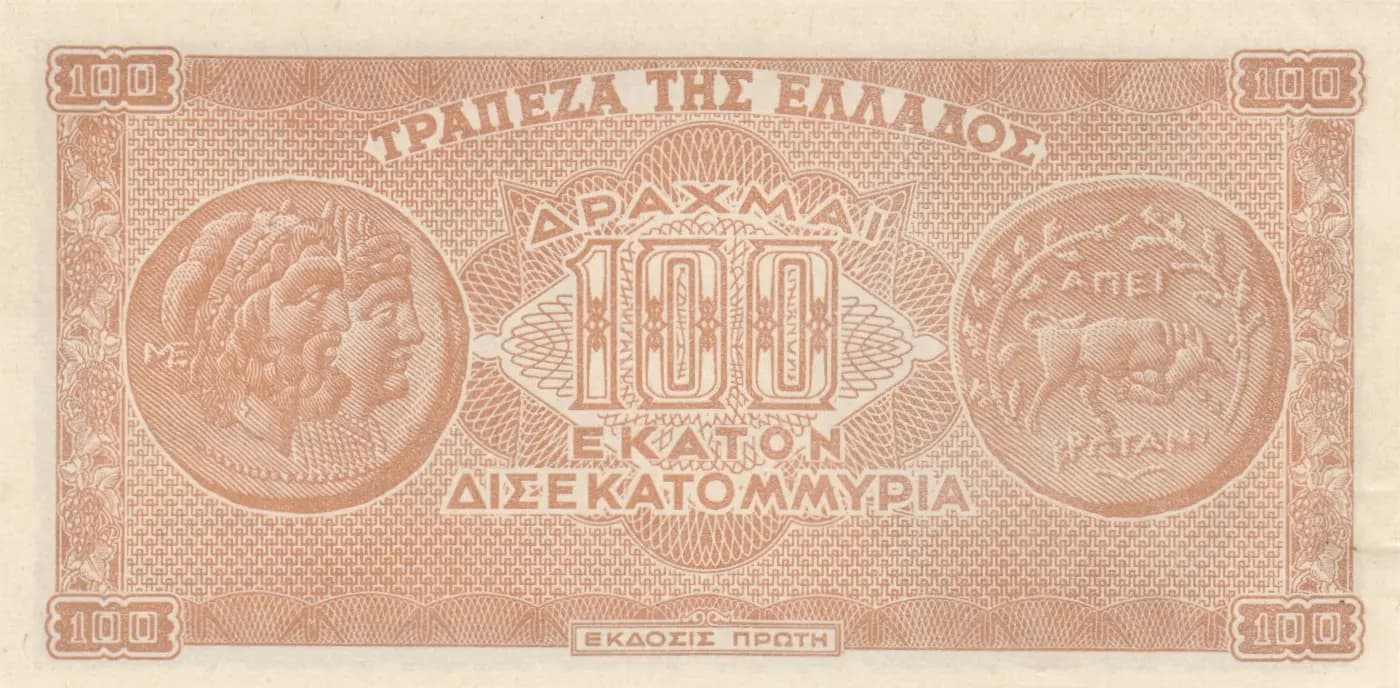
This is an AU-graded 100 billion drachmai note from the Bank of Greece, issued November 3, 1944, representing one of the final hyperinflationary issues during Greece's post-occupation period. The note exhibits exceptional preservation with sharp, clear printing throughout, no visible creases or tears, and uniform color consistency across both sides. The fine line engraving work is particularly well-preserved, showcasing the intricate geometric border patterns and detailed portraiture that characterize this high-denomination emergency currency.
Common. Despite the hyperinflationary context and the note's astronomical denomination, 100 billion drachmai notes from the 1944 emergency issues were produced in substantial quantities as emergency currency during the economic crisis. Notes from this series survive relatively frequently in the collector market, particularly in the higher condition grades due to the late-war/post-war timeframe and their relatively recent removal from circulation. The AU condition grade is desirable but does not indicate scarcity for this particular Pick number.
This 100 billion drachmai note was issued during the acute hyperinflationary crisis following Greece's liberation from German occupation in late 1944. The issuing date of November 3, 1944, places this note at the very beginning of the Bank of Greece's emergency currency program, when astronomical denominations became necessary to facilitate commerce as the drachma's value collapsed. The formal presentation of Greek institutional imagery and classical artistic elements on both the front and back reflects the government's attempt to project stability and legitimacy despite the severe economic crisis.
The front side features a male portrait in profile facing right, depicted with glasses and headwear, rendered in fine detail using classical engraving technique. The figure is positioned on the left side with denomination and institutional text occupying the right portion. The back side displays two circular medallion portraits in profile facing opposite directions, positioned symmetrically on either side of a central ornamental cartouche containing the denomination. Both sides employ elaborate geometric border patterns with repeating motifs in the corners and fine line work covering substantial portions of the surface. The overall design employs classical Greek aesthetic elements consistent with the Bank of Greece's institutional imagery, though the specific identities of the portrayed figures are not definitively confirmed in the visual analysis. The color scheme throughout is predominantly beige and tan with brown and dark gray printing, creating a muted, formal appearance appropriate to official currency.
FRONT SIDE: 'ΤΡΑΠΕΖΑ ΤΗΣ ΕΛΛΑΔΟΣ' (Bank of Greece) | 'ΚΖ 205697' (Serial number: KZ 205697) | 'ΔΡΑΧΜΑΙ' (Drachmas) | '100' (100) | 'ΕΚΑΤΟΝ ΑΙΣΕΚΑΤΟΜΜΥΡΙΑ' (One hundred billion) | 'ΠΑΝΡΟΤΕΑΙ ΕΠΙ ΤΗ ΕΜΦΑΝΙΣΕΙ' (Payable on presentation) | 'ΕΝ ΑΘΗΝΑΙ ΤΗ 3Σ ΝΟΕΜΒΡΙΟΥ 1944' (In Athens on the 3rd of November 1944) | 'Ο ΔΙΟΙΚΗΤΗΣ' (The Director) | 'ΟΙ ΔΙΕΥΘΥΝΤΑΙ' (The Managers) | BACK SIDE: '100' (100 - corner denominations) | 'ΤΡΑΠΕΖΑ ΤΗΣ ΕΛΛΑΔΟΣ' (Bank of Greece) | 'ΔΡΑΧΜΑΙ' (Drachmas) | 'ΕΚΑΤΟΝ ΑΙΣΕΚΑΤΟΜΜΥΡΙΑ' (One hundred billion) | 'ΕΚΔΟΣΙΣ ΠΡΩΤΗ' (First issue)
Intaglio engraving (line engraving). The note exhibits the characteristic fine line patterns, detailed portraiture with precise engraving marks, complex geometric borders, and the three-dimensional depth typical of intaglio printing. The sharp clarity of fine line work throughout, the uniform pressure impression, and the intricate security patterns all confirm intaglio as the primary printing method. The Greek banknote production of this period was typically executed by the Bradbury Wilkinson company or the National Printing Works of Greece; however, specific printer attribution for Pick-135(1) would require additional documentation.
This note is identified as Pick-135(1), indicating it is the first variety of the 100 billion drachmai denomination. The serial number prefix 'ΚΖ' (KZ) and the specific issuing date of November 3, 1944 are consistent with the first emission. The notation 'ΕΚΔΟΣΙΣ ΠΡΩΤΗ' (First issue) on the reverse confirms this is the initial release. Collectors should note that subsequent varieties of this denomination may exist with different date variants, signature variations, or serial number prefixes reflecting later printings during the hyperinflationary period.