10 000 000 000 drachmai 1944
Market Prices
25 salesAbout This Note
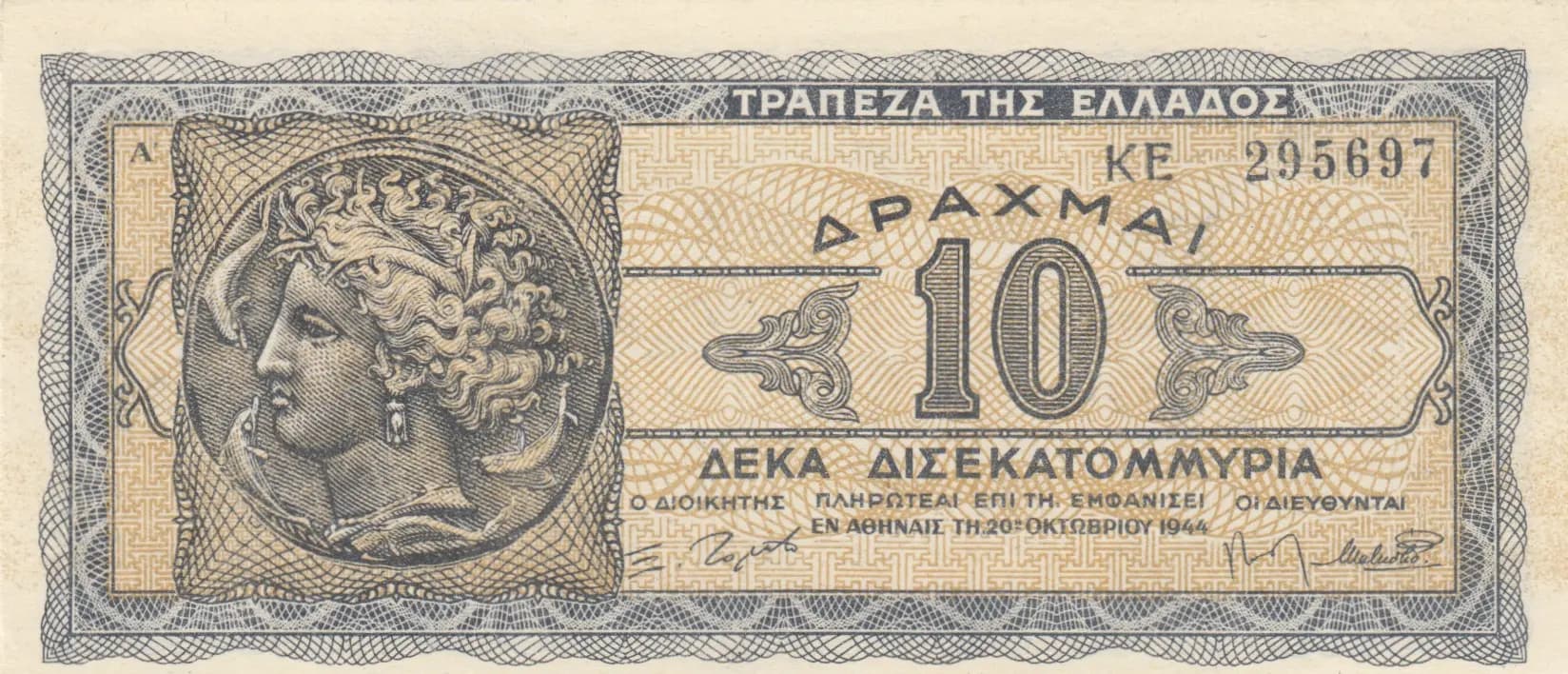
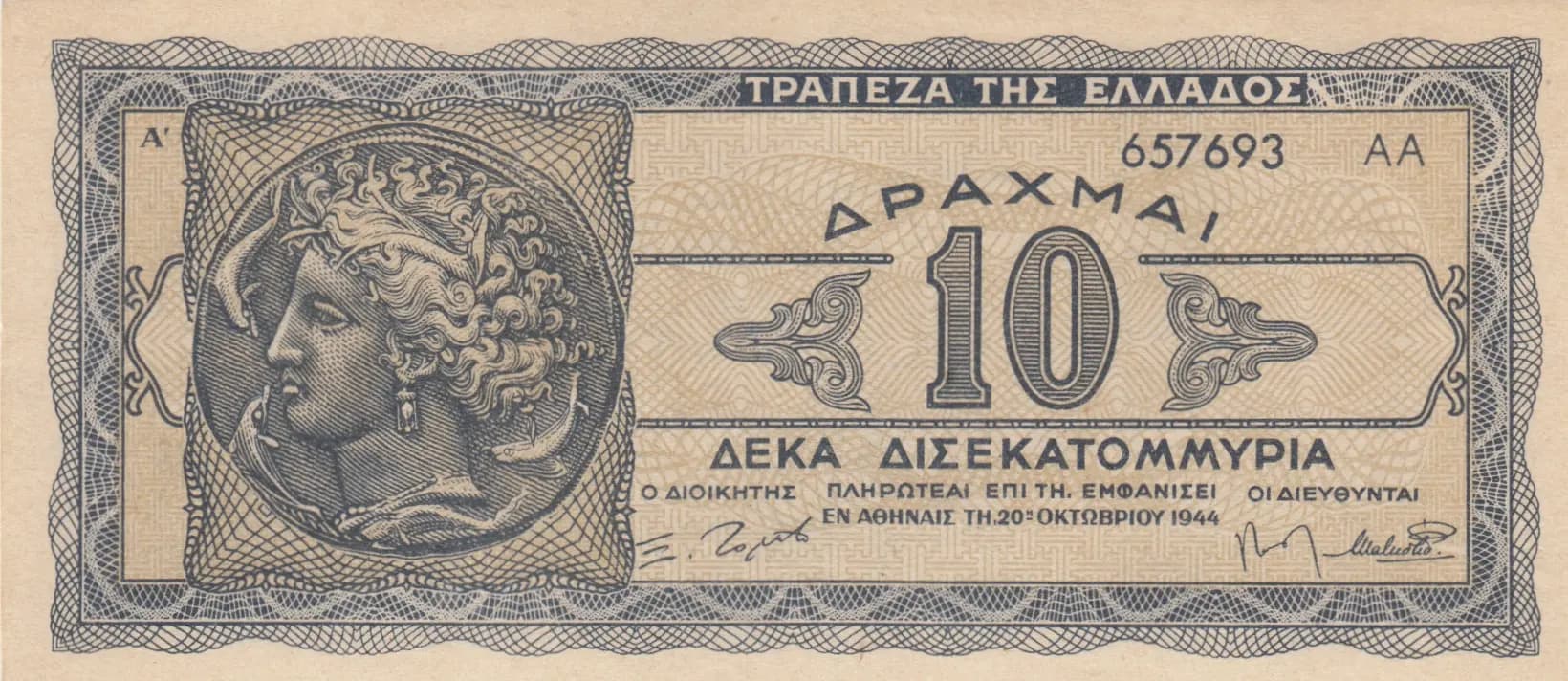
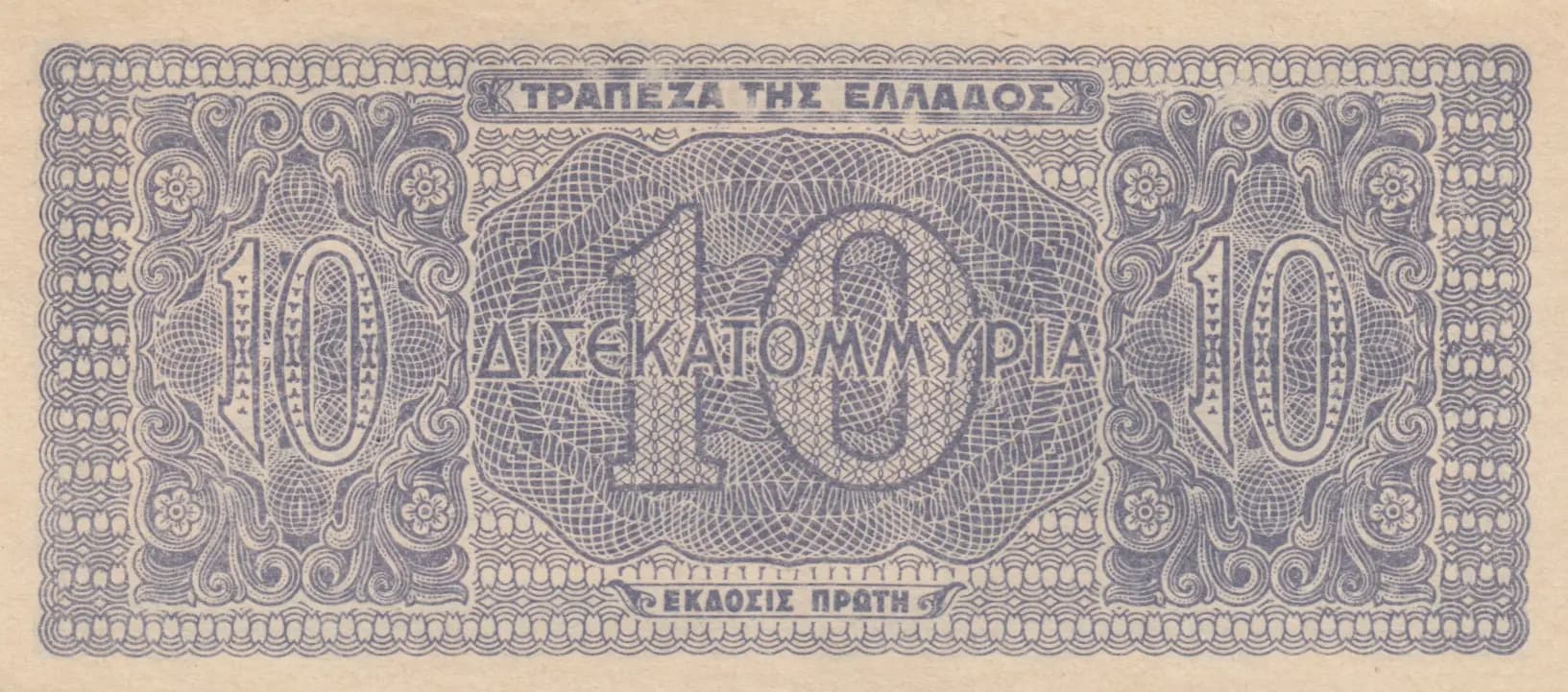
This is a Greek 10 billion drachmai note from 1944, issued during the German occupation and liberation period. The note displays excellent condition (AU) with pristine surfaces showing no circulation wear, featuring a classical Greek male portrait in profile on the obverse and an ornate decorative design on the reverse. The intricate geometric patterns and fine line engraving work are characteristic of high-quality WWII-era Greek currency, making this a historically significant example of emergency wartime currency.
Common. Despite its historical interest, this note is common in the current numismatic market. The eBay sales data shows consistent pricing in the $1-$5 range for circulated and uncirculated examples across multiple years (2009-2024), with even high-grade examples (PMG 63-65) rarely exceeding $35. These wartime inflation notes were produced in substantial quantities and remain readily available to collectors. The AU grade specified is desirable but does not significantly alter the common classification.
This note was issued on October 20, 1944, by the Bank of Greece (Trapeza tis Ellados) during a period of extreme economic crisis following Nazi occupation and the subsequent liberation of Greece. The classical male portrait references ancient Greek numismatic traditions, specifically Arethusa from the Syracuse dekadrachm, connecting Greece's cultural heritage to its post-war monetary reconstruction. The denomination of 10 billion drachmai reflects the hyperinflation that plagued Greece during and immediately after WWII, requiring increasingly large denomination notes for daily commerce.
The obverse features Arethusa, the nymph from classical Greek mythology depicted in profile facing left, rendered in the style of ancient Greek coinage (specifically referencing the renowned dekadrachm of Syracuse). She is depicted with classical curled hair and appears within an ornate rectangular frame with decorative Greek key pattern borders. The denomination is prominently displayed as both Arabic numerals ('10') and spelled out in Greek ('ΔΕΚΑ ΔΙΣΕΚΑΤΟΜΜΥΡΙΑ'). The reverse presents a highly symmetrical ornamental design dominated by elaborate floral and geometric motifs, including rosette patterns in corners and throughout, with the denomination repeated as large numerals on both left and right sides. The color scheme employs beige/tan underprinting on the obverse with black and dark blue-black inks, while the reverse features dull dark blue coloring. Throughout both sides, intricate geometric mesh patterns and fine linear designs create sophisticated security features.
FRONT: 'ΤΡΑΠΕΖΑ ΤΗΣ ΕΛΛΑΔΟΣ' (Bank of Greece) / 'ΔΡΑΧΜΑΙ' (Drachmas) / '10 ΔΕΚΑ ΔΙΣΕΚΑΤΟΜΜΥΡΙΑ' (10 Billion) / 'ο διοικητης πληρωτεαι επι τη εμφανησει οι διευθυνται εν αθηναις τη 20ε οκτωβριου 1944' (The administrator will pay on presentation; the managers [are] in Athens on October 20, 1944) / Signatures: 'Ζουγας' (Zougas) and 'Ψαλιδης' (Psalidis) / Series marks: 'Α'' and 'ΑΑ' / Serial number: 657693. BACK: 'ΤΡΑΠΕΖΑ ΤΗΣ ΕΛΛΑΔΟΣ' (Bank of Greece) / '10 ΔΙΣΕΚΑΤΟΜΜΥΡΙΑ' (10 Billion) / 'ΕΚΔΟΣΙΣ ΠΡΩΤΗ' (First Edition).
This note was produced using traditional intaglio engraving and letterpress printing techniques, characteristic of 1940s-era banknote production. The fine line engraving work visible in the detailed geometric patterns, Greek key borders, and decorative floral motifs indicates expert engraving by skilled craftsmen. The precision of the line work and the density of the geometric mesh patterns suggest printing by a security printer experienced in wartime currency production; for Greek currency of this period, notes were typically produced by the Bank of Greece's printing operations, possibly with technical assistance from international security printers.
This specimen is identified as Pick-134b, representing the second issue or printing variant of the 10 billion drachmai denomination from 1944. The visual analysis confirms 'ΕΚΔΟΣΙΣ ΠΡΩΤΗ' (First Edition) on the reverse, and series designation markers 'Α'' and 'ΑΑ' are present. The signatures of Zougas and Psalidis are consistent with the official issue signatures of this period. Serial number 657693 appears to be a standard issue serial number without special significance. Collectors should note that variants exist based on signature combinations, series letters, and printing variations, though documentation of specific varieties for Pick-134b is limited in widely available catalogs.