5 pounds 1962
Market Prices
9 salesAbout This Note
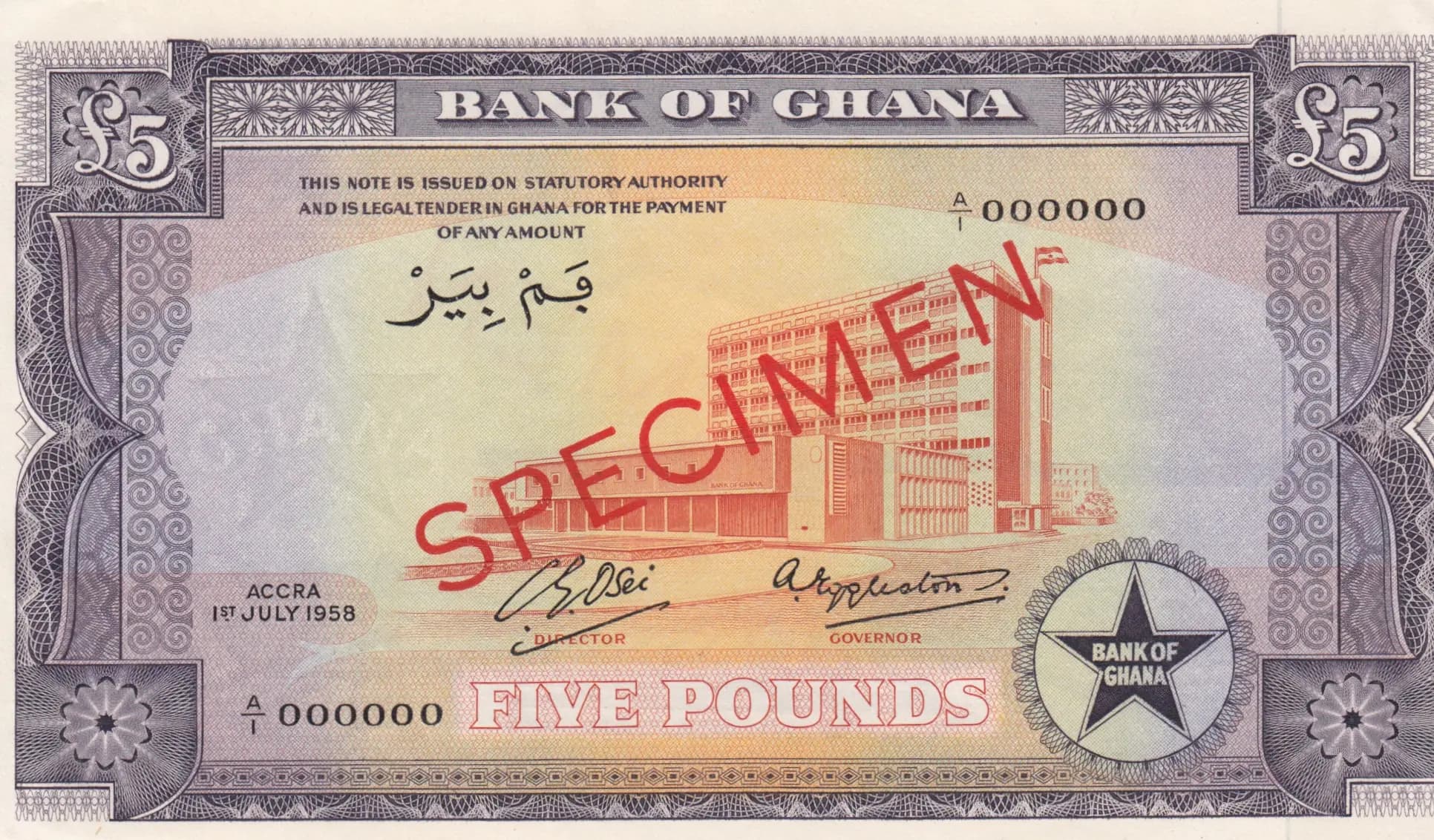
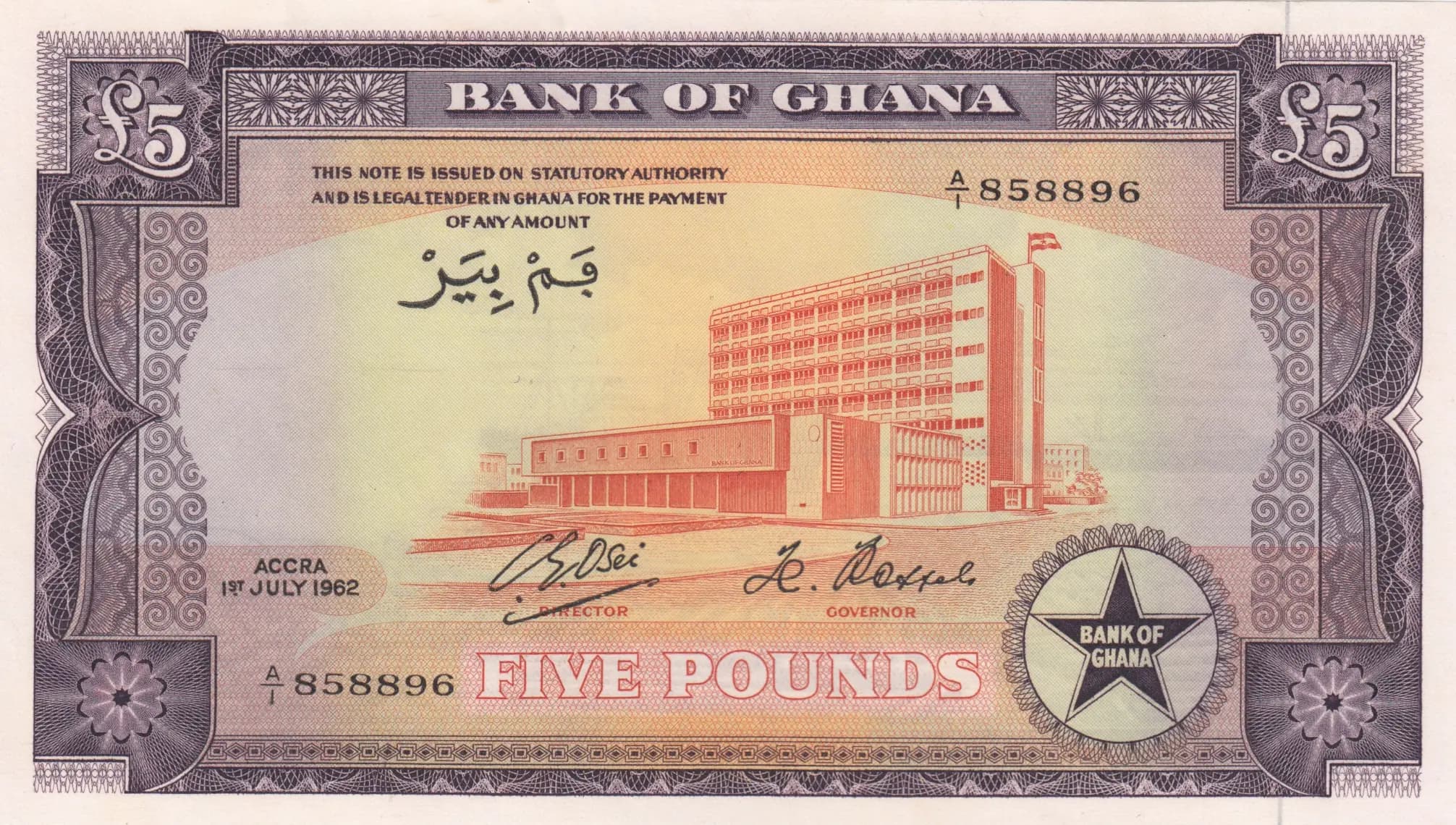
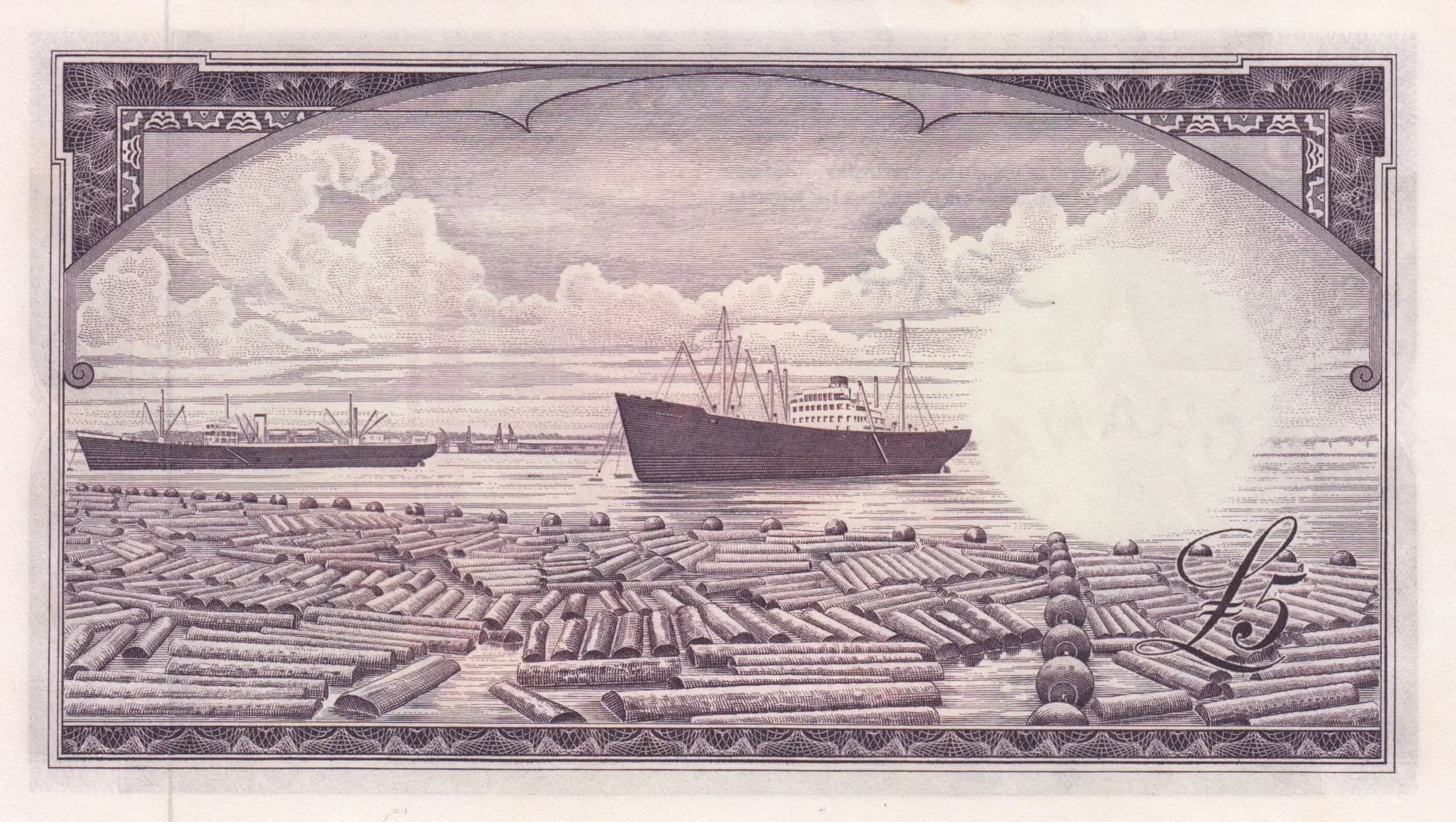
This is an exceptional example of Ghana's first pound sterling issue, a 5 Pounds note from 1962 graded UNC by its pristine condition. The note features the Bank of Ghana building in Accra rendered in warm red-orange tones on the obverse, paired with an evocative maritime scene of cargo ships and dockside logs on the reverse, representing Ghana's post-independence economic aspirations. The sharp engraving, crisp paper stock, and complete absence of wear make this an outstanding specimen of this historically significant early Bank of Ghana emission.
Common. While this is an early Bank of Ghana issue and historically significant, the 5 Pounds note P-3d had a substantial print run during 1958-1962. Secondary market data from eBay shows consistent sales of UNC examples in the $70-$155 range (2012-2024), with catalog values from 2019 listing UNC at $70. The regular availability of examples in UNC condition and modest pricing indicate this is a commonly encountered note among serious collectors rather than a scarce issue. The PMG population report lists multiple variants of this Pick number, further confirming adequate circulation in the collector market.
Issued on 1st July 1962, this note represents Ghana's early period following independence in 1957 and marks the transition to pound sterling currency under the newly established Bank of Ghana. The architectural centerpiece—the Bank of Ghana building in Accra—symbolizes the nation's modern institutional development and financial independence. The reverse imagery of merchant vessels and export cargo (logs) reflects Ghana's economic foundation in maritime trade and natural resource extraction during the immediate post-colonial period.
The obverse features a portrait-orientation layout with the Bank of Ghana building prominently displayed in the central vignette—a modernist institutional structure with horizontal lines, multiple stories, and a flag atop, rendered in red-orange tones against a multicolored underprint of purple and cream. Decorative borders with spiral and floral motifs frame the design on left and right sides. The Bank of Ghana star logo (circular emblem with central star) appears in the lower right. Two signature lines appear below the building for the Director and Governor. The reverse presents a detailed maritime scene depicting two merchant/cargo vessels on water with numerous cylindrical logs or barrels stacked on the dock in the foreground, rendered in purple, gray, and black with fine line engraving and cross-hatching to create depth and texture.
Front side: 'BANK OF GHANA' (issuing authority); 'THIS NOTE IS ISSUED ON STATUTORY AUTHORITY AND IS LEGAL TENDER IN GHANA FOR THE PAYMENT OF ANY AMOUNT' (legal tender declaration); 'ACCRA 1ST JULY 1962' (place and date of issue); 'FIVE POUNDS' and '£5' (denomination); 'DIRECTOR' and 'GOVERNOR' (signature titles). Serial number: A 858896. Note: The Arabic/Urdu script inscription observed in the visual analysis appears anomalous for a Ghanaian pound note and may represent an artifact of the image analysis process; standard inscriptions for this note are in English only. Back side: '£5' (denomination marker).
Intaglio (engraved) printing by Thomas De La Rue (TDLR), as indicated in the PMG population report for variant P-3d. The technique is evidenced by the fine line engraving details, intricate cross-hatching visible in clouds and water, sharp crisp printing throughout, and the high-quality multicolor overprinting characteristic of TDLR's 1960s banknote production.
This note is cataloged as Pick number P-3d, issued by Bank of Ghana in 1962. Per PMG population data, variant P-3d specifically was printed by Thomas De La Rue (TDLR). The serial number prefix 'A' with number 858896, combined with the date 1st July 1962, confirms this as a 1962-dated specimen. Other known varieties of this base Pick number include P-3a and P-3s1, also printed by TDLR. The specific signature combination, serial prefix, and lack of any visible overprints or serial number variants suggest this is a standard regular-issue specimen without notable scarcity factors among P-3d varieties.