10 cedis 1965
Market Prices
3 salesAbout This Note
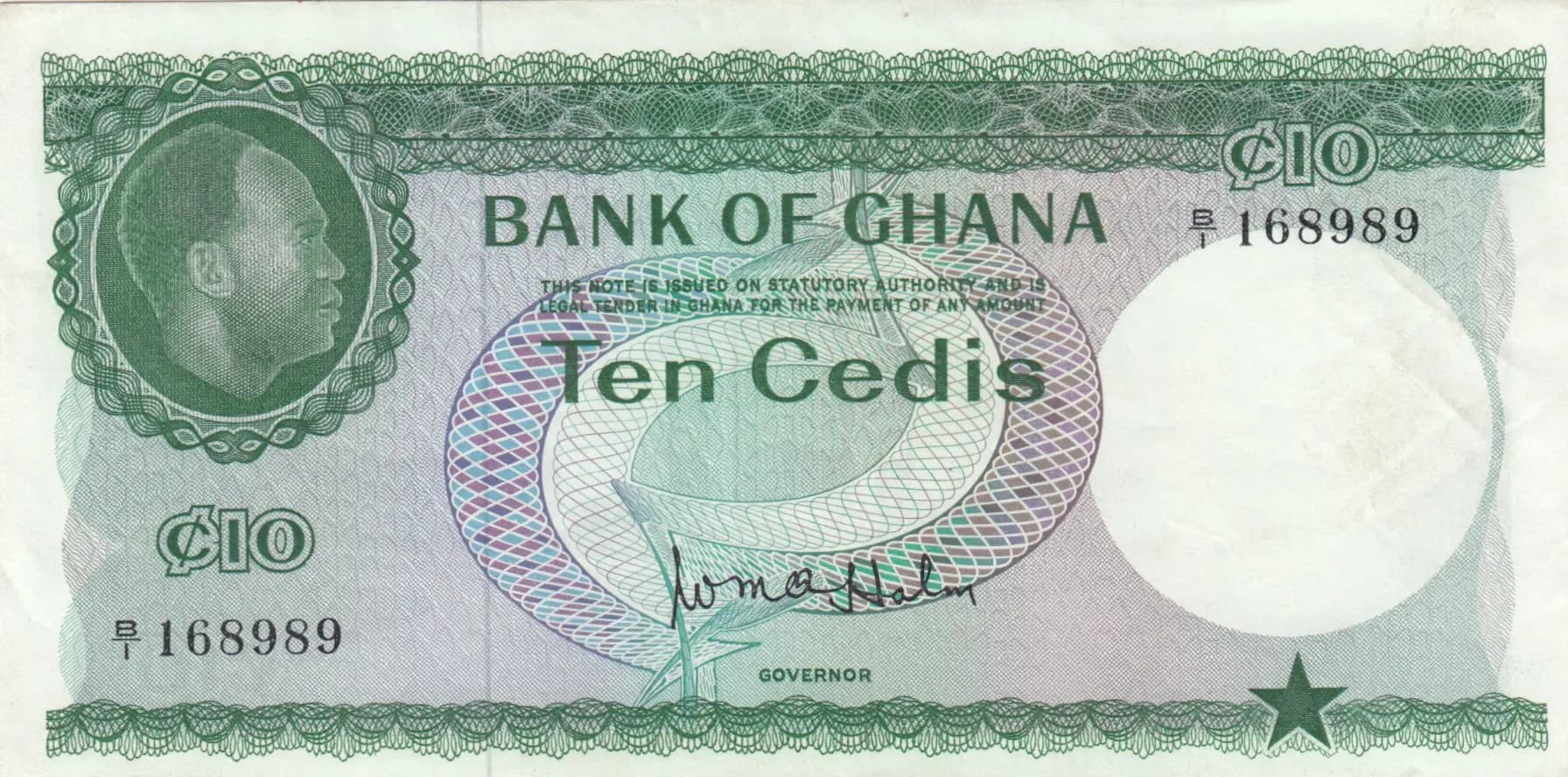
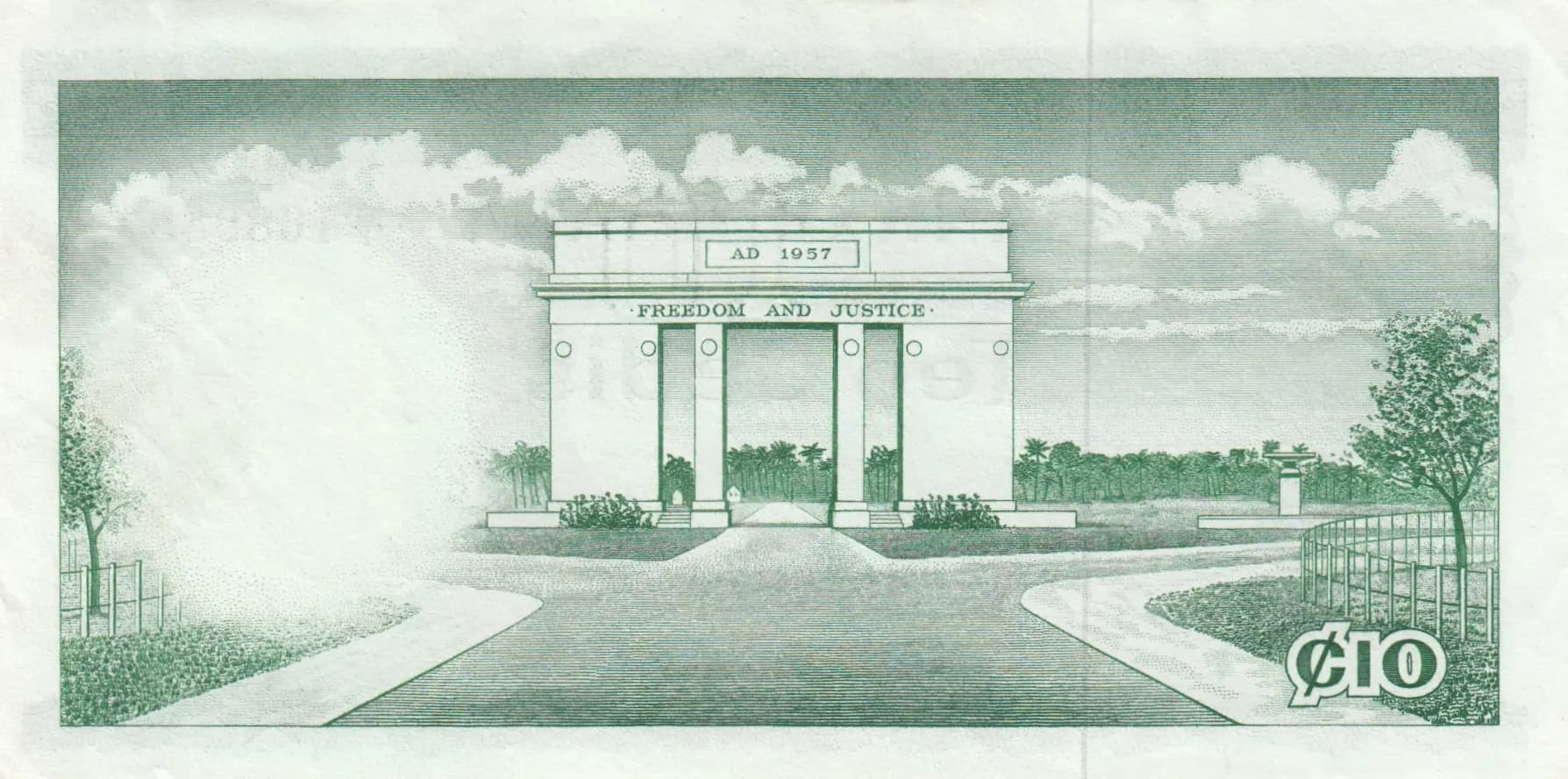
This is a Ghana 10 Cedis note from 1965, the first year of issue following Ghana's independence, graded in About Uncirculated condition. The note features a striking portrait of President Kwame Nkrumah on the obverse in an ornate circular frame with green and purple/pink multicolored printing, while the reverse displays Independence Square in Accra with classical architectural styling. Despite showing some age-related creasing and a visible vertical fold line, the note retains strong color saturation and fine engraved detail, making it a desirable example of early post-independence Ghanaian currency.
Common. The 10 Cedis 1965 (Pick-7) is a standard regular-issue banknote with substantial print runs typical of a nation's primary circulation currency. Secondary market data shows consistent availability with VF examples valued around $15 and UNC examples around $45 as of 2019, with recent eBay sales in the $50-$113 range depending on condition and grading service. The note is not from a recalled series, short-lived issuing period, or limited mintage, placing it firmly in the common category despite its historical significance.
This note was issued by the Bank of Ghana in 1965, during the presidency of Kwame Nkrumah, who led Ghana to independence in 1957 and served as the nation's first president. The reverse depicts Independence Square in Accra, featuring the inscription 'FREEDOM AND JUSTICE,' reflecting Ghana's aspirations as a newly independent nation and a leader in the Pan-African movement. The watermark bearing Nkrumah's portrait further emphasizes his central role in Ghana's early post-colonial identity and governance.
The obverse features a formal portrait of President Kwame Nkrumah positioned in profile facing right, enclosed within an ornate circular frame with decorative guilloche border work. The center of the note contains an oval geometric design in purple/pink and green tones with the Bank of Ghana name and denomination. The reverse showcases Independence Square (Osu) in Accra as a classical government building with a columned portico and seven prominent columns, rendered in fine architectural engraving style with landscaped grounds including vegetation. The overall design employs a green predominant color scheme with multicolored accents, reflecting the national colors of Ghana and the artistic standards of 1960s Commonwealth banknote production.
Front side: 'BANK OF GHANA' (issuing authority), 'Ten Cedis' (denomination in words), '₵10' (currency symbol with numerical denomination), 'THE NOTE IS ISSUED ON STATUTORY AUTHORITY AND IS LEGAL TENDER IN GHANA FOR THE PAYMENT OF ANY AMOUNT' (legal tender declaration), 'GOVERNOR' (signature authority), and serial number 'B 168989'. Back side: 'AD 1057' (date reference on the Independence Square building), 'FREEDOM AND JUSTICE' (national motto inscribed on the building's entablature), and '₵10' (denomination symbol).
Intaglio (engraved) printing on banknote paper, employing fine line engraving and guilloche pattern techniques throughout for security and aesthetic purposes. The multi-color printing with green, purple/pink, and cream tones suggests the use of multiple printing plates. The Bank of Ghana's early issues were typically produced by established Commonwealth security printers such as Thomas de la Rue, though the specific printer attribution for this Pick-7 variant would require archival confirmation.
The PMG population report indicates three cataloged variants exist for Pick-7: P-7a, P-7cts, and P-7s. The observed specimen carries serial number B 168989 with prefix 'B', suggesting it may correspond to one of these identified variants. Without additional documentation (such as whether this is a replacement note, currency test note, or specimen note indicated by the 'cts' or 's' designation), the specific variety classification cannot be definitively determined from the visual analysis alone. Standard issued notes would be cataloged as P-7a.