1 cedi 1976
Market Prices
25 salesAbout This Note
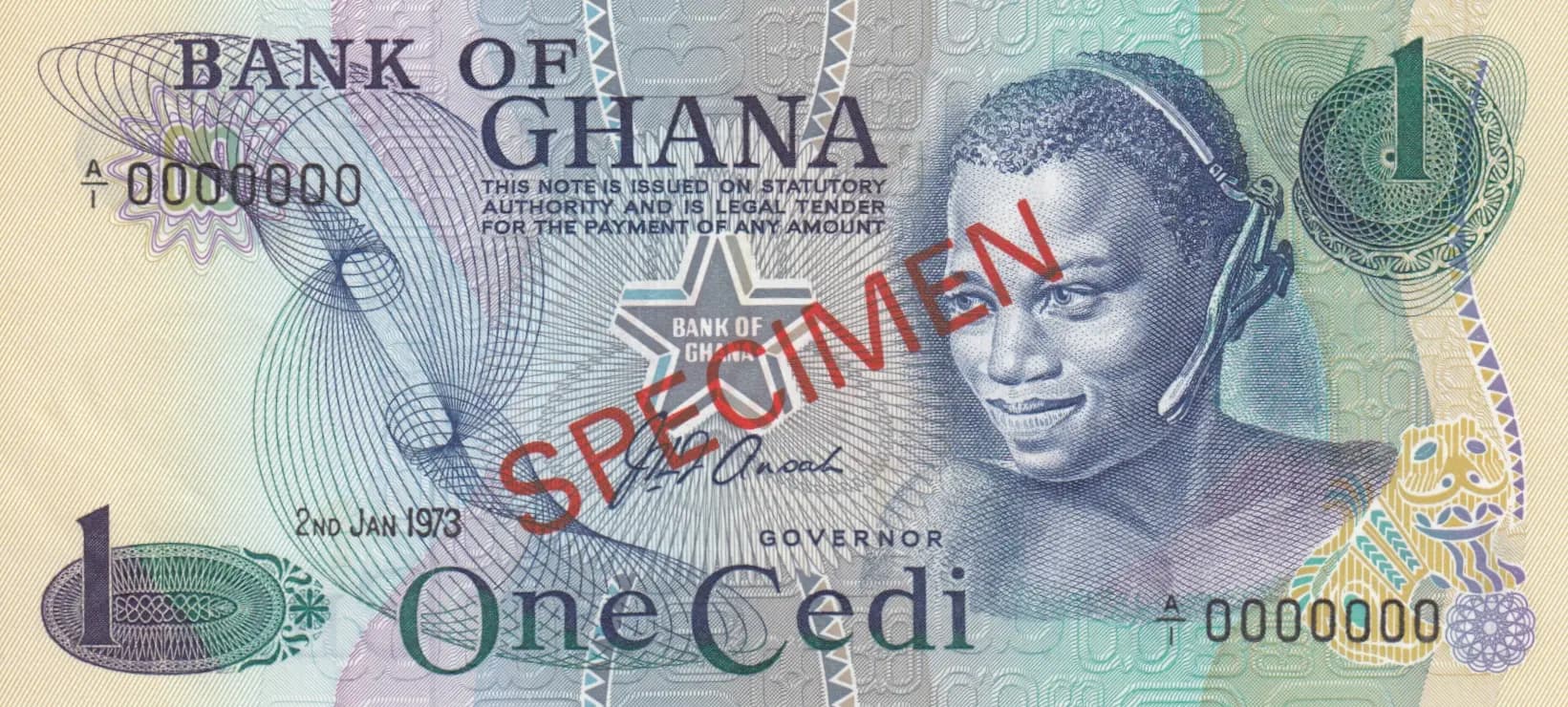
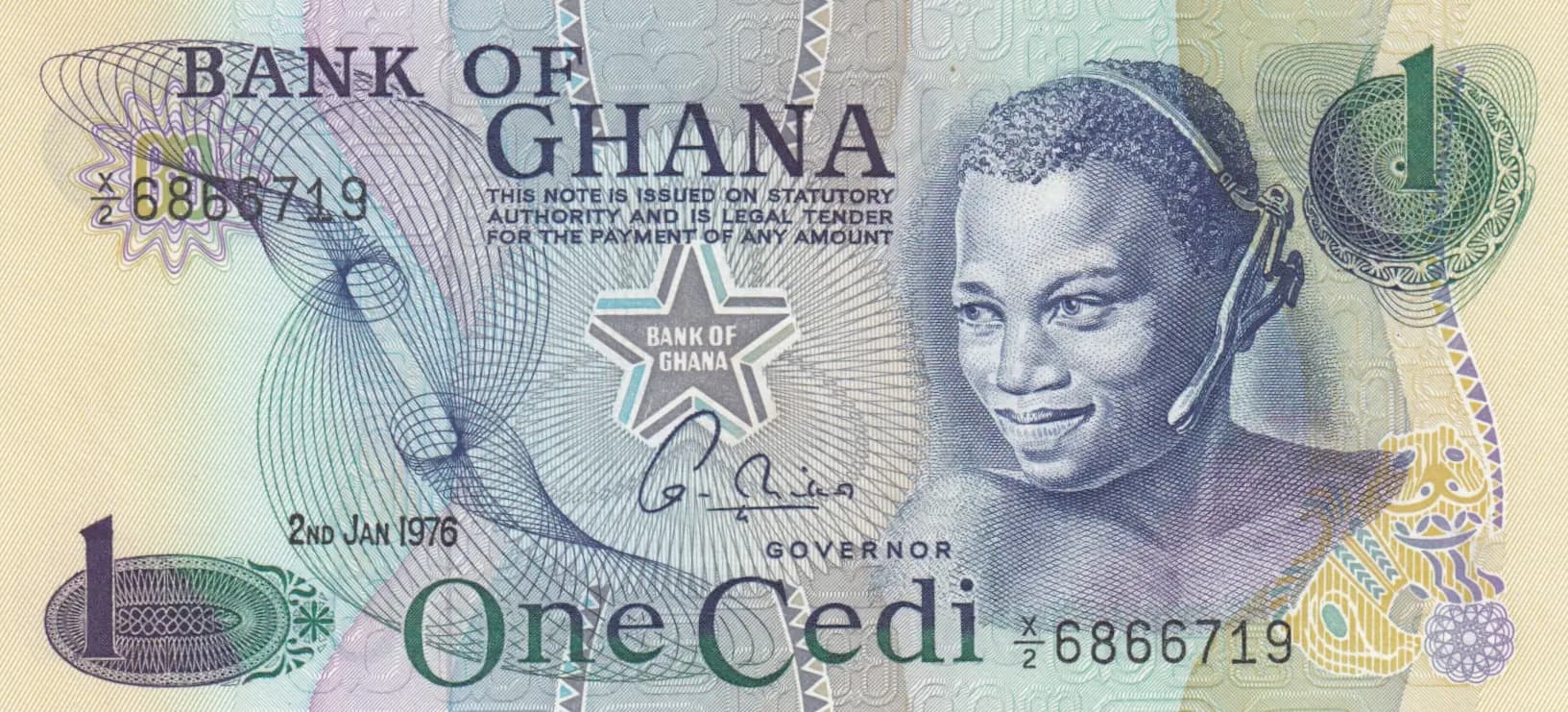
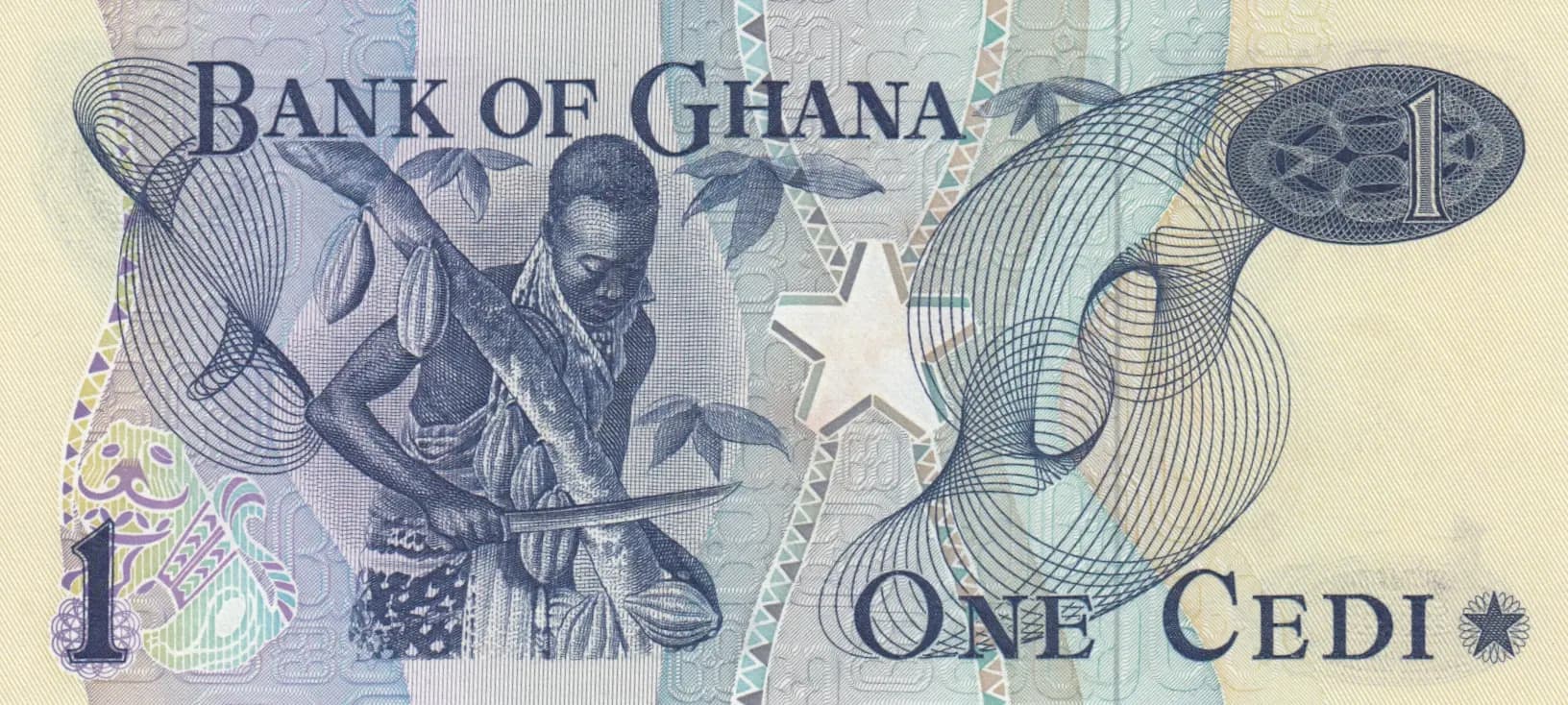
An exceptionally well-preserved example of the Ghana 1 Cedi from 2nd January 1976, graded UNC, featuring vibrant multi-color printing with purple, blue, and green tones throughout. The obverse displays a woman in traditional dress on the right side against an elaborate geometric guilloche background, while the reverse depicts a man engaged in agricultural work (consistent with cocoa harvest imagery). The sharp engraving, pristine condition, and intact security features make this an attractive example for collectors of West African currency.
Common. This is a standard circulation issue of the Bank of Ghana with a lengthy issue period (1973-1978), and eBay market data shows consistent sales activity across multiple condition grades from 2010 to 2026, with UNC examples regularly selling in the $3-$10 range and averaging around $6-$7 historically. The 2019 catalogue value for UNC is listed at $6, and the most recent UNC sale (March 2026) was $6.84. No print run restrictions, recall history, or issuing authority limitations are documented. The abundant supply and steady but modest pricing confirm this as a common issue.
This note was issued during Ghana's post-independence period under the Bank of Ghana's authority, representing the economic identity of the nation in the mid-1970s. The agricultural imagery on the reverse—depicting traditional harvest work—reflects Ghana's economic foundation in cocoa production and agricultural labor, key pillars of the nation's economy during this era. The formal portraiture and sophisticated security printing demonstrate Ghana's commitment to modern currency standards during a period of institutional development.
The obverse features a portrait of a woman wearing traditional Ghanaian dress with distinctive earrings, positioned on the right side of the note. The left side is dominated by an intricate purple and blue guilloche pattern, with a central five-pointed star containing the 'BANK OF GHANA' inscriptions—a symbol representing Ghana's national identity. The reverse depicts a male figure in traditional dress engaged in cocoa pod harvesting, shown bent over in the act of cutting pods from a tree, positioned in the left-center area. A large denomination numeral '1' appears prominently on the right side. Both sides feature elaborate decorative circular patterns in the corners and extensive geometric ornamentation throughout, typical of high-security banknote design.
Front side: 'BANK OF GHANA' (issuing authority); 'THIS NOTE IS ISSUED ON STATUTORY AUTHORITY AND IS LEGAL TENDER FOR THE PAYMENT OF ANY AMOUNT' (legal tender declaration); '2ND JAN 1976' (issue date); 'One Cedi' (denomination in words); 'GOVERNOR' (signature line designation); Serial number '2 6866719'. Back side: 'BANK OF GHANA' (issuing authority); 'ONE CEDI' (denomination in words); Large numeral '1' (denomination indicator).
Intaglio (engraved line) printing combined with multi-color offset lithography, as evidenced by the sharp, crisp guilloche patterns, detailed portrait engraving, and the layered color application visible throughout the note. The fine line work, security patterns, and dimensional depth characteristic of intaglio printing are clearly present. According to PMG population records, this Pick number (P-13c) was produced by security printers, with variants attributed to TDLR (Thomas De La Rue) identified in the P-13CS1 and P-13s designations.
This note is cataloged as Pick P-13c, representing the third variant of the 1 Cedi 1976 issue. The PMG population report identifies four variants: P-13CS1 (TDLR printer), P-13c (current specimen), P-13d, and P-13s (TDLR printer). While printer variants exist within the P-13 series, the observed specimen does not display obvious overprints or non-standard signatures that would indicate a special variety. The serial number '2 6866719' follows standard formatting. Without additional identifying marks or signature variations visible in the images, this appears to be a standard P-13c example without notable sub-variety distinctions.