1 mark 1948 specimen
About This Note
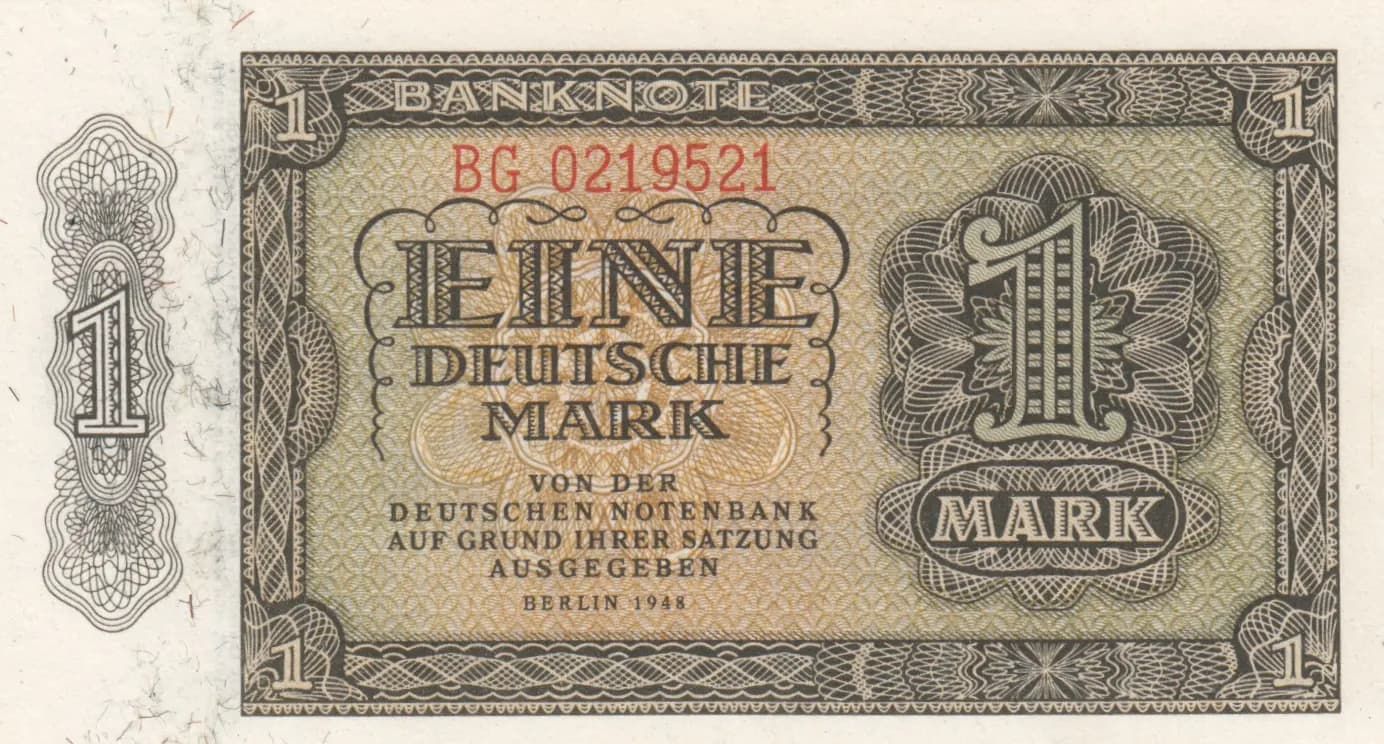
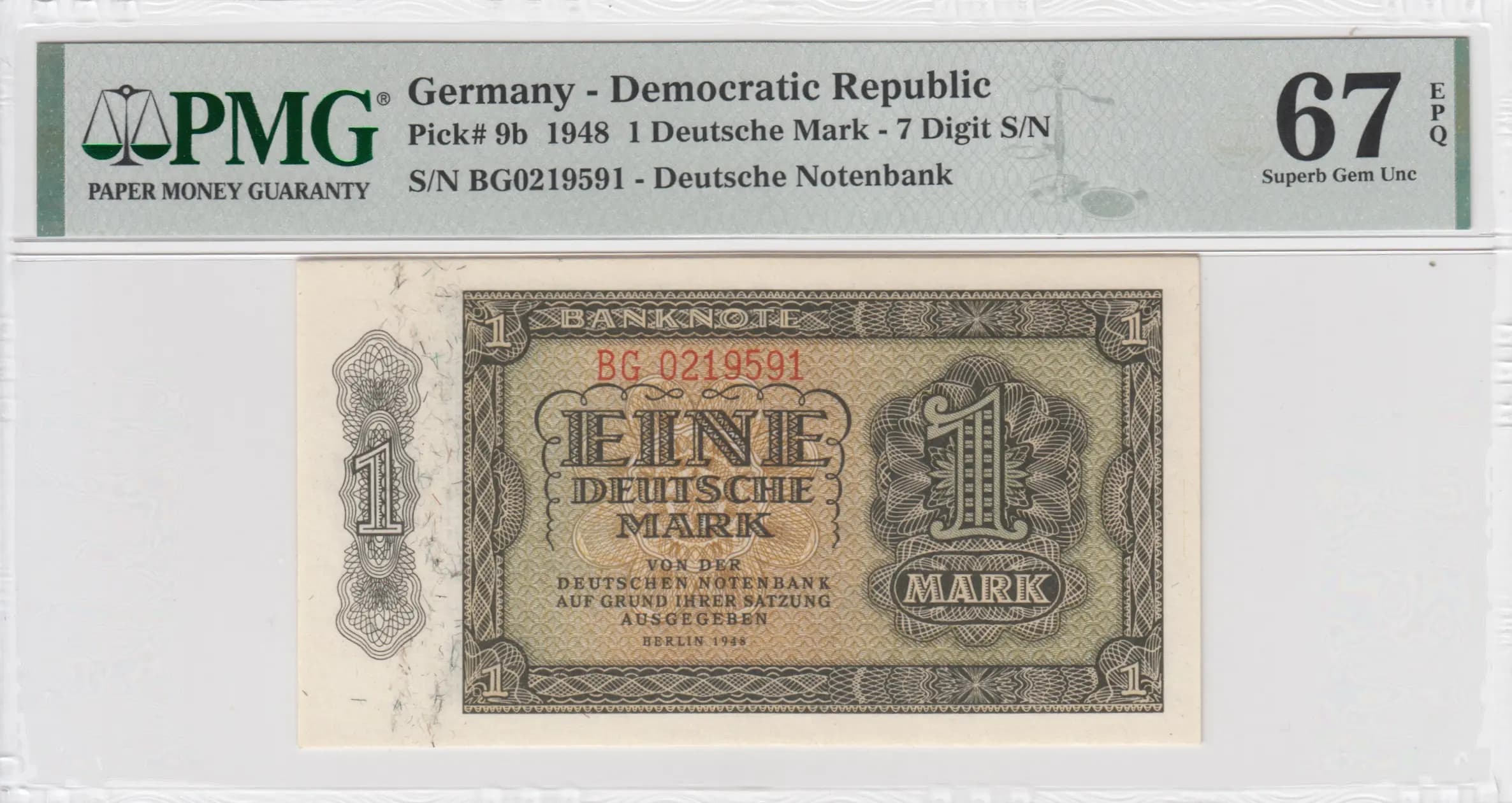
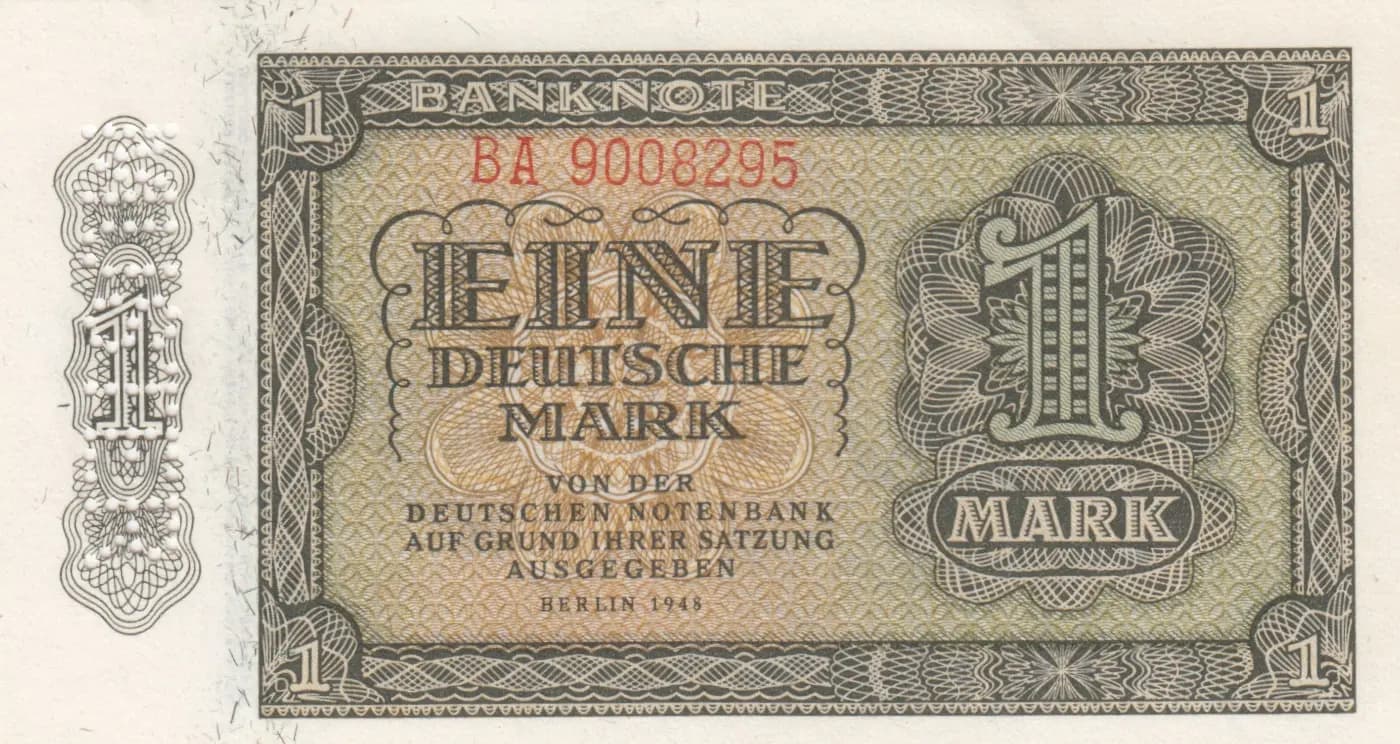
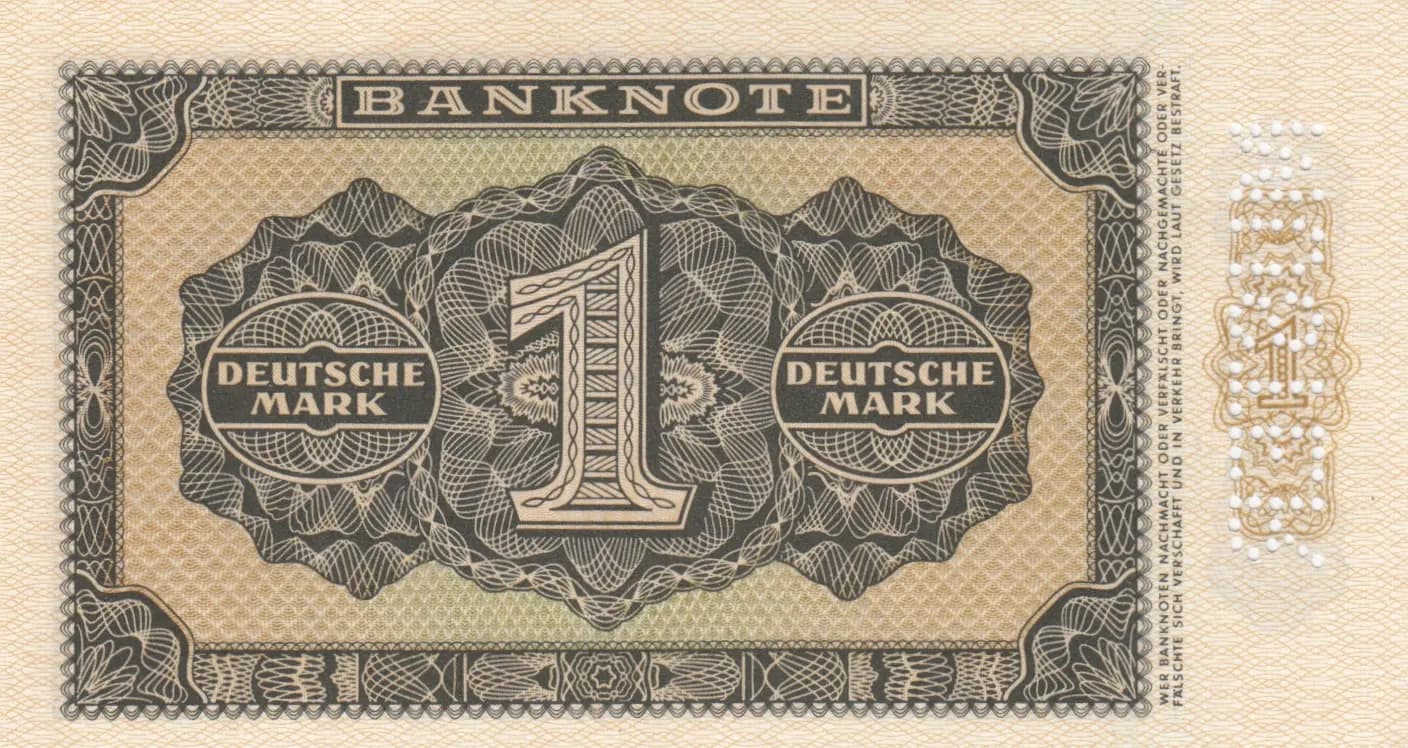
This is a 1 Deutsche Mark banknote from 1948, issued by the Deutsche Notenbank in Berlin during the early post-WWII period of East German monetary history. The note presents in near-uncirculated condition with crisp, sharp printing throughout and only minimal aging visible. The design features elegant ornamental borders, a prominent central denomination numeral, and mountain landscape imagery on the reverse—characteristic of the transitional currency issued during the Soviet occupation zone's economic reorganization.
Common. The 1948 Deutsche Mark issues of the Deutsche Notenbank were produced in substantial quantities to serve the currency needs of the Soviet occupation zone. While 1948 notes are older and condition-sensitive, specimen and circulated examples remain readily available in the collector market. The UNC condition grade elevates it above heavily circulated copies, but the denomination, issuer, and print run all indicate this is a common note in numismatic terms. Unless a specific variety or serial number prefix is known to be rare, this represents standard post-war German currency.
This 1948 Deutsche Mark represents a critical moment in German monetary history, issued by the Deutsche Notenbank (German Note Bank) in the Soviet-controlled zone that would become East Germany. The formal inscription referencing the bank's statutory authority and Berlin origin reflects the immediate post-war attempt to establish financial stability in occupied Germany. The classical ornamental design with mountain imagery evokes traditional German banking aesthetics while the 1948 date marks the currency reform that followed the German Reichsmark's collapse.
The obverse features a formal layout with the denomination '1 MARK' prominently displayed in an oval cartouche on the right side, surrounded by an intricate frame of geometric and floral ornamental patterns. The left margin contains a vertical ornamental band. The reverse showcases a large numeral '1' as the central focus, positioned within an elaborate decorative frame with a mountain range depicted in the background. Two oval frames flank the central numeral, each containing the text 'DEUTSCHE MARK'. The design employs classical banking aesthetics with no portraits, instead relying on allegorical ornamentation and landscape elements to convey authority and stability. The beige/tan color scheme with black engraving work was typical of post-war German currency design.
FRONT: 'EINE DEUTSCHE MARK' (One German Mark); 'VON DER DEUTSCHEN NOTENBANK AUFGRUND IHRER SATZUNG AUSGEGEBEN' (Issued by the German Note Bank in accordance with its statutes); 'BERLIN-1948' (Berlin-1948); Serial number 'BA 9008295' (red overprint). BACK: 'DEUTSCHE MARK' appears in two locations; 'DER MACHWÄCHTER DER OFFENTLICHEN ORDNUNG UND SICHERHEIT BERLIN' (The guardian of public order and security Berlin). The word 'BANKNOTE' appears on both sides in English.
This note was produced using intaglio (engraved) printing, evidenced by the sharp, crisp line work, intricate cross-hatching, complex ornamental borders, and detailed engraving visible throughout both sides. The fine parallel lines creating geometric patterns, the precise corner designs, and the dimensional quality of the imagery are characteristic of classical bank note engraving. The red serial number appears to be applied as a separate overprint. The Deutsche Notenbank's notes of this period were produced under Soviet-supervised conditions in Berlin; specific printer attribution would require additional research into East German printing house records.
This specimen is identified as Pick P-9bs (specimen designation). The serial number prefix 'BA' may indicate a specific printing or distribution batch from the Berlin production run. The 1948 Deutsche Notenbank issues are known in various prefixes; collectors should note prefix variations and dates on the reverse. No overprints, watermark varieties, or signature variations are apparent from the visual analysis. The specimen designation ('s') suggests this may have been marked or treated as a specimen note during production, though this would require confirmation through catalog cross-reference.