5000 mark 1923
About This Note
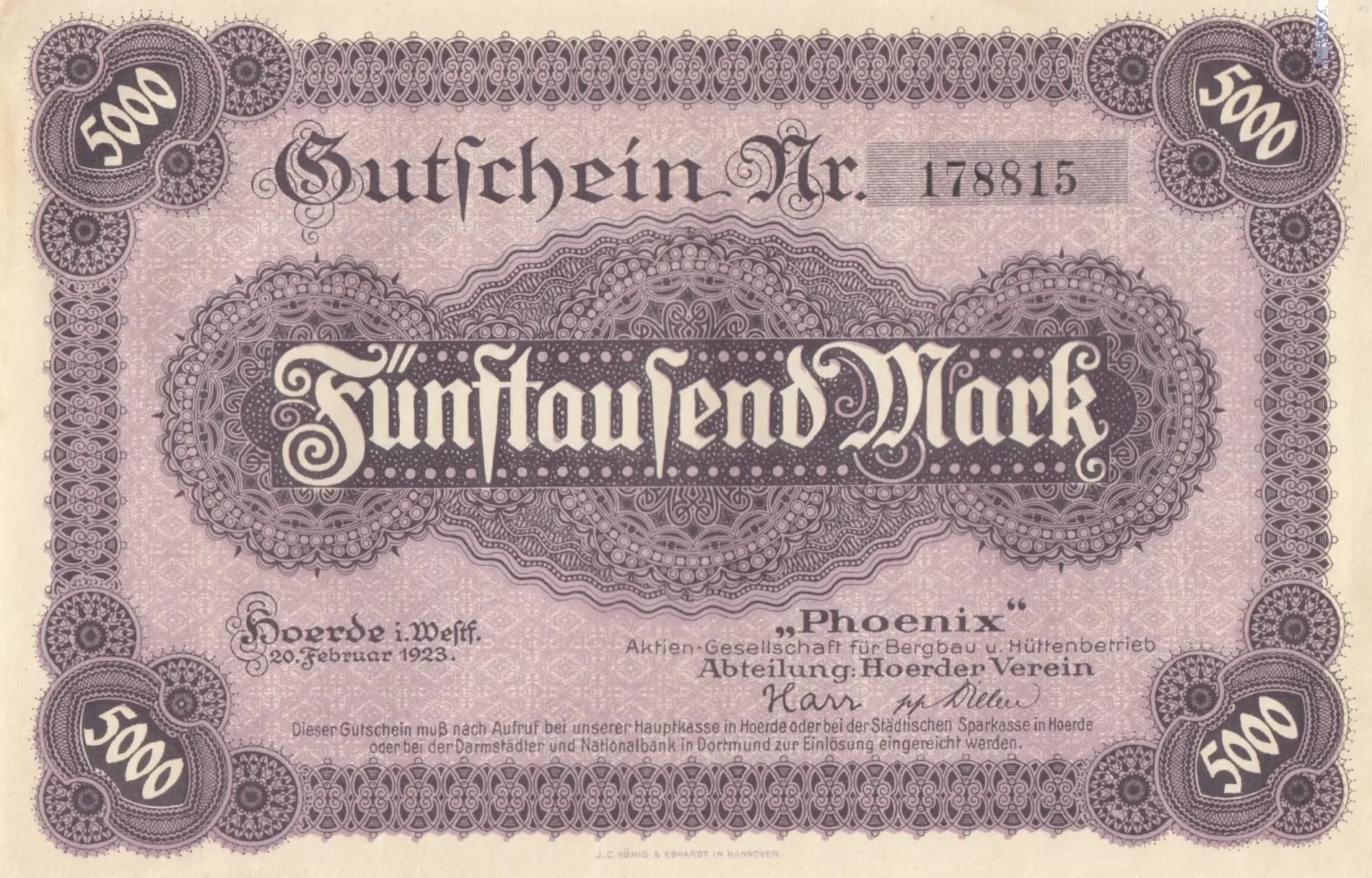
An exceptional example of a 5000 Mark emergency currency issued by Phoenix AG (mining and smelting company) in Hoerde, Westphalia on 20 February 1923, during Germany's hyperinflation crisis. The note displays striking Art Nouveau design with purple and lavender coloring, ornate circular medallions at each corner, and elaborate decorative cartouches rendered in fine engraving. In AU condition with minimal aging, this well-preserved voucher exemplifies the creative emergency currency solutions employed by industrial concerns during the economic collapse of 1923.
Common. While this is an unlisted Pick number representing a corporate emergency voucher from a specific company and location during hyperinflation, such vouchers were produced in substantial quantities by industrial firms throughout 1923. The Hoerde Phoenix AG was a major concern, and these vouchers circulated locally in significant numbers. Emergency currency from this period, though historically interesting, remains relatively common in the numismatic market. AU condition examples appear regularly in dealer inventories and auction sales.
This voucher represents a fascinating artifact of the 1923 hyperinflation period, when major German industrial and mining companies issued their own emergency currency to pay workers and conduct local commerce as the Reichsmark became worthless. The inscription noting redemption at the Municipal Savings Bank in Hoerde and the Dortmund Municipal Railway illustrates the integrated local economy of the Ruhr industrial region. The elaborate Art Nouveau design with ornamental cartouches reflects pre-war German printing traditions that persisted even as the currency system collapsed.
This is a corporate emergency voucher rather than official state currency, issued by Phoenix AG's Hoerde division during the 1923 hyperinflation. The front features a symmetrical design with four large circular medallions positioned at each corner, each containing the denomination numeral '5000' in bold type. The central composition showcases an ornamental cartouche with elaborate scrollwork in the Art Nouveau style, containing 'Fünftausend Mark' in Gothic blackletter script. The border consists of intricate repeating geometric patterns and fine decorative lines in the Art Nouveau aesthetic. The color scheme employs purple and lavender tones on a cream background, creating visual distinction and sophistication. The reverse side is blank, which was typical for many emergency vouchers of this period. No portraits or specific landmarks are depicted; instead, the design relies entirely on ornamental and typographic elements to convey value and authenticity.
FRONT: '5000' (denomination in numerals) / 'Fünftausend Mark' (Five Thousand Mark in Gothic script, in central cartouche) / 'Gutschein Jr.' (Voucher Jr.) / Serial number '178815' / 'Phoenix' (company name) / 'Aktien-Gesellschaft für Bergbau u. Hüttenbetrieb' (Joint-stock company for mining and smelting operations) / 'Abteilung: Hoerder Verein' (Department: Hoerde Association) / 'Hoerde i.Westf.' (Hoerde in Westphalia) / '20. Februar 1923' (20 February 1923, issue date) / 'Dieser Gutschein muß nach Aufruf bei unserer Hauptkasse in Hoerde oder bei der Städischen Sparkasse in Hoerde oder bei der Dortmstädter Nationalbahn zur Einlösung eingereicht werden.' (This voucher must be submitted for redemption at our main office in Hoerde or at the Municipal Savings Bank in Hoerde or at the Dortmund Municipal Railway) / 'J.C. KOENIG & EBHARDT IN HANNOVER' (printer attribution) / BACK: Blank, no inscriptions visible.
Intaglio engraving (copperplate or steel plate engraving), as evidenced by the fine, precise line work visible in the borders, decorative scrollwork, and ornamental patterns throughout the note. The intricate geometric designs and elaborate cartouche work are characteristic of high-quality intaglio production. The printer J.C. Koenig & Ebhardt of Hannover was a renowned German security printer specializing in banknote and certificate production, employing traditional intaglio engraving methods. The fine line patterns and decorative elements would have required skilled engraving.
This specific variety is identified by issuer (Phoenix AG, Hoerde division), date (20 February 1923), denomination (5000 Mark), and serial number (178815). The 'Jr.' designation in 'Gutschein Jr.' may indicate a specific series or issue variant. No other known varieties have been documented for this specific corporate voucher, as each industrial concern's emergency currency typically had limited production runs and regional circulation. The blank reverse is standard for this issue type.