500 000 mark 1923
“1 serial #”
Market Prices
34 salesAbout This Note
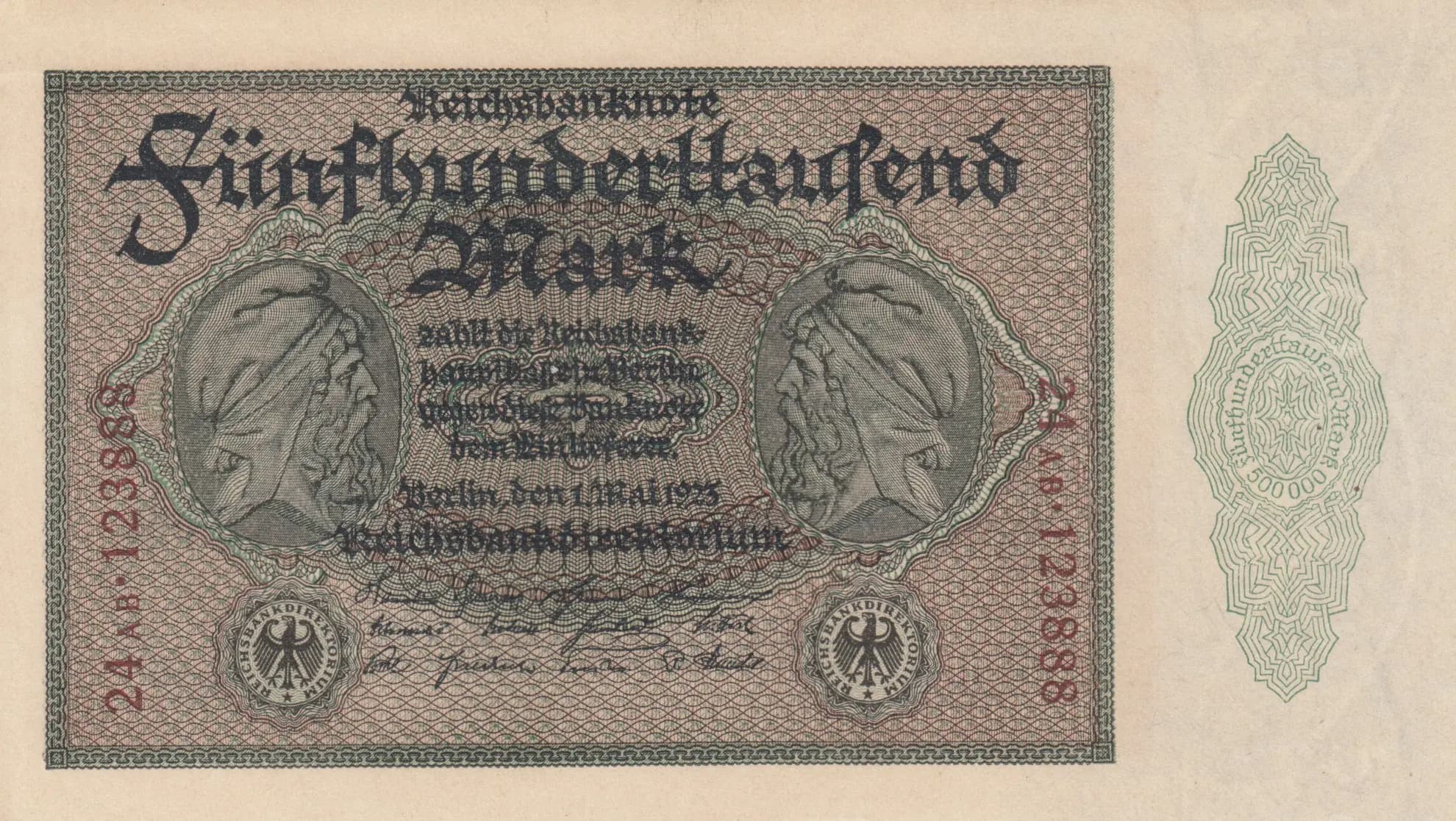
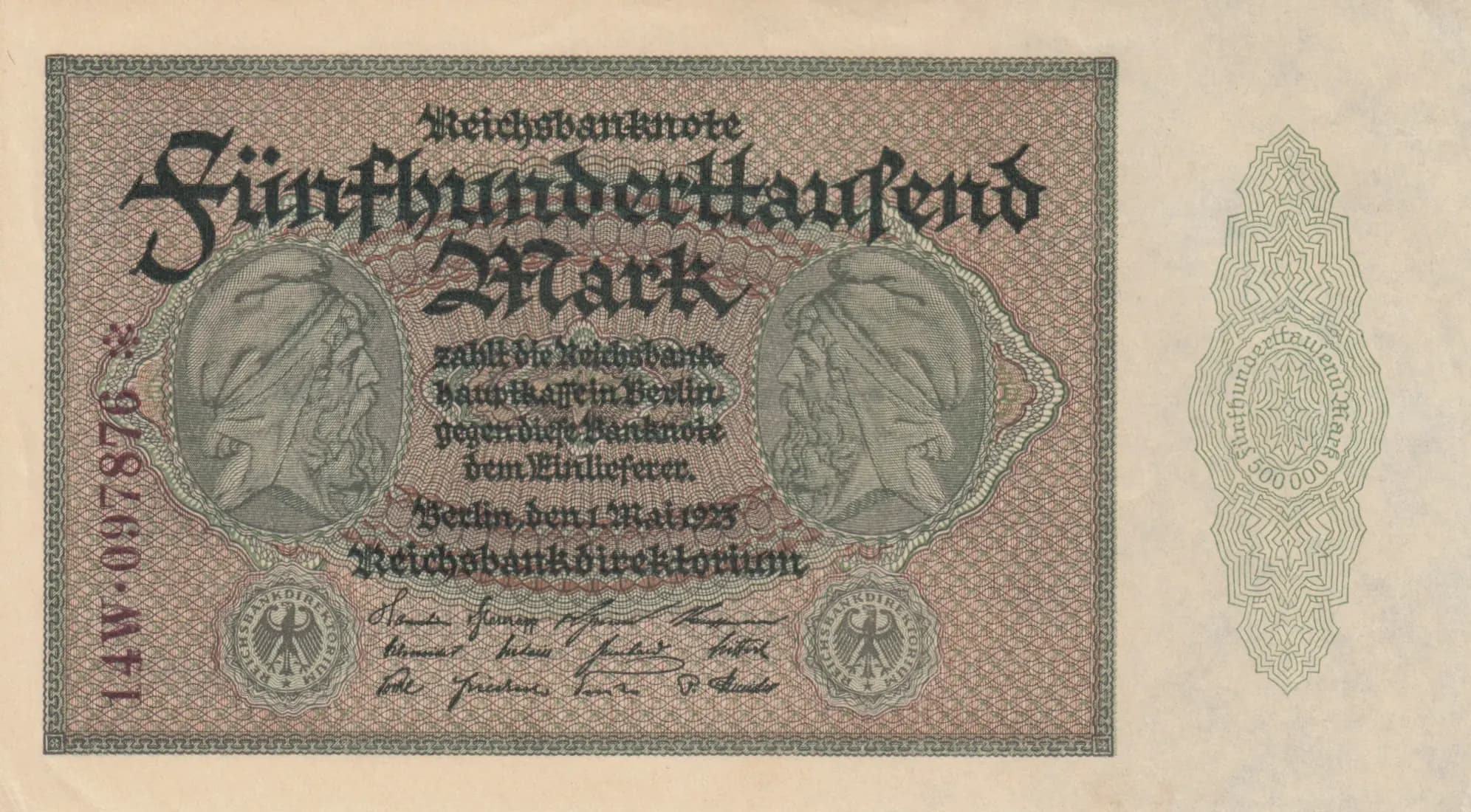
This Pick-88b 500,000 Mark note from August 1923 represents a striking example of German hyperinflation currency in About Uncirculated condition. The note features exceptional engraving quality with dual classical portraits in oval frames, ornamental geometric borders, and period-appropriate security features including multiple official seals and handwritten signatures. As a single serial number specimen, this note captures a pivotal moment in Weimar economic history when the German mark had become nearly worthless, with denominations reaching astronomical levels within months.
Common. The 500,000 Mark denomination was printed in large quantities during the August-September 1923 period as hyperinflation accelerated. While the AU condition is desirable, the Pick-88b variety was not produced in limited quantities and survives in reasonable numbers in collections. The single serial number notation suggests a collected specimen rather than a rare variant. Hyperinflation-era German notes, though historically significant, are generally abundant in the collector market.
Issued during the catastrophic hyperinflation of 1923, this 500,000 Mark note represents the Reichsbank's desperate attempt to maintain currency circulation as the mark's value collapsed. The note's August 1923 date places it in the final months before the introduction of the Rentenmark in November, when such high denominations became commonplace overnight. The formal German imperial eagle seals and official signatures on the front reflect the state's continued attempt to maintain institutional credibility even as the currency became virtually valueless, with individuals requiring suitcases of notes for basic transactions.
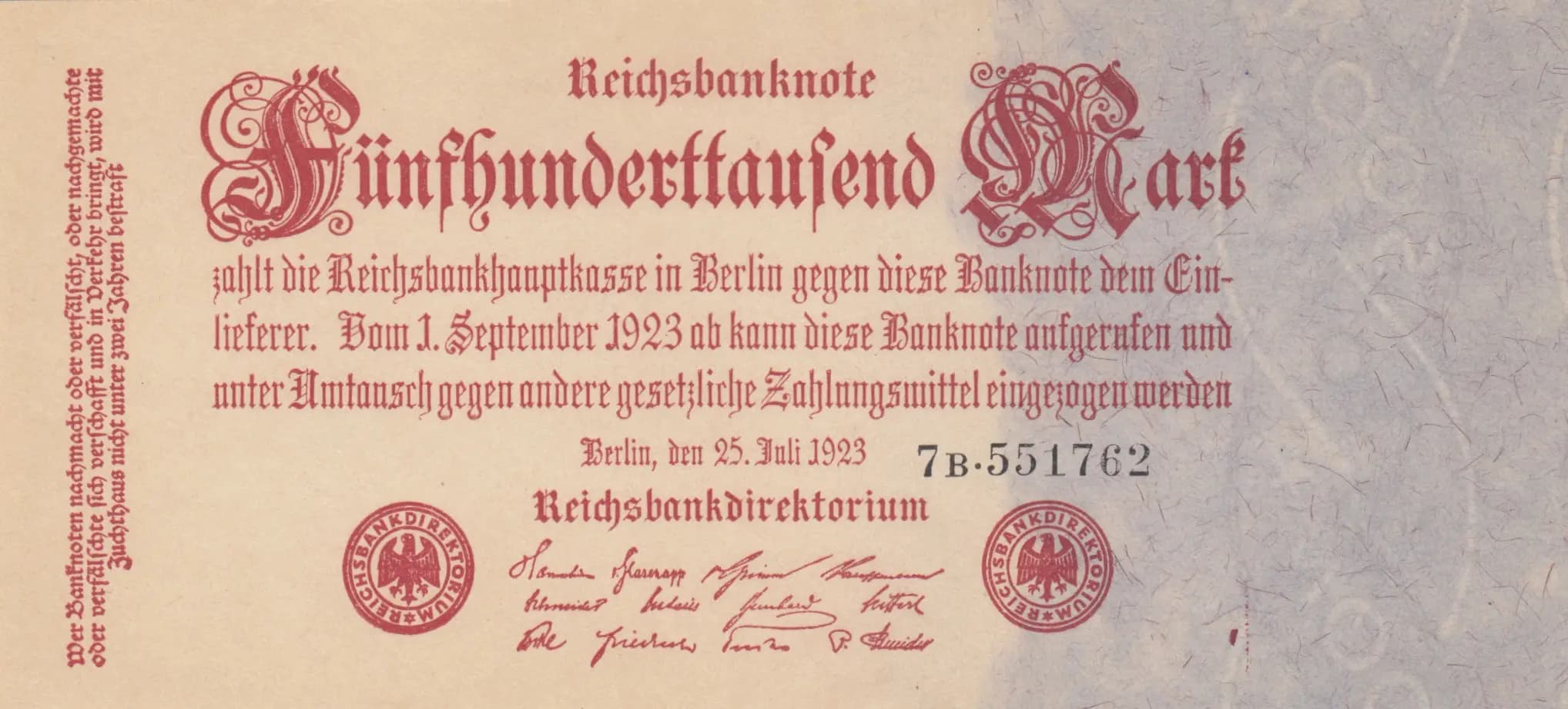
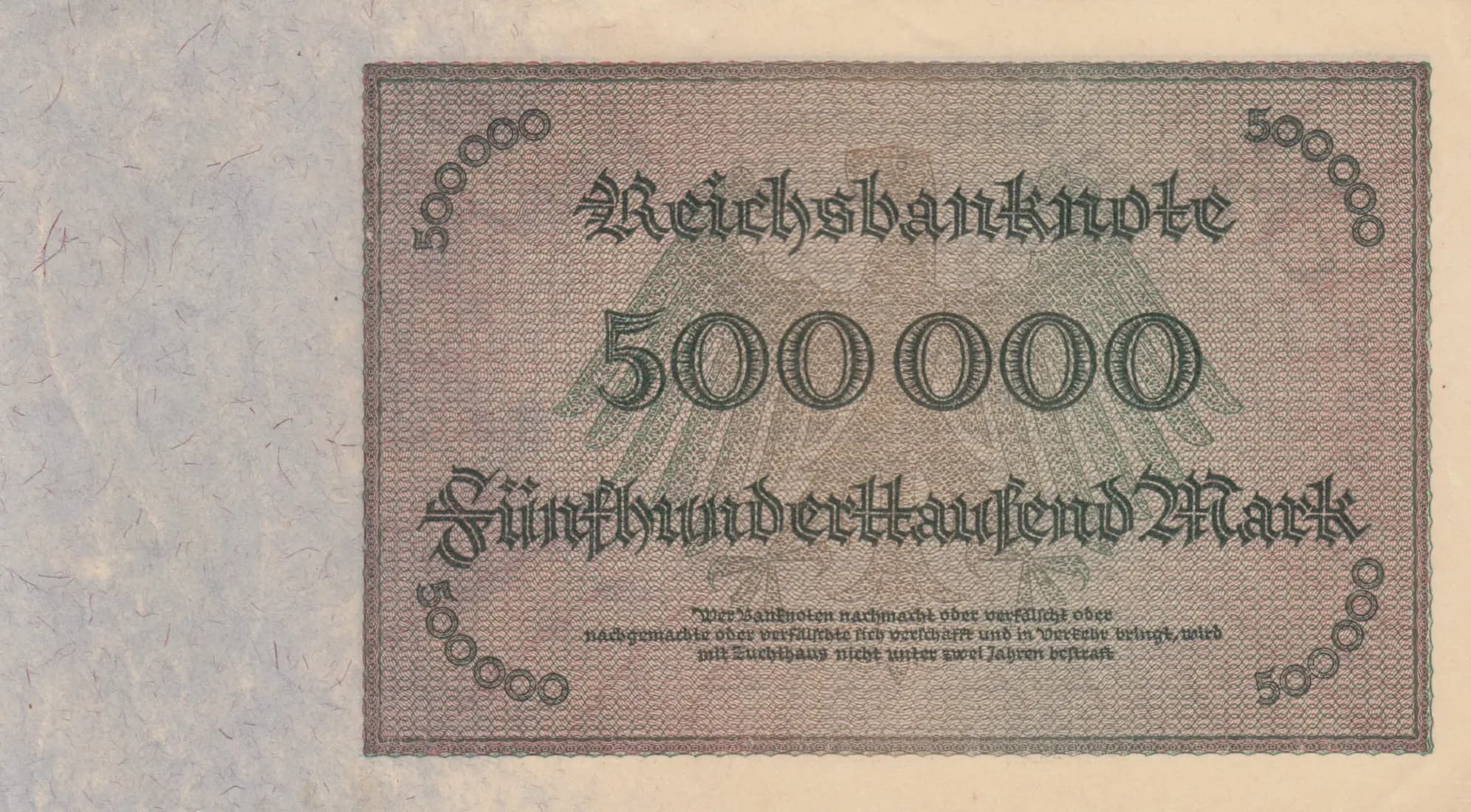
The front design employs dual classical profile portraits in ornate oval frames positioned symmetrically on either side of the central text area, a common motif on Reichsbank notes intended to convey authority and heritage. The ornamental geometric border patterns frame the composition in green and reddish-brown inks on a cream background. The back presents a more austere design, centering on massive denomination numerals '500000' as the focal point, with decorative circular corner patterns and fine line engraving fill providing security features. German imperial eagles appear twice on the front near official signatures and seals, affirming state authority. The handwritten signatures of Reichsbank directors at the bottom authenticate the issue, though their individual identities would require archival research to determine.
FRONT: 'Reichsbanknote' (Reichsbank Note); 'Fünf Hundert Tausend Mark' (Five Hundred Thousand Mark); 'Zahlbar in Berlin' (Payable in Berlin); 'Gegenüber der Reichskanzlei' (Opposite the Reich Chancellery); 'Vom Bundesrat' (From the Federal Council); 'Berlin, den 1.8.6.1923' (Berlin, dated August 1, 1923 [note: date format appears mixed]; 'Reichsbankdirektoren' (Reichsbank Directors). BACK: 'Reichsbanknote' (Reichsbank Note); '500000' (Five Hundred Thousand); 'Fünf Hundert Tausend Mark' (Five Hundred Thousand Mark); 'Wer Banknoten nachahmt oder verfälschte oder verfälschte Banknoten in Verkehr bringt, wird mit Zuchthaus nicht unter zwei Jahren bestraft' (Whoever counterfeits or forges banknotes or brings forged banknotes into circulation will be punished with imprisonment for not less than two years).
This note was produced using traditional steel engraving and intaglio printing methods, evidenced by the fine line engraving patterns visible throughout both sides, the crisp detail in the portrait ovals, and the dimensional shading on the large denomination numerals. The Reichsbank employed Germany's leading security printers for this series; the high quality of the engraving work visible in the geometric borders and security patterns is consistent with the Reichsdruckerei (Reich Printing Office) or J.D. Reichel printing house standards. Multiple passes would have been required to layer the green and reddish-brown color schemes observed.
This specimen is identified as Pick-88b, indicating it is a specific cataloged variety of the 500,000 Mark note. The August 1, 1923 (or 1.8.6.1923) date places it within the variant window for this denomination. The notation of '1 serial #' suggests this is a tracked individual specimen. Without access to signature identification records and complete serial number databases, specific variety distinctions (such as signature variations among the multiple 'Reichsbankdirektoren' who authorized notes during this period) cannot be definitively established from the visual analysis alone, though the presence of handwritten signatures indicates this is likely one of several signed varieties within the Pick-88b classification.