500 000 000 mark 1923
Market Prices
8 salesAbout This Note
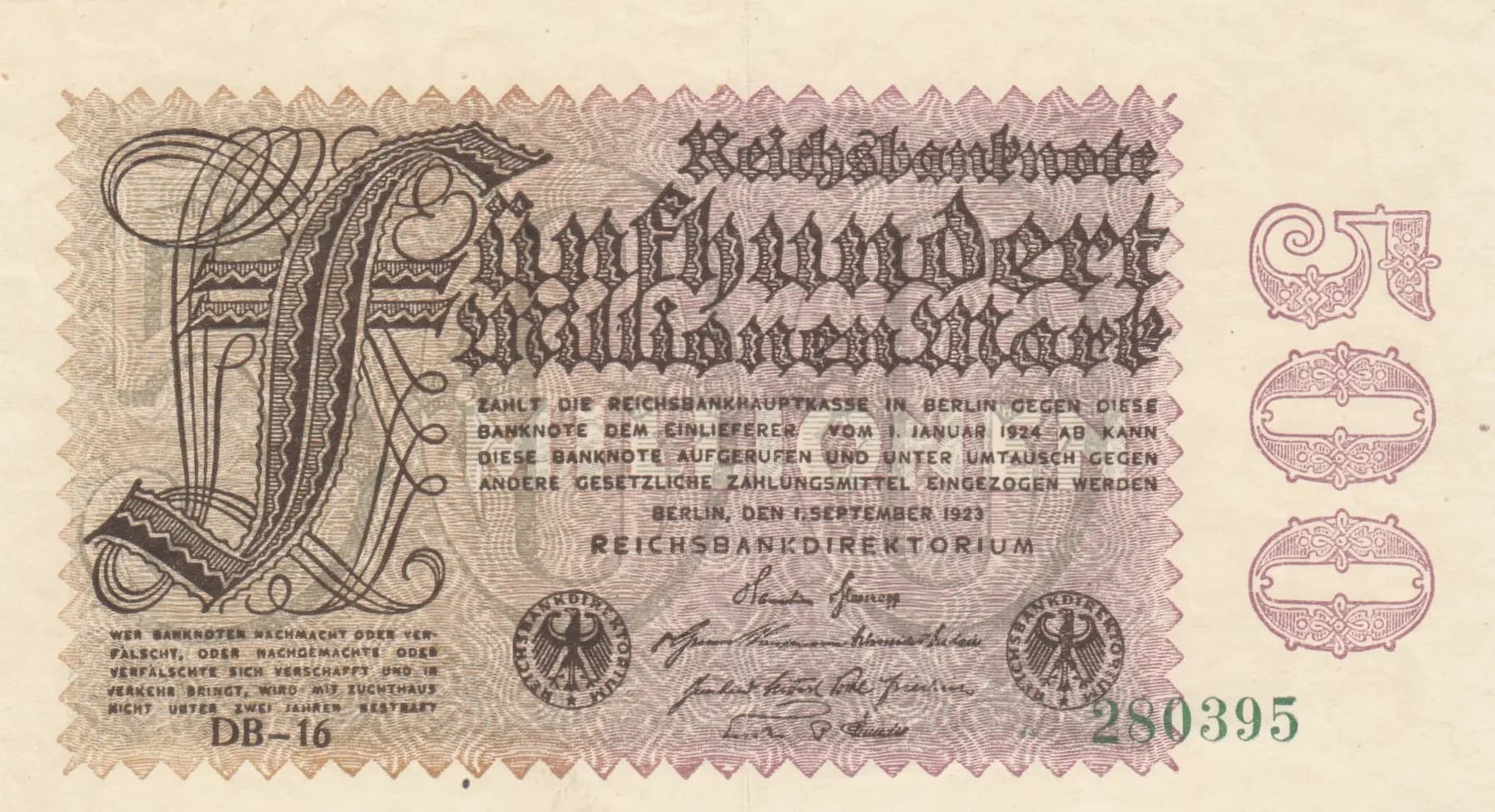
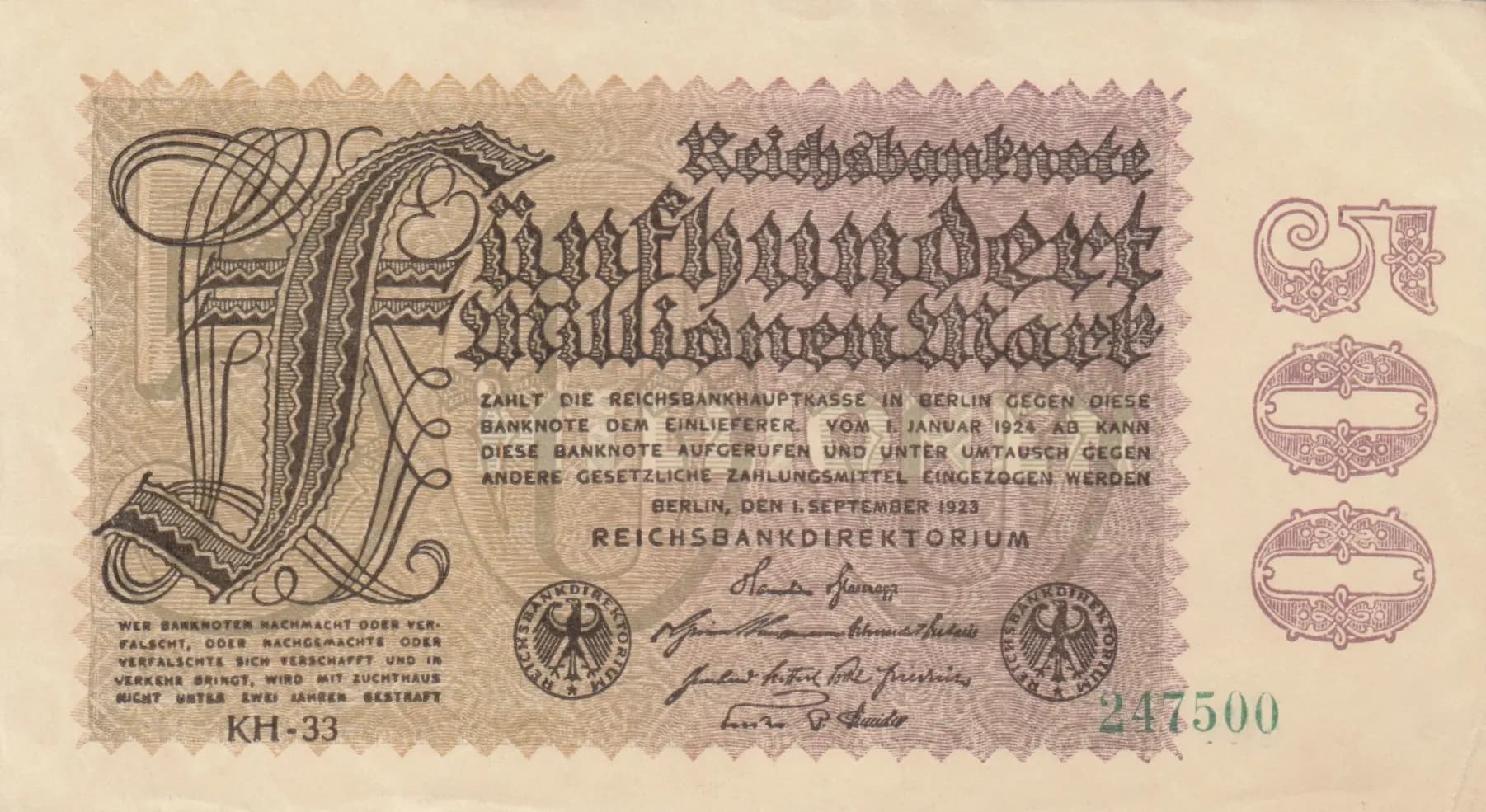
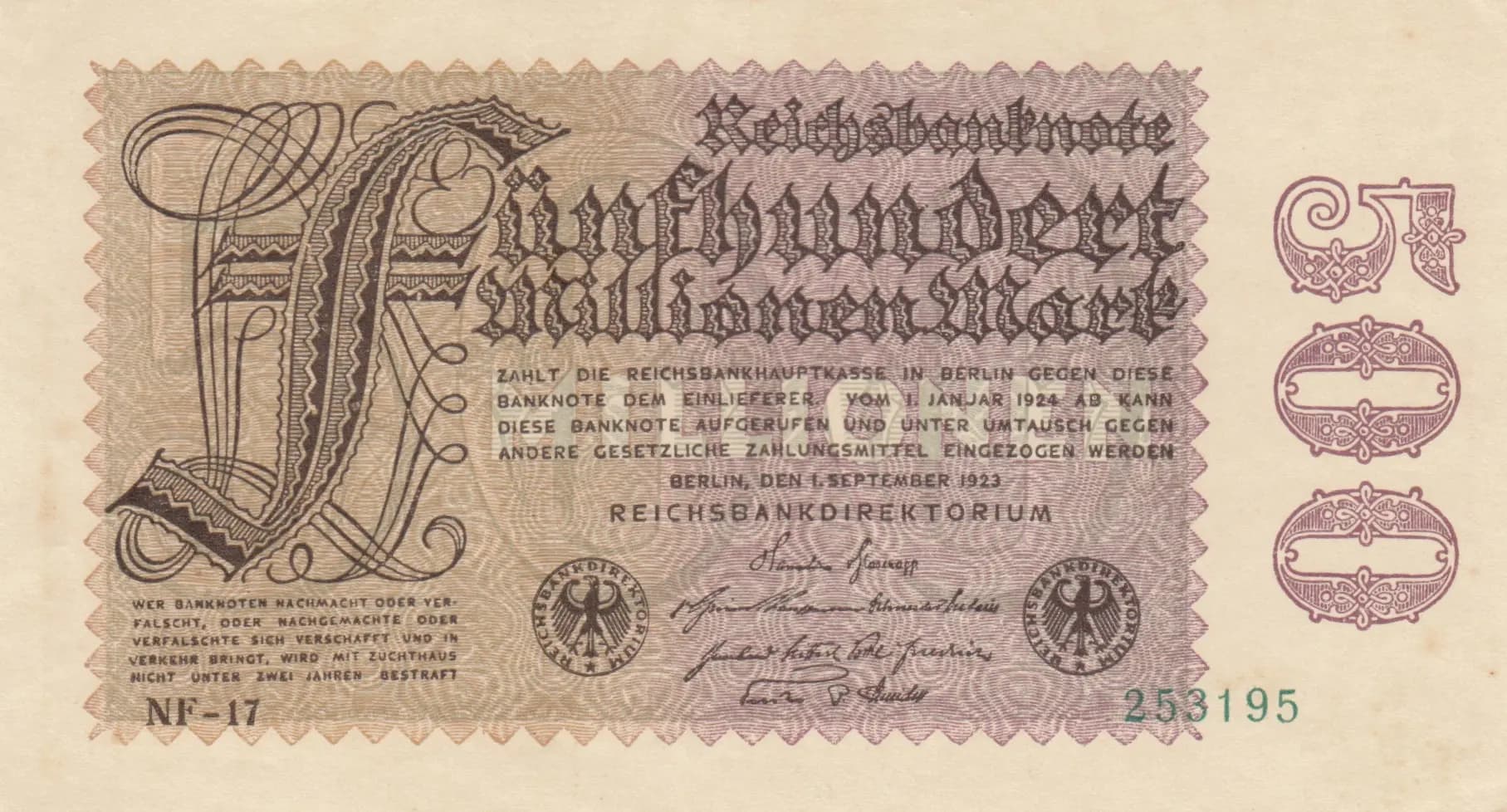
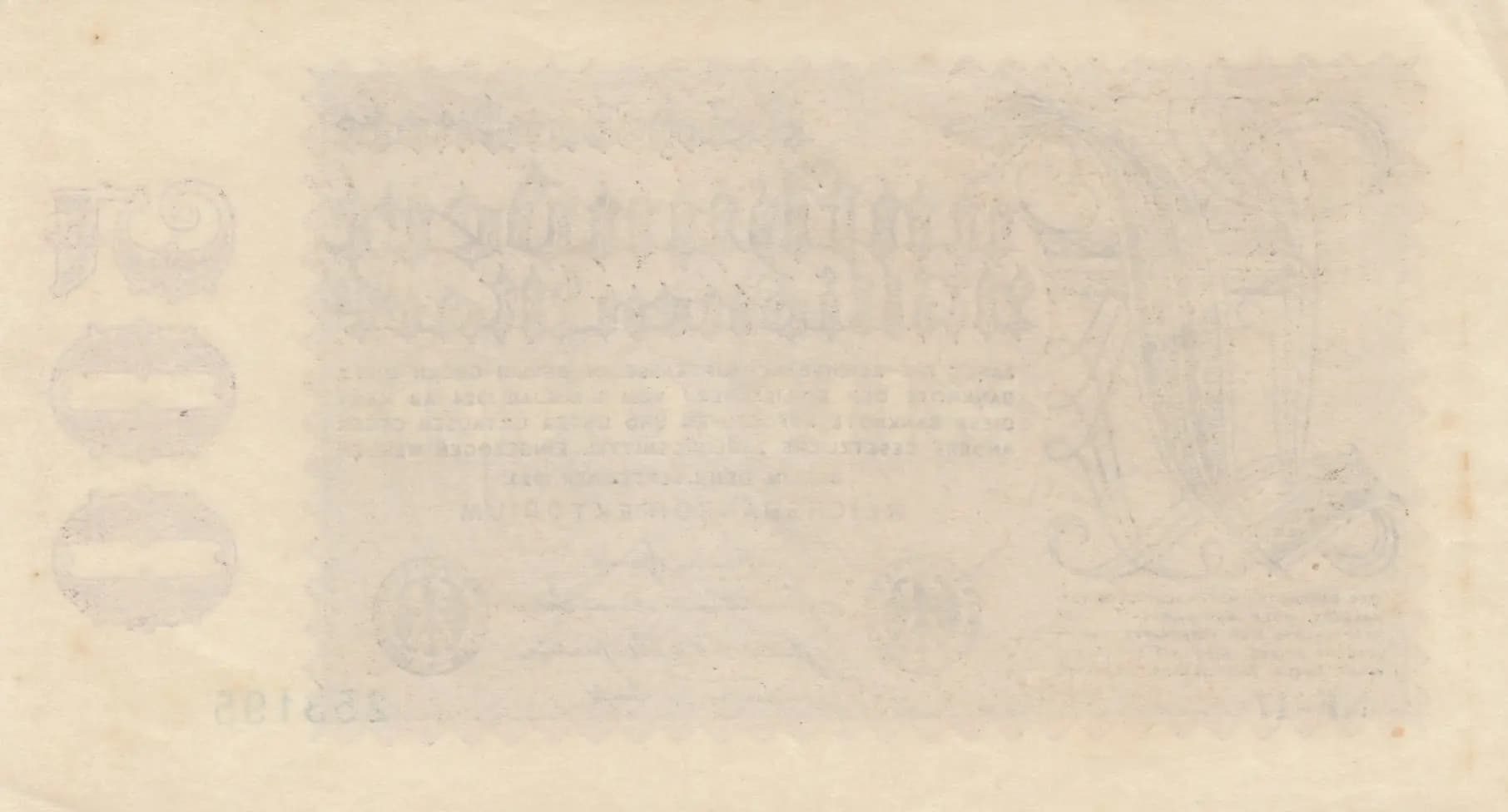
This is a 500 Million Mark note from the German hyperinflation crisis of September 1, 1923, graded AU and issued by the Reichsbank. The note features an ornate Gothic letter 'D' on the left and three decorative circular medallions on the right, printed in dark brown on a tan/beige underprint with purple mauve tints. The excellent condition and crisp printing throughout make this a visually striking example of Weimar-era emergency currency, with the reverse showing only subtle watermark impressions of the medallion designs.
Common. This note is a regular issue from the hyperinflation period with a large print run. eBay market data shows recent sales of comparable specimens (AU/UNC condition) in the $12.50 range, with catalog values of $10 for UNC and $5 for VF as of 2016. The denomination, while large numerically, was one of many issued during the 1923 hyperinflation and remains readily available to collectors. The AU grade is desirable but not scarce.
Issued during the catastrophic hyperinflation of 1923, this note represents the Reichsbank's desperate response to economic collapse following World War I. The inscription dated September 1, 1923, and the prominent eagle seals of the Reichsbank Directorate underscore the German government's attempt to maintain financial authority even as the currency became nearly worthless. The note's explicit warning that it could be called in and exchanged for other legal tender from January 1, 1924 onwards reflects the planned replacement of hyperinflated marks with the Rentenmark, which temporarily stabilized the German economy.
This uniface note (printed on front only) features the Reichsadler (Imperial Eagle) emblem appearing twice in circular seals with laurel wreaths at the bottom of the central text block, flanking official signatures of the Reichsbank Directorate. The left margin is dominated by an ornate Gothic-style decorative letter 'D,' a characteristic design element typical of German banknotes of this period. The right margin displays three circular medallion designs with elaborate ornamental frames, each enclosed in decorative borders. The reverse side is largely blank except for watermark impressions of the same circular medallion patterns visible on the obverse, a security feature common to notes of this era. The overall design employs classical ornamental guilloche patterns and multiple decorative borders throughout.
FRONT SIDE: 'Reichsbanknote' (Reichsbank Note); 'Fünfhundert Milliarde Mark' (Five Hundred Billion Mark); 'ZAHLT DIE REICHSBANKHAUPT KASSE IN BERLIN GEGEN DIESE BANKNOTE DEM EINLIEFERER, VOM 1 JANUAR 1924 AB KANN DIESE BANKNOTE AUFGERUFEN UND UNTER UMTAUSCH GEGEN ANDERE GESETZLICHE ZAHLUNGSMITTEL EINGEZOGEN WERDEN' (The Reichsbank Main Office in Berlin pays against this banknote to the presenter. From January 1, 1924 onwards, this banknote can be called in and exchanged for other legal tender); 'BERLIN, DEN 1. SEPTEMBER 1923' (Berlin, September 1, 1923); 'REICHSBANKDIREKTORIUM' (Reichsbank Directorate); 'NF-17' (reference code); Serial number '253195'; 'WER BANKNOTEN NACHMACHT ODER VERFÄLSCHT, ODER NACHGEMACHTE ODER VERFÄLSCHTE BANKNOTEN BRINGT, WIRD MIT ZUCHTHAUS NICHT UNTER ZWEI JAHREN BESTRAFT' (Whoever counterfeits banknotes or forges them, or brings counterfeit or forged banknotes, will be punished with imprisonment of not less than two years). BACK SIDE: No inscriptions visible; watermark areas only.
Intaglio (engraved) printing on bank note paper, evidenced by the crisp definition of fine lines, the ornamental guilloche patterns, and the precise detail visible in the eagle emblems and decorative elements. The multi-color printing (dark brown on tan/beige with purple mauve underprint) suggests a combination of intaglio for the main design with colored paper or underprint application. The watermark visible on the reverse indicates specialty banknote paper produced by a security printer; for Reichsbank notes of this period, this would typically be the Reichsdruckerei (German State Printing Office) or contracted security printers such as Giesecke & Devrient.
Pick catalog number P-110d indicates this is variety 'd' of the 500 Million Mark note. The note displays reference code 'NF-17' and serial number '253195'. Varieties of this denomination are distinguished by different printing dates and watermark variations (the catalog reference notes watermark 'G/D in stars, E'). The September 1, 1923 date on this example is consistent with the standard issue date for P-110d.