5 000 000 mark 1923
“black serial #”
About This Note
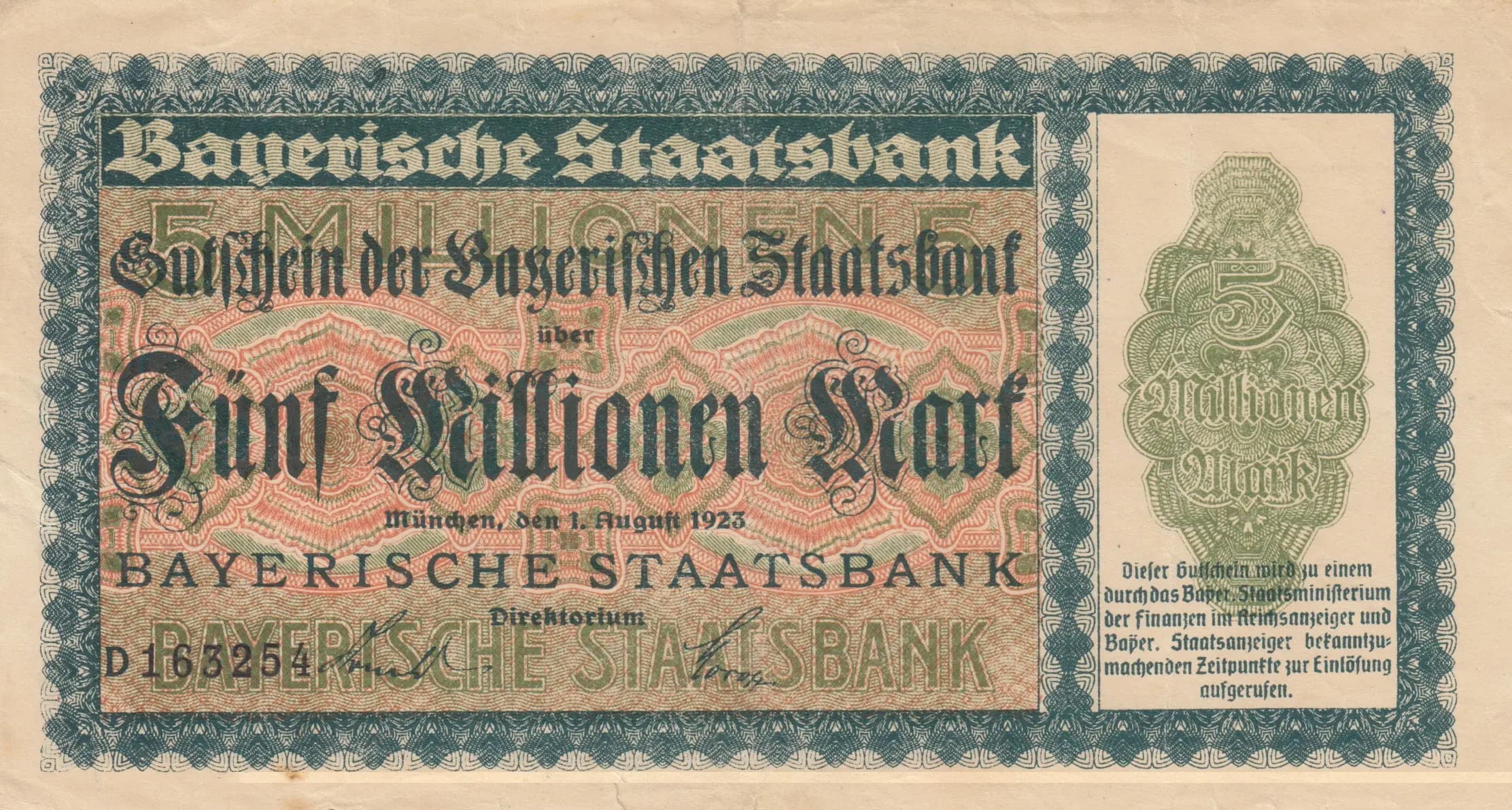
A spectacular example of German hyperinflation currency from August 1, 1923, this 5 million mark voucher from the Bayerische Staatsbank showcases the extraordinary denominations required during the Weimar period's economic collapse. The note displays excellent condition (VF) with vibrant color printing in teal, green, red, and cream tones, featuring intricate ornamental borders and fine engraving throughout. The black serial number and redemption clause language underscore its nature as a temporary financial instrument issued during one of history's most severe currency crises.
Common. This denomination and date combination from the Bayerische Staatsbank's 1923 emergency issues circulated widely during hyperinflation and significant quantities survive. While these notes are historically important and visually striking, they were produced in large numbers to meet the currency crisis demands, and survivors are readily available in the collector market. The specific variety with black serial number in VF condition is not particularly scarce.
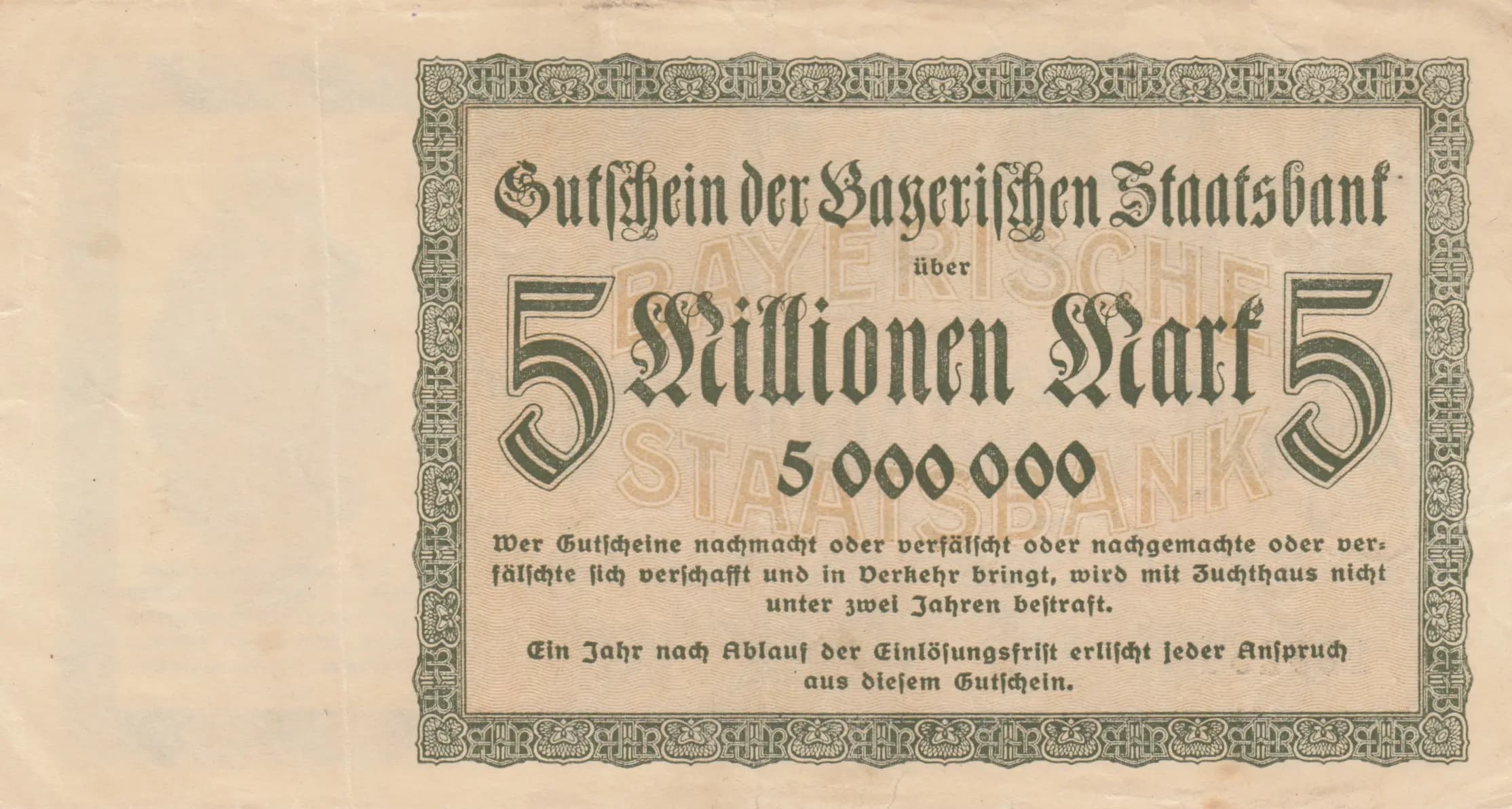
This note represents the peak of German hyperinflation during summer 1923, when the Bavarian State Bank—a regional issuer with emergency authority—was forced to print astronomical denominations to conduct daily commerce. The redemption language printed on the reverse ('This voucher will be called for redemption at a time announced by the Bavarian State Ministry of Finance') reflects the temporary, transitional nature of these issues, which were intended to be replaced by the stabilized Reichsmark in November 1923. The Munich date and Bavarian-specific issuer details emphasize how regional banks undertook their own emergency currency measures before the currency reform that ended hyperinflation.
This voucher features a formal, symmetrical design typical of Weimar emergency currency. The front displays a prominent ornamental central panel in red/pink containing the large denomination '5 Millionen Mark,' flanked by vertical panels with geometric and floral ornamental designs. A dark teal/green decorative border frames the entire note with repeating geometric and floral motifs in fine lines. The reverse similarly employs an olive-green ornamental border with matching geometric patterns and corner elements, containing the redemption terms and counterfeiting penalties in structured text blocks. The color palette—teal, olive green, red, and cream—creates visual hierarchy emphasizing the denomination while the extensive fine-line engraving provided security against counterfeiting. No portraits or specific landmarks appear; instead, the design relies entirely on abstract ornamental patterns and carefully rendered typography.
FRONT: 'Bayerische Staatsbank' (Bavarian State Bank); 'Fünf Millionen Mark' (Five Million Mark); 'münchen, den 1. August 1923' (Munich, August 1, 1923); 'Dieser Gutschein wird zu einem durch das Bayer. Staatsministerium der Finanzen ist Reichsanzeiger und Bayer. Staatsanzeiger bekanntmachenden Zeitpunkt zur Einlösung aufgerufen' (This voucher will be called for redemption at a time announced by the Bavarian State Ministry of Finance in the Reichsanzeiger and Bavarian State Gazette); '5 Millionen Mark' (5 Million Mark). BACK: 'Gutschein der Bayerischen Staatsbank über 5 Millionen Mark' (Voucher of the Bavarian State Bank for 5 Million Mark); '5000000' and '5' (denomination numerals); 'Wer Gutscheine nachmacht oder verfälscht oder nachgemachte oder verfälschte sich verschafft und in Verkehr bringt, wird mit Zuchthaus nicht unter zwei Jahren bestraft' (Whoever counterfeits or falsifies vouchers or obtains counterfeit or falsified vouchers and puts them into circulation will be punished with imprisonment for not less than two years); 'Ein Jahr nach Ablauf der Einlösungsfrist erlischt jeder Anspruch aus diesem Gutschein' (One year after expiration of the redemption period, all claims on this voucher expire).
Intaglio engraving (taille-douce) combined with letterpress printing, evidenced by the fine, crisp line patterns visible in the ornamental borders, the precision of the denomination numerals, and the consistent ink application across both sides. The layered color effect (particularly the teal borders and red/pink central panels) suggests multiple passes or multicolor intaglio capability. This was standard for German Staatsnoten during the hyperinflation period, representing the state printing works' highest security standards. The sharp engraving details and consistent register throughout indicate professional security printer production, likely the Bavarian State Printing Office (Bayerische Staatsdruckerei).
Variety identifiable by black serial number (as noted in catalog data). The Bayerische Staatsbank issued this denomination on August 1, 1923, with variations in serial number colors and formatting across printings. The Pick-unlisted status suggests this specific note or this particular variety may fall outside the main standard catalog hierarchy, possibly due to it being a regional emergency issue rather than a centralized Reichsbank note. Further variety information would require comparison with documented examples of serial number prefixes and color variations from the August 1923 Bavarian State Bank emissions.