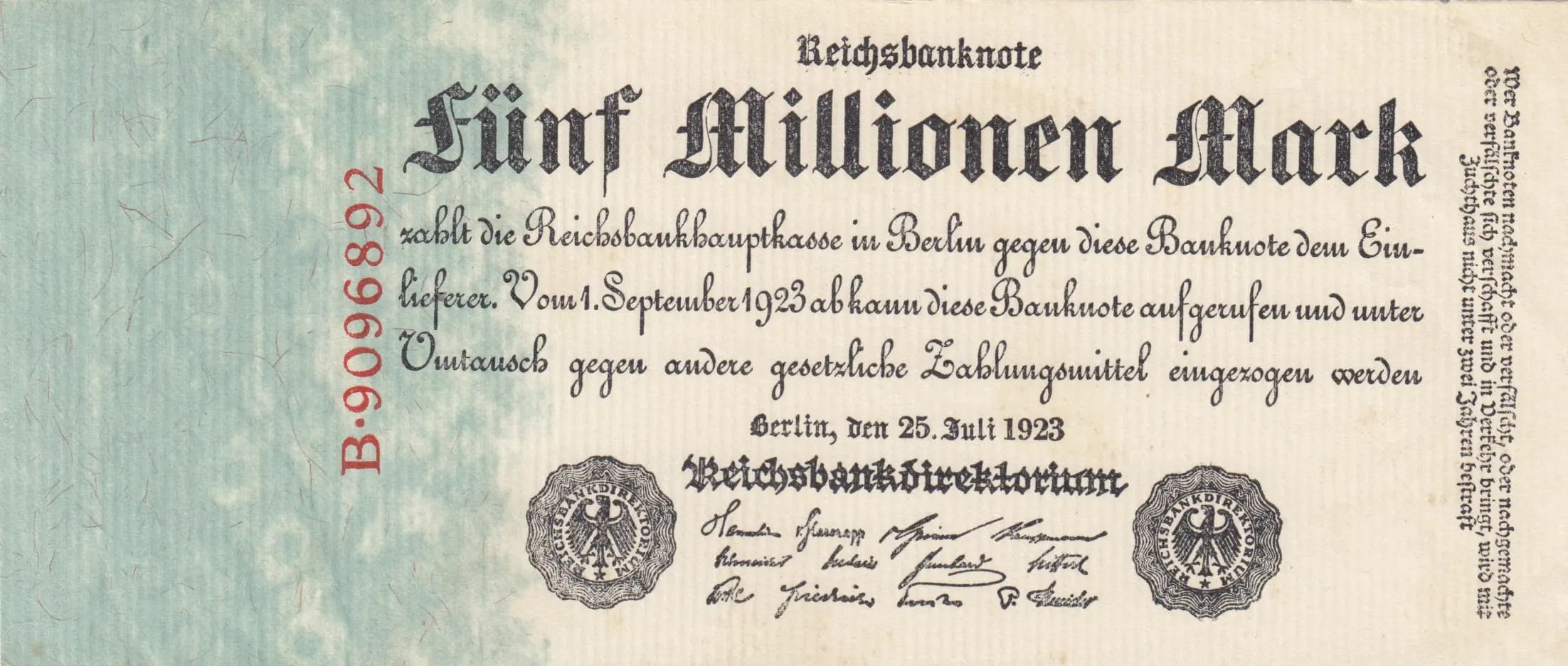
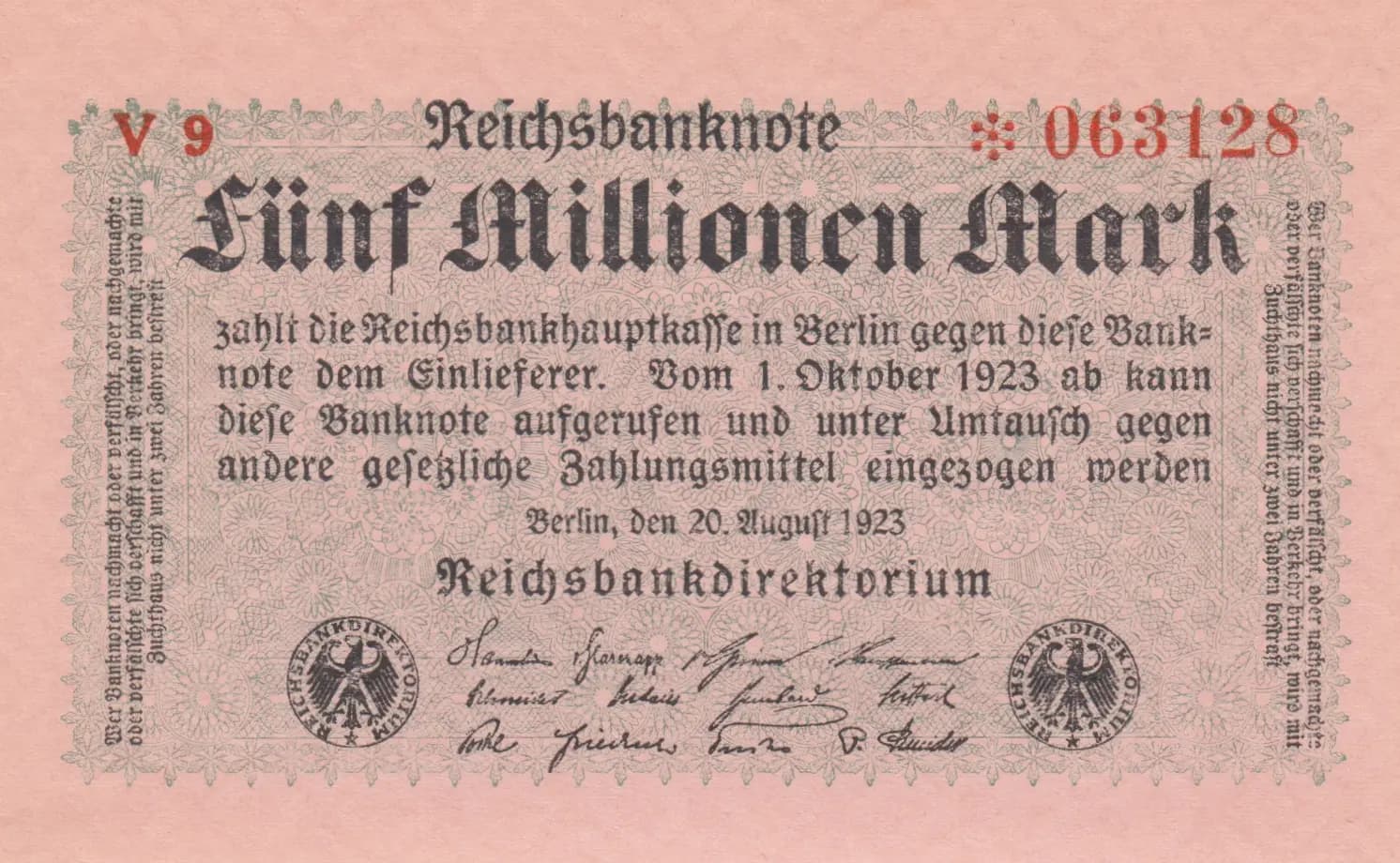
5 000 000 mark 1923
Market Prices
16 salesAbout This Note
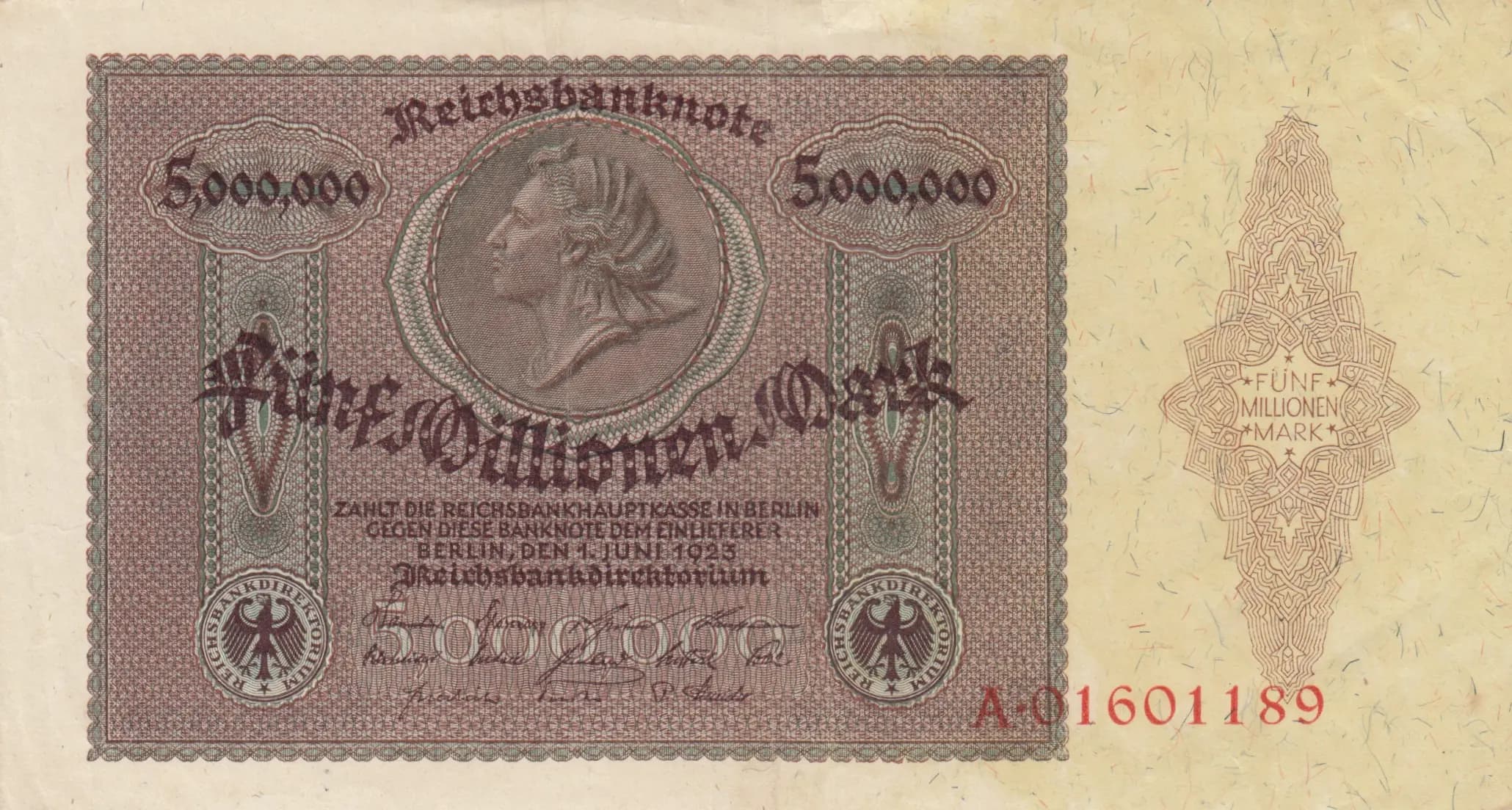
This German 5,000,000 Mark note from 1923 (Pick-90) represents a fascinating artifact of the Weimar hyperinflation crisis, issued during the peak of Germany's monetary collapse. The note displays the classic design elements of this emergency currency period: a refined classical female portrait in a central medallion, ornate security printing with intricate geometric patterns, and denominations presented in decorative ovals across the face. In VF condition, this example shows light aging and patina consistent with a century-old banknote, with cream-tan discoloration and minor foxing but no significant creases or tears—a well-preserved specimen of one of history's most economically significant currency issues.
Common. This note is a regular-issue denomination from a massive, short-lived printing run necessitated by hyperinflation. The eBay price data provided clearly indicates consistent sales well under $20 for VF examples (recent VF sales at $9 in 2026, $20.50 in 2018, $11.09 in 2015, $10.01 in 2013), with even premium grades (PMG 66) showing historical pricing below $150. These notes were produced in enormous quantities, rapidly became worthless, and survived in significant numbers. Current catalog values place VF at $80, but secondary market evidence contradicts artificial elevation—genuine collector demand and actual sales volume remain modest. The denomination itself (5 million marks) was one of the most commonly encountered emergency notes of the 1923 crisis.
Issued on July 5, 1923, this note represents the Reichsbank's desperate attempt to maintain confidence in German currency during the final months of hyperinflation, when the Mark became virtually worthless. The ornate design with classical female allegorical imagery reflects pre-war artistic standards of the Imperial era, while the prominent Reichsadler (German Imperial Eagle) symbols appearing four times throughout the note reinforce state authority and legitimacy at a moment when economic stability was collapsing. By November 1923, such high-denomination notes became obsolete overnight, making these surviving examples tangible evidence of one of the 20th century's most severe monetary crises.
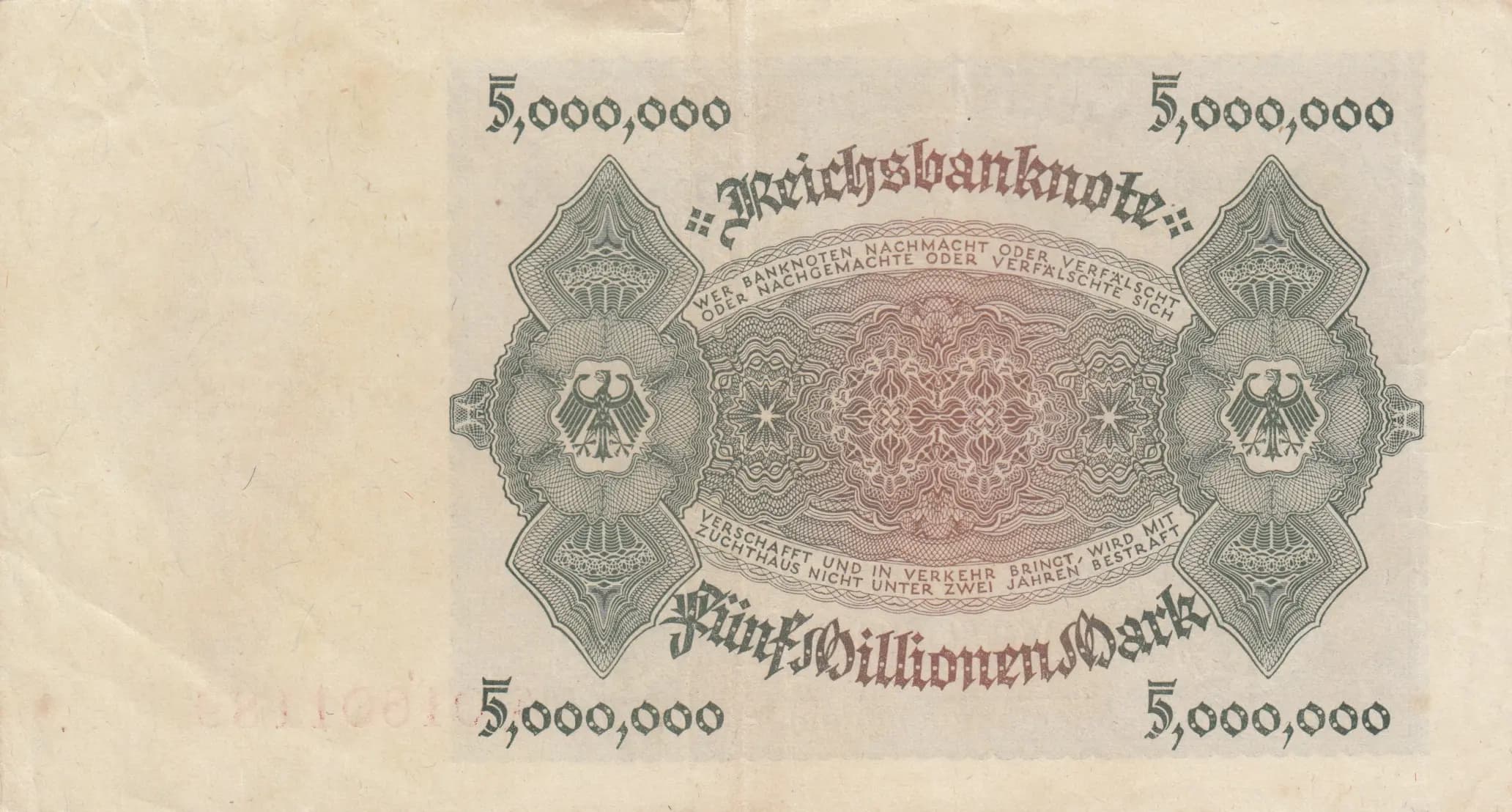
The obverse features a classical female allegorical portrait (representing the Constitutional Medallion or 'Verfassungsmedaillon'), positioned in an ornate circular frame at the center-upper portion of the note. This profile-facing portrait is characteristic of Weimar-era design, evoking stability and continuity with Germany's cultural heritage during political upheaval. The denomination '5,000,000' appears in four decorative ovals distributed across the face. The reverse displays an elaborate oval central medallion containing intricate geometric and floral patterns in red/pink and green, flanked by four Reichsadler (Imperial Eagles) enclosed in ornate diamond-shaped frames with shield designs. The entire design utilizes fine-line engraved patterns, geometric borders, and floral vine motifs in the corners, employing multiple colors—brown, tan, cream, green, red/pink, and red serial number accents—to create a visually complex security design typical of emergency high-denomination currency of this period.
FRONT SIDE: 'Reichsbanknote' (Imperial Bank Note); '5,000,000' and 'Fünf Millionen Mark' (Five Million Mark); 'ZAHLT DIE REICHSBANKHAUPT KASSE IN BERLIN GEGEN DIESEN SCHEIN DEM INHABER' (The Imperial Bank's main office in Berlin pays the bearer against this note); 'BERLIN, DEN 5. JULI 1923' (Berlin, July 5, 1923); 'Der Reichsbankdirektorium' (The Imperial Bank Directorate); Serial Number: 'A.01601189'. BACK SIDE: '5,000,000' and 'Reichsbanknote' (repeated); 'Fünf Millionen Mark' (Five Million Mark); 'OHNE BANKNOTEN NACHMAACHT ODER VERFÄLSCHT VERSCHAFFT UND IN VERKEHR BRINGT, BESITZ MIT ZUCHTHAUS NICHT IN FREIHEIT UNTER ZWEI JAHREN' (Without counterfeit bank notes or falsification—those who counterfeit and place into circulation are punished with imprisonment not in freedom under two years).
This note employs intaglio (engraved) printing with multi-color capability, the standard security printing method for Reichsbank notes during the Weimar period. The intricate fine-line geometric patterns, ornate borders, and detailed medallion work visible throughout both sides are characteristic of steel engraving. The precise multi-color registration observed in the green and red elements of the reverse design indicates advanced printing coordination typical of German state security printers of this era, likely produced by either the Reichsbank's own printing facility or contracted security printers in Berlin.
The serial number prefix 'A' and the specific date of July 5, 1923, position this note within the later emission period of the 5,000,000 Mark series. Pick-90 encompasses the broad 5,000,000 Mark regular issue with constitutional medallion obverse. Known varieties exist based on signature combinations (Reichsbankdirektorium officials changed) and minor date variations within the 1923 window. This example with serial A.01601189 represents the standard printed variety of this denomination. No overprints or special issue markings are visible, indicating a mainstream circulation note rather than a special printing or regional variant.