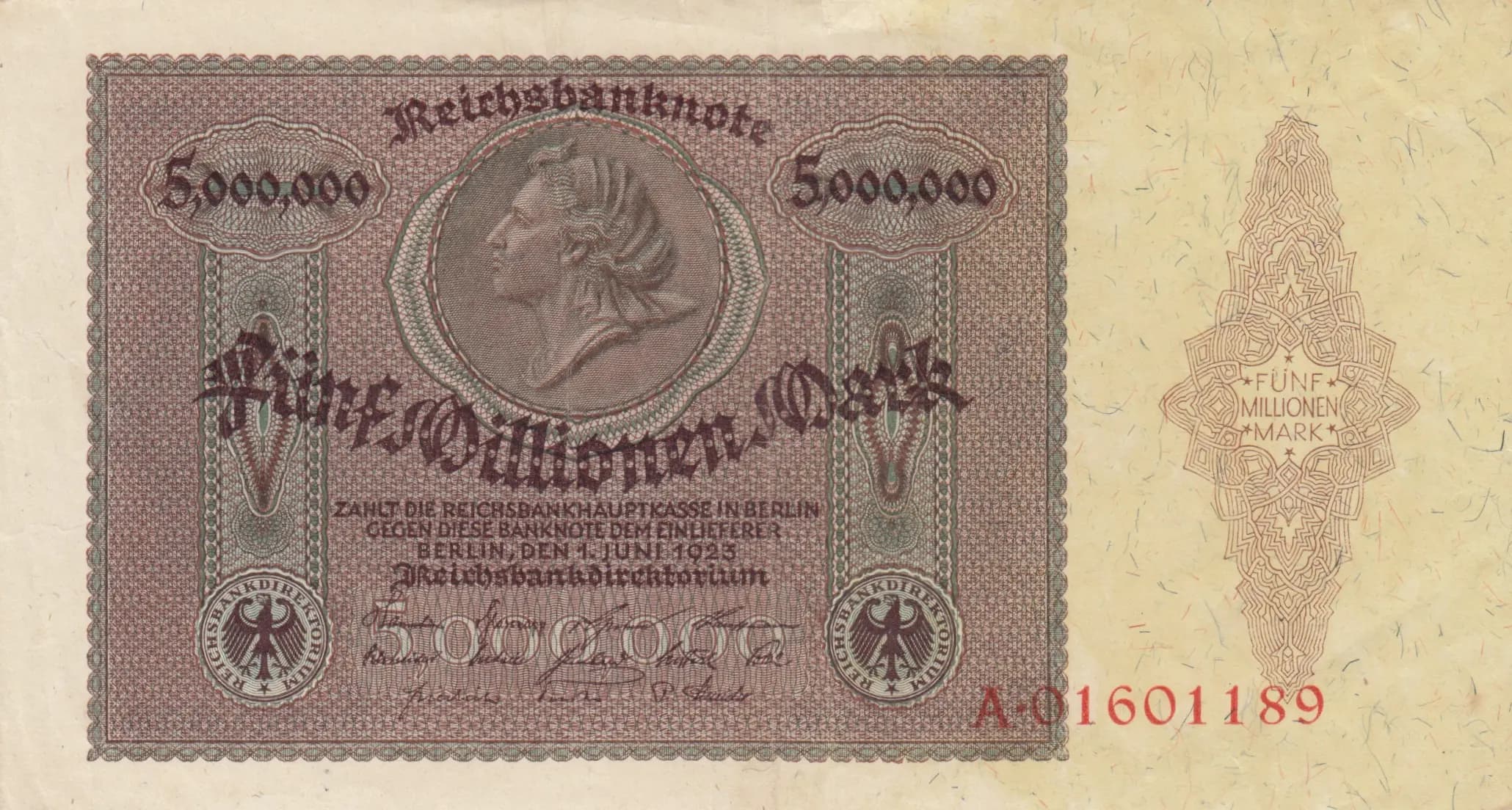
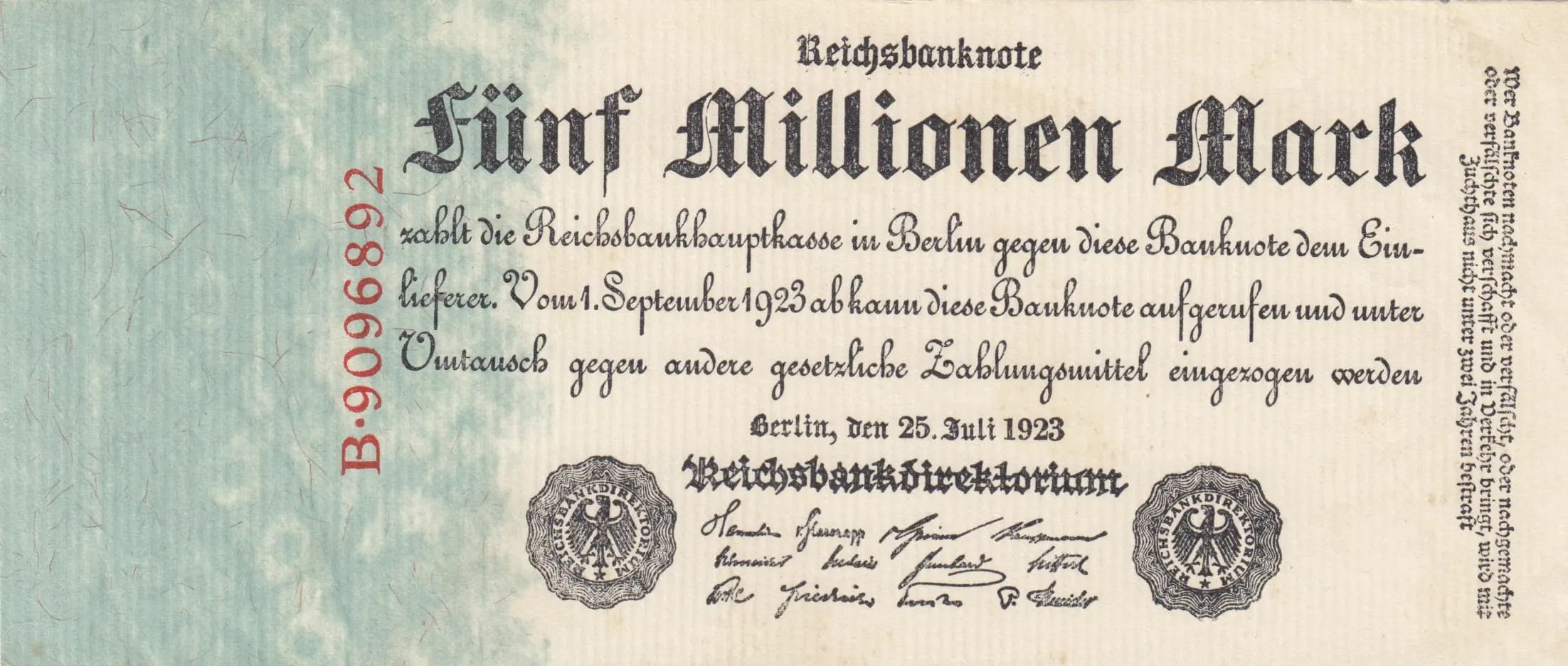
5 000 000 mark 1923
Market Prices
25 salesAbout This Note
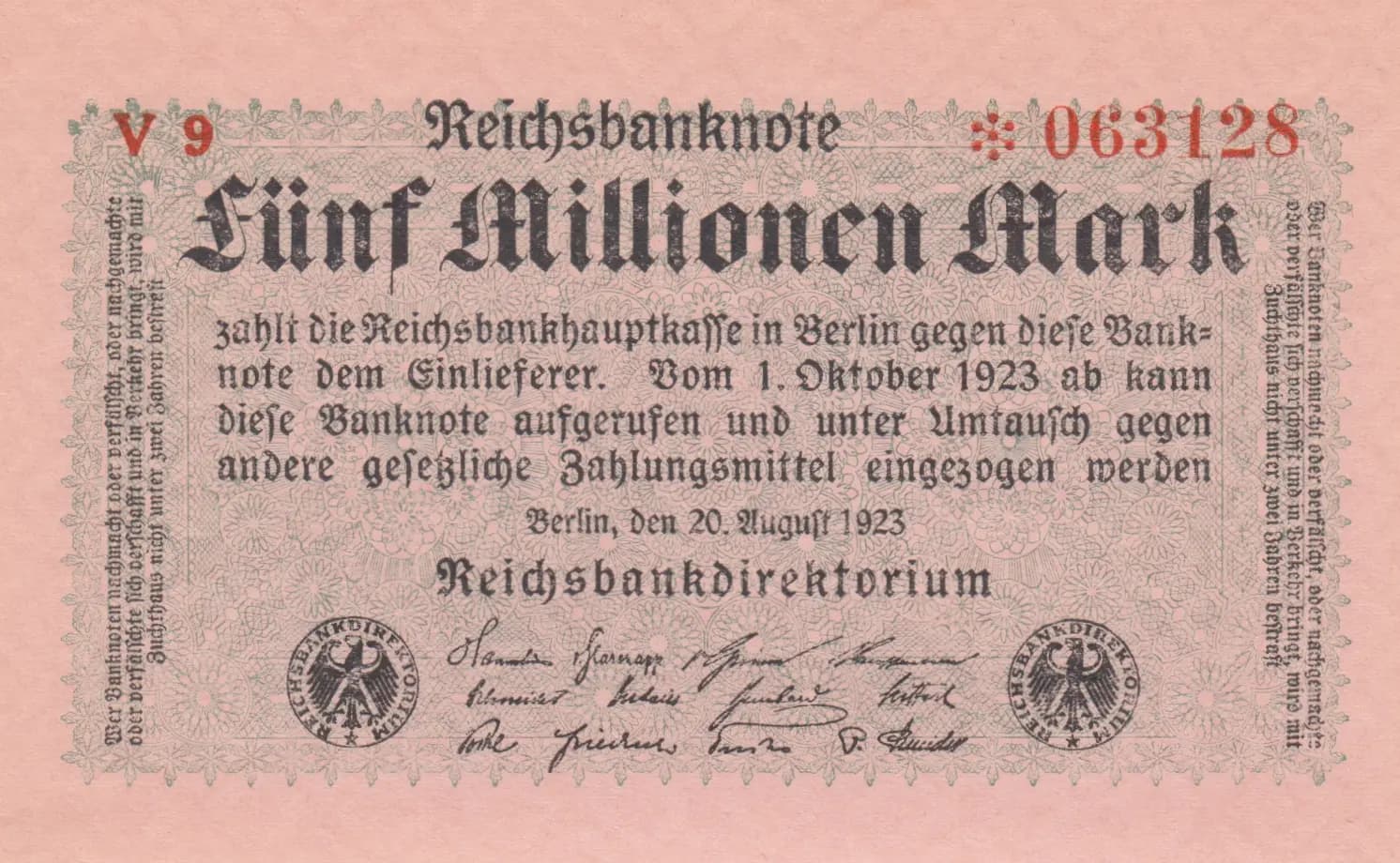
This is a German Reichsbank 5,000,000 Mark note issued on August 20, 1923, during the hyperinflation crisis of the Weimar Republic. The note displays excellent condition (AU grade) with crisp pink coloring, intricate ornamental borders, and clearly legible Gothic script inscriptions and official seals. The uniface design with the bold black denomination text on a gray-green underprint is characteristic of the emergency currency issued during Germany's most severe inflationary period.
Common. Despite the historical significance of hyperinflation-era currency, these 5,000,000 Mark notes were produced in substantial quantities to meet demand during summer 1923. eBay auction records provided show consistent trading at low valuations: most examples sell in the $1–$5 range for circulated VF condition, with even uncirculated examples typically bringing $4–$8 (except for professionally graded PMG 66 examples which commanded $15–$31 in 2018). The 2016 catalog values ($5 VG, $10 VF, $20 UNC) further confirm this is a common issue. The high print run and widespread survival of these notes means they remain affordable and readily available to collectors.
Issued at the peak of Germany's post-World War I hyperinflation, this banknote represents the desperate monetary measures taken by the Reichsbank to maintain liquidity as the Mark's value collapsed. The August 20, 1923 issue date places it just before the currency stabilization efforts of autumn 1923 and the eventual introduction of the Rentenmark in November. The formal inscriptions referencing the Reichsbankdirektorium and mention of potential redemption as of October 1, 1923, reflect the transitional and chaotic nature of Germany's monetary system during this period.
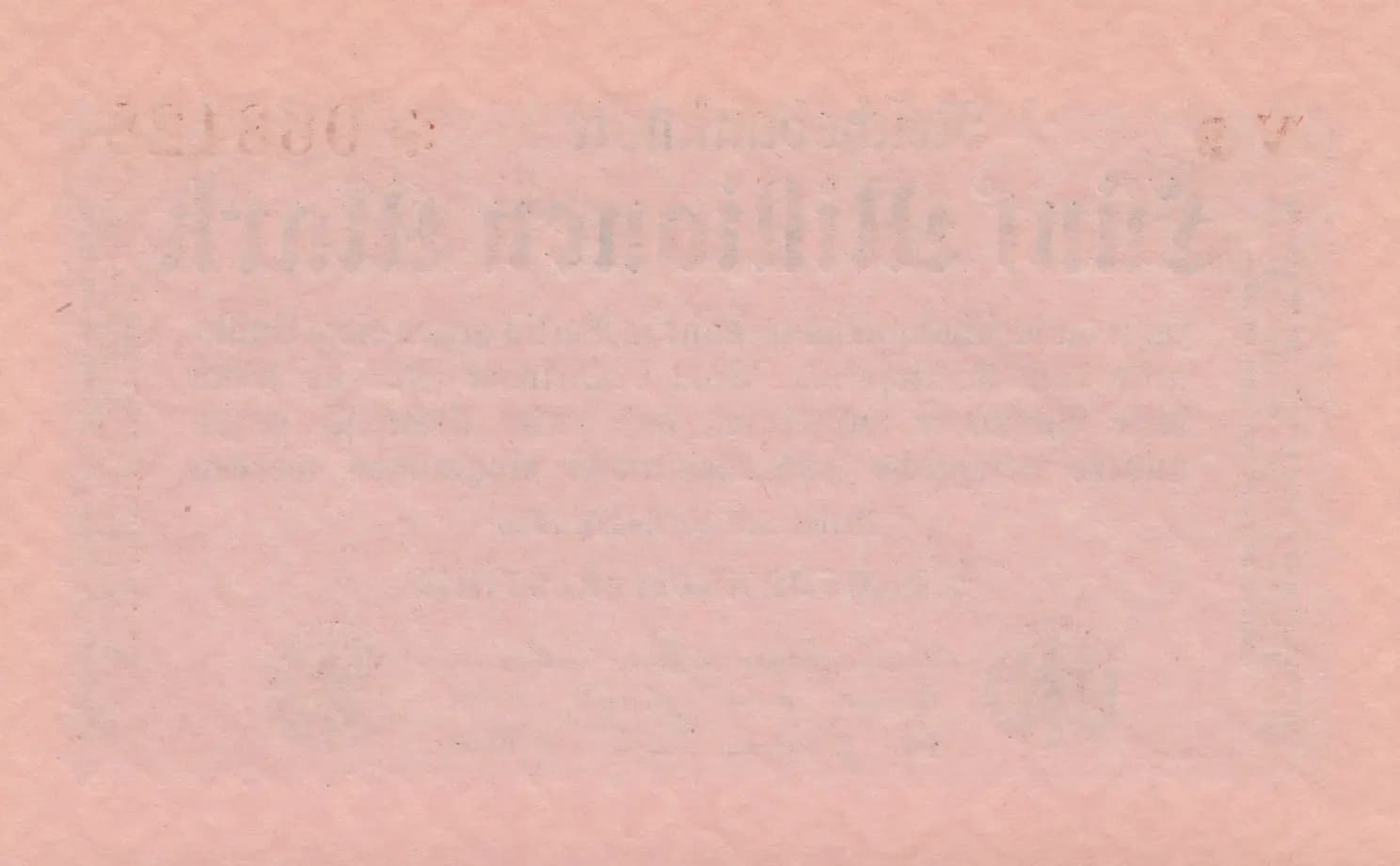
The note is a uniface design (printed front only) with no portrait figures depicted. The front features two circular seals of the Reichsbankdirektorium positioned at the bottom left and right, each containing an Imperial eagle emblem. The design emphasizes ornate decorative floral and geometric patterns throughout the border and background, characteristic of contemporary security printing. The dominant pink/salmon background with black text in Gothic Fraktur script was typical of German hyperinflation-era currency. The gray-green underprint provides additional visual security. Multiple signature lines at the bottom represent authorization by Reichsbank officials. The reverse appears nearly blank, a cost-saving measure during the emergency issuance period when speed of production was critical.
FRONT SIDE: 'V 9' (Series designation); 'Reichsbanknote' (Reich Bank Note); Serial number '063128' (red); 'Fünf Millionen Mark' (Five Million Mark); 'zahlt die Reichsbankhautkasse in Berlin gegen diese Banknote dem Einlieferer. Vom 1. Oktober 1923 ab kann diese Banknote aufgerufen und unter Umtausch gegen andere gesetzliche Zahlungsmittel eingezogen werden' (The Reichsbank main office in Berlin pays against this banknote to the bearer. From October 1, 1923 onwards, this banknote can be called in and exchanged under exchange for other legal means of payment); 'Berlin, den 20. August 1923' (Berlin, August 20, 1923); 'Reichsbankdirektorium' (Reichsbank Directorate). BACK SIDE: Predominantly blank with faint watermark or security pattern impressions barely legible.
Intaglio engraving (line engraving) was used for the primary design elements, security features, and text, as evidenced by the fine line work visible in the ornamental borders and the crisp, sharp appearance of the Gothic script and official seals. The gray-green underprint was applied as a separate security measure. The printer is not definitively identified from the visual analysis, though German state printing facilities (likely Reichsdruckerei or a contracted security printer) produced these emergency notes. The uniface printing on one side only reduced production time and costs during the height of the hyperinflation crisis.
Series designation 'V 9' is noted on this example. Serial number 063128 is visible in red in the upper right corner. The date 'Berlin, den 20. August 1923' confirms this as part of the August 20, 1923 issue. Multiple series and serial number combinations exist for this Pick number. No overprints or significant varieties are apparent on the observed example; the note appears to be a standard production variant from the primary August 1923 printing.