42 pfennig gold= 1/10 dollar 1923
About This Note
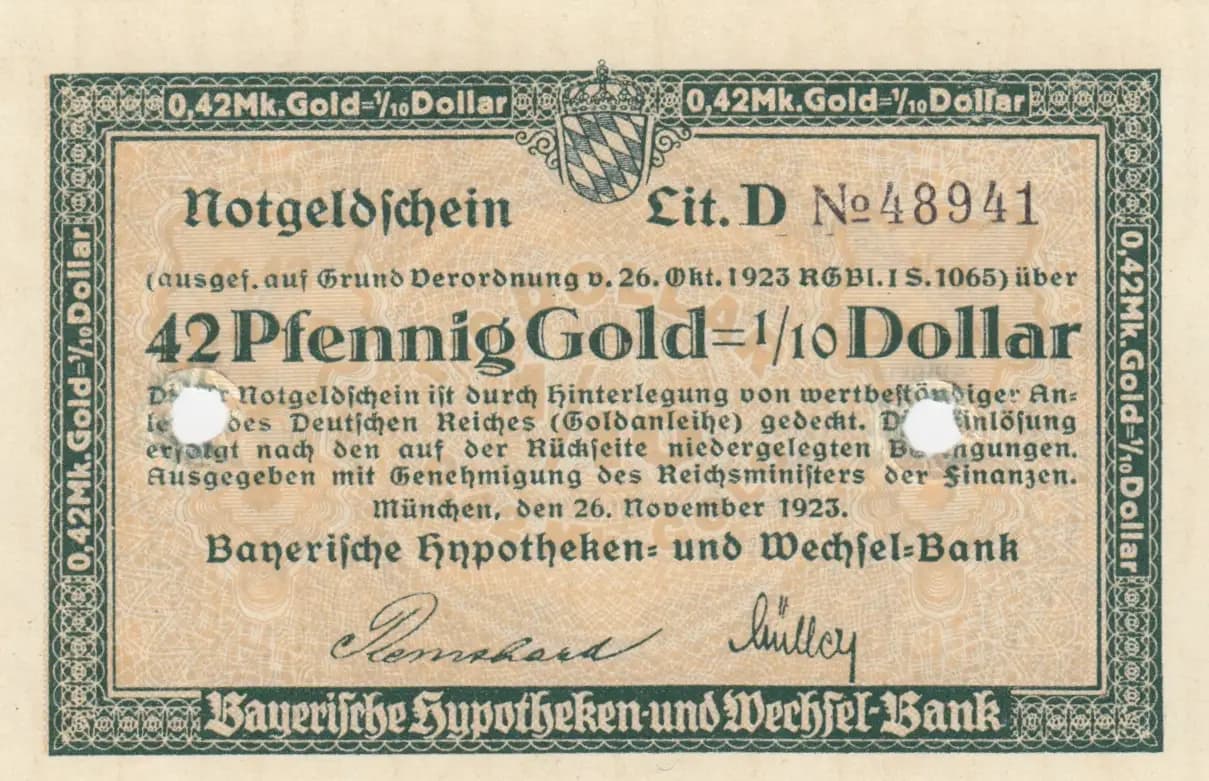
A striking German emergency currency note (Notgeldschein) from the Bayerische Hypotheken- und Wechsel Bank, issued November 26, 1923, during the height of German hyperinflation. The note is denominated as 42 pfennig gold = 1/10 dollar and features an elaborate ornamental design with a Bavarian coat of arms, intricate green/teal floral borders, and two archival punch holes. In uncirculated condition, this note preserves crisp printing and minimal aging, making it an excellent example of Weimar-era emergency currency design.
Common. German hyperinflation emergency currency from 1923 was issued in substantial quantities by multiple Bavarian and German banks to facilitate commerce during the currency crisis. The Bayerische Hypotheken- und Wechsel Bank issued multiple denominations of Notgeldscheine during this period, and surviving examples are readily available to collectors. The unlisted Pick catalog status does not indicate rarity—many emergency currency variants were never systematically cataloged in major references. No evidence suggests this particular note had a restricted print run or was recalled, and examples appear regularly in dealer inventories and online markets.
This note was issued under emergency decree (Verordnung v. 26 Oct. 1923) during Germany's monetary collapse, when the Reichsmark became worthless and banks issued gold-backed substitute currency. The denomination in gold and dollars reflects the desperate attempt to restore confidence by backing the note with German gold loans (Goldanleihe des Deutschen Reiches). The Bavarian coat of arms and Munich address (Theatinerstr. 11) anchor this issue to Bavaria's financial institutions during the crisis period of late 1923.
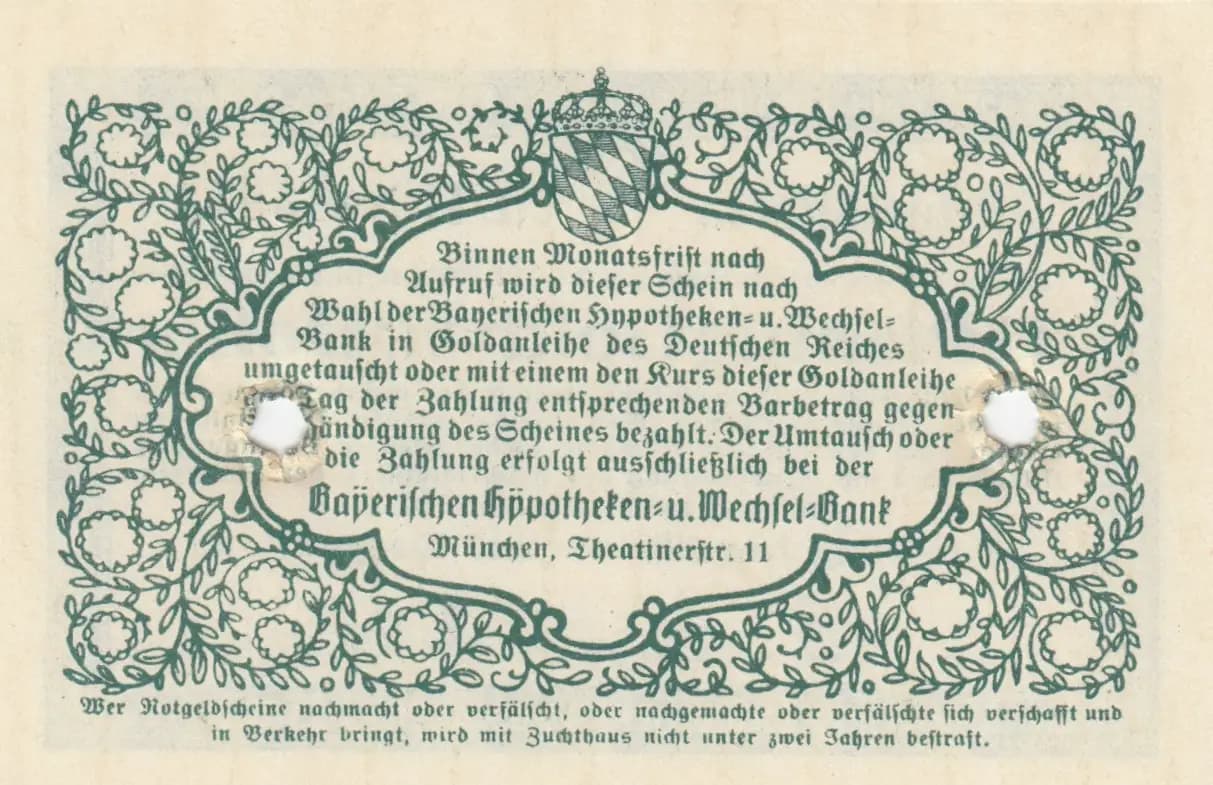
This Notgeldschein features a classical ornamental design characteristic of high-quality bank emergency currency from 1923. The front displays a symmetrical layout with a cream/beige background and green/teal printing throughout. A Bavarian coat of arms shield is prominently positioned at the top center within an ornamental cartouche, flanked by decorative floral and geometric border elements. The denomination and key text are arranged in serif typeface across the middle section. The reverse side continues the ornamental theme with an elaborate decorative border containing rosette patterns and fine floral motifs, framing a central rectangular cartouche that contains the redemption conditions. A crown symbol appears at the top center of the reverse. The note lacks portraits or specific landmarks but relies entirely on heraldic symbolism and ornamental design to convey authority and legitimacy. Two circular punch holes, visible on both sides in the upper left and right portions, indicate archival processing or binding by a collector or institution.
FRONT: Main denomination inscription reads '0.42 Mk. Gold = 1/10 Dollar' (0.42 Mark Gold = 1/10 Dollar). The issuing bank name: 'Bayerische Hypotheken- und Wechsel- Bank' (Bavarian Mortgage and Exchange Bank). Authority statement: '(ausgef. auf Grund Verordnung v. 26. Okt. 1923 RGBl. I S. 1065) über 42 Pfennig Gold = 1/10 Dollar' (issued on basis of regulation of 26 October 1923 RGBl. I S. 1065 for 42 Pfennig Gold = 1/10 Dollar). Backing declaration: 'Der Notgeldschein ist durch Hinterlegung von wertbeständiger Anleihe des Deutschen Reiches (Goldanleihe) gedeckt. Die Einlösung erfolgt nach den auf der Rückseite niedergelegten Bedingungen. Ausgebeben mit Genehmigung des Reichsministers der Finanzen. münchen, den 26. November 1923.' (The emergency currency note is backed by deposited stable-value loans of the German Reich (gold loan). Redemption takes place according to the conditions set out on the reverse side. Issued with approval of the Reich Minister of Finance. Munich, November 26, 1923.) Reference: 'Lit. D No 48941'. BACK: Redemption terms: 'Binnen Monatsfrist nach Ausruf wird dieser Schein nach Wahl der Bayerischen Hypotheken- u. Wechsel- Bank in Goldanleihe des Deutschen Reiches umgetauscht oder mit einem den Kurs dieser Goldanleihe am Tage der Zahlung entsprechenden Barbetrag gegen Einhändigung des Scheines bezahlt. Der Umtausch oder die Zahlung erfolgt ausschließlich bei der Bayerischen Hypotheken- u. Wechsel- Bank München, Theatinerstr. 11' (Within one month of notification, this note will be exchanged at the choice of the Bavarian Mortgage and Exchange Bank for gold loans of the German Reich or paid in cash corresponding to the value of this gold loan on the day of payment against surrender of the note. The exchange or payment takes place exclusively at the Bavarian Mortgage and Exchange Bank Munich, Theatinerstr. 11). Anti-counterfeiting warning: 'Wer Notgeldscheine nachmacht oder verfälscht, oder nachgemachte oder verfälschte sich verschafft und in Verkehr bringt, wird mit Zuchthaus nicht unter zwei Jahren bestraft.' (Anyone who counterfeits or forges emergency currency notes, or procures or circulates counterfeit or forged notes, will be punished with hard labor for no less than two years.)
This note was produced using letterpress (relief) printing, evidenced by the crisp, well-defined serif typeface and the sharp impression of the ornamental border designs and heraldic elements. The dual-color printing in green/teal and black on cream stock is consistent with German bank printing standards of the period. The intricate fine-line borders and floral rosette patterns suggest skilled engraving work typical of German security printers of the Weimar era. The two circular punch holes appear to have been added post-printing, likely during archival processing.
This note is cataloged as Pick unlisted, indicating it falls outside the standard Pick catalog's scope, likely due to its status as a small-denomination emergency issue or a variant of a cataloged series. The catalog reference 'Lit. D No 48941' suggests it may be documented in specialized German emergency currency literature. The date of issue is November 26, 1923, and the redemption location is specified as Munich (München), Theatinerstr. 11. No serial numbers are visible in the visual analysis, and no signature varieties are noted. The two punch holes are consistent with archival processing rather than an intentional design feature or official variety marker.