4 mark 20 pfennig gold= 1 dollar 1923
About This Note
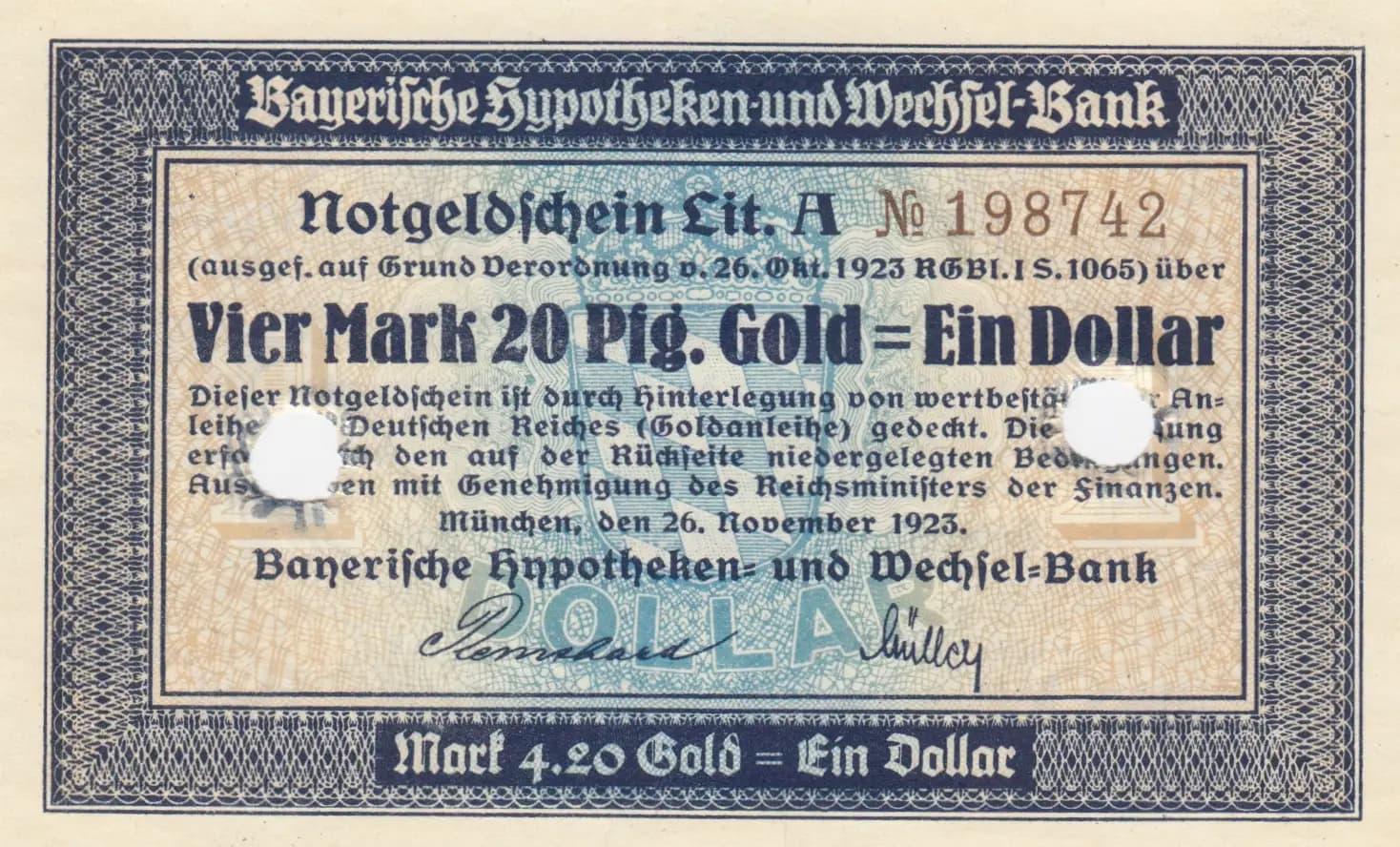
A Notgeldschein (emergency banknote) issued by the Bayerische Hypotheken-und Wechsel-Bank on November 26, 1923, denominated at 4 Mark 20 Pfennig Gold = 1 Dollar. The note features ornate Art Nouveau-style decorative borders in dark blue with intricate geometric and floral patterns on cream-colored paper, reflecting the aesthetic standards of German emergency currency during the hyperinflation crisis. Despite visible foxing and age-related yellowing consistent with storage over a century, the note remains legible and displays the fine line work characteristic of security printing from this period.
Common. Notgeldscheine from this period, while historically significant, were issued in substantial quantities by numerous German municipalities and institutions to address the acute shortage of circulating currency during hyperinflation (1923). The Bayerische Hypotheken-und Wechsel-Bank was a legitimate financial institution with multiple locations, and this denomination represents standard emergency currency rather than a limited commemorative or special issue. The absence of this note from standard Pick catalogs (listed as P-unlisted) suggests it falls outside major philatelic reference works, but this reflects catalog incompleteness rather than scarcity. No specific print run data is available, but the survival of multiple specimens and the institutional nature of the issuer indicate a substantial original emission. The observed condition with foxing and age-related wear is typical for notes of this age rather than indicative of rarity.
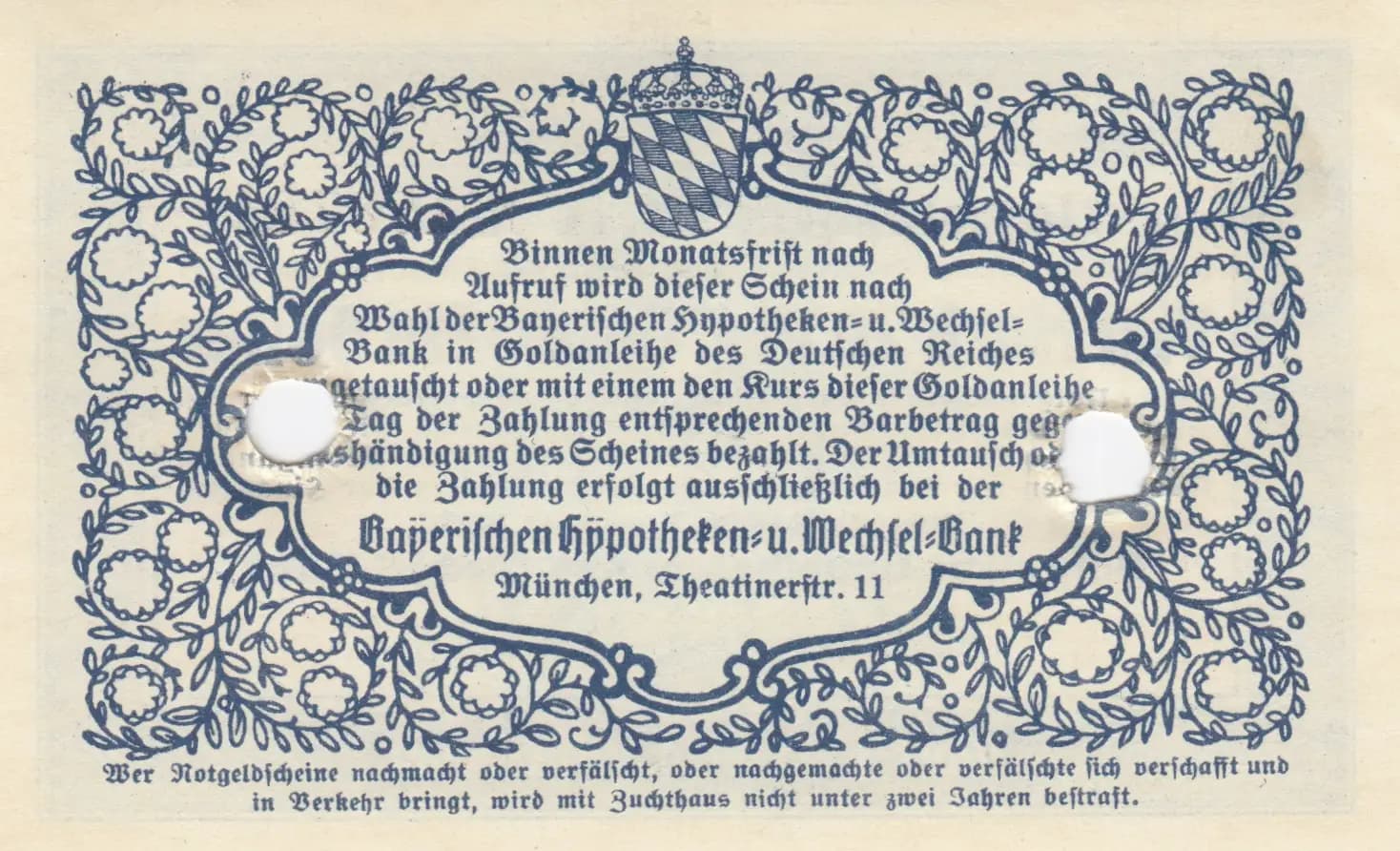
This note was issued under the emergency currency decree of October 26, 1923 (RGBl. J. S. 1065), during Germany's peak hyperinflation period when the Reichsmark had collapsed and municipalities and institutions issued emergency banknotes backed by gold reserves or government bonds. The Munich-based bank explicitly declares the note secured by the Goldanleihe (German Reich Gold Loan), representing an attempt to stabilize value through tangible asset backing. The Bavarian coat of arms and heraldic imagery prominently displayed on the reverse reinforce Bavarian regional identity during a period when central authority was fractured across the German states.
The obverse displays a classical Art Nouveau design with elaborate dark blue ornamental borders featuring interlocking geometric and floral motifs typical of early 20th-century German bank note aesthetics. A watermarked male portrait occupies the center background, likely representing a historical figure of financial significance, though the watermark overlay obscures definitive identification. The reverse side is dominated by the Bavarian coat of arms—a shield bearing the characteristic lozenges (diamonds) in the traditional Bavarian colors—surmounted by a crown, positioned at the top center within an ornate cartouche. The entire design is framed by elaborate foliate borders and decorative wreath-like corner elements. The central text area on the reverse is enclosed within an intricate decorative frame with fine geometric patterning. Both sides employ a consistent cream-beige paper stock with light blue undertones, and the text throughout is rendered in blackletter (gothic) typeface, the formal standard for official German documents of the period.
FRONT SIDE: 'Bayerische Hypotheken-und Wechsel-Bank' (Bavarian Mortgage and Exchange Bank). 'Notgeldschein Lit. A' (Emergency Banknote Type A). '№ 198742' (Serial Number 198742). '(ausgef. auf Grund Verordnung p. 26. Okt. 1923 RGBl. J. S. 1065)' (Issued pursuant to Ordinance of October 26, 1923 RGBl. J. p. 1065). 'Vier Mark 20 Pfg. Gold = Ein Dollar' (Four Mark 20 Pfennig Gold = One Dollar). 'Dieser Notgeldschein ist durch Hinterlegung von wertbeständ... Anleihe Deutschen Reiches (Goldanleihe) gedeckt' (This emergency banknote is secured by deposit of value-stable... German Reich loan [Gold loan]). 'Ausgaben mit Genehmigung des Reichsministers der Finanzen' (Issued with approval of the Reich Minister of Finance). 'München, den 26. November 1923' (Munich, November 26, 1923). 'Mark 4.20 Gold = Ein Dollar' (Mark 4.20 Gold = One Dollar). REVERSE SIDE: 'Binnen Monatsfrist nach Aufruft wird dieser Schein nach Wahl ber Bayerischen Hypotheken- u.Wechsel-Bank in Goldanleihe des Deutschen Reiches getauscht oder mit einem den Kurs dieser Goldanleihe Lag der Zahlung entsprechenden Barbetrag geg... shändigung des Scheines bezahlt' (Within one month of notice, this note will be exchanged at the option of the Bavarian Mortgage and Exchange Bank for German Reich gold loan or paid with a cash amount corresponding to the rate of this gold loan on the date of payment). 'Der Umtausch oder die Zahlung erfolgt ausschließlich bei der Bayerischen Hypotheken-u.Wechsel-Bank, München, Theatinerstr. 11' (The exchange or payment is effected exclusively at the Bavarian Mortgage and Exchange Bank, Munich, Theatinerstrasse 11). 'Wer Notgeldscheine nachmacht oder verfälscht, oder nachgemachte oder verfälschte sich verschafft und in Verkehr bringt, wird mit Zuchthaus nicht unter zwei Jahren bestraft' (Whoever counterfeits or falsifies emergency banknotes, or obtains counterfeit or falsified ones and puts them into circulation, will be punished with hard labor for not less than two years).
This note was produced using traditional letterpress/relief printing combined with intaglio line engraving techniques, evident from the crisp, fine line work visible in the ornamental borders and the sharp detail of the geometric patterns and floral designs. The watermarked portrait and complex border designs suggest production by a specialized security printer, likely Giesecke+Devrient or a comparable German security printing house, though the specific printer attribution for this unlisted Pick number is not documented in standard catalogs. The quality of execution and anti-counterfeiting measures (complex ornamentation, fine line work, watermark, and heraldic symbols) are consistent with currency-standard security printing protocols of the Weimar era.
Serial number 198742 is recorded on this specimen. This note represents 'Notgeldschein Lit. A' (Emergency Banknote Type A) according to the inscriptions, suggesting the issuing bank produced multiple types or series. The specific legal authorization cited (Verordnung of October 26, 1923, RGBl. J. S. 1065) is consistent with the final wave of federally-sanctioned emergency currency issues before currency stabilization in late November 1923. Known varieties for Bayerische Hypotheken-und Wechsel-Bank notes from this series likely include different denominations and letter designations (Type A, potentially Type B, etc.), though comprehensive variety documentation for unlisted Notgeldscheine is limited. The November 26, 1923 date places this issue among the latest emergency banknotes before the introduction of the Rentenmark (November 15, 1923 announced; circulated from December 1, 1923).